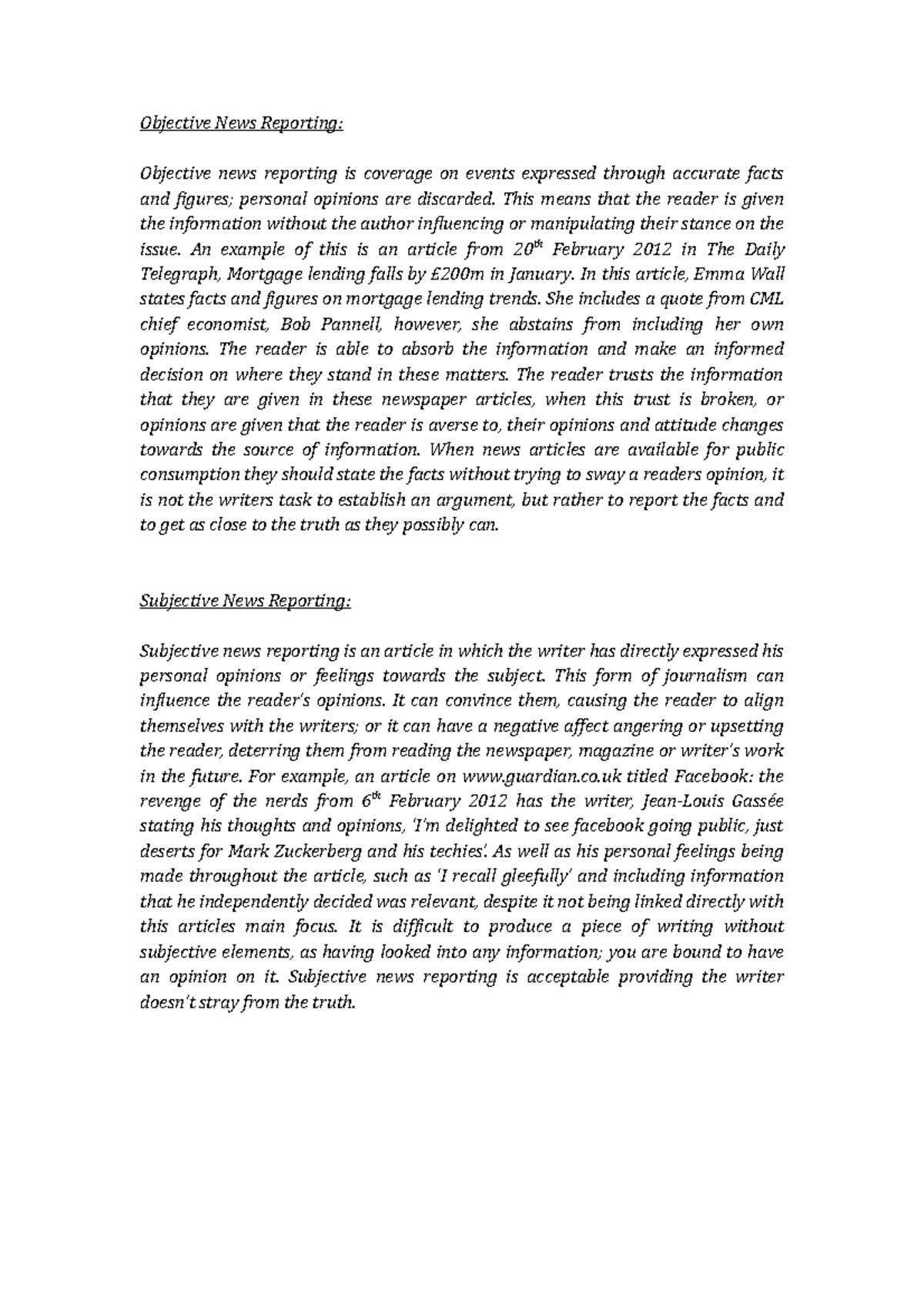
How Objective Articles Shape News Reporting: The Pillars of Modern Journalism
Objective articles shape news reporting by establishing a factual baseline that dictates the narrative arc of public discourse. Through disciplined verification and the elimination of overt bias, these pieces provide a reliable referen...
Objective articles shape news reporting by establishing a factual baseline that dictates the narrative arc of public discourse. Through disciplined verification and the elimination of overt bias, these pieces provide a reliable reference point for editorial boards, policy-makers, and the general public, effectively steering the focus of subsequent reporting toward evidence-based reality.
Contents
The concept of objectivity in journalism is often misunderstood as a passive stance of neutrality or a simple "he-said, she-said" presentation of facts. In 2026, the definition has evolved into a more active, rigorous "objectivity of method." This approach demands that journalists apply a scientific level of scrutiny to their reporting, ensuring that the information shared is not only accurate but also contextualized. Objective articles serve as the north star for the entire media ecosystem, providing the essential data points from which analysis, opinion, and community discussion can safely emerge.
The Structural Influence of Objective Reporting on the Media Cycle
Objective articles act as the primary source material for the global news cycle. When a major wire service or a specialized technical journal publishes a deeply researched, objective report, it sets off a "cascade effect." Other news organizations do not merely repeat the facts; they use the objective report as a foundation to build specialized coverage, local angles, and investigative follow-ups.
This influence is structural because it defines the vocabulary and the boundaries of a news event. For instance, if an objective report on a new environmental regulation focuses on the specific metrics of carbon reduction and the legal timeline for implementation, the subsequent reporting in local newspapers and trade journals will likely adopt those same metrics. By providing a clear, jargon-free, and evidence-supported framework, objective articles prevent the fragmentation of reality into competing sets of "alternative facts."
Furthermore, objective reporting shapes the hierarchy of news. In a 24-hour digital environment, the stories that receive the most rigorous objective treatment are often the ones that gain the most traction among institutional stakeholders. When a report is backed by multiple verified sources and transparent data, it carries a weight that forces competing outlets to address the core facts, even if their own editorial slant is highly partisan.
The Objectivity of Method: A Technical Necessity in 2026
By 2026, the proliferation of generative AI and deepfake technology has made the technical execution of objectivity more critical than ever. Objective articles shape news reporting by establishing "epistemic clarity"—a shared understanding of what is true and verifiable. This is achieved through a specific set of technical standards that distinguish high-quality reporting from mere content.
Verification and Provenance
Modern objective reporting relies heavily on the transparency of the evidence chain. Journalists now routinely include "transparency sidebars" or metadata that show the provenance of their data. This might include links to original government filings, raw data sets, or encrypted verification of source identities. By setting this high bar, objective articles pressure the rest of the industry to adopt similar levels of transparency.
Neutrality of Language
The choice of language in an objective article is designed to minimize emotional manipulation. By avoiding loaded adjectives and focusing on active-voice descriptions of actions and outcomes, these articles provide a "cooling effect" on highly charged topics. This neutrality allows the reader to form their own conclusions based on the provided evidence rather than being led by the reporter’s personal sentiment.
Multi-Perspective Sourcing
True objectivity does not mean giving equal time to a lie and a truth. Instead, it involves representing the diverse range of legitimate viewpoints surrounding a complex issue. In 2026, this means going beyond the two-party political binary to include academic, technical, and community perspectives. This comprehensive sourcing shapes news reporting by forcing a broader, more inclusive view of events that might otherwise be seen through a narrow lens.
Comparing Objective Reporting and Opinion-Based Media
Understanding the impact of objective articles requires a clear comparison with other forms of media. While opinion journalism and analysis have their place in a healthy democracy, they rely on the existence of objective reporting to maintain their relevance.
| Feature | Objective Reporting | Opinion/Analysis Journalism |
|---|---|---|
| Primary Goal | To inform with verified facts | To persuade or provide context |
| Tone | Neutral, descriptive, and measured | Evaluative, argumentative, or urgent |
| Sourcing Requirements | Multiple, independent, verified sources | Selective sources that support a thesis |
| Editorial Oversight | Rigorous fact-checking and peer review | Focused on clarity of argument and logic |
| Accountability | Correction of factual errors | Accountability to the author's viewpoint |
| Role in the Cycle | Sets the foundational narrative | Shapes the interpretation of the narrative |
The Economic and Algorithmic Impact of Objectivity
The shaping of news reporting is not just an ethical or professional matter; it is also driven by the economic realities of the 2026 media market. Objective articles are often the most valuable assets for a news organization because they are "durable." An opinion piece may lose relevance within hours, but a deeply reported objective article can remain a primary reference point for months or years.
Advertiser Preference for "Brand Safety"
In the current advertising landscape, brands are increasingly wary of being associated with polarizing or inflammatory content. Objective articles provide a "brand-safe" environment that attracts premium advertising revenue. This economic incentive encourages news organizations to invest in objective reporting desks, which in turn shapes the overall output of the newsroom toward more factual, less sensationalist content.
Algorithmic Prioritization
Search engines and social media algorithms in 2026 have become more sophisticated in identifying "signal" versus "noise." Algorithms now prioritize articles that demonstrate high levels of authority, original reporting, and consensus-based factual accuracy—qualities inherent in objective articles. As a result, objective pieces are more likely to be featured in top search results and news aggregators, forcing other outlets to emulate their style and substance to maintain visibility.
The Challenges to Objectivity and the Risk of False Equivalence
While objective articles are the backbone of reporting, the practice faces significant challenges. One of the most persistent issues is the trap of "false equivalence." This occurs when a reporter, in an attempt to appear objective, provides equal weight to a factual statement and a demonstrably false one.
In 2026, the industry has largely pivoted away from this "both-sidesism." Modern objective articles shape news reporting by prioritizing the "weight of evidence." If 99% of climate scientists agree on a specific trend, an objective article will report that as the primary fact, while perhaps mentioning dissenting views as a footnote rather than a co-equal perspective. This shift has redefined news reporting by moving the goalposts from "balance" to "accuracy."
Another challenge is the inherent bias of the reporter. No human is truly free of bias, but objective reporting utilizes a "discipline of verification" to mitigate it. By following a set of standardized procedures—such as seeking comment from all parties involved and using standardized metrics—the reporter’s personal views are subordinated to the process. This methodological rigor is what ultimately shapes the credibility of the news industry.
Ethical Standards and Professional Training
The influence of objective articles is also maintained through the rigorous training and ethical codes of professional organizations like the Society of Professional Journalists (SPJ) and the Reuters Institute for the Study of Journalism. These organizations provide the guidelines that define what constitutes an objective piece in the modern era.
- Seek Truth and Report It: The primary mandate is to be honest, fair, and courageous in gathering, reporting, and interpreting information.
- Minimize Harm: Objective reporting acknowledges that truth can be painful, but it balances the public's need for information against potential harm to individuals.
- Act Independently: Reporters must avoid conflicts of interest, whether they are financial, political, or personal.
- Be Accountable and Transparent: This includes explaining the ethical choices made during the reporting process and correcting errors promptly.
These ethical pillars ensure that objective articles remain a trusted source of information. When a newsroom commits to these standards, it influences the entire culture of the organization, leading to more disciplined, fact-based reporting across all departments.
Frequently Asked Questions
How does objectivity differ from being unbiased?
Objectivity is a method of reporting, whereas being unbiased is a psychological state. While no journalist can be entirely free of personal bias, they can use an objective method—relying on evidence, multiple sources, and neutral language—to ensure the final article is fair and accurate regardless of their personal feelings.
Can an article be objective if it uses anonymous sources?
Yes, but with caveats. Objective articles in 2026 use anonymous sources only when the information is vital and cannot be obtained elsewhere. To maintain objectivity, the reporter must verify the information through other means and explain to the reader why the source's identity is being protected.
Why is objectivity important for a functioning democracy?
Objectivity provides a shared reality. Without objective articles to establish the facts of an event or policy, public debate becomes a clash of irreconcilable opinions. A democracy requires a common set of facts for citizens to make informed decisions and for the government to be held accountable.
How do objective articles handle "fake news"?
Objective articles act as a corrective force. By providing a clear, evidence-based account of an event, they make it easier for readers and automated systems to identify and debunk misinformation. The more "weight" an objective report has (in terms of sourcing and data), the more effective it is at neutralizing false narratives.
Does the push for speed in modern news hurt objectivity?
It can. The pressure to be first often leads to shortcuts in verification. However, the most respected news organizations in 2026 have found that the reputational cost of being wrong far outweighs the benefit of being first. Many have adopted "verified-only" protocols that prioritize accuracy over speed.
How can readers distinguish between objective reporting and opinion?
Readers should look for neutral language, a diversity of sources, and the absence of first-person "I" statements or loaded adjectives. An objective article will present the facts and let the reader decide, whereas an opinion piece will use facts to support a pre-determined conclusion.
Recommendation for Navigating the 2026 Media Landscape
To stay accurately informed in an increasingly complex information environment, readers should prioritize news outlets that consistently produce objective, primary-source reporting. When consuming news, look for the "Methodology" or "Sources" section that many top-tier publications now include. Verify that the article cites multiple independent viewpoints and provides links to the original data or documents mentioned. By supporting and sharing objective articles, you contribute to a more stable and fact-based public discourse.
Image Gallery