Why Students Lie About Net Worth on the FAFSA and the Risks of Misreporting Assets
Students and families often misreport net worth on the FAFSA to artificially lower their Student Aid Index (SAI), hoping to qualify for more need-based grants and subsidized loans. Faced with skyrocketing tuition costs in 2026, some ap...
Students and families often misreport net worth on the FAFSA to artificially lower their Student Aid Index (SAI), hoping to qualify for more need-based grants and subsidized loans. Faced with skyrocketing tuition costs in 2026, some applicants underreport assets to bridge the gap between their actual savings and the high expected family contribution.
Contents
The Free Application for Federal Student Aid (FAFSA) serves as the gatekeeper for billions of dollars in federal, state, and institutional aid. As the cost of higher education continues to rise, the pressure to secure "free money" in the form of Pell Grants or institutional scholarships has intensified. This pressure occasionally leads applicants to provide inaccurate information regarding their net worth. However, the Department of Education has implemented sophisticated verification tools, making the consequences of such actions more severe than ever.
The Motivation Behind Misreporting Assets
The primary driver for lying about net worth is the desire to reduce the Student Aid Index (SAI). In the financial aid formula, a portion of a family’s reportable assets is expected to be used for educational expenses. For parents, this rate is typically up to 5.64%, while for independent students, it can be as high as 20%. By hiding $10,000 in assets, a family might theoretically increase their aid eligibility by several hundred dollars.
The "Middle-Class Squeeze"
Many families who misreport information do not consider themselves "wealthy." They often fall into a middle-income bracket where they earn too much to qualify for significant federal grants but too little to afford the "sticker price" of elite universities. These families may feel that the FAFSA formula is inherently unfair because it does not account for the high cost of living in certain geographic regions or the reality of private debt. Consequently, they may justify underreporting savings or investments as a survival tactic to ensure their child can attend a specific institution.
The Complexity of the Asset Protection Allowance
Over the last decade, the Asset Protection Allowance—a portion of assets that the FAFSA formula ignores based on the age of the older parent—has plummeted. In the mid-2010s, this allowance could protect $40,000 to $50,000 for older parents; by 2026, it has remained at or near $0 for many demographics. Because almost every dollar in a savings account now impacts aid eligibility, the temptation to "forget" an account has grown significantly.
Common Areas of FAFSA Misrepresentation
When applicants choose to lie or omit information, they typically focus on specific asset categories that are perceived as harder for the government to track. However, modern data-sharing agreements between the IRS and the Department of Education have closed many of these loopholes.
Underreporting Cash, Savings, and Checking Accounts
The most common form of misrepresentation is simply entering a lower number for liquid assets. Applicants may believe that because bank balances fluctuate daily, they can report a lower "average" rather than the balance on the day they sign the form. In reality, the FAFSA requires the net worth of assets as of the day the application is submitted.
Omitting Non-Retirement Investments
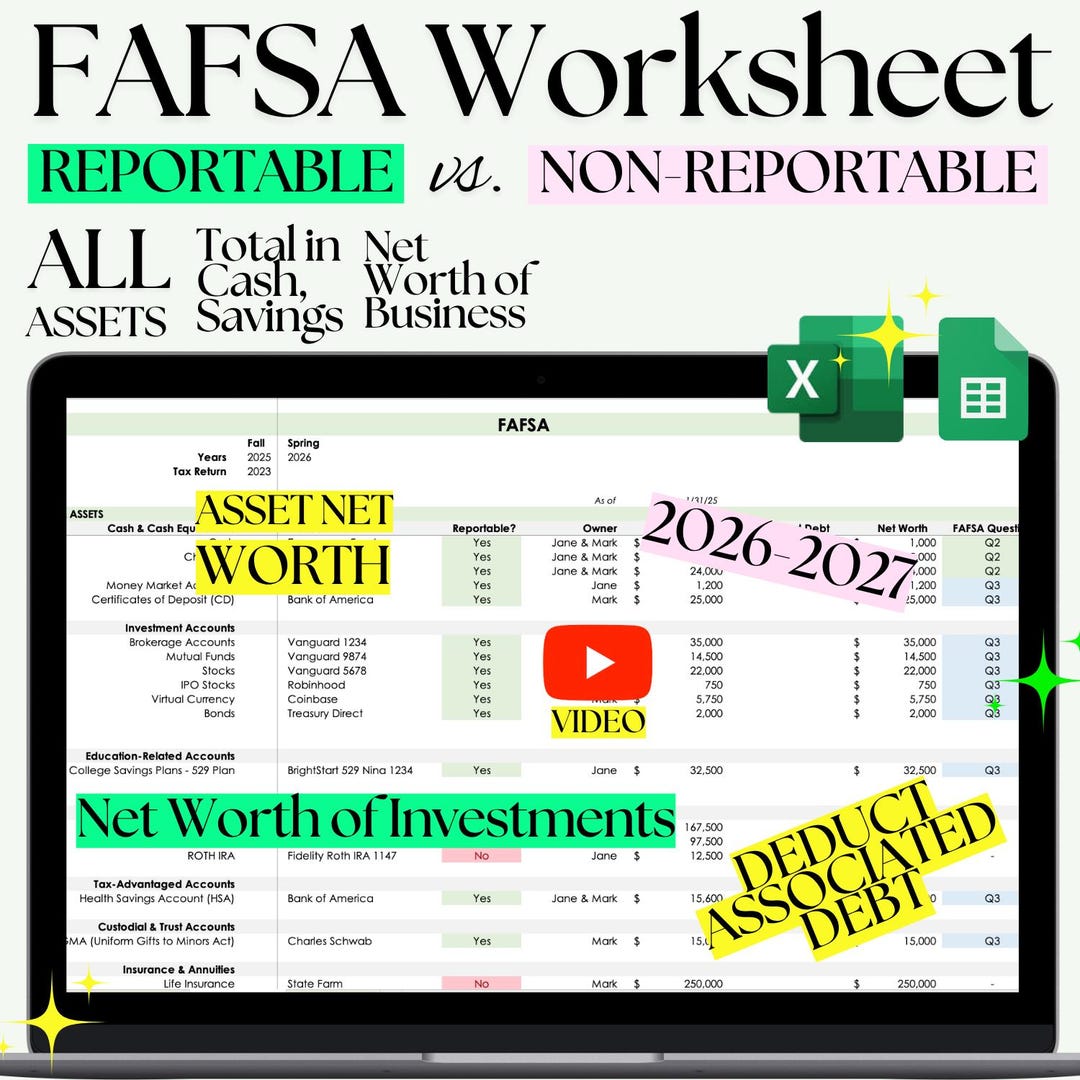
While the FAFSA explicitly excludes 401(k)s, IRAs, and other qualified retirement accounts, it requires the disclosure of brokerage accounts, CDs, and mutual funds. Some applicants mistakenly (or intentionally) categorize brokerage accounts as "retirement savings" to shield them from the formula. Additionally, the rise of digital assets has created a new frontier for misreporting. Many students fail to report cryptocurrency holdings, despite clear guidance that these are considered reportable investments.
The Small Business and Farm Exclusion Change
A significant shift occurred with the FAFSA Simplification Act, the effects of which are fully felt in 2026. Previously, family-owned small businesses with fewer than 100 employees were excluded from asset reporting. Now, the net worth of all businesses and for-profit farms must be reported, regardless of the number of employees. This change has frustrated many families who own small enterprises, leading some to drastically undervalue their business equipment, inventory, and real estate to maintain aid eligibility.
How the Department of Education Verifies Net Worth
The idea that "the government won't find out" is a dangerous misconception. The Department of Education employs a multi-layered approach to ensure data integrity, primarily through the FA-DDX (FAFSA Device Direct Data Exchange).
The Role of the IRS Data Exchange
The FA-DDX allows the Department of Education to pull tax information directly from the IRS. While the IRS doesn't report your daily bank balance, it does report unearned income, such as interest and dividends. If a student reports $0 in assets but their tax return shows $5,000 in dividend income, a "flag" is immediately generated. This discrepancy triggers a process known as Verification, where the college financial aid office is required to collect bank statements and investment records to reconcile the data.
Institutional Verification and Professional Judgment
Colleges often have their own internal flags. If a student’s lifestyle, zip code, or private school background doesn't align with a "zero-asset" FAFSA, financial aid officers may exercise their right to request additional documentation. Colleges are protective of their institutional funds and are trained to spot inconsistencies between the FAFSA and other documents, such as the CSS Profile, which is often used by private universities for awarding non-federal aid.
The Legal and Financial Consequences of FAFSA Fraud
Lying on a federal document is a serious offense. The FAFSA includes a "read before you sign" section that explicitly outlines the penalties for providing false information.
| Consequence Type | Description | Potential Severity |
|---|---|---|
| Financial Penalties | Fines for submitting fraudulent information to the federal government. | Up to $20,000 |
| Criminal Charges | Federal prosecution for fraud or making false statements. | Up to 5 years in prison |
| Aid Forfeiture | Immediate loss of all current and future federal student aid. | Permanent ban |
| Repayment | The requirement to return all funds received based on false data. | Full amount plus interest |
| Institutional Action | Expulsion or rescinded admission from the university. | Career-altering |
Beyond the legal ramifications, students found to have lied may be blacklisted from receiving state grants and private scholarships. Most private scholarship donors include clauses in their contracts that require the repayment of funds if the student's FAFSA data is found to be fraudulent.
Legitimate Ways to Minimize Asset Impact
It is not necessary to lie to minimize the impact of assets on the FAFSA. There are several legal strategies that families can use to lower their net worth before filing the application.
- Pay Down High-Interest Debt: The FAFSA does not look at consumer debt (like credit cards or auto loans). Using cash from a savings account to pay off these debts effectively lowers your reportable assets while improving your overall financial health.
- Spend Down Student Assets: Because student assets are taxed at a higher rate (20%) than parent assets (5.64%), it is often beneficial to spend the student's own savings on legitimate educational expenses, such as a laptop or textbooks, before filing.
- Timing of Large Purchases: If a family needs to replace a car or make necessary home repairs, doing so before filing the FAFSA reduces the cash on hand that must be reported.
- Maximize Retirement Contributions: Since retirement accounts are not reportable assets, contributing to a 401(k) or IRA before the FAFSA is filed moves that money into a "protected" category.
Professional Advice and Limitations
Financial aid regulations are subject to change by the U.S. Department of Education and the Internal Revenue Service. The information provided here is for educational purposes and does not constitute legal or financial advice. Families should consult with a qualified financial advisor or a certified public accountant (CPA) when making significant financial moves. For the most current official guidelines, always refer to StudentAid.gov.
Frequently Asked Questions
Does the FAFSA check my bank accounts? The Department of Education does not have direct, real-time access to your bank account balances. However, they use the FA-DDX to see interest income reported to the IRS. If you report no assets but show significant interest income, you will likely be selected for verification, requiring you to submit bank statements.
What happens if I made an honest mistake on my net worth? Honest mistakes are common. If you realize you entered the wrong amount, you should log back into your FAFSA and submit a correction. If you are already under verification, simply provide the correct documentation to your school’s financial aid office. Penalties are generally reserved for "willful" misrepresentation, not clerical errors.
Should I report my primary residence as an asset? No. The FAFSA specifically excludes the value of your primary residence. You do, however, have to report the net worth of any secondary properties, vacation homes, or rental units.
Are 529 plans considered a student asset or a parent asset? For a dependent student, a 529 plan owned by a parent is considered a parent asset. This is beneficial because parent assets are assessed at a much lower rate (5.64%) than student assets (20%). If the 529 is owned by the student, it is still treated as a parent asset on the FAFSA, provided the student is a dependent.
Do I have to report my child's UTMA/UGMA account? Yes. UTMA (Uniform Transfers to Minors Act) and UGMA (Uniform Gifts to Minors Act) accounts are considered the legal property of the student. Therefore, they must be reported as student assets, which have a high impact on aid eligibility.
Final Recommendation for 2026 Applicants
The best course of action is total transparency. While it may be frustrating to see your aid eligibility decrease because of modest savings, the risk of a fraud investigation far outweighs the marginal gain of a slightly higher grant. Instead of misreporting, focus on Professional Judgment (PJ) appeals. If your family has unique financial circumstances—such as high medical bills, recent job loss, or private school tuition for younger siblings—contact your college's financial aid office. Financial aid officers have the authority to manually adjust your SAI based on documented hardships, providing a legal and safe path to more aid.
Image Gallery