Term Coverage Life Insurance in Sandy Hill: Complete 2026 Guide
Term coverage life insurance in Sandy Hill provides local residents with fixed financial protection over a set period, such as 10, 20, or 30 years. It pays a tax-free lump sum to beneficiaries if the policyholder dies during the term,...
Term coverage life insurance in Sandy Hill provides local residents with fixed financial protection over a set period, such as 10, 20, or 30 years. It pays a tax-free lump sum to beneficiaries if the policyholder dies during the term, helping cover mortgage balances, income replacement, student debt, or family living expenses at affordable rates.
Contents
Understanding Term Life Insurance in Sandy Hill
Term life insurance is the most straightforward and cost-effective form of life coverage available to residents in Sandy Hill, Ottawa. Unlike permanent life insurance policies—such as whole life or universal life, which accumulate cash value and remain active for the policyholder's entire lifetime—term insurance focuses purely on income protection and debt coverage over a specified timeline.
When you purchase a term policy, you choose both the coverage amount (the death benefit) and the duration of the policy (the term length). Common term lengths in Ontario include 10, 20, and 30 years, though custom terms matching specific mortgage durations (such as 15 or 25 years) are also widely available from Canadian insurers. If the insured individual passes away while the policy is active, the designated beneficiaries receive the full face value of the policy. In Canada, life insurance death benefits paid directly to a named beneficiary are received entirely free of federal and provincial income tax under the Income Tax Act.
If the policy reaches the end of its term while the insured is still living, the coverage simply expires without a payout, unless the policyholder chooses to exercise a contractual conversion or renewal privilege. This straightforward design keeps administrative overhead low, making term insurance substantially cheaper than permanent alternatives.
Why Sandy Hill Residents Require Tailored Life Insurance
Sandy Hill is a distinct, vibrant neighborhood in East Central Ottawa, positioned between the Rideau River and the Rideau Canal, adjacent to the University of Ottawa (uOttawa) and downtown federal government office complexes. The demographic profile of Sandy Hill creates unique financial planning considerations for life insurance buyers:
- Historic Homeowners & High Mortgage Liabilities: Sandy Hill features a blend of historic Victorian residences, converted multi-family homes, modern infill developments, and high-rise condominiums. Real estate values in central Ottawa mean that local homeowners often carry significant mortgage balances. A term life policy aligned with a 20- or 25-year mortgage amortization schedule ensures surviving family members can remain in their home without financial distress.
- Young Professionals & Academic Faculty: Positioned adjacent to uOttawa and downtown business districts, Sandy Hill attracts university professors, administrative staff, tech professionals, and federal public servants. Early- and mid-career professionals frequently use 20-year or 30-year term policies to lock in low premium rates while their dependents are young.
- Graduates & Young Families with Debt: Many young adults residing in Sandy Hill carry student loan debt, co-signed private loans, or personal lines of credit. Term coverage prevents co-signers or surviving spouses from absorbing personal debt obligations.
- Real Estate Investors & Property Owners: Property owners holding multi-unit residential properties in Sandy Hill often utilize term policies as business continuation tools or to cover potential capital gains liabilities upon estate settlement.
Primary Types of Term Life Insurance Policies
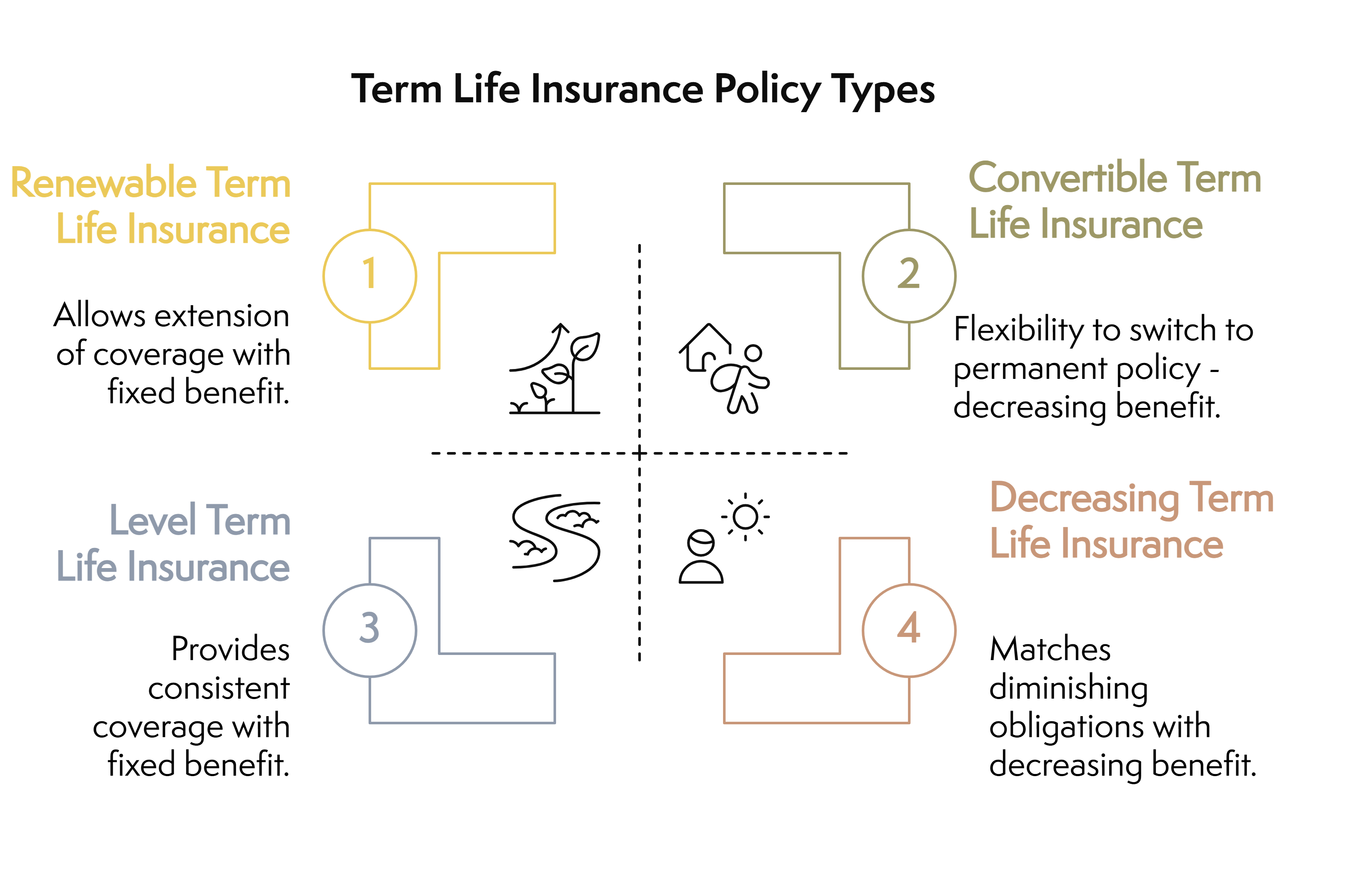
Insurers across Ontario offer several variations of term life insurance. Selecting the right structure depends on your specific financial obligations and long-term planning goals.
| Policy Type | Description |
|---|---|
| Level Term Insurance | Premiums and death benefit remain identical throughout term |
| Decreasing (Mortgage) Term Insurance | Payout reduces over time as debt balance declines |
| Convertible Term Insurance | Converts to permanent policy without new medical exams |
| Renewable Term Insurance | Extends at term end automatically; rates increase by age |
1. Level Term Life Insurance
Level term is the industry standard. Both your monthly (or annual) premium and the total coverage amount remain completely fixed for the entire policy period. For example, a $750,000 20-year level term policy issued in 2026 will cost the exact same amount per month in year 1 as it does in year 20, and the payout remains $750,000 throughout.
2. Convertible Term Life Insurance
A convertible term clause allows the policyholder to convert their temporary term policy into a permanent whole life or universal life policy without undergoing a medical examination or answering health questions. This feature is crucial if your health changes during the term, as it guarantees insurability into your senior years regardless of new medical diagnoses. Most reputable Canadian insurers include a conversion rider automatically in standard term policies, usually executable up to age 65 or 70.
3. Renewable Term Life Insurance
Renewable term policies permit you to extend your coverage for an additional term (such as another 10 years) when the original term ends, without completing a new medical assessment. However, the premium rate resets based on your attained age at the time of renewal. While renewal premiums can be significantly higher, this option offers a vital safety net if you still require coverage but have developed health conditions that prevent you from passing standard underwriting.
4. Decreasing Term Insurance
Decreasing term coverage features a death benefit that drops over time, usually matching the declining principal balance of a standard amortized mortgage. While historically popular, traditional level term policies have largely superseded decreasing term in Canada due to competitive pricing and greater flexibility for beneficiaries.
Key Underwriting Factors and Cost Drivers
Canadian life insurance carriers evaluate several key risk criteria when determining your eligibility and monthly premium rates.
- Age and Gender: Age is the single largest determinant of life insurance pricing. Statistically, mortality risk increases with age, so securing coverage earlier locks in lower rates. Biological female applicants generally receive lower rates than male applicants of the same age due to higher average life expectancies.
- Health History & Medical Records: Underwriters examine personal health metrics, including blood pressure, cholesterol ratios, body mass index (BMI), family medical history (specifically early cardiovascular disease or cancer among first-degree relatives), and pre-existing chronic conditions.
- Tobacco and Nicotine Usage: Smokers, vapers, and users of nicotine replacement products pay significantly higher premiums—often 50% to 200% more than non-smokers. To qualify for non-smoker rates in Ontario, carriers typically require at least 12 consecutive months completely free of all nicotine and cannabis products (though some carriers maintain separate guidelines for recreational cannabis use).
- Lifestyle & Hazardous Occupations: Hazardous hobbies (such as private aviation, scuba diving, or rock climbing) and high-risk occupations can lead to policy exclusions or rating surcharges.
- Coverage Amount & Term Duration: Higher death benefits and longer term lengths increase the total cumulative risk for the insurer, leading to higher monthly premiums.
2026 Estimated Cost Comparison for Term Life Insurance in Ontario
The following table provides representative monthly premium estimates for healthy non-smokers living in Ontario. Rates assume standard underwriting approval for level term policies in 2026.
| Issue Age | Policy Term | $500,000 Coverage (Female) | $500,000 Coverage (Male) | $1,000,000 Coverage (Female) | $1,000,000 Coverage (Male) |
|---|---|---|---|---|---|
| 30 Years Old | 10-Year Term | $15.50 / mo | $18.20 / mo | $24.80 / mo | $29.50 / mo |
| 30 Years Old | 20-Year Term | $21.00 / mo | $25.40 / mo | $34.50 / mo | $43.00 / mo |
| 40 Years Old | 10-Year Term | $24.00 / mo | $29.50 / mo | $39.00 / mo | $50.50 / mo |
| 40 Years Old | 20-Year Term | $38.50 / mo | $47.00 / mo | $68.00 / mo | $84.50 / mo |
| 50 Years Old | 10-Year Term | $53.00 / mo | $69.00 / mo | $94.00 / mo | $126.00 / mo |
| 50 Years Old | 20-Year Term | $102.00 / mo | $138.00 / mo | $188.00 / mo | $258.00 / mo |
Note: The figures listed above represent estimated ranges for illustrative purposes based on standard underwriting classes. Actual premiums vary based on personal health profile, medical exam findings, and individual insurer underwriting algorithms.
Ontario Regulatory Safeguards and Consumer Protections
Life insurance in Sandy Hill is subject to strict regulatory oversight to safeguard policyholders and ensure financial solvency across the insurance sector.
Financial Services Regulatory Authority of Ontario (FSRA)
In Ontario, life insurance agents, brokers, and insurance companies are regulated by the Financial Services Regulatory Authority of Ontario (FSRA). FSRA enforces licensing standards, market conduct rules, and consumer disclosure requirements. Always verify that your life insurance advisor holds a valid license under FSRA before sharing sensitive medical or financial documentation.
Assuris Protection
All licensed life insurance carriers operating in Canada are required to be members of Assuris, an independent non-profit organization designated to protect Canadian policyholders in the unlikely event that an insurance company becomes insolvent.
If a life insurer fails, Assuris automatically protects individual policyholders by guaranteeing:
- Death Benefits: Up to $1,000,000 or 90% of the promised benefit, whichever is higher.
- Monthly Income Benefits: Up to $5,000/month or 90% of the benefit, whichever is higher.
This protection applies automatically to residents of Sandy Hill holding policies with member institutions, requiring no separate enrollment or fees.
Medical vs. Non-Medical Term Life Insurance
When applying for term coverage in Sandy Hill, you will typically choose between fully underwritten policies and simplified or non-medical policies.
- Selecting an Underwriting Path
- Fully Underwritten
- Blood & urine samples
- Paramedical exam
- Lowest premium cost
- High coverage limits
- Non-Medical / Quick
- Online health survey
- No fluid samples
- Fast approval (days)
- Higher premium rates
- Fully Underwritten
Fully Underwritten Life Insurance
- Process: Requires an extensive health questionnaire, access to attending physician statements (APS), and often a complimentary paramedical exam involving blood samples, urine samples, and blood pressure checks.
- Best For: Individuals in good health seeking the lowest possible premiums and maximum coverage limits ($500,000 to several million dollars).
- Timeline: Processing typically takes 2 to 6 weeks depending on doctor response times.
Non-Medical (Simplified Issue) Insurance
- Process: Eliminates blood tests, urine collection, and medical exams. Applicants complete an online or paper medical questionnaire.
- Best For: Individuals with needle phobias, moderate pre-existing medical conditions that might trigger traditional underwriting rejections, or those needing coverage bound urgently for business or court-ordered obligations.
- Timeline: Approval often occurs within 24 to 48 hours.
- Trade-off: Premiums are noticeably higher per dollar of coverage, and maximum coverage limits are generally capped (e.g., $250,000 to $500,000).
Step-by-Step Guide to Securing Term Life Insurance in Sandy Hill
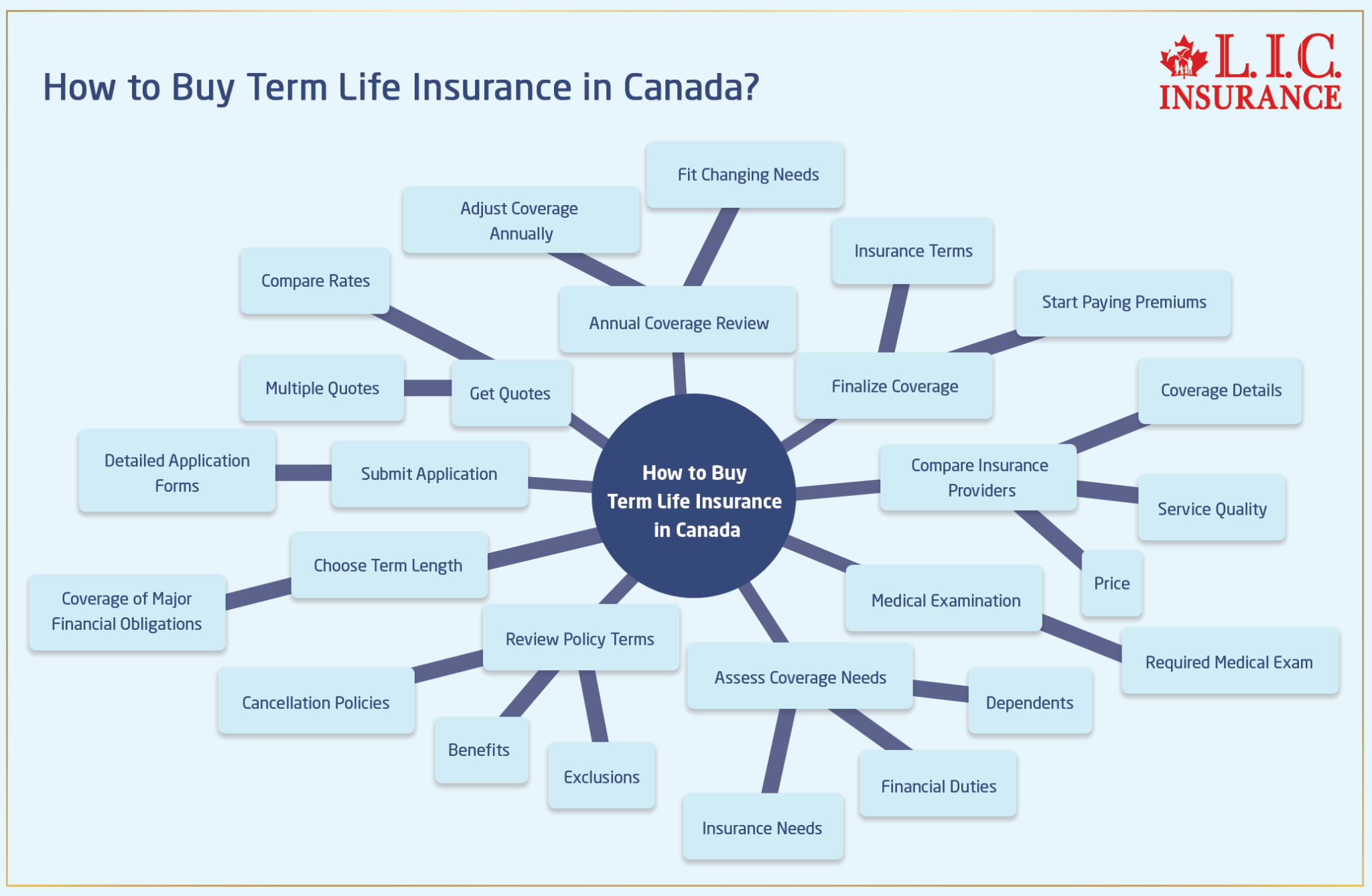
To obtain optimal term coverage tailored to your financial situation, follow this structured process:
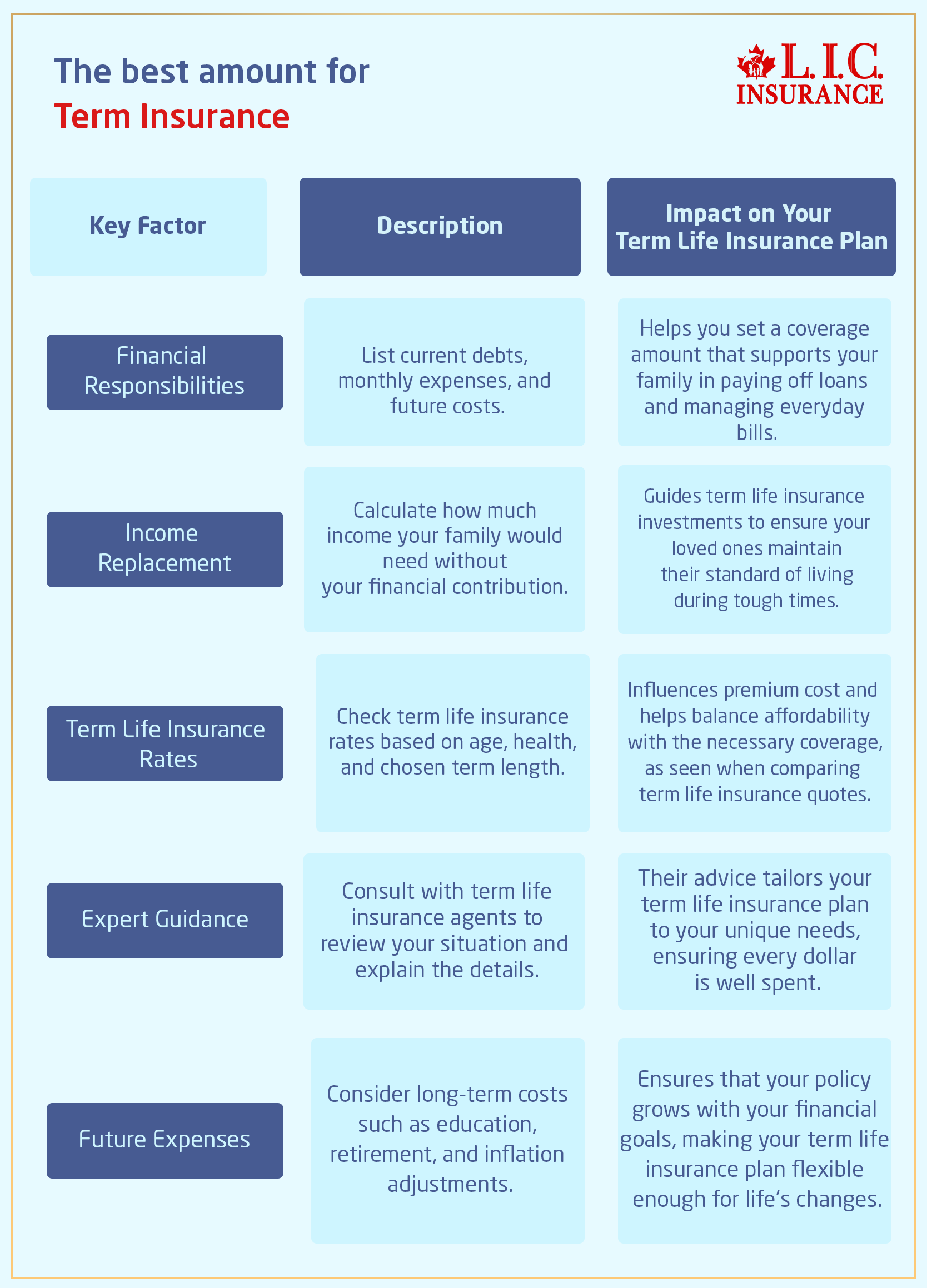
- Calculate Your Coverage Needs: Multiply your gross annual income by an appropriate factor (typically 7x to 10x) and add major outstanding debts, such as mortgage balances and anticipated post-secondary education costs for children. Subtract existing liquid assets or existing workplace group life insurance benefits.
- Determine the Ideal Term Length: Align the policy term with your longest financial liability. If you just purchased a Sandy Hill property with a 25-year mortgage, a 25-year or 30-year term is appropriate. If your children will be financially independent in 15 years, a 15-year or 20-year term may suffice.
- Work with an Independent Broker: Independent life insurance brokers in Ottawa have access to multiple competitive carriers (such as Canada Life, Manulife, Sun Life, Industrial Alliance, and RBC Insurance) rather than representing a single insurer. This enables side-by-side pricing comparisons.
- Complete the Application Accurate Details: Disclose your medical history, family history, and lifestyle activities fully. Under Canadian insurance law, material misrepresentation on an application can lead to claim denial during the initial two-year contestability period or policy voidance in cases of fraud under the Insurance Act of Ontario.
- Complete Medical Requirements (If Applicable): If traditional underwriting is required, schedule your paramedical exam promptly. Fasting for 8 to 12 hours prior to blood work and avoiding heavy exercise or caffeine before the exam helps ensure accurate results.
- Review Policy Documents: Once approved, review your policy contract carefully. Pay close attention to the schedule of premiums, conversion expiration dates, non-smoker definitions, and beneficiary designations. In Ontario, policyholders receive a "10-day free look" period during which they can cancel the policy for a full refund if unsatisfied with the contract terms.
Common Mistakes to Avoid When Purchasing Term Insurance
- Relying Solely on Group Employer Coverage: Federal government employees and university workers in Sandy Hill often receive group life insurance through workplace benefits. However, group coverage is usually capped at 1x or 2x annual salary, which is rarely sufficient for a family mortgage. Furthermore, group coverage is tied to your employment and typically terminates or becomes expensive to convert if you change jobs or retire.
- Choosing Too Short a Term Duration to Save Money: Selecting a 10-year term when you actually need 20 years of coverage reduces your immediate monthly bill, but renewing at age 40 or 50 will result in vastly higher rates—or potential uninsurability if you suffer a serious health event during the initial decade.
- Naming Minor Children Directly as Beneficiaries: In Ontario, life insurance proceeds cannot be paid directly to minors under age 18. If a minor is named directly without a designated trustee or formal legal trust structure, the funds must be held by the Accountant of the Superior Court of Justice until the child reaches legal adulthood, causing unnecessary delays and legal fees.
- Failing to Update Beneficiary Designations: Life changes such as marriage, divorce, or the birth of children require updating beneficiary forms. Insurance payouts bypass your will and go directly to the named beneficiary on file with the insurer.
Frequently Asked Questions
Can I convert my term life policy to a permanent policy later?
Yes. Most standard term life insurance contracts in Canada include a built-in conversion privilege. This clause allows you to convert your term insurance into a permanent whole life or universal life insurance policy without providing new evidence of insurability or undergoing medical exams, provided the conversion occurs before the contractual age deadline (usually between age 65 and 70).
What happens if I outlive my term coverage in Sandy Hill?
If you live past the end of your policy's term (e.g., beyond the 20th year of a 20-year term), the policy reaches its expiration date. You will not receive a return of premiums unless you originally purchased an optional "Return of Premium" (ROP) rider. At expiration, you can choose to let the policy terminate, renew it at higher guaranteed age-adjusted rates, or convert it to permanent coverage if conversion rights remain active.
Is the payout from term life insurance taxable in Ontario?
No. Under the Canadian Income Tax Act, death benefits paid directly to a named personal beneficiary (such as a spouse, partner, or child) are received completely tax-free. However, if no beneficiary is named and the payout defaults to the deceased's estate, the funds become subject to Ontario Estate Administration Tax (probate fees) and potential creditor claims against the estate.
How much term life insurance do I need for a home in Sandy Hill?
To determine coverage, add your total remaining mortgage balance to 5–10 times your annual net income, plus any outstanding personal debts or future educational expenses for dependents. For a typical family home or condo in central Ottawa, coverage amounts between $500,000 and $1,500,000 are standard to fully protect surviving household members against debt and income loss.
Can I cancel my term life insurance policy early without penalty?
Yes. Term life insurance policies do not impose cancellation fees or early exit penalties. If you no longer require coverage, you can stop paying premiums or notify your insurer in writing to lapse the policy immediately. Because term policies do not build up cash surrender value, cancelling simply terminates your financial protection moving forward.
Next Steps for Sandy Hill Residents
Securing term life insurance is a foundational step in establishing a resilient personal financial plan. To get started today:
- Gather your current mortgage statements, loan balances, and annual budget details to determine your total household coverage needs.
- Check your current workplace benefits policy to quantify existing group life coverage and identify coverage gaps.
- Consult an independent, FSRA-licensed life insurance advisor specializing in the Ottawa area to compare policies across multiple top-tier Canadian insurance providers.
Professional Advice Disclaimer: This guide is provided for informational purposes only and does not constitute formal financial, legal, or tax advice. Life insurance products, underwriting rules, and rates vary by individual health history and insurer. Consult a licensed life insurance agent or financial planner certified by the Financial Services Regulatory Authority of Ontario (FSRA) for personal advice.
Image Gallery