Comprehensive Guide to Acquiring Belgian Citizenship in 2026
To obtain Belgian citizenship, most residents must apply through a "Nationality Declaration" after five years of uninterrupted legal residency. Applicants must demonstrate proficiency in a national language (A2 level), prove social int...
To obtain Belgian citizenship, most residents must apply through a "Nationality Declaration" after five years of uninterrupted legal residency. Applicants must demonstrate proficiency in a national language (A2 level), prove social integration through education or professional training, and verify economic participation via recent employment. Exceptional cases may qualify through naturalization or family ties.
Contents
The process of becoming a Belgian citizen is governed by the Belgian Code of Nationality. While the legislation has undergone various reforms over the last two decades to emphasize integration, the core pathways remain stable. In 2026, the process is primarily administrative, managed by local municipalities (communes/gemeenten) in coordination with the Federal Public Service (FPS) Justice and the King’s Prosecutor.
Understanding the Primary Pathways to Belgian Nationality
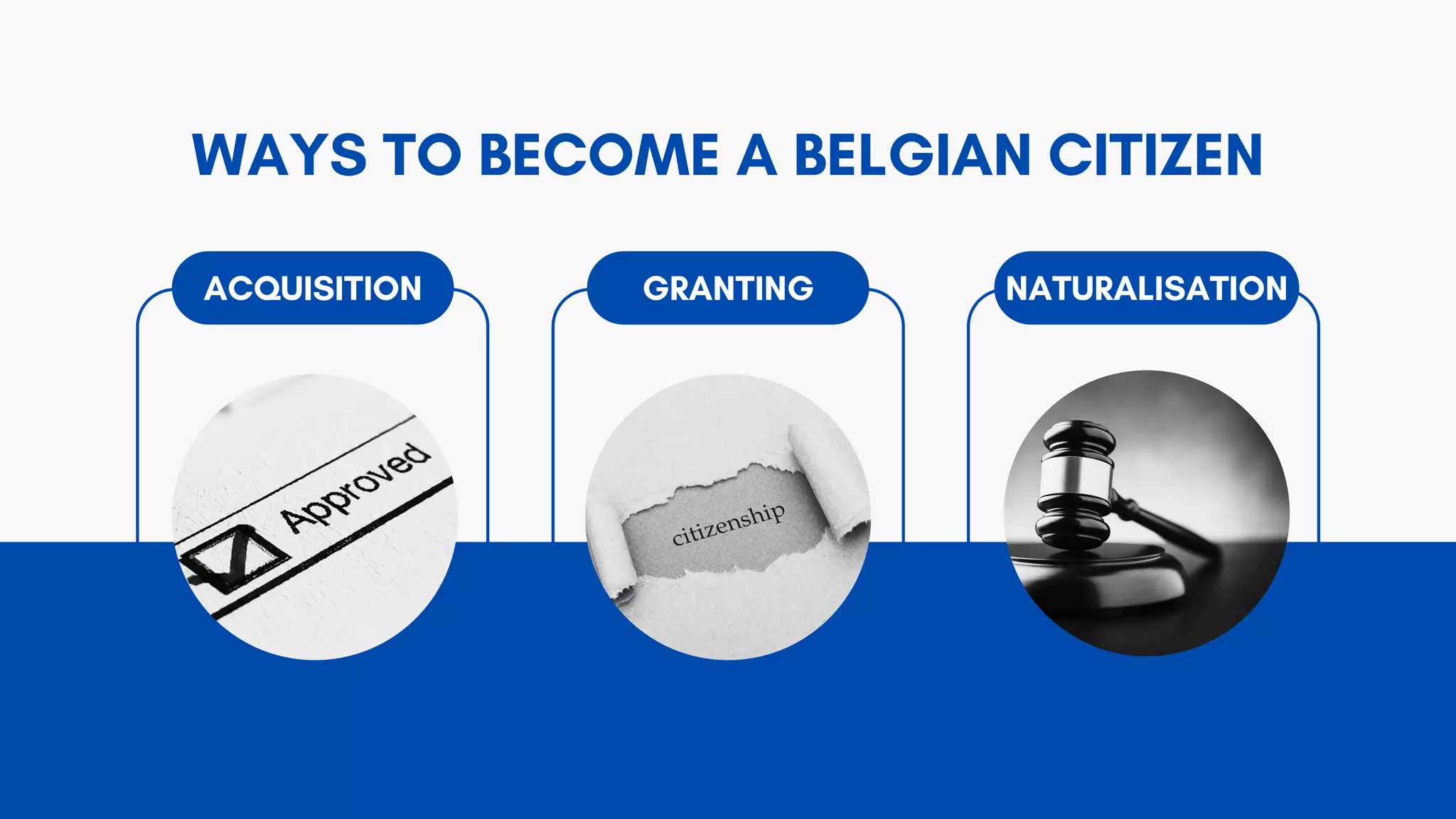
There are two main ways for an adult to acquire Belgian citizenship: Nationality Declaration and Naturalization. It is critical to distinguish between them, as the requirements and success rates differ significantly.
Nationality Declaration (The Standard Route)
The Declaration is the most common route for foreign residents. It is a "right" granted to those who meet specific legal criteria. If you satisfy all the conditions, the King’s Prosecutor cannot refuse the application unless there is a serious criminal record or a threat to public safety. There are five main sub-categories under the Declaration:
- Adults born in Belgium and residing there legally since birth.
- Legal residency of five years with proof of language skills, social integration, and economic participation.
- Legal residency of five years based on marriage to a Belgian citizen or being the parent of a minor Belgian child.
- Legal residency of five years for those who are handicapped or invalid and cannot work.
- Legal residency of ten years with proof of language skills and participation in the life of the host community.
Naturalization (The Exceptional Route)
Naturalization is an exceptional favor granted by the Chamber of Representatives. It is no longer the standard path for residents. In 2026, naturalization is strictly reserved for individuals who can demonstrate "exceptional merits" in the fields of science, sports, or culture, which contribute to Belgium’s international reputation. Applicants must also explain why it is impossible for them to acquire citizenship via the Declaration route.
Detailed Requirements for the 5-Year Declaration
The "Social and Economic Integration" pathway is the most frequent choice for expatriates and non-EU residents. To succeed, you must meet four cumulative criteria.
1. Legal Residency
You must have been legally resident in Belgium for at least five years preceding the application. "Legal residency" means being registered in the Population Register and holding a valid residency permit (such as an E, E+, F, or F+ card for EU/EEA citizens, or a long-term B, C, D, or L card for non-EU nationals). Short-stay visas or temporary "Annex" documents usually do not count toward the five-year total. Crucially, your residency must be uninterrupted; significant gaps or moving your main residence abroad can reset the clock.
2. Language Proficiency
Belgium requires applicants to prove they have reached at least the A2 level of the Common European Framework of Reference for Languages (CEFR) in one of the three national languages: Dutch, French, or German. You can prove this through:
- A diploma or certificate obtained in Belgium (secondary or higher education).
- Professional training of at least 400 hours recognized by a regional authority.
- An integration course certificate provided by regional agencies like Atlas, Inburgering, or VIA.
- Success in a government-recognized language exam (e.g., SELOR).
3. Social Integration
Social integration is often proven simultaneously with language skills. If you have a Belgian degree or have completed a recognized integration course (Inburgeringstraject), this requirement is satisfied. Alternatively, having worked continuously for the past five years also serves as evidence of integration into Belgian society.
4. Economic Participation
Applicants must prove they have contributed to the Belgian economy. The standard requirement is having worked for at least 468 working days during the five years prior to the application. If you are a self-employed worker, you must prove you have paid at least six quarters of social security contributions within that same period.
The 10-Year Residency Path
For individuals who cannot meet the strict economic participation requirements (such as those who have not worked 468 days), a secondary path exists after ten years of legal residency. While the residency requirement is doubled, the applicant still must prove:
- Knowledge of one of the national languages (A2 level).
- Participation in the life of their host community (this is a qualitative assessment that can include membership in clubs, volunteering, or local activities).
Required Documentation and Fees
The application is filed at the Civil Registry of your local municipality. You must provide a specific set of documents, which must be translated and legalized if they originated outside the EU.
- Birth Certificate: A certified copy, translated into the language of the municipality.
- Proof of Residency: A historical record of addresses (Certificat de résidence avec historique/Getuigschrift van woonst met historiek).
- Proof of Identity: A certified copy of your current foreign passport and Belgian residency card.
- Proof of Language and Integration: Certificates from recognized schools or integration offices.
- Proof of Work: For employees, this involves "Compte Individuel" (Individual Account) statements; for the self-employed, proof of social security payments.
- Payment Receipt: In 2026, the federal registration fee for a nationality declaration remains €150. This must be paid via the FPS Finance MyMinfin portal before submitting the file.
Comparison of Citizenship Pathways
| Requirement | 5-Year (Standard) | 5-Year (Family/Marriage) | 10-Year (Long Term) | Naturalization |
|---|---|---|---|---|
| Residency Duration | 5 Years | 5 Years | 10 Years | 2 Years (in some cases) |
| Language (A2) | Mandatory | Mandatory | Mandatory | Mandatory |
| Social Integration | Mandatory | Mandatory | Participation proof | Not explicitly required |
| Work Requirement | 468 Days | No (if living with spouse) | No | No |
| Success Rate | Very High (Legal Right) | High (Legal Right) | Moderate (Discretionary) | Very Low (Discretionary) |
The Application Process: Timeline and Review
Once you submit your file to the municipality, the registrar has 30 days to review the completeness of the application. If the file is complete, you will receive a certificate of receipt.
- Notification of the Prosecutor: The municipality sends your file to the King’s Prosecutor at the local Court of First Instance.
- Investigation Phase: The Prosecutor, the State Security Service, and the Foreigners Office have four months to investigate your background. They check for criminal records, tax compliance, and whether you pose a threat to public order.
- Silence as Consent: If the Prosecutor does not issue a negative opinion within four months, the citizenship is automatically granted. If the Prosecutor issues a positive opinion earlier, the process may conclude faster.
- Final Registration: Once the four-month period passes without objection, the municipality registers you in the records. You will then be invited to apply for your Belgian ID card and passport.
Rights and Responsibilities of Belgian Citizens
Acquiring Belgian citizenship provides several significant benefits, but it also carries mandatory duties.
- EU Citizenship: As a Belgian citizen, you are an EU citizen, granting you the right to live, work, and vote in any of the 27 EU member states.
- Voting Rights: Voting is mandatory in Belgium. Once you are a citizen, you are legally required to participate in local, regional, federal, and European elections.
- Consular Protection: You gain access to Belgian consular services worldwide.
- Dual Nationality: Belgium allows dual citizenship. You do not have to renounce your original nationality to become Belgian, provided your country of origin also permits it.
- Passports: The Belgian passport consistently ranks as one of the most powerful in the world, offering visa-free or visa-on-arrival access to over 180 countries.
Common Pitfalls to Avoid
- Expired Permits: Your residency permit must be valid during the entire application process. If it expires while the Prosecutor is reviewing your file, the application may be voided.
- Incorrect Language Level: Ensure your certificate explicitly mentions "A2 level" or higher. Attendance certificates that do not confirm a passing grade are often rejected.
- Missing 150 EUR Payment: The payment must be made to the specific account of the FPS Finance, and the receipt must be included in the initial submission.
- The "Work Gap" Error: When calculating the 468 working days, do not count days spent on long-term disability or certain types of unpaid leave, as these may be excluded by the reviewer.
FAQ
Can I get Belgian citizenship through marriage? Yes, but marriage alone does not grant citizenship. You must have lived in Belgium legally for five years, and you must have lived together with your Belgian spouse for at least the last three years of that period. You must also prove A2 language proficiency and social integration. Unlike the standard route, the work (economic participation) requirement is generally waived for those married to Belgians.
How long does the whole process take in 2026? After you have gathered your documents and submitted the file to the municipality, the legal timeframe for the investigation is four months. Including the initial appointment wait times and the time to issue a new ID card, most applicants become citizens within 5 to 7 months of their submission date.
Does Belgium allow dual citizenship? Yes, since 2008, Belgian law has allowed citizens to hold multiple nationalities. If you acquire Belgian citizenship, you will not lose your original nationality under Belgian law. However, you should check the laws of your home country, as some nations (like Japan or India) may require you to renounce your original citizenship upon acquiring a new one.
Do I need a lawyer to apply for Belgian citizenship? In most cases, a lawyer is not necessary. The "Nationality Declaration" is a standardized administrative procedure. If you meet the criteria and have the correct documents, the municipality will guide you. A lawyer is only recommended if you have a complex criminal record or if your residency history has significant gaps that need legal interpretation.
Can my children become Belgian when I do? If you have children under the age of 18 who are living with you in Belgium at the time your citizenship is granted, they automatically become Belgian citizens along with you. Their names should be included in the application process to ensure their records are updated simultaneously.
Final Recommendation
Before heading to your local municipality, visit the official FPS Justice website to download the latest checklist for the Nationality Declaration. Ensure all foreign documents are apostilled or legalized by the issuing country’s embassy. If you are missing the social integration requirement, enrolling in a regional integration course (like the Inburgeringstraject in Flanders or the Parcours d'intégration in Wallonia) is the most reliable way to secure your eligibility.
Image Gallery