Choosing the Best International Accounting Certification for a Global Career in 2026
Choosing the right international accounting certification depends on your geographic focus and career specialization. While the US CPA remains the premier choice for North American markets and US-listed firms, the ACCA offers the broad...
Choosing the right international accounting certification depends on your geographic focus and career specialization. While the US CPA remains the premier choice for North American markets and US-listed firms, the ACCA offers the broadest global mobility across 180 countries. For strategic roles, the CMA or CIMA are the industry standards for management and internal financial leadership.
Contents
The global financial landscape in 2026 has been fundamentally reshaped by digital transformation and the universal adoption of sustainability reporting. For accounting professionals, a certification is no longer just a proof of technical competence in debits and credits; it is a vital credential that signals your ability to navigate international financial reporting standards (IFRS), interpret AI-driven data analytics, and manage complex environmental, social, and governance (ESG) disclosures.
Selecting an international accounting certification requires a deep understanding of your long-term career goals. Are you aiming for a partnership at a Big Four firm, a CFO role in a multinational manufacturing company, or a career as a global internal auditor? Each pathway demands a specific set of credentials that are recognized by local regulators and international bodies.
The Evolution of Accounting Credentials in 2026
By 2026, the "CPA Evolution" model in the United States and the integrated digital modules in the ACCA and CIMA syllabi have become the standard. The traditional boundaries between "IT" and "Accounting" have dissolved. Modern international certifications now require candidates to demonstrate proficiency in automated auditing, blockchain ledger verification, and real-time financial reporting.
Furthermore, the International Sustainability Standards Board (ISSB) standards, specifically IFRS S1 and S2, are now core components of international accounting curricula. Professionals are expected to bridge the gap between financial performance and carbon accounting. When evaluating which certification to pursue, you must consider how well the curriculum prepares you for these 2026 market demands.
ACCA (Association of Chartered Certified Accountants)
The ACCA is often referred to as the most "international" of all accounting certifications. Headquartered in the UK, it has a massive footprint across Europe, Asia, Africa, and the Middle East.
Curriculum and Structure
The ACCA qualification is divided into three main stages: Applied Knowledge, Applied Skills, and Strategic Professional.
- Applied Knowledge: Provides a foundation in financial and management accounting.
- Applied Skills: Covers more technical areas like taxation, performance management, and audit.
- Strategic Professional: This is where the ACCA distinguishes itself. It includes mandatory modules in Strategic Business Reporting and Strategic Business Leader, plus elective options like Advanced Audit or Advanced Financial Management.
By 2026, the ACCA has fully integrated "Digital Innovation" throughout its exams, requiring students to use professional-grade software for data manipulation during the examination process.
Global Portability and Recognition
One of the primary reasons professionals choose the ACCA is its high degree of portability. Through Mutual Recognition Agreements (MRAs), ACCA members can often gain local audit rights or equivalent status in various jurisdictions, although some countries (like the US) require additional bridging exams. It is the preferred choice for those working in IFRS-compliant countries.
US CPA (Certified Public Accountant)
The US CPA remains the "Gold Standard" for anyone intending to work with US-based multinational corporations, public accounting firms (The Big Four), or within the United States financial markets.
The CPA Evolution Model
Following the massive overhaul in 2024, the 2026 CPA exam follows a "Core + Discipline" model. Every candidate must pass three core sections:
- Financial Accounting and Reporting (FAR)
- Auditing and Attestation (AUD)
- Taxation and Regulation (REG)
Candidates then choose one of three "Disciplines" to demonstrate deeper expertise:
- Business Analysis and Reporting (BAR)
- Information Systems and Controls (ISC)
- Tax Compliance and Planning (TCP)
This specialized approach allows the CPA to remain relevant in a world where accountants are often specialized data analysts or technology consultants.
Licensing Requirements
The CPA is not just an exam; it is a license granted by one of the 55 US jurisdictions (states and territories). Most follow the "150-hour rule," requiring 150 semester hours of college education (typically a Master’s degree or equivalent) and at least one to two years of verified professional experience under the supervision of a licensed CPA.
CMA (Certified Management Accountant)
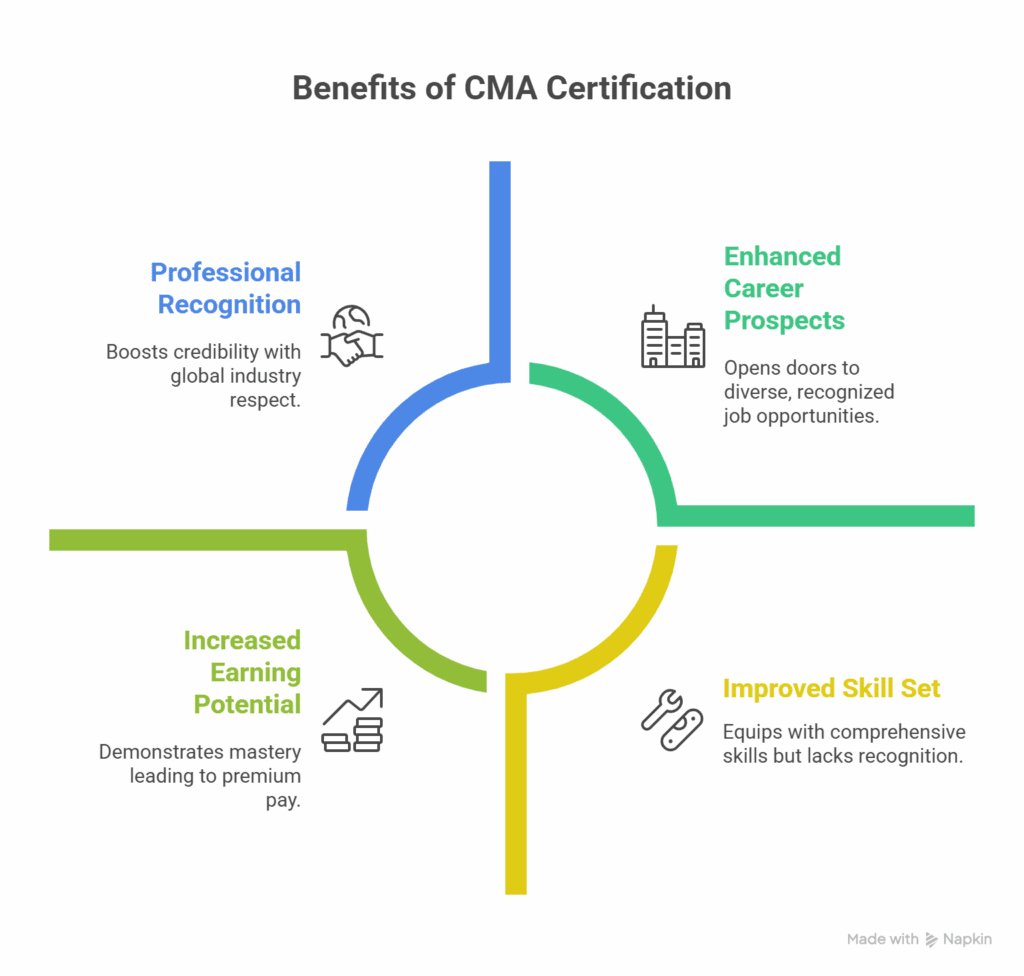
The CMA, offered by the Institute of Management Accountants (IMA), is the leading global certification for internal corporate finance and management accounting. Unlike the CPA or ACCA, which have a heavy focus on external audit and tax, the CMA focuses on what happens inside a business.
Strategic Focus
The CMA consists of two parts:
- Part 1: Financial Planning, Performance, and Analytics. This covers internal controls, cost management, and the increasingly important "Technology and Analytics" section.
- Part 2: Strategic Financial Management. This focuses on financial statement analysis, corporate finance, decision analysis, and professional ethics.
Career Path and ROI
The CMA is particularly valuable for those aiming for roles such as Financial Controller, Budget Analyst, or Chief Financial Officer (CFO). It is highly respected in the United States, China, and India. Because it only involves two exams, it often has a faster path to completion (12–18 months) compared to the CPA or ACCA, providing a high return on investment for mid-career professionals.
CIMA (Chartered Institute of Management Accountants)
Based in the UK, CIMA is the management accounting equivalent of the ACCA. Through its partnership with the AICPA, it grants the CGMA (Chartered Global Management Accountant) designation.
CIMA is unique because it uses a "Competency Framework" that blends financial skills with business, people, and leadership skills. The 2026 CIMA syllabus places immense weight on "Value Creation"—teaching accountants how to use financial data to drive business strategy and sustainability initiatives.
Comparing International Accounting Certifications
| Feature | US CPA | ACCA | CMA (US) | CIMA (UK) |
|---|---|---|---|---|
| Primary Region | USA / Global US Firms | UK, Europe, Asia, Africa | Global / Corporate | UK, Commonwealth |
| Number of Exams | 4 (3 Core + 1 Discipline) | Up to 13 (Exemptions apply) | 2 Parts | 12+ (Based on level) |
| Education Req. | 150 Credit Hours | High School / Degree | Bachelor's Degree | High School / Degree |
| Experience Req. | 1-2 Years | 3 Years | 2 Years | 3 Years |
| Focus Area | Audit, Tax, Reporting | Generalist / Public Practice | Management & Strategy | Business Strategy |
| Estimated Cost | $3,000 - $6,000 | $2,500 - $5,000 | $2,000 - $3,500 | $3,000 - $5,500 |
Specialized Certifications: CIA and IFRS
While the certifications above are broad, many 2026 professionals seek niche credentials to distinguish themselves in specific departments.
- CIA (Certified Internal Auditor): Offered by the Institute of Internal Auditors (IIA), this is the only globally accepted certification for internal auditors. As corporate governance and risk management become more complex, the CIA has seen a surge in demand.
- IFRS Certification: For CPAs in the US who want to work abroad, or for accountants in developing markets, obtaining a specific "Certificate in IFRS" (often through the ICAEW or ACCA) provides a shortcut to understanding the nuances of international standards without completing a full three-year qualification.
Costs and Resource Considerations
Pursuing an international accounting certification is a significant financial and temporal investment. Beyond the registration and exam fees listed in the table above, candidates must account for:
- Review Courses: Leading providers like Becker, Kaplan, or BPP can cost between $1,500 and $3,500.
- Annual Membership Fees: Most bodies require an annual fee (ranging from $200 to $500) to maintain the designation.
- Continuing Professional Education (CPE): To keep your license active in 2026, you must complete 20–40 hours of learning per year, often involving paid seminars or subscriptions.
How to Choose the Right Path
To make the best decision, use the following framework:
- Identify Your Target Location: If you want to work in New York or for a US firm in London, the CPA is mandatory. If you are targeting Singapore, Dubai, or Johannesburg, the ACCA is often more recognized.
- Assess Your Background: If you already have a Master’s degree in Accounting, you may qualify for significant exemptions in the ACCA or CIMA, potentially shortening your path by years.
- Determine Your Specialty: If you love the rigor of auditing and law, go for the CPA or ACCA. If you prefer business strategy, data analytics, and operational decision-making, the CMA or CIMA is a better fit.
- Check Reciprocity: Before starting, check the International Federation of Accountants (IFAC) or the local accounting body in your country to see if they have a Mutual Recognition Agreement with the certification you are considering.
Frequently Asked Questions
Which international accounting certification pays the most?
Salaries depend more on your role and location than the specific initials after your name. However, in the 2026 market, US CPAs working in high-cost-of-living areas (like San Francisco or Zurich) typically see the highest starting salaries. CMAs often see higher mid-career salaries in corporate leadership roles.
Can I get a US CPA if I live outside the United States?
Yes. The American Institute of Certified Public Accountants (AICPA) and NASBA offer the CPA exam at international testing centers in dozens of countries. However, you must still meet the educational and experience requirements of one of the 55 US state boards of accountancy to be licensed.
Is the ACCA harder than the CPA?
"Hardness" is subjective. The ACCA has more exams (up to 13), which can take 3 to 4 years to complete. The US CPA has only four exam sections but the content is extremely dense, and the 150-hour education requirement is a significant barrier to entry. Most professionals consider them equally rigorous but different in structure.
Do these certifications expire?
The designations do not expire as long as you pay your annual membership dues and fulfill your Continuing Professional Education (CPE) or Continuing Professional Development (CPD) requirements. If you fail to report your hours, your status may be moved to "inactive."
How has AI affected the 2026 accounting exams?
Exam bodies have moved away from testing rote memorization. In 2026, exams focus on "Professional Judgment." You are often provided with a dataset and must use tools to identify anomalies, assess risk, or suggest strategic pivots. AI is treated as a tool the accountant must oversee, not a replacement for the accountant's ethics and skepticism.
Final Recommendation
If you are early in your career and undecided on a location, the ACCA provides the most flexible global foundation. If you are certain about working within the sphere of US influence or aiming for a Big Four audit career, the US CPA is the non-negotiable choice. For experienced professionals already in the corporate sector who want to move into executive management, the CMA offers the most efficient path to a recognized international credential.
Regardless of the path you choose, ensure that your study plan includes a heavy focus on ESG reporting and data analytics, as these are the defining competencies for the global accounting profession in 2026.
Image Gallery