Professional Mold Remediation Services in Leland, NC: Complete Guide to Removal, Costs, and Prevention
Professional mold remediation services in Leland, North Carolina, systematically identify, contain, and eliminate indoor mold growth while addressing the underlying moisture sources causing fungal proliferation. Certified remediation t...
Professional mold remediation services in Leland, North Carolina, systematically identify, contain, and eliminate indoor mold growth while addressing the underlying moisture sources causing fungal proliferation. Certified remediation technicians use specialized containment protocols, High-Efficiency Particulate Air (HEPA) filtration, antimicrobial treatments, and structural drying equipment to restore healthy indoor air quality and protect property values.
Contents
Understanding Mold Risks in Leland’s Coastal Environment
Leland, North Carolina, situated in Brunswick County near the Cape Fear River and coastal waterways, experiences a humid subtropical climate characterized by long, hot summers, frequent precipitation, and high ambient relative humidity. These atmospheric conditions create an environment where indoor mold can germinate and spread rapidly. Mold spores exist naturally in outdoor air, but when they enter residential or commercial structures with elevated humidity levels (exceeding 60%), poor ventilation, or active moisture intrusion, fungal colonies can establish within 24 to 48 hours.
Homeowners and commercial property owners in Leland face distinct environmental factors that accelerate mold development:
- Subtropical Humidity and Heat: Average summer relative humidity in southeastern North Carolina routinely exceeds 80%. High outdoor humidity makes indoor climate control critical; when air conditioning systems are improperly sized or inadequately maintained, moisture accumulates on building surfaces.
- Crawl Space Moisture Intrusion: A vast majority of homes in Leland are constructed over raised crawl space foundations. The high local water table, coupled with damp soil and traditional open exterior vents, allows warm, humid air to enter crawl spaces. When warm air contacts cool ductwork or floor joists, condensation forms, fostering extensive Aspergillus, Penicillium, or Cladosporium growth under subflooring.
- Coastal Storms and Flooding: Tropical storms, severe thunderstorms, and hurricanes bring intense rainfall and storm surges to Brunswick County. Roof leaks, window seal failures, and ground-level water entry can saturate drywall, insulation, and framing members, requiring immediate emergency water mitigation and structural remediation.
- Closed-Building Syndrome in Modern Homes: Energy-efficient construction practices in newer Leland developments minimize air leakage. While beneficial for heating and cooling efficiency, tightly sealed building envelopes can trap indoor humidity from cooking, bathing, and HVAC condensation if adequate mechanical ventilation is lacking.
Left unaddressed, indoor mold contamination compromises structural integrity by degrading cellulose materials like drywall, plywood, and timber framing. Beyond physical building damage, exposure to elevated airborne spore counts and mycotoxins can trigger upper respiratory symptoms, allergic reactions, asthma flare-ups, and sinus irritation among building occupants.
The Professional Mold Remediation Process (IICRC S520 Standards)
Reputable mold remediation contractors in North Carolina adhere to the Institute of Inspection Cleaning and Restoration Certification (IICRC) S520 Standard for Professional Mold Remediation. This industry-standard protocol outlines the science-based procedures required to safely isolate, remove, and verify fungal cleanup without spreading contamination into uninfected areas of the building.
- Initial Assessment & Assessment
- Moisture mapping, thermal imaging, root-cause identification
- Containment & Air Filtration
- Critical barriers, negative air pressure, HEPA air scrubbers
- Remediation & Physical Removal
- Controlled removal of porous goods, HEPA vacuuming, scrubbing
- Structural Drying & Antimicrobial Treatment
- Industrial dehumidification, EPA-registered fungicides
- Post-Remediation Verification (PRV)
- Independent clearance testing, surface & airborne sampling
Step 1: Inspection, Moisture Mapping, and Containment Planning
Remediation begins with a comprehensive physical assessment. Qualified technicians utilize calibrated pinless moisture meters, hygrometers, and forward-looking infrared (FLIR) thermal imaging cameras to trace invisible moisture pathways behind walls, above ceilings, and underneath flooring.
Once the boundaries of contamination and moisture source are established, contractors establish a scope of work. According to guidelines set by the U.S. Environmental Protection Agency (EPA), identifying and eliminating the moisture source is the mandatory prerequisite to any physical cleanup effort.
Step 2: Isolation and Negative Pressure Setup
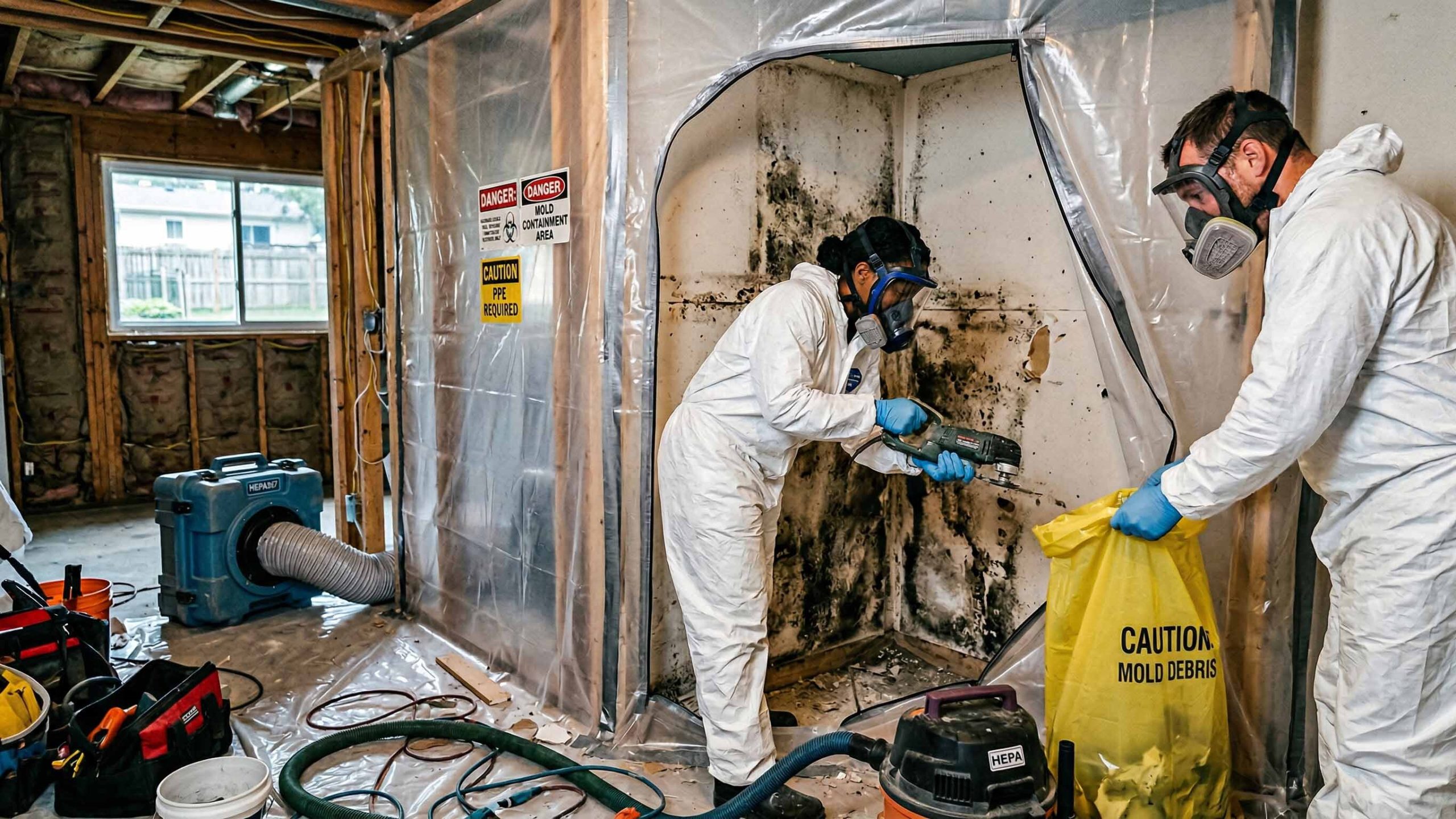
To prevent cross-contamination into uncontaminated living spaces, remediation teams construct physical containment zones. Heavy-duty 6-mil polyethylene sheeting seals off doorways, HVAC supply and return vents, and structural openings.
Technicians install negative air machines fitted with true HEPA filters (capable of capturing 99.97% of particles down to 0.3 microns). These machines continuously exhaust filtered air outside the property, creating negative pressure within the work zone. This pressure differential ensures that microscopic mold spores disturbed during demolition cannot escape into the rest of the home.
Step 3: Controlled Demolition and Material Removal
Mold-affected building materials are categorized into three primary structural types:
- Porous Materials (Drywall, Carpet, Insulation, Ceiling Tiles): Deep fungal hyphae penetrate structural pores, making complete decontamination impossible. These materials are misted with water to prevent airborne dust dispersion, carefully cut out, double-bagged in 6-mil plastic bags, sealed, and safely removed.
- Semi-Porous Materials (Framing Lumber, Concrete, Plywood): Structural wood framing cannot easily be replaced. Technicians clean semi-porous surfaces using abrasive methods such as wire brushing, media blasting (dry-ice or soda blasting), or sanding to physically strip surface mold colonies.
- Non-Porous Materials (Glass, Metals, Hard Plastics): These items are thoroughly sanitized using EPA-registered antimicrobial disinfectants and biocide washes.
Step 4: HEPA Vacuuming and Deep Cleaning
After physical removal, technicians perform detailed HEPA vacuuming across all horizontal and vertical surfaces within the containment area. Standard household or commercial vacuums without sealed HEPA systems must never be used, as their exhaust forces microscopic spores into suspension. Following vacuuming, structural framing and non-porous surfaces undergo damp-wiping with specialized antifungal cleaning solutions.
Step 5: Structural Drying and Dehumidification
Physical removal alone does not complete remediation; structural moisture content must be returned to safe baseline levels (typically below 15% wood moisture content for framing timbers). Industrial-grade LGR (Low Grain Refrigerant) dehumidification systems and high-velocity air movers run continuously within containment until independent moisture readings confirm target dry standards are met.
Step 6: Post-Remediation Verification (PRV)
Before containment barriers are disassembled, a Post-Remediation Verification (PRV) or clearance inspection is conducted. An independent Environmental Protection Professional (EPP) or certified mold inspector visually inspects the area for settled dust or remaining water stains and collects air cassette samples. The containment stands until laboratory analysis confirms airborne spore counts and species distributions inside the containment match or remain lower than outdoor control samples.
Crawl Space Encapsulation and Moisture Control in Leland
In coastal North Carolina, structural mold remediation frequently centers around the home’s crawl space. Vented, unconditioned crawl spaces exposed to Leland’s high ambient humidity develop chronic dampness, standing groundwater, and wood decay fungi (Coniophora puteana or white pocket rot).
Resolving crawl space mold permanently requires transitioning open vents to a fully encapsulated, engineered crawl space system.
- Typical Vented Crawl Space (High Moisture Risk)
- Warm, Damp Outdoor Air via Open Vents
- Bare Dirt / Damp Soil Ground Evaporation
- Condensation on Joists and Mold Growth
- Encapsulated Crawl Space (Controlled Environment)
- Solid Foundation Wall (Sealed Vents)
- 12-20 mil Reinforced Sealed Vapor Barrier
- Specialized Crawl Space Dehumidifier
Components of a Mold-Resistant Crawl Space System
- Full Subfloor Decontamination: Mold-affected floor joists, subflooring, and rim joists undergo HEPA vacuuming, media blasting, and treatment with a borate-based wood preservative to inhibit future fungal growth and wood-boring insects.
- Ground Moisture Vapor Barrier: Traditional 6-mil loose-laid poly sheeting is replaced with heavy-duty 12-mil to 20-mil puncture-resistant reinforced vapor barriers. The membrane is mechanically fastened and sealed up foundation walls to within 3 inches of the sill plate (leaving a termite inspection strip required by North Carolina building codes) and taped air-tight along all seams and piers.
- Foundation Vent Sealing: Exterior foundation vents are permanently closed using insulated vent covers and masonry sealant to block hot, humid summer air from entering the space under the home.
- Dedicated Crawl Space Dehumidifier: An energy-efficient, self-draining crawl space dehumidifier rated for low temperatures is installed to maintain relative humidity consistently below 55%.
- Sump Pump and Drainage Systems: In areas of Leland with high groundwater tables or localized drainage issues, interior perimeter French drains and heavy-duty sump pump systems are integrated to pump bulk water away from the foundation before encapsulation.
Cost of Mold Remediation in Leland, NC
Mold remediation pricing in Leland varies depending on the square footage of the affected zone, accessibility, containment needs, and the degree of structural reconstruction required. The table below outlines average costs across common scope levels in Brunswick County.
| Remediation Project Scope | Typical Affected Area | Key Services Included | Estimated Cost Range (USD) |
|---|---|---|---|
| Minor Localized Remediation | Single closet, small bathroom vanity, under-sink cabinet (< 30 sq ft) | Source repair, local containment, HEPA vacuuming, antimicrobial cleaning, dry-out | $500 – $1,500 |
| Attic Mold Remediation | Partial to full attic space (500 – 1,500 sq ft) | Vent clearing, roof leak response, media blasting timber rafters, HEPA vacuuming, anti-fungal sealing | $2,000 – $5,500 |
| Crawl Space Remediation & Encapsulation | Full crawl space footprint (1,000 – 2,500 sq ft) | Structural mold removal, borate treatment, ground vapor barrier (12-20 mil), vent sealing, commercial dehumidifier | $4,500 – $11,000 |
| Whole-Home Structural Remediation | Multiple rooms, drywall removal, HVAC duct sanitization | Multi-zone containment, negative pressure setups, extensive demolition, HVAC cleaning, structural drying | $6,000 – $18,000+ |
Note: The cost ranges above reflect baseline remediation and moisture control. Full reconstruction services (replacing drywalled walls, insulation, finish flooring, and paint) are billed separately or handled by licensed general contractors.
Selecting a Certified Mold Remediation Contractor in Brunswick County
North Carolina does not currently maintain a specific state licensing exam specifically for mold remediation contractors. Because state-level licensing for mold is absent, home and business owners must diligently evaluate prospective contractors based on national industry certifications, insurance coverage, and business practices.
- Third-Party Environmental Inspector
- Conducts initial diagnostic sampling
- Writes objective remediation scope
- Certified Mold Remediation Contractor
- Executes physical containment & cleanup
- Resolves underlying moisture source
- Third-Party Clearance Inspector (PRV)
- Performs independent post-test
- Issues official property clearance pass
Critical Qualifications to Verify
- IICRC Certifications: Confirm that technicians hold active certifications such as Applied Microbial Remediation Technician (AMRT), Water Damage Restoration Technician (WRT), and Fire & Smoke Restoration Technician (FSRT).
- Micro / NORMI Certifications: Recognized industry organizations such as the National Organization of Remediators and Mold Inspectors (NORMI) or MICRO provide specialized training for mold assessment and remediation.
- Comprehensive Insurance Coverage: Verify that the company holds General Liability insurance specifically carrying Pollution Liability (Mold) Coverage. Standard commercial liability insurance often contains explicit mold exclusions, leaving property owners vulnerable to damages if cross-contamination occurs during job execution.
- Separation of Assessment and Remediation (No Conflict of Interest): To protect property owners, reputable companies recommend or require that initial mold testing and final Post-Remediation Verification testing be performed by an independent third-party industrial hygienist or environmental inspector. A company that performs its own pre- and post-testing without third-party validation presents a clear conflict of interest.
- Local Expertise: Ensure the contractor has documented experience dealing with coastal North Carolina construction techniques, crawl space mechanics, and local building codes enforced by Brunswick County.
Frequently Asked Questions
How long does the professional mold remediation process take?
For standard residential jobs in Leland, physical remediation typically takes between 1 to 5 business days. Minor surface cleanups in small bathrooms can take a single day, whereas extensive whole-house remediation or complex crawl space encapsulation projects take 3 to 5 days. Structural drying equipment may need to run continuously for 48 to 72 hours before post-clearance testing can occur.
Does homeowner's insurance cover mold remediation in North Carolina?
Standard home insurance policies in North Carolina usually cover mold remediation only if the mold directly resulted from a covered "sudden and accidental" peril, such as a burst plumbing pipe, water heater rupture, or appliance discharge. Policies generally exclude mold growth caused by neglected home maintenance, long-term unaddressed plumbing leaks, high ambient humidity, or ground surface flooding. Many insurers apply a specific dollar cap (often $5,000 to $10,000) for mold claims unless an endorsement is purchased.
Can I clean structural mold myself using household bleach?
No, chlorine bleach is not recommended by the EPA or IICRC for removing mold on porous or semi-porous surfaces such as drywall, wood joists, or subflooring. Bleach contains roughly 90% water; when applied to porous timber, the chlorine chemical evaporates off the surface while the high water content absorbs deep into the wood fibers, feeding embedded mold roots (hyphae) and encouraging rapid regrowth.
What are the immediate signs that a Leland home requires professional mold intervention?
Key warning indicators include visible black, green, or white discoloration on walls, baseboards, or ceiling tiles; persistent musty or damp odors; unexplained worsening of respiratory allergies among occupants while indoors; peeling paint or warping drywall; and visible standing water or white efflorescence salt deposits on crawl space walls.
How can Leland homeowners prevent mold from returning after remediation?
Long-term prevention requires controlling indoor relative humidity. Homeowners should keep indoor humidity below 50% using central air conditioning and dedicated dehumidifiers, install bath exhaust fans vented directly to the exterior, seal crawl spaces with heavy vapor barriers and dedicated crawl space dehumidification, inspect roof flashing and plumbing lines annually, and clear gutter downspouts so rainwater sheds at least 5 feet away from the foundation.
Recommended Next Steps for Leland Property Owners
If you suspect mold growth or have experienced recent water damage in your Leland home or business, follow these practical steps to protect your property and health:
- Identify and Stop Active Water Leaks: Shut off main water valves if an active plumbing leak is detected, or cover damaged roof areas with tarps immediately following storm events.
- Avoid Disturbing Affected Surfaces: Do not scrub, scrape, or run household fans directly across moldy surfaces. Disturbing dry fungal colonies releases millions of microscopic spores into the air, spreading contamination throughout the HVAC system.
- Schedule an Independent Diagnostic Mold Assessment: Hire an accredited environmental inspector or industrial hygienist to perform baseline air sampling and thermal moisture mapping if contamination boundaries are unclear.
- Hire an IICRC-Certified Remediation Contractor: Request proof of mold pollution insurance, review itemized containment scopes, and verify that all work will conform to IICRC S520 industry standards.
- Implement Preventative Moisture Controls: Upon completion of structural cleanup, install engineered crawl space encapsulation, clean HVAC condensate drains regularly, and monitor indoor relative humidity with digital hygrometers year-round.
Image Gallery