Where Most Motorcycle Accidents Occur: Why Urban Streets Pose the Highest Risk
According to traffic safety data from the National Highway Traffic Safety Administration (NHTSA) and the Insurance Institute for Highway Safety (IIHS), the vast majority of motorcycle accidents occur on urban streets rather than open r...
According to traffic safety data from the National Highway Traffic Safety Administration (NHTSA) and the Insurance Institute for Highway Safety (IIHS), the vast majority of motorcycle accidents occur on urban streets rather than open rural highways or high-speed interstates. Approximately 60% to 67% of all fatal motorcycle crashes take place in urban environments, primarily at intersections and along heavily congested arterial roadways where complex traffic patterns and vehicle turning maneuvers intersect.
Contents
Statistical Breakdown: Urban vs. Rural Crash Environments
While open highways are often associated with high speeds and severe impacts, empirical crash data confirms that urban roadways are statistical hotspots for motorcycle incidents. Federal traffic safety evaluations reveal distinct patterns in where and how these collisions happen.
- Motorcycle Crash Locations
- Urban Streets & Non-Interstates: ~65%
- Rural Roads & Highways: ~35%
Urban Non-Interstate Dominance
Data compiled by the National Highway Traffic Safety Administration (NHTSA) demonstrates that more than two-thirds of all motorcycle fatalities occur on non-interstate urban roads. These include major city avenues, commercial thoroughfares, and multi-lane suburban collectors. Interstates and freeways, despite carrying higher speed limits, account for a significantly lower percentage of total crashes due to controlled access points and the absence of cross-traffic.
Time of Day and Day of Week Trends
Urban crashes spike during specific windows. Weekday rush hours (7:00 AM – 9:00 AM and 4:00 PM – 7:00 PM) see elevated non-fatal collision rates driven by heavy commuter traffic and distracted driving. However, weekend evenings account for a disproportionate number of severe and fatal urban accidents, where reduced visibility, alcohol impairment, and higher traffic volume combine to elevate risk.
Intersections vs. Mid-Block Locations
Nearly half of all urban motorcycle collisions occur directly within or immediately adjacent to intersections. Unlike straight segments of road where traffic moves uniformly, intersections force vehicles traveling in opposite directions to cross paths, creating immediate hazard zones for two-wheeled vehicles.
Key Factors That Make Urban Streets Dangerous for Motorcyclists
Urban traffic environments present a dense web of variables that tax a driver's cognitive load and reduce a motorcyclist's margin for error. Understanding why urban streets generate high accident volumes requires examining human perception, traffic mechanics, and physical infrastructure.
1. The Left-Turn Vehicle Phenomenon
The single most frequent scenario in urban motorcycle crashes involves a passenger car or commercial truck turning left across the path of an oncoming motorcycle traveling straight through an intersection.
Drivers frequently fail to notice oncoming motorcycles due to a psychological phenomenon known as inattentional blindness. Because drivers primarily look for the size and silhouette of other passenger cars or trucks, smaller profiles like motorcycles are often overlooked by the brain during quick visual scans. Furthermore, human visual perception struggles to accurately gauge the speed and distance of smaller objects, leading drivers to falsely assume they have sufficient time to execute a left turn.
2. High Density of Vehicle Traffic and Visual Noise
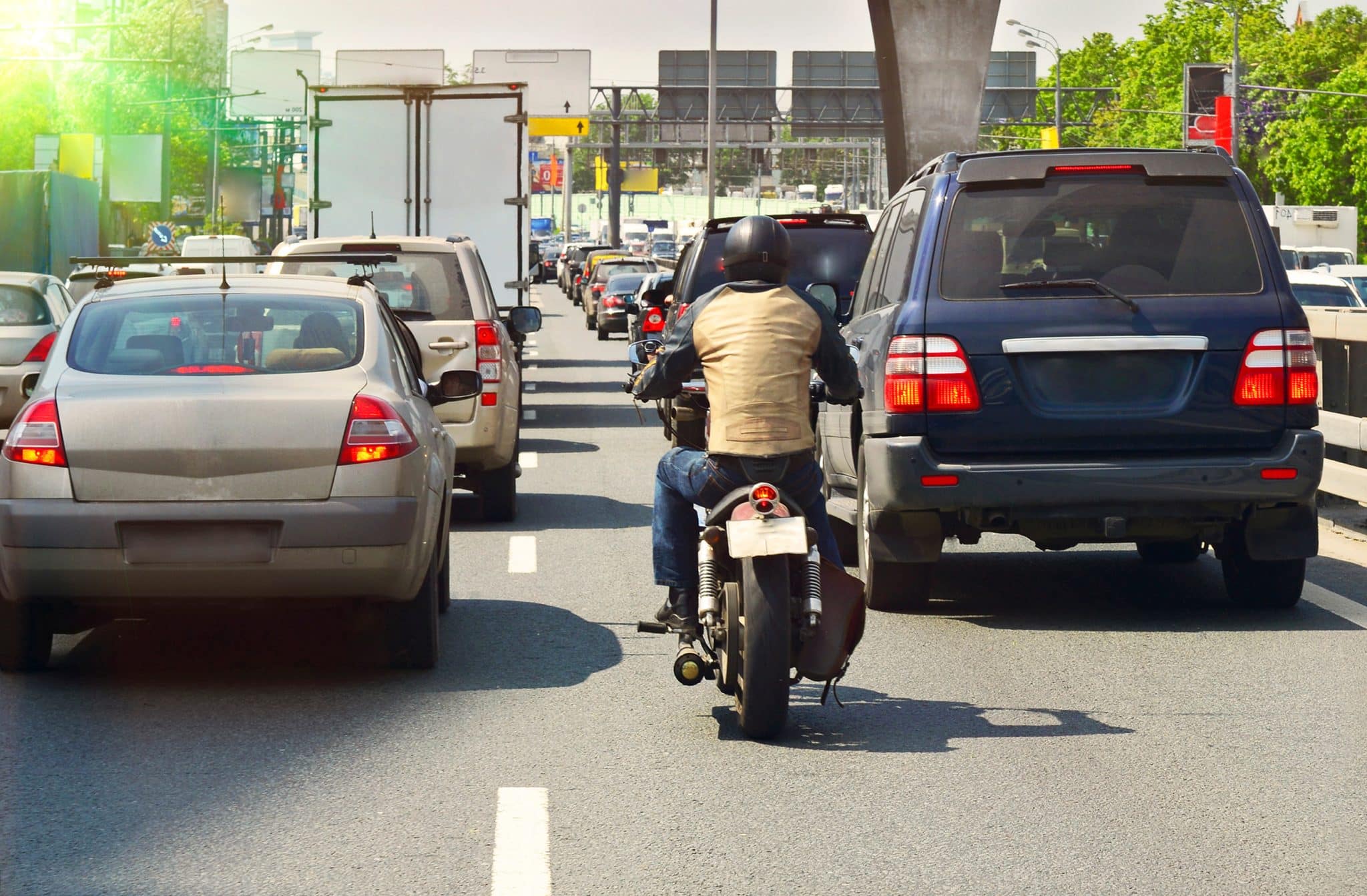
Urban streets feature constant visual stimulation: neon storefront signs, traffic lights, pedestrians, bicycles, delivery trucks, and flashing signals. In this high-clutter environment, a single motorcycle headlight easily blends into the background illumination—a challenge known as conspicuity loss. When combined with dense multi-lane traffic, motorcycles can quickly disappear behind larger vehicles or inside passenger car blind spots.
3. Frequent Road Surface Hazards and Infrastructure Friction
Metropolitan roadways undergo continuous wear and tear, yielding surface conditions that are far more hazardous to two-wheeled vehicles than to four-wheeled passenger cars:
- Manhole covers and utility plates: Metallic surfaces offer minimal friction, especially when wet.
- Painted road markings: Crosswalk lines and directional arrows become slick during rainfall.
- Debris accumulation: Gravel, sand, and spilled diesel fuel tend to collect in urban turning lanes and intersection centers.
- Potholes and uneven pavement: Urban road degradation can easily unsettle a motorcycle's chassis, causing loss of control or tire blowout.
4. Stop-and-Go Congestion and Distracted Driving
Urban commuting involves constant acceleration and deceleration. In stop-and-go conditions, drivers frequently check mobile devices, adjust navigation systems, or engage with passengers. Distracted drivers regularly misjudge stopping distances, resulting in rear-end collisions with stopped or slowing motorcyclists at red lights and pedestrian crossings.
Common Types of Urban Motorcycle Collisions
Analyzing specific crash categories highlights how urban roadway design contributes to vehicle-on-motorcycle impacts.
- Common Urban Crash Scenarios
- Left-Turn Cutoffs: Vehicle turns across oncoming traffic path.
- Rear-End Impacts: Impact at signals or congested corridors.
- Blind-Spot Sideswipes: Lane changes in dense multi-lane arterial roads.
The Left-Turn Cutoff
As noted, this is the leading cause of fatal urban motorcycle collisions. The vehicle executing the left turn typically strikes the motorcycle head-on or turns directly into its path, leaving the rider with virtually no time or distance to perform an evasive swerve or emergency braking maneuver.
Rear-End Strikes at Traffic Signals
Because motorcycles stop faster than passenger cars under optimal conditions, a rider stopping for a yellow or red light faces severe risk from trailing drivers who are distracted or following too closely. Rear-end impacts frequently launch the rider from the motorcycle or pin the motorcycle between two passenger cars.
Sideswipes During Unsignalized Lane Changes
Urban avenues often feature multiple lanes moving in the same direction with frequent lane hopping by drivers seeking faster movement. Motorcyclists traveling in a driver's blind spot—or riding in a lane positioned adjacent to double-parked delivery vehicles—are exceptionally vulnerable to sudden lane changes executed without turn signals.
"Dooring" Incidents in Dense Commercial Corridors
In urban commercial zones with parallel street parking, riders operating in the right-hand lane face the risk of parked vehicle occupants opening their doors directly into the lane of travel. "Dooring" collisions give riders zero reaction distance, often resulting in direct impact with the door edge or forcing the rider to swerve into adjacent moving traffic.
Comprehensive Environment & Risk Profile Comparison
The following table compares the distinct operational characteristics and accident dynamics across different roadway categories:
| Roadway Type | Percentage of Total Crash Fatalities | Primary Collision Mechanism | Dominant Contributing Factor | Relative Risk Severity |
|---|---|---|---|---|
| Urban Non-Interstate Arterials | ~50% – 55% | Intersections, Left-Turn Cutoffs | Inattentional blindness, failure to yield right-of-way | Extreme (Highest overall volume) |
| Urban Local / Collector Streets | ~10% – 15% | Dooring, backing out of driveways, low-speed impacts | Visibility obstructions, parked cars, pedestrian interaction | Moderate-High (Frequent non-fatal injuries) |
| Rural Non-Interstate Highways | ~25% – 30% | Single-vehicle runoff, cornering loss, animal strikes | Excessive speed for curves, fixed object collisions, darkness | High (High fatality rate per crash) |
| Interstate Freeways (Urban/Rural) | ~8% – 12% | High-speed rear-end, chain-reaction pileups | Speed differentials, sudden traffic slowdowns | High (Extreme energy transfer upon impact) |
Legal Considerations and Determining Fault in Urban Crashes
Navigating the legal outcome of an urban motorcycle accident requires careful investigation, as liability is rarely straightforward and insurance companies frequently harbor institutional bias against riders.
Disclaimer: Traffic laws and legal doctrines vary by jurisdiction. Motorcyclists involved in accidents should consult a qualified legal professional for advice tailored to their specific circumstances.
Determining Right-of-Way and Presumption of Fault
In most urban left-turn collisions, traffic codes establish a strong presumption of fault against the driver executing the turn. Traffic laws generally mandate that turning vehicles must yield the right-of-way to oncoming traffic until it is reasonably safe to complete the turn. However, defense insurers frequently counter by asserting that the motorcyclist was:
- Exceeding the posted speed limit, thereby shortening the driver's decision window.
- Operating with non-functioning headlights or inappropriate lane positioning.
- Executing an unsafe pass or illegal lane-splitting maneuver.
Comparative and Contributory Negligence Systems
The financial recovery in an urban crash lawsuit often depends on the state's negligence doctrine:
- Modified Comparative Fault: A rider can recover damages as long as their share of fault is below a specific threshold (typically 50% or 51%), though their compensation is reduced proportionally by their percentage of blame.
- Pure Comparative Fault: A rider can recover damages even if they are majority at fault, with their recovery reduced by their assigned degree of fault.
- Contributory Negligence: In a small number of jurisdictions, if a motorcyclist is found to be even 1% at fault (e.g., traveling 3 mph over the speed limit), they may be entirely barred from recovering compensation from the negligent driver.
Evidentiary Sources in Urban Environments
Urban streets offer unique opportunities for gathering evidence that are unavailable on remote rural highways. Key sources of evidence include:
- Traffic and Surveillance Cameras: Commercial storefronts, municipal traffic management systems, and dashcams frequently record urban intersections.
- Event Data Recorders (EDRs): Modern passenger cars log speed, braking input, and steering angle in the seconds leading up to an impact.
- Witness Testimony: Higher pedestrian and commuter density provides independent eyewitness statements to corroborate light cycles and vehicle positions.
Tactical Safety Measures for Navigating Urban Traffic
Motorcyclists cannot control driver behavior, but implementing structured, defensive riding techniques drastically lowers the probability of an urban accident.
- Urban Defensive Riding System
- Lane Positioning: Occupy dominant lane position; maximize visibility.
- Visual Scanning: Maintain 12-second visual search path; check mirrors.
- Space Cushion: Keep 3-second buffer; plan escape routes.
1. Dominant Lane Position (The "Blocker" Position)
Never ride in the center of a lane where oil drippings collect and where rear-view visibility from leading cars is reduced. Instead, select the left or right third of the lane (typically the left tire track of passenger cars) to establish a clear line of sight through the windows of vehicles ahead, preventing other drivers from improperly merging into your lane space.
2. Active Intersection Scanning (The SEE Strategy)
Safety organizations such as the Motorcycle Safety Foundation (MSF) emphasize the SEE strategy (Search, Evaluate, Execute):
- Search: Scan intersections continuously for turning vehicles, pedestrians stepping off curbs, and drivers preparing to pull out of side streets or parking lots.
- Evaluate: Anticipate potential hazards. Assume the driver turning left does not see you.
- Execute: Adjust your speed early, cover your front brake lever with two fingers to eliminate reaction latency, and shift your lane position to maximize distance from the hazard.
3. Maintain Dynamic Space Cushions
In dense urban traffic, maintain a minimum three-to-four-second following distance behind the vehicle ahead. When stopped at a red light:
- Stop off-center (toward the left or right edge of the lane) rather than directly behind the car ahead.
- Keep the motorcycle in first gear with the clutch pulled in.
- Monitor your rear-view mirrors continuously until two or three cars have come to a complete stop behind you, giving you an immediate escape path if an approaching vehicle fails to slow down.
Frequently Asked Questions
Why do more motorcycle accidents happen on urban streets than on highways?
Urban streets feature significantly higher vehicle density, frequent intersections, turning traffic, visual distractions, and complex right-of-way interactions. On highways, traffic flows in the same direction without cross-traffic or left-turn signals, eliminating the primary conflict points that lead to motorcycle crashes.
What is the single most common cause of urban motorcycle crashes?
The most common cause is a passenger vehicle making a left turn at an intersection directly into the path of an oncoming motorcycle. Drivers frequently fail to see the motorcycle due to visual clutter, inattentional blindness, or an inability to accurately estimate the motorcycle's approach speed.
Does lane splitting increase or decrease urban accident risk?
Research on lane splitting (riding between lanes of stopped or slow-moving traffic) shows mixed findings depending on execution. Studies, such as those conducted by the University of California, Berkeley, indicate that moderate lane splitting (at low speed differentials in heavy traffic) can reduce rear-end collisions for motorcyclists. However, high-speed lane splitting or filtering through moving traffic significantly increases the risk of sideswipe and sudden lane-change collisions.
Who is usually at fault when a car turns left in front of a motorcycle?
In the vast majority of cases, the driver of the left-turning vehicle is deemed primarily at fault for failing to yield the right-of-way to oncoming traffic. However, liability can be split if the insurer proves the motorcyclist was speeding, lane-splitting illegally, or riding without working lights.
How does urban road maintenance impact motorcycle stability?
Motorcycles rely on two small tire contact patches for stability. Metal utility plates, painted crosswalk markings, loose gravel, pothole repairs, and oil slicks at intersections drastically reduce traction, especially during rain, making simple turning or braking maneuvers hazardous for riders.
Next Steps for Riders and Crash Victims
Reducing urban motorcycle accidents requires active defensive strategy from riders and accountability from drivers on shared roads.
- For Active Motorcyclists: Prioritize high-visibility gear (hi-vis jackets and helmets), practice emergency braking and swerving maneuvers regularly in open spaces, and treat every urban intersection as an active threat zone. Consider enrolling in advanced street-skills training courses to refine your spatial awareness and hazard perception.
- For Crash Victims: If you or a family member has been involved in an urban street collision, immediately preserve evidence by requesting police crash reports, securing surrounding surveillance video footage before store owners overwrite digital records, and contacting legal representation familiar with motorcycle reconstruction dynamics to protect your rights.
Image Gallery