Why Apophis Cannot Destroy Earth: Analyzing the 100-Year Safety Forecast
Asteroid 99942 Apophis cannot destroy Earth because its trajectory has been refined with extreme precision, ruling out any impact for at least the next 100 years. While it will make an exceptionally close approach in April 2029, modern...
Asteroid 99942 Apophis cannot destroy Earth because its trajectory has been refined with extreme precision, ruling out any impact for at least the next 100 years. While it will make an exceptionally close approach in April 2029, modern radar observations have confirmed it poses zero risk of collision, removing it from all global impact risk assessments.
Contents
The Discovery and Initial Threat Assessment of 99942 Apophis
When astronomers at the Kitt Peak National Observatory first discovered 99942 Apophis in June 2004, the initial data caused a significant stir in the scientific community. Early orbital calculations suggested a 2.7% chance that the asteroid could strike Earth during its flyby in 2029. This was an unprecedentedly high probability for a near-Earth object (NEO) of its size—approximately 340 to 370 meters (about 1,100 to 1,210 feet) in diameter.
For a brief period, Apophis was ranked at a Level 4 on the Torino Scale, a metric used to communicate the impact hazard of NEOs to the public. Level 4 indicates a "close encounter, meriting attention by astronomers," but also carries a 1% or greater possibility of collision capable of regional devastation. As more observations were collected over the following months and years, the 2029 impact was ruled out, but a small possibility remained for a 2036 encounter. This was later dismissed as well, leaving the 2068 flyby as the final remaining concern for the 21st century.
The persistent concern regarding 2068 was rooted in the concept of "gravitational keyholes." A keyhole is a tiny region in space where Earth’s gravity could nudge an asteroid's orbit just enough to set it on a collision course during a subsequent pass. Until recently, the uncertainty in Apophis’s orbital path was large enough that scientists could not definitively say whether the asteroid would pass through one of these keyholes in 2029, potentially leading to an impact in 2068.
The 2021 Radar Breakthrough: Eliminating the Impact Risk
The narrative surrounding Apophis changed fundamentally in March 2021. As the asteroid made a distant flyby of Earth (about 17 million kilometers away), astronomers utilized the powerful Goldstone Deep Space Communications Complex in California and the Green Bank Telescope in West Virginia to conduct a massive radar imaging campaign.
These observations were transformative. Radar allows scientists to measure the distance and velocity of an asteroid with incredible accuracy—often down to a few meters. Before this campaign, the uncertainty in Apophis's future position was measured in hundreds of kilometers. After the 2021 data was integrated into the orbital models, that uncertainty shrank to just a few kilometers.
The results were conclusive: the 2068 impact was officially ruled out. NASA’s Center for Near-Earth Object Studies (CNEOS) and the European Space Agency’s (ESA) Near-Earth Object Coordination Centre removed Apophis from their "Risk Lists." As we stand in 2026, the scientific consensus is absolute: Apophis cannot and will not destroy Earth for at least the next century. The asteroid is no longer considered a threat, but rather a premier scientific opportunity.
The 2029 Close Approach: What Will Actually Happen?
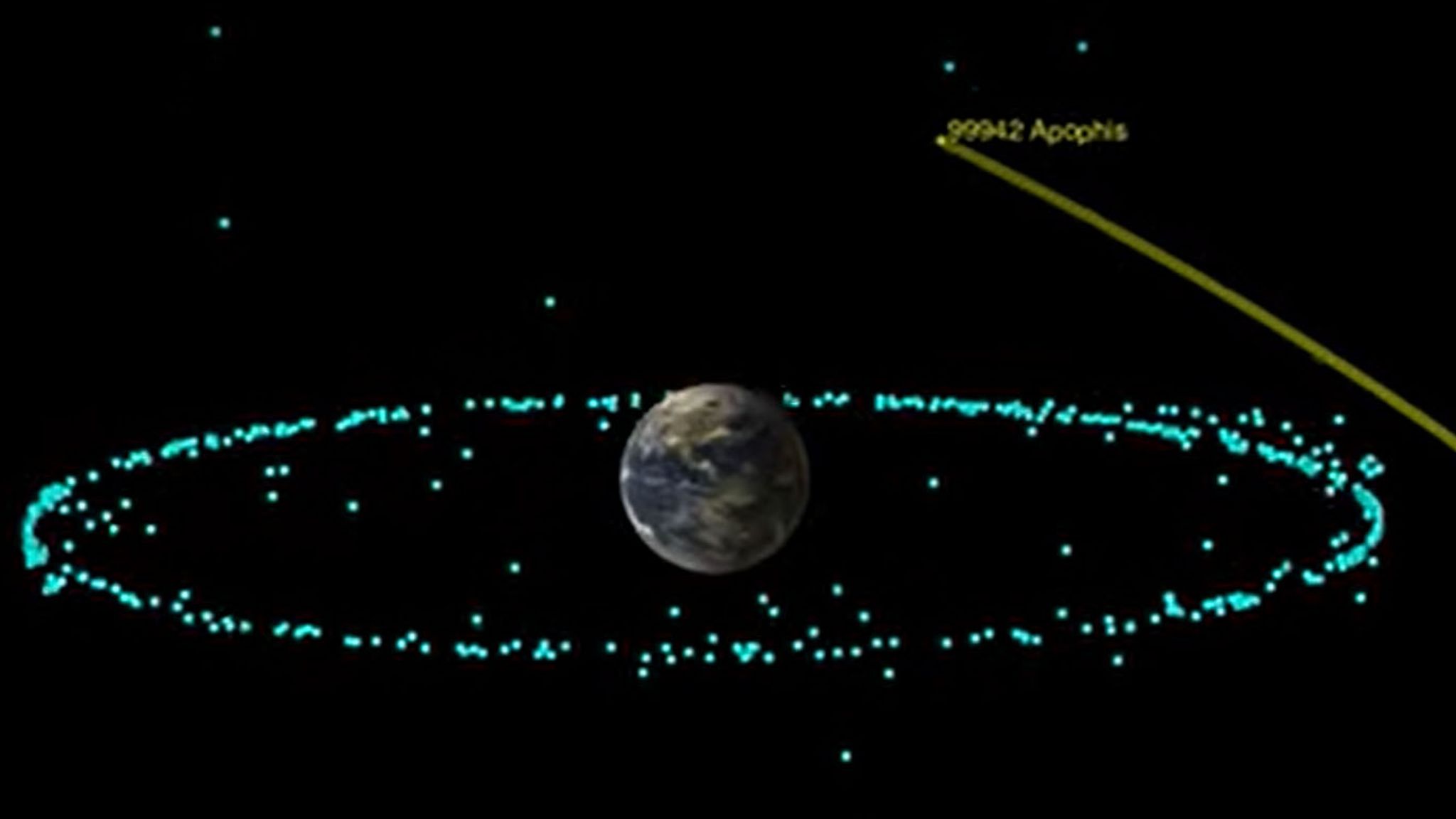
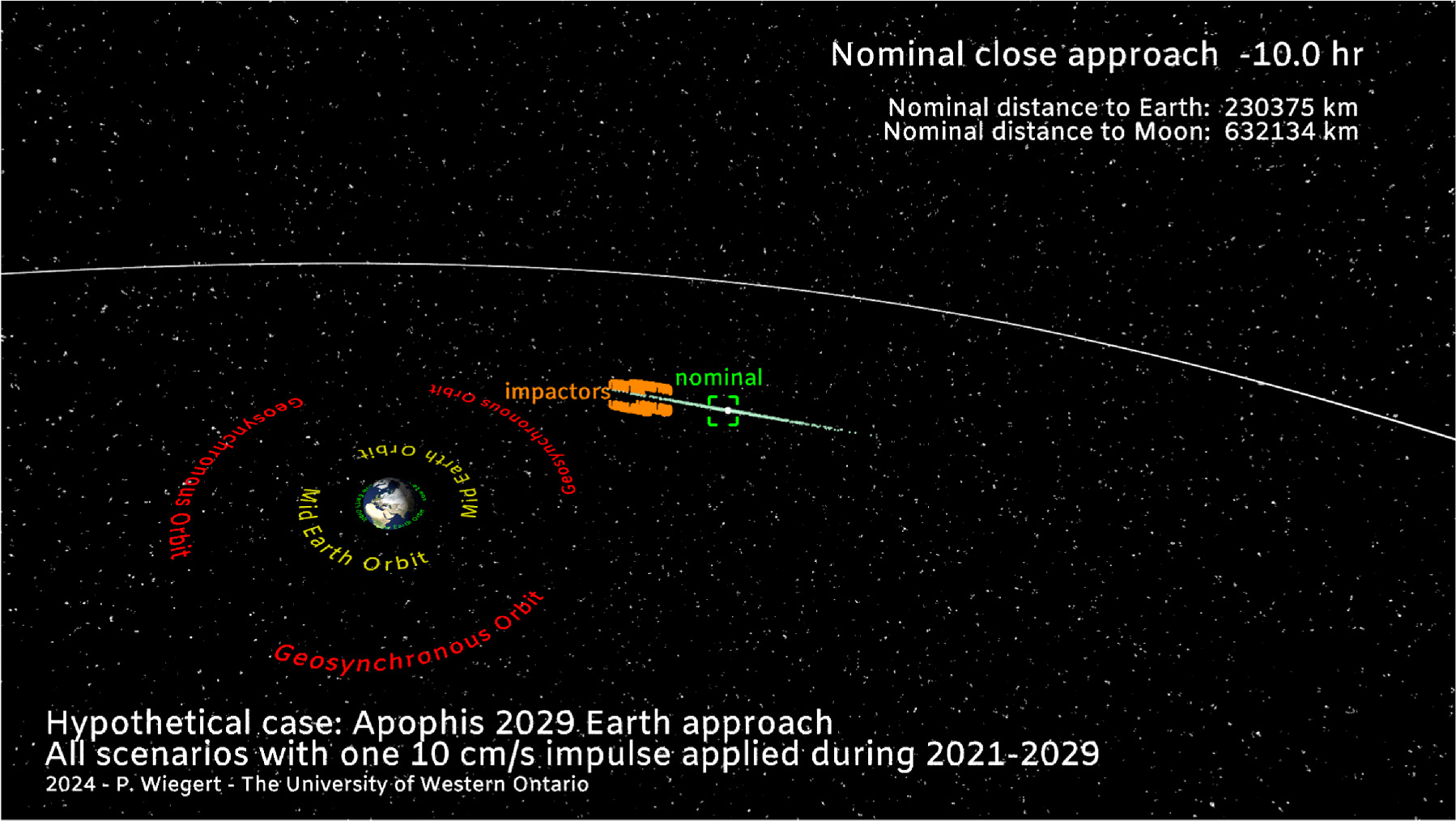
On April 13, 2029, Apophis will pass closer to Earth than any other asteroid of its size in recorded history. It will fly within approximately 32,000 kilometers (20,000 miles) of our planet's surface. To put this in perspective, this is closer than the ring of geostationary satellites that provide our global communications and weather data.
During this encounter, Apophis will be visible to the naked eye for about two billion people across Europe, Africa, and parts of Asia. It will look like a point of light moving across the sky, similar to a satellite but much faster. This event is extremely rare; while small pebbles and meteoroids hit Earth daily, an asteroid of this magnitude passing this close only happens once every few thousand years.
Gravitational Interactions and Orbital Shifts
While Apophis will not hit Earth, Earth will definitely "hit" Apophis—gravitationally speaking. The massive pull of our planet will significantly alter the asteroid's orbit. It currently follows an orbit that stays mostly within Earth’s path around the Sun (classified as an Aten asteroid). After the 2029 encounter, its orbit will expand, and it will become an Apollo asteroid, meaning its orbit will primarily stay outside of Earth's.
Furthermore, Earth's tidal forces may cause "asteroid quakes" on Apophis. Scientists believe the gravitational tug could shift surface material, potentially exposing "fresh" unweathered rock beneath the surface. This provides a rare chance to study the internal structure and surface mechanics of a rubble-pile asteroid without having to land on it.
Understanding the Scale: Is Apophis a "Planet Killer"?
Even if Apophis were to hit Earth—which, again, it will not—calling it a "planet killer" is a scientific exaggeration. To understand why Apophis cannot destroy Earth as a biological entity, we must compare it to historical impactors.
- Apophis: ~340 meters. An impact would result in regional devastation. It could flatten a city, cause a massive tsunami if it hit the ocean, or devastate an area the size of a small country. It would be a humanitarian catastrophe, but not a global extinction event.
- Chicxulub Impactor (The Dinosaur Killer): ~10 to 15 kilometers. This asteroid was roughly 30 times larger in diameter than Apophis. The energy released was billions of times greater, causing global climate shifts, acid rain, and the extinction of 75% of all species.
Apophis lacks the mass required to trigger a "nuclear winter" or the global collapse of the biosphere. Its energy release would be measured in hundreds of megatons—orders of magnitude higher than any nuclear weapon ever tested, but insufficient to threaten the existence of the human race or the planet itself.
Flyby Statistics and Comparison Data
The following table outlines the key technical data regarding Apophis and its relationship with Earth during its most significant upcoming intervals.
| Metric | Details / Measurement | Significance |
|---|---|---|
| Diameter | ~340–370 meters | Larger than 90% of known NEOs. |
| Mass | ~27 billion kilograms | High kinetic energy potential. |
| 2029 Flyby Distance | ~31,860 km | Closer than geostationary satellites. |
| Relative Velocity | ~30 km/s | Extremely high speed during approach. |
| Current Impact Risk | 0.0 (Torino Scale) | No risk for at least 100 years. |
| Next Major Flyby | April 13, 2029 | Visible to the naked eye. |
| Post-2029 Orbit Type | Apollo-class | Changed from Aten-class by Earth's gravity. |
Future Missions: Exploring Apophis Up Close
Because Apophis is no longer viewed as a threat, space agencies have pivoted to using it as a "natural laboratory." The most notable mission currently being prepared for the 2029 encounter is OSIRIS-APEX (formerly OSIRIS-REx).
After successfully delivering samples from the asteroid Bennu to Earth in 2023, the NASA spacecraft was redirected toward Apophis. In 2029, shortly after the asteroid’s closest approach to Earth, OSIRIS-APEX will enter orbit around Apophis. It will spend 18 months studying the asteroid's composition and how its orbit and rotation changed during the flyby.
This mission is critical for planetary defense. By understanding the physical characteristics of Apophis—such as its density, porosity, and mineralogy—scientists can better design deflection missions for future asteroids that might actually be on a collision course. If we ever need to nudge an asteroid out of the way, we need to know if we are hitting a solid rock or a loose pile of gravel. Apophis provides the perfect opportunity to learn this without the pressure of an impending impact.
Frequently Asked Questions
Could another asteroid push Apophis into Earth?
While space is full of debris, the chances of a "billiard ball" scenario—where a smaller asteroid hits Apophis and redirects it toward Earth—are infinitesimally small. The vastness of space makes such precise collisions extremely unlikely. Furthermore, even a significant impact on Apophis would likely only change its velocity by a fraction of a millimeter per second, which would not be enough to cause an impact in the near term.
Why was there so much confusion about the 2068 impact date?
The 2068 concern was based on the Yarkovsky effect. This is a tiny force acting on an asteroid caused by the way it absorbs sunlight and re-radiates it as heat. Over decades, this "thermal thrust" can shift an asteroid's path by kilometers. Until the 2021 radar measurements, scientists weren't sure how much the Yarkovsky effect was pushing Apophis. We now know the effect is too small to push it into a collision course for 2068.
Is Apophis the biggest asteroid we should worry about?
Apophis is the most famous because of its proximity in 2029, but it is not the only object being tracked. NASA’s Planetary Defense Coordination Office tracks thousands of NEOs. While there are larger asteroids out there, none currently have a significant probability of hitting Earth in the next 100 years. The focus now is on finding the "undiscovered" 140-meter-plus asteroids that haven't been cataloged yet.
Will the 2029 flyby affect Earth’s tides or satellites?
Apophis is too small to have any noticeable effect on Earth's tides or tectonic plates. However, there is a very small, manageable risk to satellites. Because the asteroid passes through the altitude of geostationary orbits, satellite operators will need to monitor its path closely. However, space is mostly empty, and the likelihood of a direct hit on a specific satellite is extremely low.
How do we know the 100-year forecast is accurate?
Orbital mechanics is a highly precise branch of physics. Once the position and velocity of an object are known at a specific time (the epoch), computers can project its path forward using gravity models that include the Sun, all the planets, the Moon, and even the largest asteroids in the belt. The 2021 radar data provided a "starting point" so accurate that the projected path remains clear of Earth for well over a century.
Recommendation for the Public
There is no need for alarm regarding 99942 Apophis. Instead of viewing the 2029 flyby as a potential "doomsday," people should treat it as a once-in-a-lifetime astronomical event. On April 13, 2029, look to the night sky (if you are in the Eastern Hemisphere). You will be witnessing a rare piece of solar system history—a massive celestial traveler passing safely by our home, providing scientists with the data needed to protect Earth from real threats in the centuries to come.
For those interested in real-time updates on planetary defense, the most reliable sources are the NASA CNEOS Sentry Table and the ESA Near-Earth Objects Coordination Centre. These databases are updated constantly as new telescopic data arrives, ensuring that any genuine threat would be identified decades before it became a crisis.
Image Gallery