PDX to Costa Rica Flight Time and Travel Guide: What to Expect Flying South
Flying from Portland International Airport (PDX) to Costa Rica typically requires 8 to 12 hours of total travel time, including a single layover, as direct non-stop flights are rarely available on this route. Depending on whether you l...
Flying from Portland International Airport (PDX) to Costa Rica typically requires 8 to 12 hours of total travel time, including a single layover, as direct non-stop flights are rarely available on this route. Depending on whether you land in San José (SJO) or Liberia (LIR), pure air time averages between 7.5 and 8.5 hours.
Contents
Understanding PDX to Costa Rica Flight Routes and Durations
Traveling from the Pacific Northwest down to Central America involves covering approximately 3,300 to 3,600 flight miles. Because Portland International Airport (PDX) does not feature regular non-stop service to Central American destinations, travelers must book a connecting itinerary.
Total travel duration is dictated primarily by the location and length of your layover. Most major U.S. carriers schedule flight itineraries with single connections ranging from 1.5 to 3.5 hours.
Pure Air Time vs. Total Elapsed Travel Time
- Pure Air Time: The cumulative hours spent physically in the air across both flight segments typically totals 7 hours and 30 minutes to 8 hours and 45 minutes.
- Total Elapsed Travel Time: When including standard airport layovers, total journey time spans 9 hours and 30 minutes to 13 hours. Poorly timed layovers or multi-stop itineraries can extend travel time beyond 15 hours.
Common Layover Hubs and Airlines
Several major network airlines operate flights connecting PDX to Costa Rica’s two international airports: Juan Santamaría International Airport (SJO) in San José and Guanacaste Airport (LIR) in Liberia.
- United Airlines (via Houston - IAH or Denver - DEN): Connecting through Houston George Bush Intercontinental Airport offers one of the shortest overall transit windows. The PDX-to-IAH leg takes roughly 4 hours, followed by a 3.5-hour flight into San José or Liberia.
- American Airlines (via Dallas/Fort Worth - DFW or Phoenix - PHX): DFW is a primary gateway for Central America bound traffic. PDX to DFW takes approximately 3 hours and 50 minutes, with the secondary leg to Costa Rica taking another 4 hours.
- Alaska Airlines (via Los Angeles - LAX): Alaska operates strong West Coast connectivity. Passengers fly south to LAX (approx. 2 hours 20 minutes) before connecting on seasonal or partner service into SJO or LIR.
- Delta Air Lines (via Atlanta - ATL or Salt Lake City - SLC): Flying through Atlanta adds physical distance, pushing total flight time toward the higher end of the scale, though service reliability remains high.
Choosing the Right Destination Airport: SJO vs. LIR
Costa Rica has two main international entry points. Selecting the correct airport based on your ultimate destination within the country saves hours of driving on rural mountain roads.
- PDX: Portland International
- (Single Layover Connection)
- DFW / IAH / LAX / DEN / ATL / PHX
- SJO: San José
- Central Valley & Capital
- Arenal / La Fortuna Volcano
- Manuel Antonio & Central Pacific
- LIR: Liberia
- Guanacaste Beaches
- Papagayo Peninsula
- Tamarindo & Nicoya Peninsula
- SJO: San José
Juan Santamaría International Airport (SJO)
Located in Alajuela, just outside the capital city of San José, SJO is the country’s main international gateway.
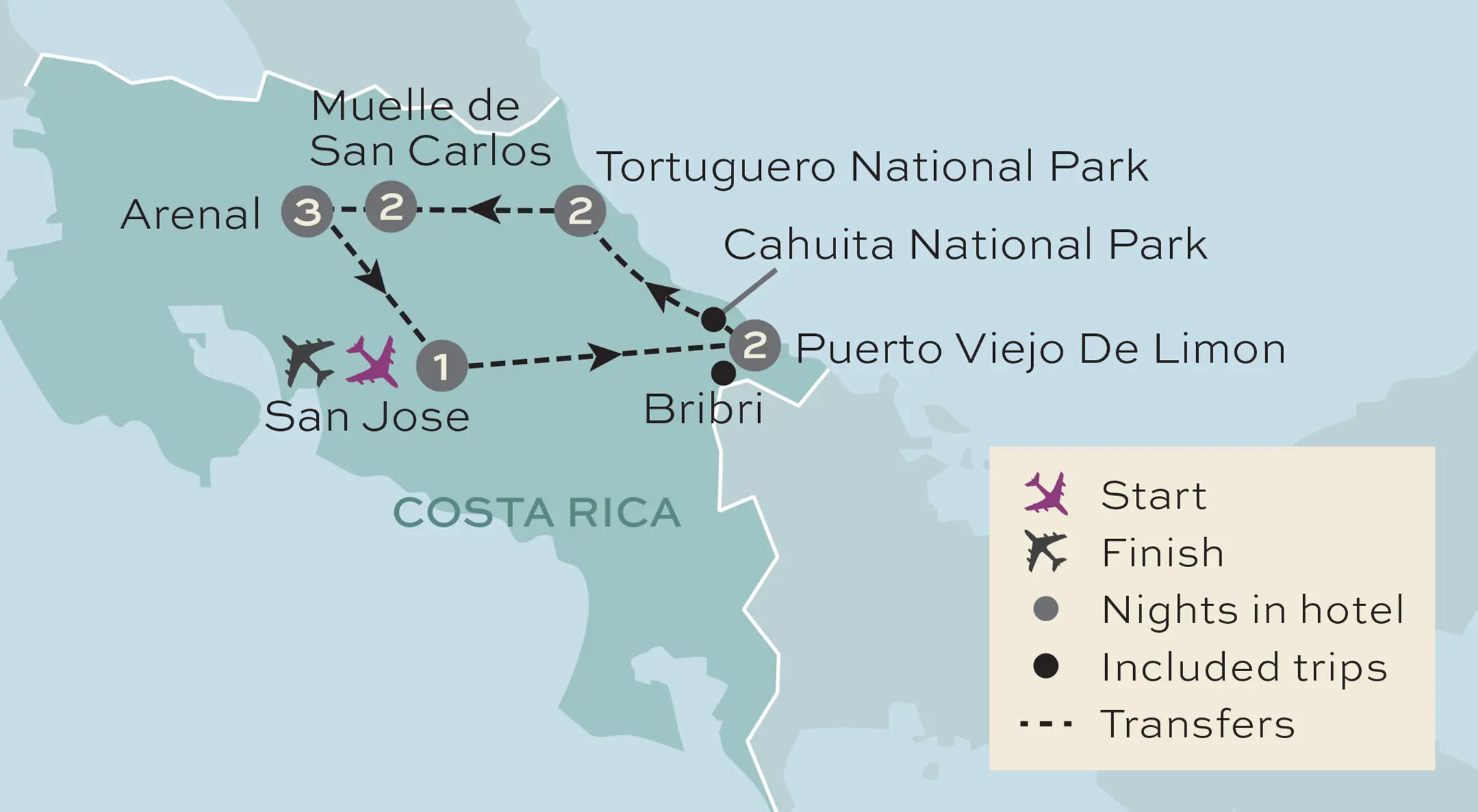
- Best For: Travelers heading to the Arenal Volcano (La Fortuna), the Central Pacific coast (Manuel Antonio, Jacó), the Cloud Forests of Monteverde, or the Caribbean coast (Puerto Viejo).
- Flight Availability: SJO offers the highest volume of daily flights from U.S. hubs, often resulting in lower fares and more flexible departure times from PDX.
Guanacaste Airport (LIR)
Located in the northwestern province of Guanacaste near Liberia, LIR provides direct access to Costa Rica's Pacific beach resorts.
- Best For: Vacationers visiting the Gulf of Papagayo, Tamarindo, Conchal, Flamingo, or the Nicoya Peninsula.
- Flight Availability: LIR features extensive seasonal schedules during the North American winter and spring. It is a smaller, modern terminal with efficient customs processing.
Flight Time and Routing Comparison
The table below outlines common single-layover flight paths from Portland (PDX) to Costa Rica, detailing flight segment durations and estimated total travel times.
| Departure (PDX) | Layover Hub | Arrival Airport | Average Air Time | Typical Layover | Total Elapsed Time |
|---|---|---|---|---|---|
| PDX | Houston (IAH) | San José (SJO) | 7h 30m | 1h 45m | 9h 15m |
| PDX | Dallas/Fort Worth (DFW) | Liberia (LIR) | 7h 50m | 2h 10m | 10h 00m |
| PDX | Los Angeles (LAX) | San José (SJO) | 7h 45m | 2h 30m | 10h 15m |
| PDX | Denver (DEN) | San José (SJO) | 7h 40m | 3h 00m | 10h 40m |
| PDX | Atlanta (ATL) | Liberia (LIR) | 8h 30m | 2h 00m | 10h 30m |
Note: Actual flight schedules and connection windows vary based on airline schedules, seasonal shifts, and air traffic control routing.
Entry Requirements and Official Documentation
Entering Costa Rica requires adherence to specific immigration laws. Missing documentation will result in denied boarding at PDX or entry refusal upon arrival.
Passport Validity
U.S. and Canadian passport holders must possess a valid passport. While Costa Rican regulations technically require a passport valid for the duration of the intended stay, standard international aviation rules and airline check-in policies strongly recommend carrying a passport with at least six months of remaining validity beyond your planned departure date.
Proof of Onward Travel (Mandatory)
Costa Rican law strictly enforces proof of departure. Upon check-in at PDX and again at immigration in Costa Rica, you must show a confirmed ticket out of the country. This can be:
- A return flight ticket back to the United States.
- An outbound flight ticket to another international country.
- An official ticket for an outbound international bus line (such as Ticabus or TransNica).
Failing to present proof of onward travel is the single most common reason travelers are denied boarding at check-in.
Tourist Visa Duration
Citizens of the United States, Canada, the European Union, and the United Kingdom do not require an advance entry visa for tourist stays. Upon arrival, immigration officials stamp passports granting entry for up to 180 days, depending on the border official’s discretion and the length of your declared itinerary.
What to Expect During the Journey
Traveling from the cool climate of the Pacific Northwest to tropical Central America involves distinct logistical steps. Knowing what to expect at each stage ensures a smoother trip.
Departing Portland International Airport (PDX)
Most southbound itineraries connecting to Central America leave PDX early in the morning (between 5:00 AM and 7:00 AM) to align with afternoon connecting flights out of Southern hubs.
Arrive at PDX at least 2.5 to 3 hours prior to departure for international itineraries, even if the first leg is domestic. Airlines must verify passport details and check mandatory return tickets at the counter before issuing international boarding passes.
Managing Time Zone Shifts
Costa Rica operates on Central Standard Time (CST) year-round and does not observe Daylight Saving Time (DST).
- During Pacific Daylight Time (PDT - Spring to Autumn): Costa Rica is 1 hour ahead of Portland.
- During Pacific Standard Time (PST - Late Autumn to Winter): Costa Rica is 2 hours ahead of Portland.
Because the time shift is minimal, jet lag is negligible compared to transatlantic or transpacific travel, allowing you to adapt quickly upon arrival.
Navigating Layovers and Connections
If your domestic leg and international leg are booked under a single ticket confirmation:
- Your checked luggage will automatically transfer at your U.S. connection point (e.g., Houston, Dallas, or Los Angeles) directly to Costa Rica.
- You do not need to clear U.S. customs or retrieve bags during your southbound layover.
- Double-check gate assignments immediately upon landing at your intermediate airport, as international departure gates frequently differ from domestic arrival concourses.
Arrival and Immigration Processing in Costa Rica
Upon landing at SJO or LIR, passengers disembark directly into the terminal or via tarmac shuttle buses.
- Passport Control: Join the line for foreign visitors ("Extranjeros"). Have your passport, printed or digital return flight details, and destination address (hotel or rental home name) ready. The officer will ask basic questions regarding the purpose of your trip and length of stay.
- Baggage Claim: Retrieve your checked luggage from the carousels past immigration.
- Customs Screening: All incoming luggage—including carry-ons and checked bags—must pass through an X-ray scanner before exiting the customs hall.
- Ground Transportation: Step outside into designated arrival areas. Authorized official taxis (red taxis at SJO, orange taxis at LIR) and pre-arranged shuttle drivers wait immediately outside the terminal doors. Avoid unofficial, unbadged taxi drivers soliciting rides inside the baggage hall.
Practical Travel Preparation Tips
Clothing and In-Flight Comfort
Dressing in layers is critical when traveling from PDX. Portland mornings can be cold and damp, whereas Costa Rica is warm and humid year-round. Wear breathable base layers underneath a warm jacket that can be easily stowed in your carry-on once you reach your layover hub or land in Central America.
Currency and Payment Methods
The local currency is the Costa Rican Colón (CRC). However, U.S. Dollars (USD) are widely accepted across tourist destinations, hotels, and restaurants.
- Carry crisp, undamaged USD bills in small denominations ($1, $5, $10, and $20). Damaged or torn bills are often rejected by local businesses and banks.
- Major credit cards (Visa and Mastercard) are accepted in most established businesses. Notify your issuing bank of your travel dates to prevent fraud holds.
- Expect change for USD transactions to be given in local colones.
Medical and Safety Advice
- Health Considerations: No specific mandatory vaccinations (such as Yellow Fever) are required for travelers flying directly from the United States, unless you have recently transited through an endemic South American or African country.
- Sun Protection: Costa Rica is located near the equator (roughly 8 to 10 degrees North latitude). The UV index is exceptionally high. Pack reef-safe sunscreen, a wide-brimmed hat, and adequate hydration solutions.
Frequently Asked Questions
Are there non-stop flights from PDX to Costa Rica?
As of current airline schedules, there are no year-round direct non-stop flights from Portland International Airport (PDX) to either San José (SJO) or Liberia (LIR). All commercial routes require at least one connection, typically through major southern or West Coast airline hubs such as Houston, Dallas/Fort Worth, Los Angeles, Phoenix, or Atlanta.
Which airport in Costa Rica is best to fly into from Portland?
The choice depends on your final destination within Costa Rica. Fly into Liberia (LIR) if you are spending your trip at the northern Pacific beaches of Guanacaste or the Nicoya Peninsula. Fly into San José (SJO) if you plan to explore the Arenal Volcano region, Monteverde Cloud Forest, Manuel Antonio, or the Caribbean coast.
How early should I arrive at PDX for a flight to Costa Rica?
Arrive at PDX at least 2.5 to 3 hours before your scheduled departure time. Even though your first flight segment lands at a domestic hub, airline staff at PDX must physically or digitally verify your international travel documents, including passport validity and proof of onward travel, prior to issuing your final boarding passes.
Do I need a return flight ticket to enter Costa Rica?
Yes. Costa Rican law strictly mandates that all non-resident visitors possess verifiable proof of exit from the country before entering. Airlines will not permit you to board your flight at PDX without a confirmed return or onward ticket to another destination.
What is the time difference between Portland, Oregon, and Costa Rica?
Costa Rica operates on Central Standard Time (UTC-6) year-round and does not observe Daylight Saving Time. When Portland is on Pacific Daylight Time (spring to autumn), Costa Rica is 1 hour ahead of Portland. When Portland switches to Pacific Standard Time (late autumn to winter), Costa Rica is 2 hours ahead.
Recommended Next Steps for Travelers
To ensure a seamless journey from the Pacific Northwest to Costa Rica, follow this pre-departure checklist:
- Verify Documentation Early: Check your passport expiration date immediately. Ensure it has at least six months of validity remaining beyond your travel dates to avoid issues with airline boarding policies.
- Align Destinations with Airports: Match your hotel or resort locations with the correct airport (SJO vs. LIR) before booking flights to avoid multi-hour ground transfers across the country.
- Lock In Onward Travel: Secure return flight tickets and print physical copies of your itinerary to present at the PDX check-in counter and Costa Rican border control.
- Arrange Airport Transfers: Pre-book authorized private shuttles or rental cars in advance, particularly during peak dry-season months (December through April), when vehicle availability at SJO and LIR can become constrained.
EDITORIAL CATEGORY METADATA:
Image Gallery