What are Heptagon Examples? Real-World Applications of Seven-Sided Polygons
A heptagon is a seven-sided polygon, often called a septagon, defined by seven straight sides and seven interior angles. Common real-world examples include the British 20p and 50p coins, the architectural layout of "The Heptagon" build...
A heptagon is a seven-sided polygon, often called a septagon, defined by seven straight sides and seven interior angles. Common real-world examples include the British 20p and 50p coins, the architectural layout of "The Heptagon" building in France, certain molecular structures like cycloheptane, and rare biological occurrences such as the seven-petaled Chickweed Wintergreen flower.
Contents
Understanding the Heptagon: Geometry and Properties
Before exploring specific examples, it is essential to understand the geometric constraints that make the heptagon unique. In the world of Euclidean geometry, a heptagon is any closed plane figure with seven vertices. Because the sum of the interior angles of any polygon is calculated by the formula $(n-2) \times 180^\circ$, a heptagon always possesses an interior angle sum of $900^\circ$.
In a regular heptagon, all sides are of equal length, and all interior angles are approximately $128.57^\circ$. This specific angle is significant because it is not a whole number, which contributes to the heptagon's rarity in traditional manufacturing and tiling. Unlike hexagons (which tile perfectly) or octagons (often used in stop signs for high visibility), the heptagon occupies a middle ground that is mathematically complex and visually distinct.
There are two primary classifications of heptagons:
- Convex Heptagons: All interior angles are less than $180^\circ$, and all vertices point outward.
- Concave Heptagons: At least one interior angle is greater than $180^\circ$ (a reflex angle), causing part of the shape to "cave in."
Heptagon Examples in Currency
The most ubiquitous examples of heptagons in daily life are found in national currencies. However, these are often not "perfect" straight-edged heptagons but rather Reuleaux heptagons (curves of constant width).
The British 20p and 50p Coins
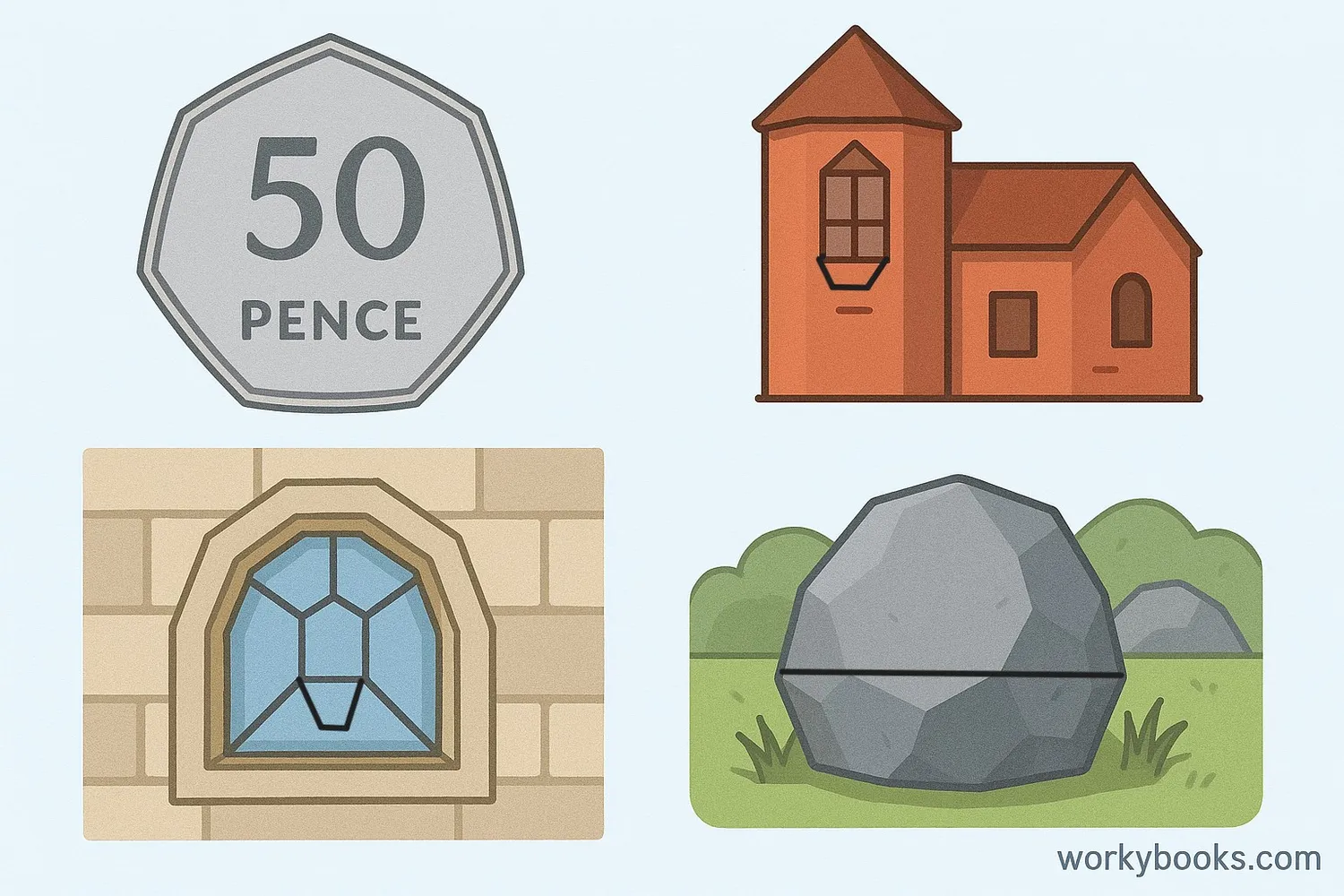
The United Kingdom’s 20-pence and 50-pence coins are the world's most famous heptagonal currency. Introduced in 1969 (50p) and 1982 (20p), these coins were designed with seven sides to make them easily distinguishable from round coins by touch.
The technical brilliance of these coins lies in their curved edges. If the coins were regular, straight-edged heptagons, they would not work efficiently in vending machines or coin-counting devices. Because they are Reuleaux heptagons, they have a constant diameter regardless of their orientation. This allows them to roll smoothly and pass through narrow slots without jamming, providing the tactile benefits of a polygon with the mechanical functionality of a circle.
International Heptagonal Coins
While the UK is the most prominent user, other nations have utilized the seven-sided design:
- Barbados: The 1-dollar coin is a regular heptagon.
- Jordan: The 1/4 Dinar coin features a heptagonal shape.
- Namibia: Several denominations of the Namibian Dollar have featured heptagonal borders.
- Mauritius: The 10-rupee coin is another functional example of the seven-sided design.
Architectural and Structural Examples
Architects occasionally use the heptagon to create a sense of uniqueness or to solve specific spatial challenges that more common shapes like squares or hexagons cannot address.
The Heptagon (L'Heptagone), France
Located in the heart of the "Cœur Défense" district near Paris, the building known as L'Heptagone serves as a major administrative hub. The choice of a seven-sided footprint allows for a maximum amount of window surface area relative to the building's internal volume, ensuring that more office spaces have access to natural light. This geometric choice also assists in managing wind loads around the structure, as the asymmetrical nature of the seven sides prevents the "canyon effect" often found in strictly rectangular urban layouts.
Garden Gazebos and Pavilions
In landscape architecture, heptagonal gazebos are prized for their aesthetic "off-balance" beauty. While hexagonal (6-sided) and octagonal (8-sided) gazebos are standard, a heptagonal structure provides a unique vantage point where no two sides are directly parallel to each other. This creates a more panoramic, immersive view of a garden, as the interior space feels less like a box and more like a fluid circle.
The Seven-Sided House
There are several custom-built "Seven-Sided Houses" across North America and Europe. These are often designed by owners looking to maximize "dead space" on irregularly shaped plots of land. Because a heptagon is more "circular" than a square but easier to frame than a true circle, it serves as a compromise for builders who want an organic flow without the extreme costs associated with curved glass and circular foundations.
Heptagon Examples in Nature and Biology
Nature rarely utilizes the number seven in geometry, preferring the efficiency of the hexagon (honeycombs) or the simplicity of the pentagon (starfish). However, there are notable exceptions where the heptagon appears.
The Chickweed Wintergreen (Trientalis europaea)
The Chickweed Wintergreen is one of the few flowering plants that consistently produces seven petals, seven sepals, and seven stamens. In the botanical world, this is known as heptamerous symmetry. Most flowers follow the Fibonacci sequence or have 3, 4, 5, or 6 parts. The Trientalis europaea stands out as a biological anomaly, using the heptagonal structure to display its petals in a way that maximizes exposure to pollinators in forest floor environments.
Cactus Cross-Sections
Certain species of columnar cacti, such as the Pachycereus or some varieties of Cereus, exhibit seven-sided symmetry in their vertical ribs. These ribs function like the folds of an accordion, allowing the cactus to expand as it stores water during the rainy season and contract during droughts. While the number of ribs can vary, seven is a common configuration that provides structural integrity against wind while allowing for significant volumetric change.
Marine Life
While most starfish (sea stars) have five arms, some species—and individuals within species—can naturally develop seven arms, creating a star-heptagon (heptagram) shape. The Luidia ciliaris, or the seven-armed starfish, is a primary example. This radial symmetry is an adaptation that allows for multi-directional movement and increased surface area for sensory organs.
Heptagons in Science and Chemistry
In the microscopic world, the heptagon appears in the arrangement of atoms and the structure of certain molecules.
Cycloheptane
Cycloheptane is a cycloalkane with the molecular formula $C_7H_{14}$. In a two-dimensional diagram, it is represented as a regular heptagon. However, in three-dimensional space, a flat heptagon would create significant "ring strain" because the interior angles of $128.57^\circ$ do not align perfectly with the natural tetrahedral bonding angle of carbon ($109.5^\circ$). As a result, the molecule "puckers" into various 3D shapes, such as the "twist-chair" or "twist-boat" conformations, to remain stable.
Heptagonal Tesselations in Materials Science
In the study of quasicrystals, researchers have discovered patterns that possess "forbidden" symmetries, including seven-fold symmetry. While you cannot tile a flat floor with regular heptagons without leaving gaps (unlike squares or hexagons), heptagonal structures appear in complex metallic alloys. These materials are used in high-tech applications, such as non-stick coatings for surgical instruments and heat-shielding for aerospace components, because their non-repeating structures make them incredibly hard and heat-resistant.
Technical Comparison: Heptagons vs. Other Polygons
To better understand why the heptagon is chosen for certain applications, it is helpful to compare it to its neighboring shapes.
| Feature | Pentagon | Hexagon | Heptagon | Octagon |
|---|---|---|---|---|
| Number of Sides | 5 | 6 | 7 | 8 |
| Interior Angle Sum | $540^\circ$ | $720^\circ$ | $900^\circ$ | $1080^\circ$ |
| Regular Interior Angle | $108^\circ$ | $120^\circ$ | $\approx 128.57^\circ$ | $135^\circ$ |
| Tessellation | No (leaves gaps) | Yes (perfect) | No (leaves gaps) | No (requires squares) |
| Common Use | Architecture (U.S. HQ) | Nature (Honeycombs) | Currency (UK Coins) | Traffic Signs |
| Constructibility | Easy (Compass/Edge) | Easy (Compass/Edge) | Impossible (Exact) | Easy (Compass/Edge) |
The Mathematical "Impossible" Construction
One of the most interesting "examples" of a heptagon is its role in mathematical history. Under the rules of classical Greek geometry—using only a compass and an unmarked straightedge—it is physically impossible to construct a perfect regular heptagon. This was proven by the Gauss-Wantzel theorem in 1801.
Because the number 7 is a "Pierpont prime" but not a "Fermat prime," it does not fit the criteria for constructible polygons. Therefore, every "regular" heptagon you see in a textbook or in architecture is technically an approximation. Engineers usually use a method called the "Neusis construction" or modern CAD software to achieve a precision that is visually indistinguishable from a perfect heptagon.
Practical Identification of Heptagons
To identify a heptagon in the wild, you should look for specific traits that distinguish it from its more common cousins:
- Asymmetry in Alignment: Unlike a hexagon or octagon, a regular heptagon does not have sides that are parallel to one another. If you look at one side, the opposite "side" is actually a vertex (a point). This gives the shape a "pointed" appearance even when it is standing on a flat base.
- Odd-Number Symmetry: Heptagons possess seven-fold rotational symmetry. If you rotate a regular heptagon by $360/7$ degrees (approx $51.4^\circ$), it will look identical to its starting position.
- Visual "Roundness": Because seven sides are more than the four of a square or five of a pentagon, a heptagon looks remarkably close to a circle from a distance. This is why it is often used for "security" shapes that need to roll but remain distinct.
FAQs About Heptagon Examples
Are there any heptagonal buildings in the United States?
While not as famous as the Pentagon, several private residences and small-scale commercial buildings in the U.S. use heptagonal designs. A notable example is the "Seven-Sided House" in various architectural archives, often built to maximize views in mountainous regions where a 360-degree vista is desirable but a circular build is too expensive.
Why don't we see more heptagons in furniture or tiling?
The primary reason is that heptagons do not "tessellate." You cannot place regular heptagons side-by-side to cover a surface without leaving gaps or overlapping. Hexagons are the "gold standard" for tiling because they fill space perfectly. Using heptagons in furniture or flooring results in significant material waste and complex joinery.
Is a septagon the same as a heptagon?
Yes. "Heptagon" is derived from the Greek word hepta (seven), while "septagon" is derived from the Latin septua. In professional geometry and mathematics, "heptagon" is the preferred technical term to maintain consistency with other Greek-derived names like pentagon, hexagon, and octagon.
Are there any 3D heptagons?
A 3D shape with heptagonal faces is called a heptagonal prism (two heptagonal bases connected by seven rectangles) or a heptagonal pyramid (one heptagonal base meeting at a single point). You might see heptagonal prisms in the design of high-end cosmetic bottles or specialized mechanical bolts.
What is a "Heptagram" and where is it used?
A heptagram is a seven-pointed star drawn by connecting the vertices of a heptagon. It is used in various cultural and religious contexts, most notably on the flag of Jordan (representing the seven verses of the Al-Fatiha) and on the flag of Australia (the Commonwealth Star, which has seven points representing the six states and the territories).
Recommendation for Further Exploration
If you are interested in the practical application of heptagons, the best next step is to examine a British 50p coin. Notice how the "edges" are slightly curved; this is a prime example of how geometry is modified for industrial utility. For students or hobbyists, attempting to draw a heptagon using a protractor (measuring $128.6$ degrees for each angle) is an excellent exercise in understanding the limitations of manual precision versus digital design.
Image Gallery