Is Having a Financial Advisor Worth It? A Data-Driven Guide for 2026
Whether having a financial advisor is worth it depends on your portfolio complexity, your emotional discipline, and the specific fee structure of the professional. For many, the "Advisor Alpha"—the quantifiable value added through tax...
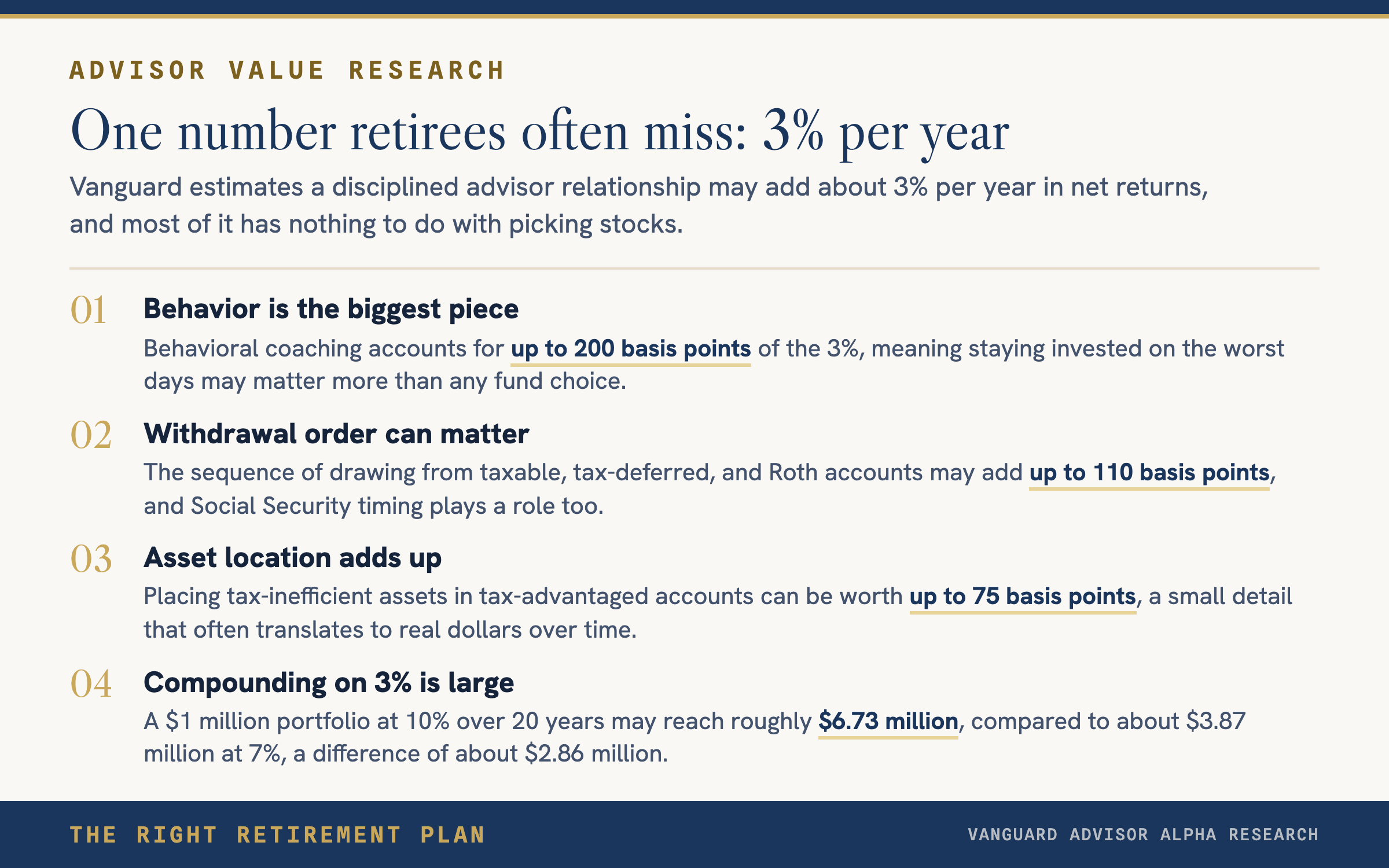
Whether having a financial advisor is worth it depends on your portfolio complexity, your emotional discipline, and the specific fee structure of the professional. For many, the "Advisor Alpha"—the quantifiable value added through tax optimization, behavioral coaching, and estate planning—exceeds the typical 1% fee, often providing a net benefit of 3% or more in annual returns.
Contents
The Quantifiable Value: Understanding "Advisor Alpha"
The question of whether an advisor is "worth it" has moved beyond subjective opinion into the realm of quantitative research. Several major financial institutions have conducted long-term studies to measure the "alpha," or the excess return, that a professional advisor can provide compared to an individual investor managing their own accounts.
As of 2026, the consensus remains that while an advisor cannot guarantee market-beating returns on individual stocks, they provide significant value through systematic management. According to the "Advisor's Alpha" framework developed by Vanguard, professional guidance can add approximately 3% in net returns through a combination of several factors:
- Asset Location (approx. 0.60% value): This involves placing tax-inefficient investments (like high-yield bonds) in tax-advantaged accounts (like IRAs) while keeping tax-efficient investments (like index funds) in taxable brokerage accounts.
- Cost-Effective Implementation (approx. 0.30% value): Moving clients away from high-cost mutual funds into low-cost ETFs and institutional share classes.
- Rebalancing (approx. 0.25% value): Systematically selling high and buying low to maintain a target risk profile, which is often emotionally difficult for DIY investors during market swings.
The largest single contributor to an advisor’s value, however, is often behavioral coaching. During market downturns, the tendency for individuals to sell out of fear can derail decades of progress. An advisor acts as a circuit breaker, preventing "panic selling" and ensuring the investor stays the course, which research suggests can account for up to 1.50% of the total value added.
Fee Structures and the Cost of Advice in 2026
To determine if an advisor is worth the investment, one must understand exactly what they are paying. In 2026, the financial services industry has shifted significantly toward transparency, but three primary models remain dominant.
Assets Under Management (AUM)
This is the traditional model where the advisor charges a percentage of the assets they manage for you. The industry standard is roughly 1% annually for the first $1 million, with tiered discounts for larger portfolios.
- Pros: Aligns the advisor's growth with your own; often includes comprehensive planning.
- Cons: Can become very expensive as your wealth grows; creates a potential conflict of interest regarding whether you should use cash to pay off a mortgage versus keeping it in the portfolio.
Flat-Fee or Project-Based
Many modern firms now offer "flat-fee" financial planning. You might pay $2,500 to $7,500 for a comprehensive financial plan or a recurring annual retainer of $5,000 to $10,000 regardless of your portfolio size.
- Pros: Transparent costs; often cheaper for high-net-worth individuals than an AUM fee.
- Cons: May not include ongoing investment management or "active" rebalancing.
Hourly Consultation
For investors who only need a "check-up" or help with a specific problem (like analyzing a pension offer), hourly rates typically range from $250 to $500 per hour.
- Pros: Lowest total cost; no long-term commitment.
- Cons: Responsibility for implementation remains entirely on the investor.
When the "Worth" Becomes Obvious: Life Transitions
For a young investor with a single 401(k) and a straightforward tax return, a financial advisor is rarely "worth it" from a strictly financial standpoint. A simple target-date fund or a three-fund portfolio will suffice. However, as life becomes more complex, the "surface area" for potential errors increases.
Retirement Income Planning
Transitioning from "accumulation" (saving money) to "decumulation" (spending it) is the most complex phase of financial life. An advisor helps determine the "Safe Withdrawal Rate" and manages the Sequence of Returns Risk. If the market crashes in the first three years of your retirement and you are forced to sell shares to pay bills, your portfolio may never recover. An advisor mitigates this by maintaining "buckets" of cash or short-term bonds to weather the storm.
Tax Strategy and Optimization
In 2026, tax laws continue to evolve, and an advisor’s role in tax-loss harvesting and Roth conversion strategies is critical. By strategically converting traditional IRA funds to Roth IRAs during low-income years or market dips, an advisor can save a client hundreds of thousands of dollars in future taxes.
Estate and Legacy Planning
Wealth transfer is about more than just a will. It involves setting up trusts, maximizing the step-up in basis for heirs, and managing the potential impact of state or federal estate taxes. Advisors coordinate with estate attorneys to ensure that your assets are distributed according to your wishes with minimal leakage to the government.
Comparing DIY Management vs. Professional Advisory
The following table summarizes the trade-offs between managing your own finances and hiring a professional in 2026.
| Feature | DIY Management | Professional Financial Advisor |
|---|---|---|
| Annual Cost | 0.03% – 0.15% (Fund expenses only) | 0.50% – 1.25% (Fee + Fund expenses) |
| Time Investment | High (Research, tracking, execution) | Low (Quarterly reviews and delegation) |
| Tax Efficiency | Basic (Capital gains awareness) | Advanced (Tax-loss harvesting, Roth conversions) |
| Emotional Bias | High (Susceptible to fear/greed) | Low (Objective, data-driven discipline) |
| Complexity Level | Best for single-income, early savers | Best for business owners, retirees, high-net-worth |
| Accountability | Self-managed (Easy to procrastinate) | External partner (Keeps goals on track) |
The Fiduciary Standard: A Non-Negotiable Requirement
For a financial advisor to be truly "worth it," they must operate as a fiduciary. A fiduciary is legally obligated to act in your best interest at all times. This distinguishes them from "brokers" or "wealth managers" who may only be held to a "suitability standard," meaning they can recommend products that pay them a higher commission as long as the product is "suitable" for you.
In 2026, you can verify an advisor's credentials and disciplinary history through official regulatory bodies:
- SEC Investment Adviser Public Disclosure (IAPD): Use this to check the Form ADV of any firm, which discloses their fees, services, and any legal "red flags."
- FINRA BrokerCheck: Useful for seeing the employment history and regulatory violations of individual advisors.
- CFP Board: Confirms if an advisor holds the Certified Financial Planner™ designation, which requires rigorous education, experience, and ethics standards.
Common Pitfalls: When an Advisor Is NOT Worth It
While professional advice has many benefits, there are scenarios where the cost outweighs the value.
- High-Commission Products: If an advisor is pushing "loaded" mutual funds, whole life insurance as an investment, or complex annuities with high surrender charges, they are likely motivated by commissions rather than your financial health.
- Lack of Communication: If you only hear from your advisor once a year or they cannot explain your strategy in plain English, the fee is likely not justified.
- Static Portfolios: If your advisor simply puts you in a model portfolio and never discusses your goals, taxes, or estate, you are paying for "management" but receiving no "planning."
- Low Asset Levels: If your portfolio is under $100,000, the 1% fee might represent a large portion of your investable income without providing the complexity required for an advisor to add significant value. In these cases, a "Robo-advisor" or an hourly planner is usually a better fit.
Frequently Asked Questions
Does a financial advisor guarantee a certain return?
No. It is illegal and unethical for an advisor to guarantee specific investment returns. Their value lies in risk management, tax efficiency, and financial planning, not in "beating the market" consistently. Any advisor promising "guaranteed 10% returns" should be avoided immediately.
What is the difference between a wealth manager and a financial advisor?
The terms are often used interchangeably, but "wealth management" typically implies a higher level of service including concierge banking, complex estate planning, and philanthropic strategies, usually reserved for those with $5 million or more in investable assets. A financial advisor generally focuses on the core pillars of retirement planning, investment management, and insurance.
Can I hire an advisor just for a one-time plan?
Yes. Many advisors now offer "Advice-Only" or project-based services. This is increasingly popular in 2026 for DIY-inclined investors who want a professional to validate their strategy or help with a specific life event, such as a divorce or receiving an inheritance, without handing over control of their assets.
Are robo-advisors a good alternative to human advisors?
Robo-advisors are excellent for the "accumulation" phase of life. They provide automated rebalancing and tax-loss harvesting at a fraction of the cost (typically 0.25%). However, they lack the "human" element required for complex tax planning, estate issues, or the emotional coaching needed during a market crash.
How do I know if I'm paying too much?
Total costs (including advisor fees and the underlying fund expenses) should ideally stay below 1.25% to 1.50% of your total portfolio. If you are paying 1% to an advisor plus 1% in internal mutual fund fees, your "drag" on performance is 2%, which significantly hinders long-term growth.
Strategic Recommendation
Determining if an advisor is worth it requires a self-assessment of your "financial temperament" and complexity. If you enjoy researching tax codes, have the discipline to buy more stocks when the market is crashing, and have a simple tax situation, you are likely better off as a DIY investor.
However, if you find yourself stressed by market volatility, are approaching retirement with multiple accounts (401k, Roth, Brokerage), or have a high income that requires advanced tax mitigation, the cost of an advisor is often "paid for" by the mistakes they help you avoid and the tax savings they identify. In 2026, the most effective path for most successful individuals is a Fee-Only, Fiduciary CFP® who focuses on comprehensive planning rather than just stock picking.
Image Gallery