Shulman & Hill Workers’ Compensation Firm in Brooklyn, NY: Legal Guide and Claims Representation
Shulman & Hill is a New York law firm specializing in workers’ compensation and personal injury cases, with a primary Brooklyn office located at 26 Court Street in Downtown Brooklyn. The firm represents injured employees navigating the...
Shulman & Hill is a New York law firm specializing in workers’ compensation and personal injury cases, with a primary Brooklyn office located at 26 Court Street in Downtown Brooklyn. The firm represents injured employees navigating the New York State Workers’ Compensation Board system, handling claim filings, benefit disputes, administrative hearings, and concurrent third-party personal injury lawsuits.
Contents
Overview of Shulman & Hill in Brooklyn, NY
Workplace injuries across New York City present complex legal, medical, and financial challenges. Employees injured on the job in Brooklyn—whether in construction, health care, sanitation, warehousing, or transportation—are entitled to statutory protections under the New York Workers’ Compensation Law. Navigating the administrative process required to secure cash benefits and medical care, however, often requires experienced legal representation.
Founded by attorneys Alex Shulman and Joshua Hill, Shulman & Hill has established a prominent practice dedicated to representing injured workers and accident victims across the five boroughs. The firm’s Brooklyn office is situated in Downtown Brooklyn near key judicial institutions, including the Kings County Supreme Court and regional administrative offices.
The firm handles a full spectrum of workplace injury matters, ranging from initial claim filings for routine job injuries to complex litigation involving permanent disability, occupational diseases, and severe construction site accidents. Because New York law strictly regulates how workplace injury claims are processed, understanding the role of specialized legal counsel helps injured workers protect their rights and maximize their recovery.
Understanding New York Workers’ Compensation Laws
New York operates a mandatory, no-fault workers’ compensation system. Under the New York Workers’ Compensation Law (WCL), covered employees who sustain an injury arising out of and in the course of employment are entitled to medical coverage and wage replacement benefits, regardless of who was at fault for the incident.
- Workplace Injury Event
- Employer Written Notice (Within 30 Days - WCL § 18)
- Form C-3 Filed with NYS WCB (Within 2 Years - WCL § 28)
- Medical Care with Authorized WCB Provider
- Benefit Determination / Hearing Process (If Contested)
The Exclusive Remedy Doctrine
In exchange for guaranteed no-fault benefits, the law establishes workers' compensation as the employee's "exclusive remedy" against their direct employer. This means an injured worker generally cannot sue their employer in civil court for negligence. There are narrow exceptions to this rule—such as when an employer fails to maintain required insurance coverage or intentionally harms an employee—but in the vast majority of cases, benefits must be obtained strictly through the New York State Workers’ Compensation Board (WCB).
Covered Injuries and Occupational Diseases
Workers’ compensation coverage extends beyond sudden traumatic events like falls or machinery accidents. Legally recognized claims fall into three main categories:
- Accidental Injuries: Traumatic occurrences happening at a specific time and place, such as falling from a ladder, lifting a heavy object, or slipping on a wet surface during work hours.
- Occupational Diseases: Conditions resulting from the nature of the employment over an extended period, such as repetitive stress injuries (e.g., carpal tunnel syndrome), respiratory illnesses from chemical exposure, or loss of hearing from industrial noise.
- Repetitive Stress and Cumulative Trauma: Soft-tissue injuries, disc herniations, or joint degradation that develop gradually due to continuous heavy physical exertion or repetitive motions required by job duties.
Key Deadlines and Filing Requirements for Brooklyn Work Injuries
Strict statutory deadlines govern workers’ compensation claims in New York. Missing these timeframes can result in a total forfeiture of monetary benefits and medical care.
| Action / Requirement | Statutory Deadline |
|---|---|
| Notice to Employer | 30 Days from Date of Accident (WCL § 18) |
| Formal Claim (Form C-3) | 2 Years from Date of Injury (WCL § 28) |
| Occupational Disease | 2 Years from Disablement or Knowledge |
1. Written Notice to Employer (30 Days)
Under New York Workers' Compensation Law § 18, an injured employee must give written notice of the injury to their employer within 30 days of the accident. Verbal notification to a supervisor or co-worker is insufficient under the law. The notice must detail the date, location, and circumstances of the injury. For occupational diseases, the 30-day period begins when the worker knew or should have known that the disease was due to the nature of the employment.
2. Formal Board Claim Filing (2 Years)
Under New York Workers' Compensation Law § 28, the formal employee claim form (Form C-3) must be filed with the New York State Workers’ Compensation Board within two years of the date of the accident or within two years from the date of disablement caused by an occupational disease.
3. Medical Documentation and Authorized Providers
Injured workers must seek treatment from a medical provider authorized by the New York State Workers’ Compensation Board, except in emergency situations. The treating doctor must complete an initial medical report (Form C-4) and submit it to the Board, the employer’s insurance carrier, and the worker’s legal representative within 48 hours of treatment. Ongoing medical reports must be filed every 45 days to maintain benefit eligibility.
Workers’ Compensation vs. Third-Party Personal Injury Lawsuits
While the exclusive remedy rule prevents direct negligence lawsuits against an employer, many workplace accidents involve third parties whose negligence contributed to the injury. In such situations, injured workers can pursue two separate legal actions simultaneously: a workers' compensation claim and a third-party personal injury lawsuit.
- Workplace Injury Incident
- Workers' Compensation Claim (Filed via NYS WCB Board)
- No-fault coverage
- Medical bills paid
- Partial wage replacement (2/3 cap)
- No pain and suffering
- Third-Party Personal Injury Lawsuit (Filed in Kings County Supreme Court)
- Requires proof of third-party fault
- Full lost wage recovery (no 2/3 cap)
- Pain and suffering damages
- Loss of enjoyment of life damages
- Workers' Compensation Claim (Filed via NYS WCB Board)
Construction Accidents and New York Labor Law
Brooklyn experiences extensive commercial and residential construction, making work-site accidents a frequent source of serious injury. New York state law provides special statutory protections for construction workers under the New York Labor Law:
- Labor Law § 240(1) (The Scaffolding Law): Holds site owners and general contractors strictly liable for elevation-related falls or falling object injuries if proper safety devices (scaffolds, hoists, stays, ladders) were not provided.
- Labor Law § 241(6): Requires owners and contractors to comply with specific safety regulations outlined in the New York Industrial Code, establishing liability if a violation leads to an injury.
- Labor Law § 200: Codifies the common-law duty of site owners and general contractors to provide a safe working environment and reasonable protection for workers.
Law firms handling workers' compensation cases in Brooklyn, such as Shulman & Hill, evaluate whether an injured worker has grounds for a third-party lawsuit alongside their standard compensation claim. Third-party claims allow injured workers to recover non-economic damages, including pain and suffering, emotional distress, and full lost earnings, which are not recoverable through workers' compensation alone.
Comparing Legal Claim Paths in New York
The following table summarizes the structural differences between standard Workers' Compensation claims and Third-Party Personal Injury lawsuits for workplace incidents in New York.
| Feature / Dimension | Workers’ Compensation Claim | Third-Party Personal Injury Lawsuit |
|---|---|---|
| Primary Forum | NYS Workers’ Compensation Board (Administrative) | NY State Supreme Court (e.g., Kings County) |
| Fault Requirement | No-fault (Fault is irrelevant) | Must prove third-party negligence |
| Target Defendant | Employer’s Insurance Carrier | Negligent Third Party (Property owner, General Contractor, Equipment Mfr.) |
| Medical Coverage | 100% of authorized treatment covered | Paid out of settlement/verdict proceeds or medical liens |
| Wage Replacement | Statutorily capped at 2/3 average weekly wage (subject to state max) | 100% past and future lost earnings recoverable |
| Pain & Suffering | Not recoverable | Fully recoverable |
| Statute of Limitations | 2 years (Form C-3 filing) | 3 years for general negligence; 1 year and 90 days against municipal entities |
| Subrogation / Liens | N/A | WCB carrier holds a statutory lien (WCL § 29) on lawsuit recoveries |
The Role of Legal Representation in Claim Disputes
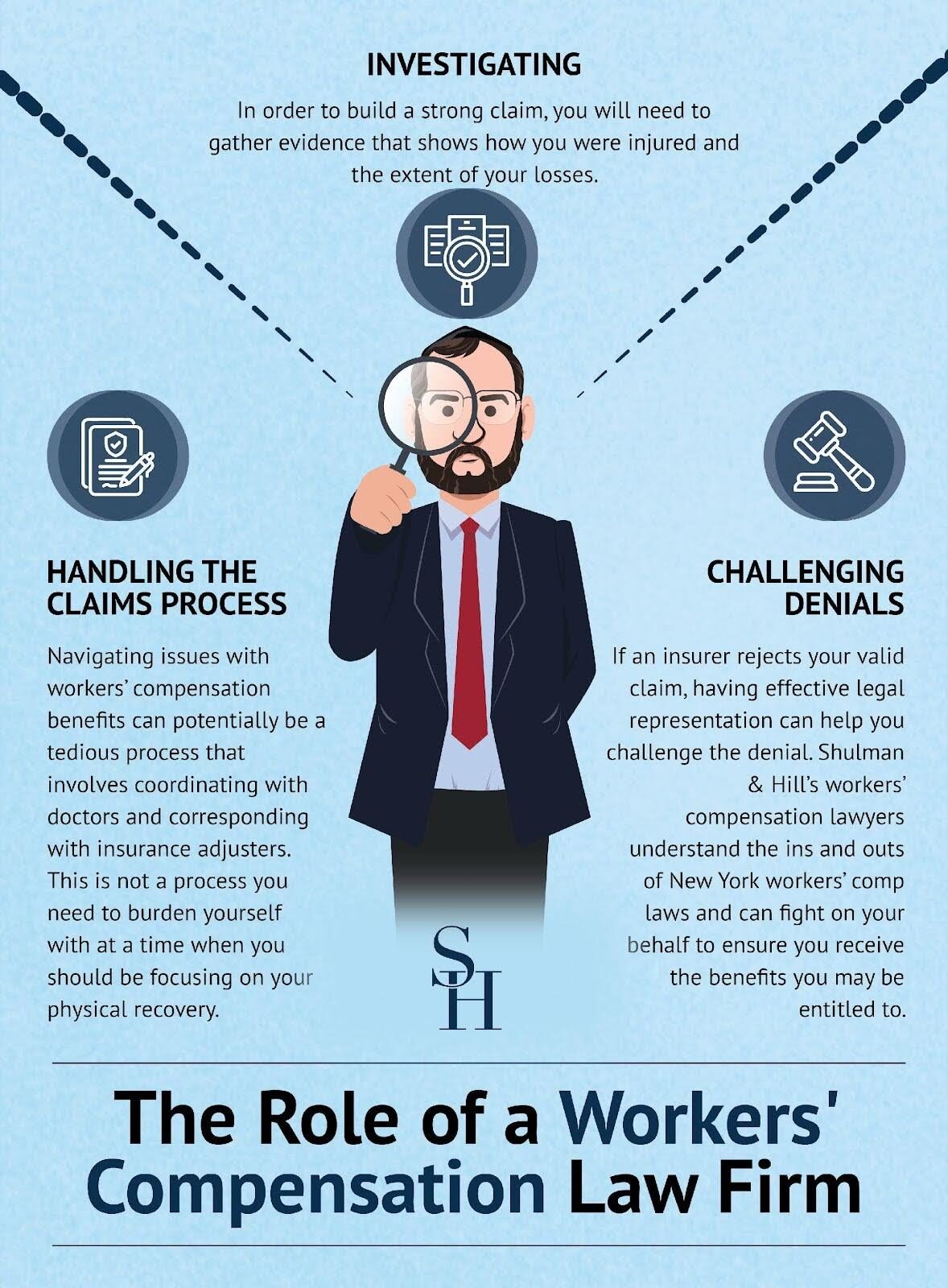
Workers' compensation insurance carriers regularly controvert (contest) claims to minimize payout liabilities. Common reasons for claim denials include allegations that the injury occurred outside work hours, pre-existing medical conditions, insufficient medical documentation, or missed notice deadlines.
Independent Medical Examinations (IMEs)
Insurance companies frequently require injured workers to undergo an Independent Medical Examination (IME) conducted by a physician paid by the carrier. IME doctors often issue reports stating that the worker has fully recovered, can return to full-duty work, or that the disability is due to a pre-existing condition. Legal counsel represents workers by challenging unfavorable IME reports, cross-examining medical experts, and presenting rebuttal evidence from authorized treating physicians.
Administrative Hearings and Board Appeals
When disputes arise, the Workers’ Compensation Board schedules hearings before a Workers’ Compensation Law Judge (WCLJ). Hearings take place virtually or at regional Board offices. Attorneys present documentary evidence, witness testimony, and formal legal arguments. If a judge issues an adverse decision, counsel can file an Administrative Appeal to a three-member Board Panel within 30 days of the decision's filing.
Section 32 Settlement Agreements
Under New York Workers' Compensation Law § 32, an injured worker and the insurance carrier can negotiate a full and final lump-sum settlement of the claim. A Section 32 agreement waives the worker’s right to future medical treatments or cash benefits in exchange for an agreed-upon payout. Because these agreements permanently close the claim, they require formal approval by a Workers' Compensation Law Judge to ensure the terms are fair and equitable.
Legal Fee Structures & What to Expect
Legal fees in New York workers' compensation cases are strictly regulated by statute to protect injured workers from excessive costs.
- No Upfront Costs: Attorneys cannot charge retainer fees, consultation fees, or out-of-pocket hourly rates to injured workers for workers' compensation claims.
- Board Approval Required: Any legal fee awarded to a claimant’s attorney must be formally requested via application (Form OC-400.1) and approved by a Workers’ Compensation Law Judge.
- Deductions from Award: Approved attorney fees are set as a percentage (typically between 10% and 15%) of the monetary benefit secured for the worker. The fee is deducted directly by the insurance carrier from the awarded back pay or lump-sum settlement and paid directly to the attorney. If no monetary award is secured, no legal fee is assessed.
- Personal Injury Contingency Fees: If the firm also handles a third-party personal injury lawsuit, legal fees for that civil action follow standard personal injury contingency fee rules in New York (typically 33.3% of the net recovery after expenses).
Step-by-Step Action Plan Following a Workplace Injury in Brooklyn
- Obtain Immediate Medical Attention: Report to an emergency room or a WCB-authorized doctor right away. Inform the treating provider that the injury occurred on the job so proper billing codes and C-4 reports are generated.
- Provide Written Notice to Your Employer: Submit formal written notification to a supervisor, manager, or HR representative within 30 days of the incident. Retain a signed copy or electronic confirmation for your records.
- Document the Incident and Evidence: Take photographs of the accident site, defective equipment, hazardous conditions, and visible injuries. Collect contact information from any co-workers or bystanders who witnessed the event.
- File Form C-3 with the NYS Workers' Compensation Board: Complete and file the Employee Claim form electronically or by mail as early as possible within the two-year statutory window.
- Consult an Experienced Workers' Compensation Attorney: Seek a legal evaluation from a Brooklyn-based law firm, such as Shulman & Hill, to review your claim, handle insurance correspondence, ensure deadlines are met, and evaluate potential third-party liability.
- Attend All Medical and Legal Appointments: Maintain consistent treatment with your authorized physicians and comply with all notices from the Workers’ Compensation Board or your legal counsel.
Frequently Asked Questions
What address is the Shulman & Hill Brooklyn office located at?
Shulman & Hill maintains its primary Brooklyn office at 26 Court Street, Suite 2200, Brooklyn, NY 11242, situated in Downtown Brooklyn near municipal courts and public transit hubs.
Can I be fired for filing a workers' compensation claim in New York?
No. Under New York Workers’ Compensation Law § 120, it is illegal for an employer to discharge, harass, or discriminate against an employee simply because they filed or attempted to file a workers' compensation claim. Employers who engage in retaliatory action face administrative penalties and back-pay obligations.
What if my workers' compensation claim was denied by the insurance carrier?
If your claim is controverted (denied), the Workers’ Compensation Board will schedule a pre-hearing conference or formal hearing before a judge. You have the right to retain legal representation to gather medical evidence, present testimony, and challenge the denial at the hearing.
Can undocumented workers receive workers' compensation benefits in New York?
Yes. Under New York law, all covered employees are eligible for workers' compensation medical care and wage replacement benefits regardless of their legal immigration status. Immigration status cannot be used by an employer or insurer to deny benefits for an on-the-job injury.
What is the maximum weekly benefit amount in New York?
Weekly indemnity benefits are calculated as two-thirds of the worker’s average weekly wage (AWW) multiplied by the percentage of disability, subject to a statutory maximum cap set annually by the New York State Workers' Compensation Board based on the state average weekly wage.
Next Steps and Practical Recommendations
If you have sustained a job-related injury or developed an occupational illness in Brooklyn, swift action is critical to safeguard your health and financial stability. Ensure that all immediate medical needs are prioritized, and promptly provide written notice of the injury to your employer. Because administrative filing requirements and third-party liability rules involve strict statutory deadlines, contacting an established workers' compensation firm—such as Shulman & Hill’s Downtown Brooklyn office—can help protect your rights, counter insurance carrier denials, and secure the compensation you deserve.
Image Gallery