Debunking Common Auto Insurance Myths in Nashua: A 2026 Resident’s Guide
In Nashua, auto insurance myths often lead to residents being underinsured or paying significantly higher premiums than necessary. While many believe that New Hampshire’s lack of a compulsory insurance law means coverage is optional or...
In Nashua, auto insurance myths often lead to residents being underinsured or paying significantly higher premiums than necessary. While many believe that New Hampshire’s lack of a compulsory insurance law means coverage is optional or that car color dictates rates, the reality is governed by complex financial responsibility laws and actuarial data. Understanding these nuances is essential for protecting your assets and staying compliant with state regulations.
Contents
The legal landscape of "The Gate City" presents a unique environment for drivers. Unlike almost every other state, New Hampshire does not require every driver to purchase an auto insurance policy. However, this does not mean there are no financial consequences for accidents. Most Nashua drivers eventually find that carrying insurance is the only way to satisfy the state’s strict "Financial Responsibility" requirements. Beyond the legalities, local myths regarding vehicle features, credit scores, and coverage types persist, often to the detriment of the policyholder’s wallet.
The "Live Free or Die" Legal Myth: Is Insurance Truly Optional?
One of the most pervasive myths in Nashua is that because New Hampshire is the only state that doesn’t mandate auto insurance for all drivers, you simply don’t need it. While technically true that you aren't required to show proof of insurance to register a vehicle or get a license (in most cases), the New Hampshire Financial Responsibility Law creates a different reality.
If you are involved in an accident in Nashua—whether on the Daniel Webster Highway or a quiet residential street in North End—and you are found at fault, you must prove you can pay for the damages. If you do not have insurance, you are personally liable for medical bills, property damage, and legal fees. If you cannot pay these costs immediately, the New Hampshire Department of Safety can suspend your driving privileges and vehicle registrations until the claims are settled or a payment plan is established.
Furthermore, certain drivers in Nashua are legally required to carry insurance. This includes individuals convicted of a DWI, those who have committed certain traffic violations, or drivers who were at fault in an uninsured accident previously. For these residents, an SR-22 certificate is mandatory. Consequently, the myth that insurance is "optional" is a dangerous oversimplification that can lead to total financial ruin for a Nashua household.
The Red Car Myth: Does Paint Color Affect Your Nashua Premium?
For decades, drivers in Nashua have shared the "fact" that driving a red car results in higher insurance premiums. The logic usually suggests that red cars are more visible to police or that they signify a "reckless" personality. In 2026, as in previous decades, this remains entirely false.
Insurance companies do not ask for the color of your vehicle when providing a quote. They are interested in the Vehicle Identification Number (VIN), which provides details on the make, model, engine size, safety features, and year of the car. These factors determine the "loss cost" of the vehicle—how much it costs to repair and how likely it is to be involved in a high-speed accident.
In Nashua, insurers look at localized data. They analyze how often a specific model is stolen or involved in collisions within the 03060 to 03064 zip codes. A silver sedan with high theft rates in Hillsborough County will likely cost more to insure than a bright red minivan with a top-tier safety rating. If you are shopping for a car at a dealership on Amherst Street, focus on safety tech and theft prevention rather than the color of the paint.
The Credit Score Misconception: Its Role in New Hampshire Rates
A common belief among Nashua residents is that their credit score has nothing to do with how they drive and, therefore, shouldn't affect their insurance rates. While the sentiment is popular, the industry reality in New Hampshire is that credit-based insurance scores are a primary factor in determining premiums.
Actuarial data has consistently shown a correlation between financial management and insurance risk. Insurers argue that individuals who manage their credit responsibly are statistically less likely to file claims. In New Hampshire, it is legal for insurance companies to use this data to set rates, provided they follow the guidelines set by the New Hampshire Insurance Department.
For a Nashua driver, a drop in credit score can lead to a "rate creep" during policy renewal, even if their driving record remains spotless. Conversely, improving your credit score is one of the most effective ways to lower your monthly premium. Residents should be aware that while some states have banned this practice, New Hampshire remains a state where your financial history and your driving history are inextricably linked.
Myth vs. Reality: Coverage Types and Local Needs
Navigating the different types of coverage can be confusing, leading to myths about what is actually protected when you are out on the road.
"Comprehensive Coverage Covers Everything"
Many drivers believe that if they have "comprehensive" insurance, they are protected against all possible scenarios. This is a linguistic misunderstanding. In insurance terms, Comprehensive Coverage specifically addresses "acts of God" and non-collision events. This includes:
- Theft or vandalism in urban Nashua parking lots.
- Damage from a fallen tree limb during a New England ice storm.
- Hitting a deer on a rural road near the Hollis line.
It does not cover a collision with another vehicle or a stationary object like a telephone pole. For those incidents, you need Collision Coverage. Without both, you are only partially protected.
"Minimum Coverage is Sufficient Protection"
Another myth is that if you do choose to buy insurance, the state-minimum limits (currently $25,000 for bodily injury per person, $50,000 per accident, and $25,000 for property damage) are enough. In 2026, with the rising costs of medical care and modern vehicle technology, these limits are often woefully inadequate.
If you cause an accident involving a new electric vehicle or a multi-car pileup on Everett Turnpike, $25,000 in property damage coverage will likely be exhausted instantly. Once the insurance limit is reached, the injured parties can pursue your personal assets—including your home, savings, and future wages—to cover the remaining balance. For most Nashua homeowners, carrying higher liability limits (such as 100/300/100) is a necessary step to protect their net worth.
The Rideshare Trap: Personal Policies and the Gig Economy
With the rise of app-based services, many Nashua residents use their personal vehicles for Uber, Lyft, or DoorDash. A dangerous myth persists that "my personal insurance covers me while I'm working."
Standard personal auto insurance policies in New Hampshire explicitly exclude commercial use. The moment you turn on a rideshare app and signify you are available for hire, your personal policy effectively "turns off" for most types of claims. While the rideshare companies provide some contingent coverage, there are significant gaps, particularly during "Period 1" (when the app is on but you haven't accepted a fare).
Nashua drivers engaging in the gig economy must seek a Rideshare Endorsement or a hybrid commercial policy. Failing to do so can result in a denied claim and the immediate cancellation of your personal insurance policy for misrepresentation of vehicle use.
Comparison of Common Auto Insurance Misconceptions
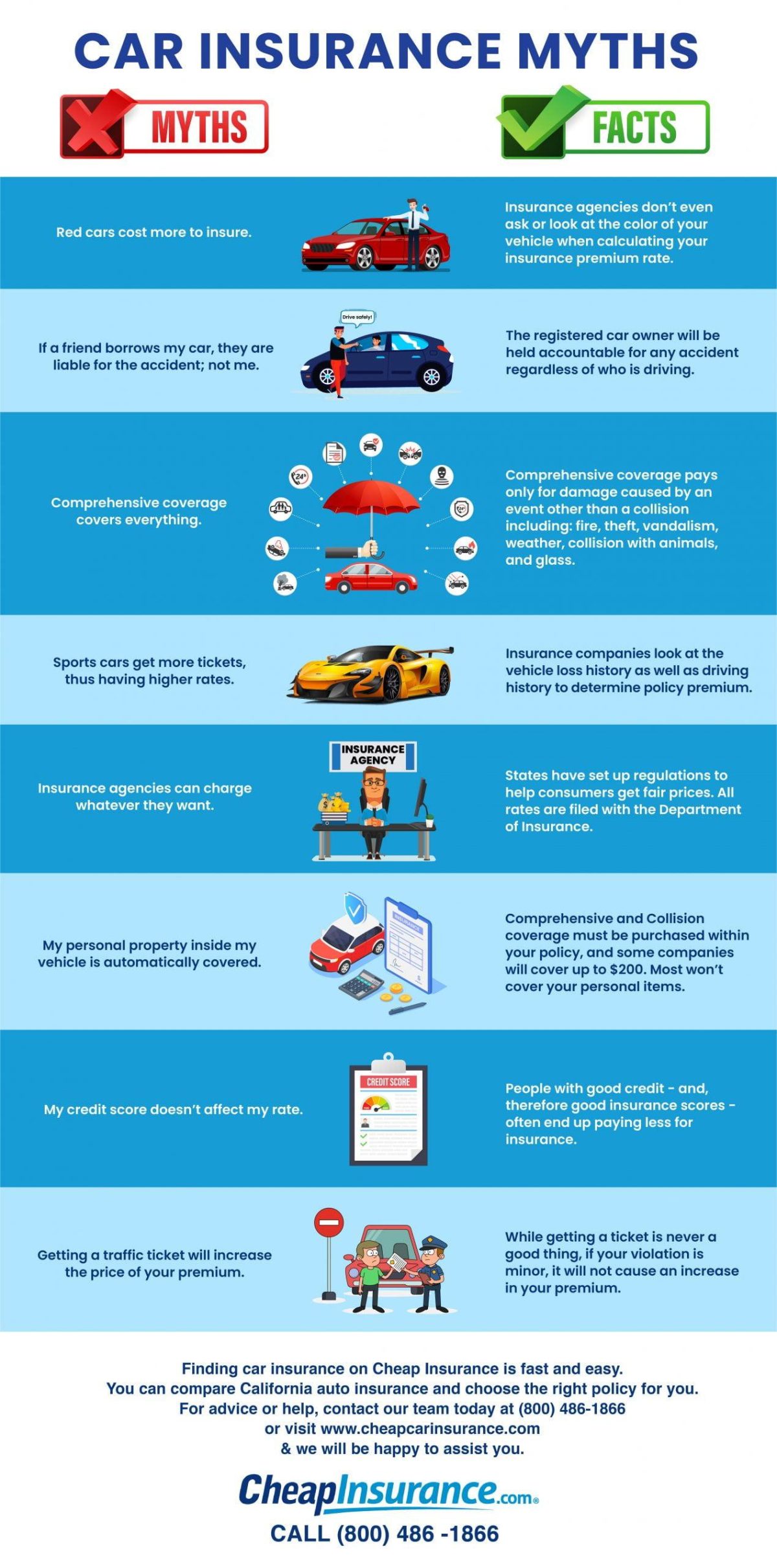
| Myth | Fact | Impact for Nashua Drivers |
|---|---|---|
| Red cars cost more to insure. | Color is not a rating factor; VIN data is. | Focus on safety ratings and theft data instead. |
| NH requires no insurance. | You must prove financial responsibility after an accident. | Uninsured drivers risk license suspension and asset loss. |
| Credit scores don't affect rates. | Credit-based insurance scores are legal and used in NH. | Poor credit can lead to significantly higher premiums. |
| Comprehensive covers all damage. | It only covers non-collision events (theft, weather). | You need Collision coverage for vehicle accidents. |
| My policy covers me for Uber/Lyft. | Personal policies exclude commercial/delivery work. | You risk total denial of claims without an endorsement. |
Frequently Asked Questions
Does my insurance premium go up automatically if I get a speeding ticket in Nashua?
Not necessarily "automatically" or "immediately," but it likely will at your next renewal. Insurance companies typically pull your Motor Vehicle Record (MVR) once a year or when you request a change to your policy. In New Hampshire, minor speeding violations stay on your insurance record for three to five years. However, some companies offer "minor violation forgiveness" for long-term customers with otherwise clean records.
If I lend my car to a friend in Nashua and they crash, whose insurance pays?
In New Hampshire, insurance generally "follows the car," not the driver. If you give someone permission to drive your vehicle, your insurance policy acts as the primary coverage for any damages they cause. However, if the damages exceed your policy limits, the driver’s own insurance may act as secondary coverage. This highlights the risk of "permissive use"—your rates will likely increase even if you weren't behind the wheel.
Does auto insurance cover items stolen from inside my car?
No. This is a common myth. Auto insurance (specifically Comprehensive coverage) covers the car itself and factory-installed equipment. If your laptop, phone, or golf clubs are stolen from your car while parked at Mine Falls Park, you must file a claim through your Homeowners or Renters insurance, not your auto policy.
Is "Full Coverage" a legal term in New Hampshire?
"Full Coverage" is a marketing term, not a legal one. It usually refers to a policy that includes Liability, Collision, and Comprehensive coverages. However, it does not mean you are covered for everything. It often excludes things like roadside assistance, rental car reimbursement, and gap insurance unless they are specifically added as riders.
Can I be denied insurance in New Hampshire?
While private companies can deny you coverage based on your risk profile (high number of accidents or DUIs), New Hampshire ensures that all drivers can obtain coverage through the New Hampshire Automobile Insurance Plan (NHAIP). This is a "market of last resort" for high-risk drivers who cannot find coverage in the voluntary market, though the premiums are substantially higher.
Practical Steps for Nashua Drivers
To navigate the complexities of auto insurance in 2026, Nashua residents should move beyond myths and take proactive steps:
- Verify Your Liability Limits: Ensure your property damage and bodily injury limits are high enough to protect your assets, especially if you own a home in the Nashua area.
- Audit Your Discounts: Many insurers offer discounts for Nashua residents who work for major local employers, have students with good grades, or bundle their auto policy with renters or homeowners insurance.
- Review the Financial Responsibility Law: Understand that while you may choose to go uninsured, you are choosing to risk your driving privileges and personal wealth in the event of an accident.
- Consult a Local Agent: Local independent agents understand the specific risks of driving in Southern New Hampshire, from the congestion of the Broad Street Parkway to the hazards of winter weather, and can help debunk myths specific to our region.
By basing insurance decisions on verified facts rather than local hearsay, you can ensure that you are both legally compliant and financially protected on New Hampshire roads.
Image Gallery