Is Legal and General Life Insurance No Exam: What You Need to Know
Legal & General America offers life insurance options that can bypass traditional medical exams for qualifying applicants, leveraging automated underwriting and public records to evaluate eligibility quickly. This type of coverage typi...
Legal & General America offers life insurance options that can bypass traditional medical exams for qualifying applicants, leveraging automated underwriting and public records to evaluate eligibility quickly. This type of coverage typically applies to specific term life products under certain face amounts and age limits, streamlining the path from application to policy approval.
Contents
Understanding Legal & General’s Life Insurance Offerings
Legal & General America—which operates primarily through Banner Life Insurance Company and William Penn Life Insurance Company of New York—is well-known in the United States insurance marketplace for providing traditional term and universal life policies. Historically, acquiring a meaningful amount of term life insurance required a comprehensive medical underwriting process. This procedure typically involved scheduling an appointment with a paramedical examiner to record height, weight, blood pressure, and pulse, alongside drawing blood and collecting urine samples for laboratory analysis.
In response to consumer demand for faster processing times and less friction, modern carriers have introduced accelerated underwriting pathways. Legal & General utilizes data analytics, prescription history databases, motor vehicle records, and credit-based insurance data to assess risk without always requiring a physical examination. However, "no exam" does not mean "no questions." Every applicant must still complete a detailed health questionnaire covering personal medical history, family medical background, occupation, and lifestyle habits such as tobacco use and hazardous hobbies.
It is important to clarify that whether a policy qualifies for an exam-free path depends heavily on the individual's risk profile. If automated data sources flag potential health risks, or if the requested death benefit and applicant age fall outside specific operational thresholds, Legal & General retains the right to require a traditional medical exam before issuing final approval.
How No-Exam Life Insurance Works with Legal & General
The application mechanism for an exam-free policy with Legal & General centers around their accelerated underwriting programs, often associated with products like OPTerm. When an applicant submits an online or agent-assisted application, the company initiates electronic searches across various underwriting databases.
The evaluation relies on several electronic verification methods:
- Prescription Database Checks: Insurers review pharmacy databases (such as Milliman IntelliScript) to see what medications have been prescribed to the applicant over the past several years, which provides insight into chronic conditions, mental health treatments, or past diagnoses.
- Motor Vehicle Reports (MVR): Driving records reveal information about speeding tickets, Driving Under the Influence (DUI) citations, and reckless driving incidents, which help underwriters gauge lifestyle risk.
- Medical Information Bureau (MIB): The MIB is a non-profit trade association containing coded data shared by member life insurance companies regarding previous applications and disclosed health conditions.
- Public Records and Credit-Based Scores: Underwriters evaluate financial stability and public records to assess overall mortality risk correlations.
Once this electronic footprint is aggregated, algorithms and human underwriters analyze the profile. If the applicant meets the strict criteria for preferred or standard health classes and falls within the eligible age and coverage amount brackets, the requirement for a physical exam and bodily fluid collection is waived.
Eligibility Criteria for Exam-Free Policies
Qualifying for a life insurance policy without a medical exam requires meeting specific parameters set by the carrier. Legal & General does not offer no-exam coverage universally to all applicants; rather, eligibility is gated by age, coverage limits, and personal health history.
Age and Coverage Limits
Generally, accelerated underwriting pathways target younger to middle-aged adults who present lower baseline statistical risk. While exact guidelines fluctuate according to product updates and internal underwriting manuals, applicants typically must fall within an age range (often up to age 60 or 65 for certain term lengths) to be considered for exam-free processing. Furthermore, death benefit amounts are capped for accelerated underwriting. While traditional policies can extend into millions of dollars with intensive medical verification, no-exam pathways usually have upper limits (frequently up to $500,000 or $1,000,000 depending on age tier and product type) above which a physical exam becomes mandatory.
Health and Lifestyle Prerequisites
Applicants must demonstrate an unremarkable health history. Chronic conditions such as diabetes, cardiovascular disease, cancer, chronic obstructive pulmonary disease (COPD), or a history of substance abuse will almost invariably trigger a requirement for traditional underwriting or result in denial of the accelerated path. Additionally, hazardous occupations (such as commercial aviation, deep-sea diving, or extreme sports) or a history of frequent international travel to high-risk regions will disqualify an applicant from the streamlined process.
Comparing Traditional Underwriting vs. Accelerated No-Exam
Choosing between a traditional medically underwritten policy and an accelerated exam-free option involves weighing speed against potential pricing and coverage depth. The table below outlines the core differences in the evaluation mechanics, timelines, and requirements.
| Feature | Traditional Underwriting | Accelerated / No-Exam Underwriting |
|---|---|---|
| Physical Exam | Required (paramedic visits home or office) | Typically waived for qualifying applicants |
| Lab Work | Blood and urine samples required | Not required unless flagged by data |
| Approval Timeline | 4 to 8 weeks on average | Days to a few weeks |
| Maximum Coverage | Multi-million dollar limits readily available | Tiered caps (often up to $500k–$1M) |
| Age Limitations | Broad acceptance across adult age brackets | Stricter age thresholds (often capped at 60) |
| Underwriting Basis | Direct lab results + database checks | Electronic databases, MIB, and MVR |
Pros and Cons of Legal & General No-Exam Options
Navigating the landscape of life insurance requires an objective assessment of the advantages and drawbacks associated with accelerated underwriting paths.
Advantages
- Speed of Issuance: Traditional exams and waiting for lab results can stretch the underwriting timeline to over a month. Exam-free options can dramatically compress this schedule, providing peace of mind and financial protection much faster.
- Convenience: Eliminating the need to fast, schedule a nurse visit, and have blood drawn removes significant friction from the application experience.
- Privacy: Applicants do not need to host a medical examiner in their home or office, reducing personal inconvenience.
Disadvantages
- Strict Qualification Thresholds: Any minor discrepancy between the health questionnaire and prescription database records can halt the accelerated process, forcing a pivot to traditional underwriting anyway.
- Pricing Variations: For individuals in pristine health, traditional underwriting that includes favorable lab results can sometimes yield the lowest possible premium class. Accelerated underwriting algorithms may price applicants conservatively if minor data points are ambiguous.
- Coverage Ceilings: High-net-worth individuals requiring substantial death benefits cannot utilize no-exam paths for their entire coverage need.
Common Misconceptions Regarding No-Exam Insurance
Several persistent myths surround life insurance policies that do not require medical examinations. Addressing these misconceptions ensures realistic expectations during the application process.
The most common myth is that "no exam" equates to "guaranteed approval." In reality, accelerated underwriting is simply a different method of risk evaluation. Insurers still thoroughly vet applicants using electronic data sources. If an applicant has a severe unmanaged health condition, the application will be declined or redirected to a specialized product, exactly as it would under traditional underwriting.
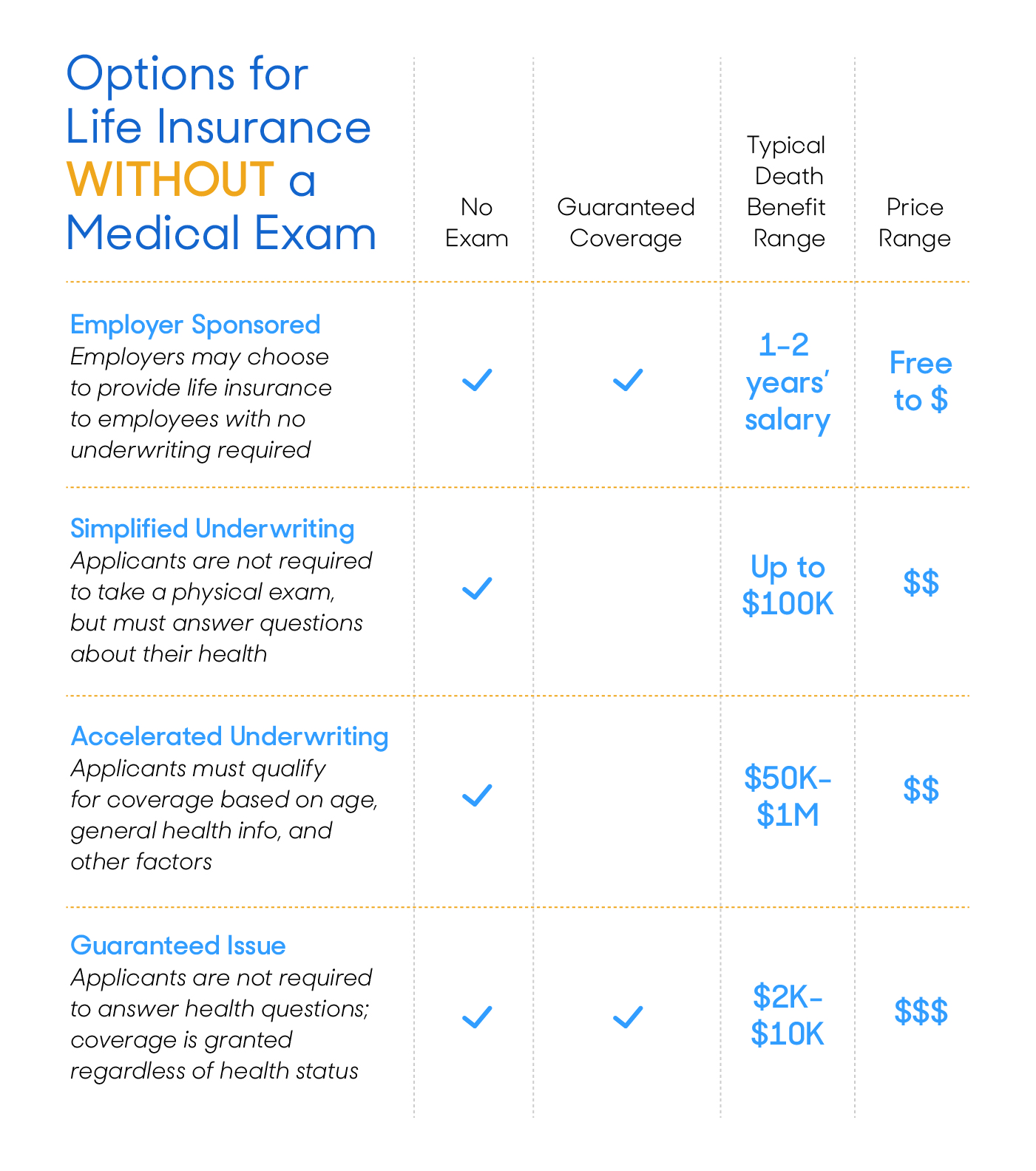
Another frequent misunderstanding is that no-exam policies are automatically more expensive than traditional policies. While some simplified issue or guaranteed issue products carry higher premiums due to the carrier assuming more blind risk, Legal & General’s accelerated term products are competitively priced. For healthy individuals who qualify, the premium rates on an accelerated term policy are often identical to those of a traditional policy.
Finally, applicants sometimes assume they can omit pre-existing conditions from the application if no blood test will catch them. Insurance applications are legal contracts. Omitting material medical facts constitutes misrepresentation, which can give the insurer the right to contest the policy or deny a death benefit claim during the contestability period (typically the first two years of the policy).
Frequently Asked Questions
Does Legal & General always approve no-exam applications without requesting medical records?
No. Even if a physical exam is waived, Legal & General may still request an Attending Physician Statement (APS) from your doctor if electronic database checks reveal a past medical treatment or prescription that requires further clarification by an underwriter.
What happens if I am denied the accelerated no-exam path?
If your application does not qualify for the accelerated program due to age, coverage amount, or data findings, you are not necessarily rejected for insurance. The carrier will simply transition your application to the traditional underwriting track, which will require scheduling a medical exam and lab work.
Are premiums higher for Legal & General no-exam term insurance?
For applicants who successfully qualify through the accelerated underwriting criteria, premium rates are generally comparable to traditional term life insurance rates for the same health classification.
Can smokers qualify for Legal & General no-exam life insurance?
While tobacco users can apply for Legal & General products, tobacco use status heavily impacts underwriting categorization and pricing. Many accelerated underwriting programs have strict rules regarding tobacco use, and frequent users may be routed to traditional underwriting to verify their overall health profile.
How long does the accelerated approval process take?
When all electronic data sources clear cleanly and no additional medical records are requested, approval decisions can be rendered in a matter of days, significantly outpacing standard multi-week underwriting cycles.
Summary and Next Steps
Evaluating whether a Legal & General no-exam life insurance policy suits your financial planning needs requires reviewing your age, desired coverage amount, and personal medical history. If you value speed, wish to avoid physical exams, and possess a clean medical and driving record, exploring an accelerated term life product is a viable path. To proceed, gather your personal medical history, medication records, and financial goals, then consult with an independent insurance agent or directly through Legal & General’s digital portals to receive an accurate, personalized quote based on your unique profile.
Image Gallery