Navigating Pharmacist Abbreviations in Modern Prescriptions: Safety, Standards, and Translation
Pharmacist abbreviations in modern prescriptions are standardized shorthand codes, historically derived from Latin, used by clinicians to specify medication dosage, route, frequency, and administration timing. While electronic prescrib...
Pharmacist abbreviations in modern prescriptions are standardized shorthand codes, historically derived from Latin, used by clinicians to specify medication dosage, route, frequency, and administration timing. While electronic prescribing (e-Rx) systems increasingly replace handwritten codes with structured plain English, understanding traditional and modern abbreviations remains critical for ensuring medication safety and preventing dispensing errors.
Contents
The Evolution of Prescription Shorthand: From Latin Roots to Electronic Health Records
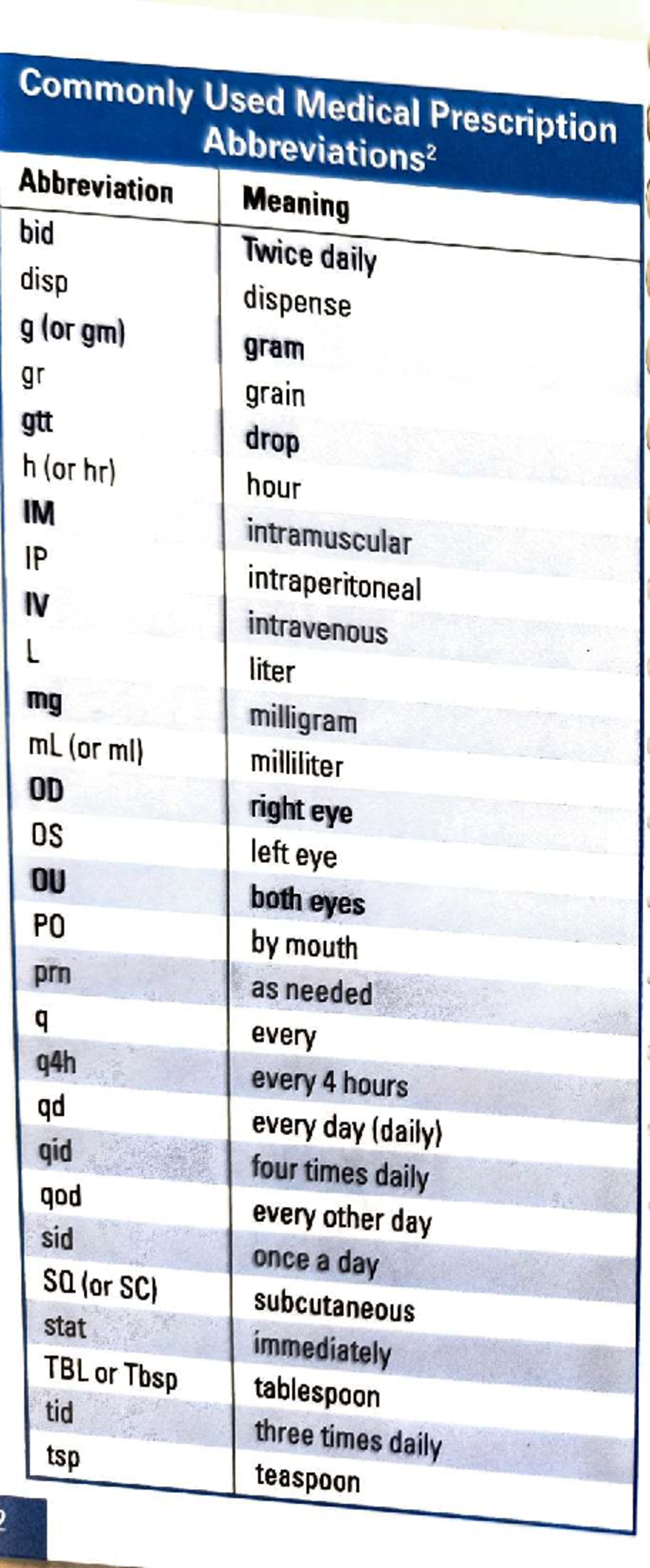
For centuries, medical practitioners relied on Latin shorthand to write prescriptions efficiently and maintain a universal language across clinical disciplines. Standard directives such as sig (short for signa, meaning "write on label"), p.o. (per os, meaning "by mouth"), and b.i.d. (bis in die, meaning "twice a day") formed the operational backbone of pharmacy dispensing. These abbreviations allowed physicians to condense complex dosing schedules into a few precise strokes of a pen.
However, the historical reliance on handwritten Latin abbreviations introduced significant operational risks. Misinterpreting illegible scrawls, ambiguous letter pairings, or poorly positioned decimal points frequently led to adverse drug events (ADEs). As healthcare infrastructure transitioned into computerized provider order entry (CPOE) and Electronic Health Record (EHR) platforms, the role of prescription abbreviations underwent a fundamental shift.
In modern pharmacy practice, electronic prescribing systems rely heavily on structured data fields rather than free-text shorthand. The National Council for Prescription Drug Programs (NCPDP) establishes standardized SCRIPT standards that convert prescriber inputs into discrete elements: verb, dose unit, route, frequency, and duration. Despite this digital standardization, traditional shorthand has not completely disappeared. Clinicians continue to use medical abbreviations in clinical progress notes, internal hospital chart orders, pharmacy workflow software, and telephone prescriptions. Consequently, pharmacy staff must remain fluent in legacy Latin terminology while strictly adhering to modern safety standards that limit error-prone abbreviations.
The Danger of Ambiguity: ISMP and Joint Commission "Do Not Use" Standards
The drive to eliminate dangerous prescription abbreviations gained national urgency following studies by the Institute for Safe Medication Practices (ISMP) and oversight bodies regarding preventable medication errors. A primary cause of dispensing mistakes stems from abbreviations that look visually similar or share identical letter patterns when written quickly.
To mitigate these risks, The Joint Commission established an official "Do Not Use" list of dangerous medical abbreviations as part of its National Patient Safety Goals. Accredited healthcare organizations are strictly required to enforce these prohibitions across all medical records, whether handwritten or electronically generated.
CRITICAL ACCREDITATION WARNINGAbbreviations on The Joint Commission "Do Not Use" list must NEVER appear on medication orders or prescription directions. Standard plain-text replacements are mandatory across all patient care settings.
High-Risk Abbreviations and Mandatory Replacements
- "U" or "u" (Units): Frequently misread as the number "0" (zero), "4" (four), or "cc". This error can cause a ten-fold or greater overdose, particularly when dosing potent biological agents like insulin. Mandatory Replacement: Always write "unit" or "units".
- "IU" (International Units): Commonly mistaken for "IV" (intravenous) or the number "10". Such confusion risks administering an oral or subcutaneous dose through an intravenous line, or miscalculating the dose. Mandatory Replacement: Always write "International Unit" or "International Units".
- "Q.D.", "QD", "q.d.", or "qd" (Daily): The period after the "q" can be mistaken for an "i", causing the abbreviation to be read as "q.i.d." (four times a day) instead of once daily. Mandatory Replacement: Always write "daily".
- "Q.O.D.", "QOD", "q.o.d.", or "qod" (Every Other Day): The "O" can easily be mistaken for an "I", leading to four-times-daily or daily administration instead of alternate-day dosing. Mandatory Replacement: Always write "every other day".
- Trailing Zeros (e.g., 5.0 mg): If the decimal point is obscured or missed on a screen or paper copy, "5.0 mg" is easily misread as "50 mg". Mandatory Requirement: Never use a trailing zero for integer doses (write "5 mg").
- Lack of Leading Zeros (e.g., .5 mg): Omitting the zero before a decimal point causes ".5 mg" to be misread as "5 mg", leading to a tenfold overdose. Mandatory Requirement: Always place a leading zero before a decimal point (write "0.5 mg").
- "MSO4" and "MgSO4": These chemical shorthand abbreviations are easily confused for one another, leading to catastrophic mix-ups between morphine sulfate and magnesium sulfate. Mandatory Replacement: Always spell out "morphine sulfate" or "magnesium sulfate" completely.
Master Reference: Modern Prescription Abbreviations and Safety Classifications
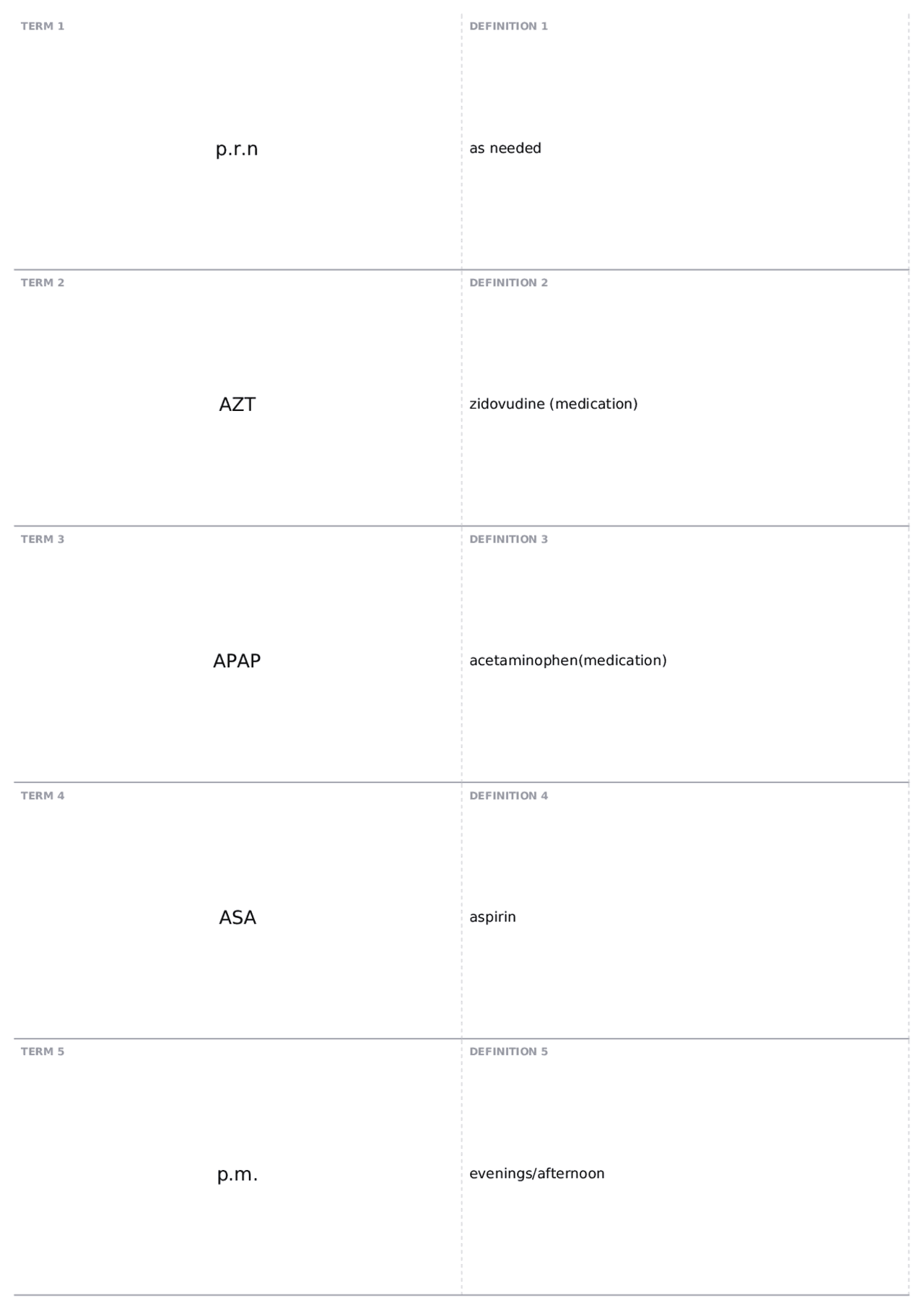
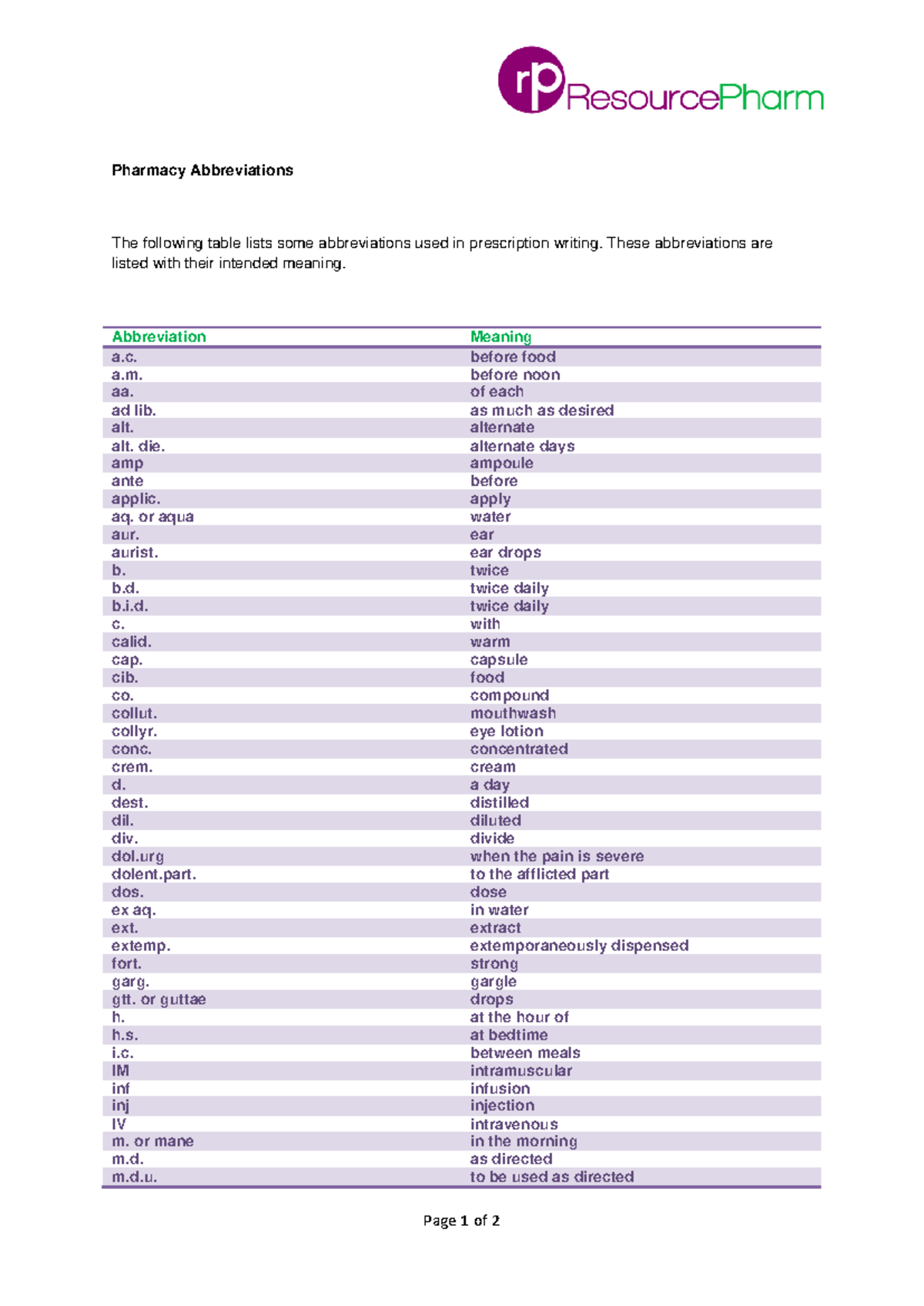
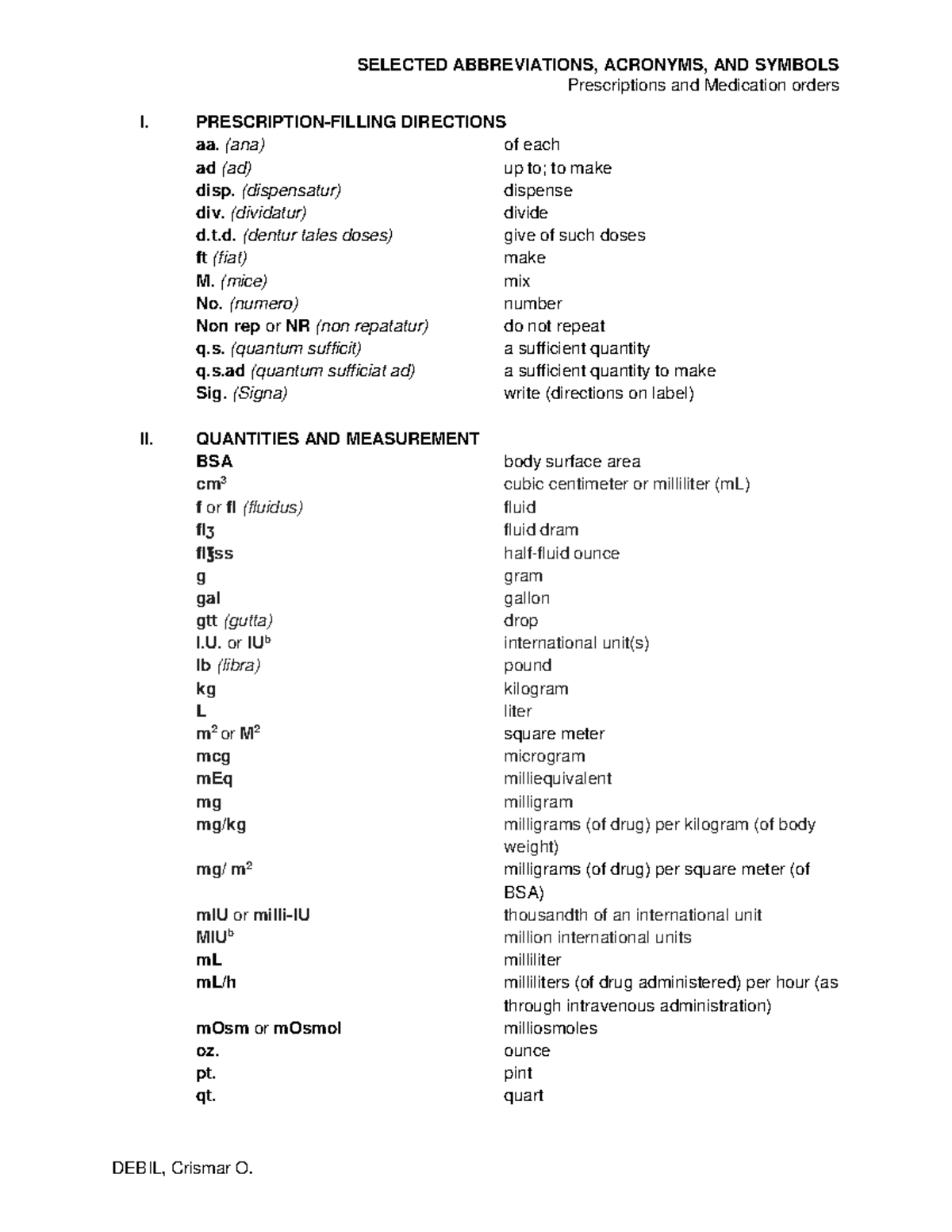
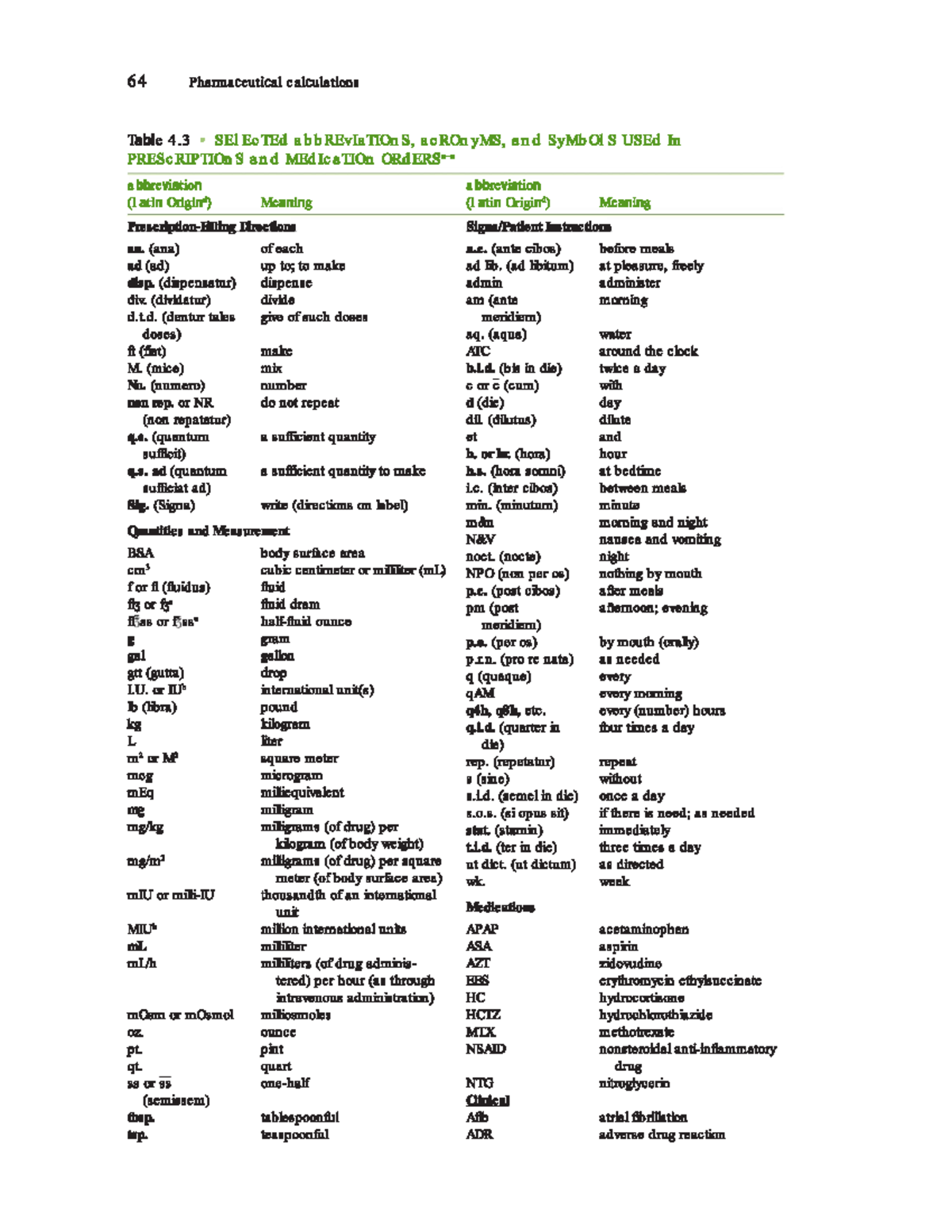
The following reference table categorizes widely encountered pharmacy abbreviations, providing their historical Latin origins, modern English translations, practical usage contexts, and safety classifications based on current clinical consensus.
| Abbreviation / Code | Latin Origin / Full Term | Modern English Meaning | Clinical Usage Context | Safety Status & Practice Guidance |
|---|---|---|---|---|
| a.c. | ante cibum | Before meals | Administration timing for metabolic drugs (e.g., rapid-acting insulin) | Acceptable (Prefer explicit instructions like "30 minutes before meals") |
| p.c. | post cibum | After meals | Administration timing to minimize GI distress | Acceptable (Prefer "take after meals") |
| b.i.d. | bis in die | Twice a day | Dosing schedule every 12 hours or twice daily | Acceptable (Avoid internal periods; e-Rx uses "twice daily") |
| t.i.d. | ter in die | Three times a day | Dosing schedule every 8 hours or three times daily | Acceptable (Prefer "three times daily") |
| q.i.d. | quater in die | Four times a day | Dosing schedule every 6 hours or four times daily | Acceptable (Ensure not confused with "q.d.") |
| p.o. | per os | By mouth / Orally | Route of administration for solid/liquid oral forms | Acceptable (Standard route descriptor) |
| p.r.n. | pro re nata | As needed | PRN orders must include a clinical reason (e.g., for pain) | Acceptable (Mandatory to specify indication/reason) |
| h.s. | hora somni | At bedtime | Administration timing for sedating medications | High Risk (Mistaken for "half-strength"; write "at bedtime") |
| q.d. / QD | quaque die | Every day / Daily | Daily administration timing | PROHIBITED (Joint Commission banned; write "daily") |
| q.o.d. / QOD | quaque altera die | Every other day | Alternate-day administration schedule | PROHIBITED (Joint Commission banned; write "every other day") |
| U / u | N/A | Unit | Expression of biological activity (e.g., insulin, heparin) | PROHIBITED (Joint Commission banned; write "units") |
| IU | N/A | International Unit | Measurement unit for vitamins/biologics | PROHIBITED (Joint Commission banned; write "International Units") |
| subq / SQ | subcutaneus | Subcutaneously | Injectable route into adipose tissue | High Risk (Mistaken for "sublingual" or "5Q"; write "subcutaneously") |
| q.4h | quaque 4 hora | Every 4 hours | Fixed interval dosing frequency | Acceptable (Clear numerical frequency designation) |
| stat | statim | Immediately | Urgent emergency dosing order | Acceptable (Restricted to genuine clinical emergencies) |
| gtt | guttae | Drops | Ophthalmic, otic, or liquid oral dosing unit | Acceptable (Specify target organ: left eye, right ear, etc.) |
| pr | per rectum | Rectally | Suppository or rectal gel administration route | Acceptable (Prefer explicit plain English) |
| pv | per vaginam | Vaginally | Vaginal cream, ring, or insert administration route | Acceptable (Prefer explicit plain English) |
Electronic Prescribing (e-Rx) and NCPDP SCRIPT Standards
Modern pharmacy practice relies heavily on electronic prescribing workflows that standardise how prescriptions are created, transmitted, and processed. Under the NCPDP SCRIPT standard, prescriptions are parsed into structured "Sig" components rather than transmitted as unstructured text blocks. This structured approach reduces ambiguity and ensures seamless integration into pharmacy management software.
- NCPDP STRUCTURED SIG COMPONENTS
- [Verb]: Take / Instill / Apply / Inject
- [Amount]: 1 / 2 / 5
- [Form]: Tablet / Capsule / Drop / Milliliter
- [Route]: By mouth / Into affected eye / Subcutaneously
- [Freq]: Twice daily / Every 8 hours / Once daily
- [Cond]: As needed for severe pain / Before meals
Despite these advancements, discrepancies still arise during electronic parsing. For example, if a prescriber enters free-text instructions alongside structured selections (e.g., selecting "Take 1 tablet daily" in the structured field while typing "Take 1/2 tab BID" in the notes section), software auto-translation can produce contradictory instructions.
Pharmacists and technicians must review both structured e-Rx fields and clinical notes to verify that automated translation software has not distorted the provider's true clinical intent.
Verification Protocols and Error Prevention Strategies for Pharmacy Teams
Maintaining patient safety requires systematic verification protocols at every stage of prescription processing. Pharmacy teams rely on a multi-tiered verification framework to intercept abbreviation errors before a medication reaches the patient.
- Prescription Received
- Order Entry & Data Input
- System Check for "Do Not Use" Codes
- Clinical Pharmacist Review
- Resolve Ambiguity / Contact Prescriber
- Product Dispensing & Labeling
- Translate Shorthand to Plain English
- Final Patient Verification
- Verbal Consultation & Clear Directions
1. Data Entry & Order Processing Verification
When processing paper, faxed, or electronic orders, pharmacy technicians and pharmacists must audit directives against standard safe-practice guidelines:
- Flag any prohibited abbreviations (such as "QD", "QOD", or "U") during initial data entry.
- Verify that all "PRN" (as needed) prescriptions state a specific indication (e.g., "as needed for anxiety" rather than simply "as needed").
- Ensure dose expressions contain appropriate leading zeros (e.g., "0.25 mg") and omit dangerous trailing zeros (e.g., "2 mg" instead of "2.0 mg").
2. Clinical Pharmacist Clarification Protocols
When an ambiguous, incomplete, or high-risk abbreviation is detected, pharmacists must not guess the prescriber's intent. Clinical protocols require formal intervention:
- Pause Dispensing: Hold the order in the pharmacy management queue.
- Direct Outreach: Contact the prescribing clinician or clinical staff to confirm the order details.
- Document Clarification: Record the verbal or electronic confirmation directly within the patient’s pharmacy record, noting the date, time, staff member contacted, and clarified instructions.
3. Patient-Centric Label Translation
Prescription container labels presented to patients must never contain technical medical shorthand or Latin abbreviations. Pharmacy staff must translate clinical directives into clear, actionable plain English:
- Translate "1 tab p.o. t.i.d. a.c." to: "Take 1 tablet by mouth three times a day, 30 minutes before meals."
- Translate "2 gtt o.d. q.4h p.r.n. pain" to: "Instill 2 drops into the right eye every 4 hours as needed for pain."
- Ensure numbers are expressed clearly, specifying exact times of day when beneficial (e.g., "Take 1 tablet in the morning and 1 tablet at bedtime").
Frequently Asked Questions
What is the difference between a prescription "Sig" and pharmacy shorthand?
A prescription "Sig" (derived from the Latin signa, meaning "mark" or "write") refers to the complete set of instructions provided for the patient on a prescription. Pharmacy shorthand consists of specific abbreviated codes (like p.o., b.i.d., or p.r.n.) used within the Sig to represent actions, doses, routes, and timing. The Sig encompasses the entire direction set, whereas shorthand codes are the individual abbreviations used to write it.
Why are certain Latin abbreviations like "QD" banned in modern healthcare settings?
Abbreviations like "QD" (meaning daily) were banned by regulatory and accreditation organizations, including The Joint Commission, because they frequently caused severe medication errors. When handwritten or rendered in small electronic fonts, the letter "D" in "QD" can be misread as "QID" (four times a day), resulting in a fourfold overdose. Standardizing to the plain English word "daily" eliminates this ambiguity.
How do electronic prescribing systems handle traditional medical abbreviations?
Modern electronic prescribing (e-Rx) systems parse medication orders using discrete data fields defined by NCPDP standards. While prescribers may enter shorthand into text boxes, compliant e-Rx software converts these entries into standardized plain English fields (such as action, amount, route, and frequency). This process prevents dispensing errors by eliminating illegible handwriting and non-standard shorthand.
What should a pharmacist do when encountering an ambiguous abbreviation on a prescription?
When an ambiguous, incomplete, or prohibited abbreviation appears on a prescription, the pharmacist must hold the order and contact the prescriber for clarification. Pharmacists are clinically and legally prohibited from guessing a prescriber's intent when directions are unclear. The clarified instructions must be formally documented in the pharmacy record before dispensing.
How can patients read and understand the directions on their medication bottles?
Patients should find plain English instructions on their prescription labels, as pharmacy dispensing software is designed to automatically translate technical medical shorthand into accessible language. If a label contains confusing terms, technical acronyms, or vague directions like "use as directed," patients should consult their pharmacist for a plain-language explanation before taking the medication.
Recommended Next Actions for Pharmacy Practice Compliance
To uphold high patient safety standards and maintain compliance with clinical accreditation bodies, pharmacy managers and healthcare organizations should implement the following steps:
- Audit Pharmacy Software Templates: Review internal dispensing software and quick-code auto-completes to ensure prohibited terms (such as "QD", "QOD", "U", "IU", and "HS") do not automatically populate on prescription labels.
- Establish Hard-Stop Clinical Alerts: Configure Computerized Provider Order Entry (CPOE) and EHR systems to generate hard-stop warnings whenever prescribers input error-prone abbreviations or improper decimal configurations.
- Conduct Annual Staff Training: Educate pharmacy technicians, pharmacists, and nursing staff on the current ISMP List of Error-Prone Abbreviations and Joint Commission National Patient Safety Goals.
- Strengthen Patient Counseling Protocols: Require verbal verification during patient checkout to confirm patients understand how, when, and why to take their medication, ensuring plain-language directions match the patient's daily routine.
Disclaimer: This article is intended solely for educational and information-sharing purposes regarding medical terminology and pharmacy safety standards. It does not constitute formal legal, regulatory, or clinical advice. Healthcare practitioners should consult official guidelines from the Institute for Safe Medication Practices (ISMP), The Joint Commission, and local pharmacy boards for regulatory compliance.
Image Gallery