How to Pitch for Funding: Step-by-Step Strategy for Entrepreneurs
Learning how to pitch for funding requires structuring a compelling pitch deck, articulating a clear market problem, demonstrating measurable traction, and presenting a defensible financial model. Founders must tailor their narrative t...
Learning how to pitch for funding requires structuring a compelling pitch deck, articulating a clear market problem, demonstrating measurable traction, and presenting a defensible financial model. Founders must tailor their narrative to their target capital source—whether venture capitalists, angel investors, or grant committees—and effectively field rigorous due diligence questions to secure investment.
Contents
1. Preparation: Aligning Capital Sources with Investor Intent
Before writing a single slide or rehearsing a verbal presentation, you must match your capital requirements with the correct type of funder. Pitching a high-growth software startup to a commercial bank or a slow-yielding physical infrastructure project to an early-stage venture capital (VC) firm usually results in immediate rejection. Each capital provider operates under distinct risk tolerances, return expectations, and governance criteria.
Venture Capital Firms
Venture capitalists manage institutional money and seek high-yield returns driven by power-law dynamics, where a small percentage of investments generate the majority of fund returns. VCs prioritize total addressable market (TAM) size, proprietary technological advantages, scalability, and exit potential within 5 to 10 years. When pitching VCs, emphasize rapid market capture, enterprise value drivers, and unit economics that scale efficiently.
Angel Investors and Syndicates
Angel investors are typically high-net-worth individuals investing personal capital. While they expect capital appreciation, angels often invest based on founder credibility, domain alignment, and personal affinity for the problem space. Angel pitches require a clear explanation of how early capital will de-risk key operational milestones to enable a subsequent seed or Series A institutional round.
Debt Financing and Banks
Commercial lenders and government-backed loan programs evaluate credit risk rather than exponential equity growth. Banks focus on historical cash flow, debt service coverage ratios (DSCR), collateral assets, and credit histories. When seeking debt financing, your presentation must emphasize operational stability, cash-flow predictability, and debt repayment schedules rather than speculative future market share.
Grants and Institutional Foundations
Government grants, such as the U.S. Small Business Administration SBIR/STTR programs or international innovation funds, provide non-dilutive capital. These grant proposals require compliance with strict research, technical, and societal criteria. The pitch narrative for grants shifts away from equity exits and focuses instead on technical feasibility, research methodology, commercial viability, and socioeconomic impact.
2. Structuring an Institutional-Grade Pitch Deck
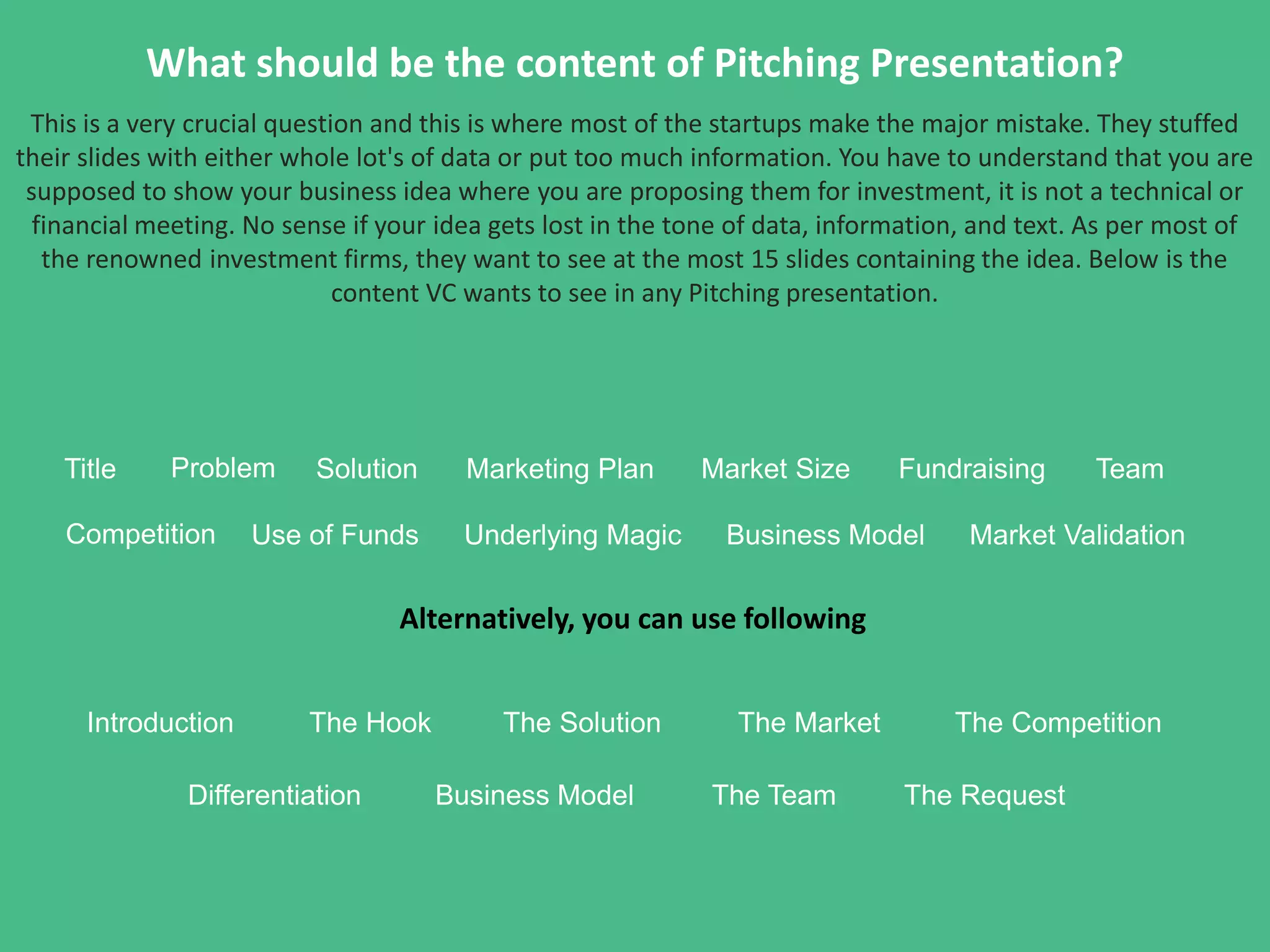
A professional pitch deck should contain between 10 and 14 slides, organized logically to construct an undeniable business case. Avoid cluttered slides, visual fluff, or vague generalities. Every slide must present verifiable data or clear logical deductions.
Slide 1: Title & Elevator Pitch Slide 2: The Problem Slide 3: The Solution & Product Slide 4: Market Opportunity (TAM / SAM / SOM) Slide 5: Business Model & Unit Economics Slide 6: Traction & Validation Slide 7: Go-To-Market (GTM) Strategy Slide 8: Competitive Analysis Slide 9: Team & Leadership Slide 10: Financial Projections & Key Metrics Slide 11: The Ask & Use of Funds
Slide-by-Slide Core Elements
1. Title and Value Proposition
State your company name, category, and a concise statement defining what your business does. Avoid jargon; use direct language that sets immediate context.
2. The Problem
Define a specific, urgent, and costly problem currently experienced by a well-defined customer segment. Quantify the pain point using verifiable industry data or direct market observation.
3. The Solution and Product
Demonstrate how your product or service solves the problem. Highlight your core technological or operational innovation, intellectual property (IP), or unique process. Focus on tangible customer benefits rather than exhaustive technical specifications.
4. Market Opportunity (TAM, SAM, SOM)
Break down your target market into three clear metrics:
- Total Addressable Market (TAM): The absolute total revenue opportunity if you achieved 100% market share globally.
- Serviceable Addressable Market (SAM): The portion of the market targeted by your specific product model and geographic reach.
- Serviceable Obtainable Market (SOM): The realistic portion of SAM you plan to capture within the next 3 to 5 years.
Ensure your market sizing uses top-down research backed by bottom-up calculations (number of prospective customers multiplied by average annual contract value).
5. Business Model and Unit Economics
Explain precisely how your company generates revenue. Outline pricing structures, contract terms, customer acquisition costs (CAC), lifetime value (LTV), and gross margins. Investors scrutinize unit economics early to determine whether your business can achieve profitability as revenue expands.
6. Traction and Milestones
Present verifiable progress that proves product-market fit or customer demand. Relevant metrics include Monthly Recurring Revenue (MRR), Annual Recurring Revenue (ARR), customer retention rates, active user growth, signed letters of intent (LOIs), or regulatory approvals.
7. Go-To-Market (GTM) Strategy
Outline your scalable channels for customer acquisition. Describe your sales cycles, channel partnerships, marketing strategy, and direct sales structure. Explain how you plan to lower customer acquisition costs over time while accelerating sales velocity.
8. Competitive Landscape
Position your business against direct competitors and indirect substitutes. Use a 2x2 matrix or feature comparison table to show your unique value proposition. Avoid claiming you have "no competition," as this signals poor market research or a non-existent market.
9. Management Team
Highlight key leaders, their domain experience, relevant exit histories, and specialized technical skill sets. Investors bet on execution capability; demonstrate why your team is uniquely qualified to build this specific enterprise.
10. Financial Projections
Provide a 3- to 5-year financial forecast detailing projected revenue, cost of goods sold (COGS), operating expense (OpEx), EBITDA, and net cash flow. Ensure your growth assumptions align logically with historical performance and GTM investments.
11. The Ask and Use of Funds
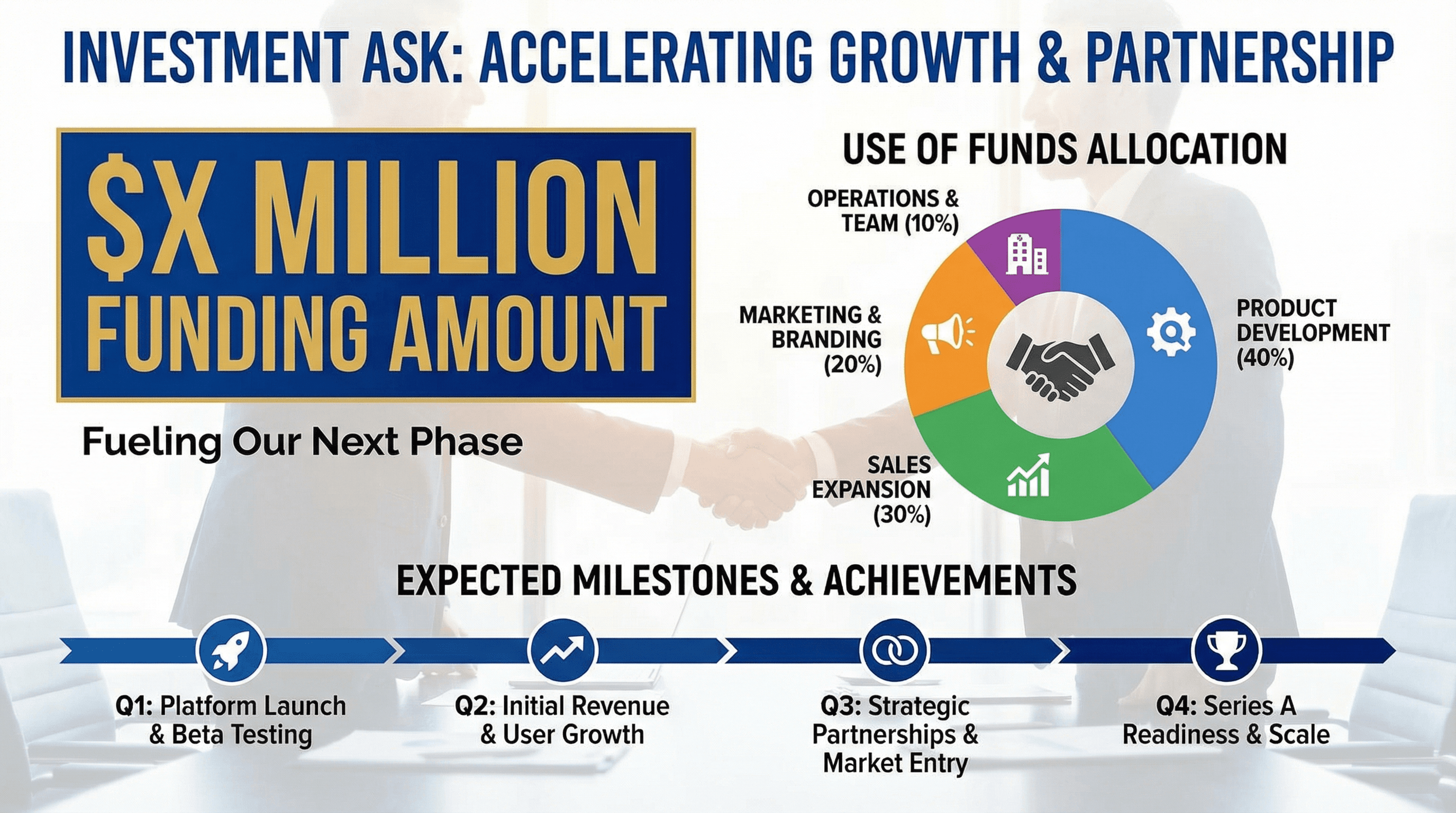
State the exact funding amount required, the structural instrument (e.g., Convertible Note, SAFE, Priced Equity Round), and the primary operational milestones this capital will unlock over an 18- to 24-month runway.
3. Pitch Strategy Breakdown Across Funding Sources
The emphasis of your pitch shifts depending on the capital provider. The following matrix details how to tailor key pitch variables:
| Funding Source | Target Focus | Key Metrics Evaluated | Typical Investment Instrument | Due Diligence Horizon |
|---|---|---|---|---|
| Angel Investors | Founder capability, market pain, early traction | CAC/LTV, initial user retention, team expertise | SAFE, Convertible Note | 2 to 6 Weeks |
| Venture Capital (VC) | Market scale, defensibility, hyper-growth potential | ARR/MRR growth rate, net revenue retention, TAM | Priced Preferred Equity | 1 to 3 Months |
| Commercial Banks | Debt coverage capability, balance sheet strength | DSCR (>1.25x), leverage ratios, collateral value | Term Loans, Lines of Credit | 2 to 8 Weeks |
| Government / Grants | Technical innovation, societal impact, R&D feasibility | Milestone achievements, research rigor, IP potential | Non-Dilutive Grant Awards | 3 to 12 Months |
| Corporate VCs (CVC) | Strategic alignment, commercial synergy, market access | Enterprise integration potential, revenue impact | Equity, Strategic Partnerships | 2 to 6 Months |
4. Mastering Verbal Delivery and Narrative Framing
A well-designed pitch deck cannot compensate for flat or disorganized verbal communication. Pitching is an act of high-stakes business communication where investors evaluate executive poise, strategic thinking, and leadership authority.
Pitch Narrative Arc: [Hook: Contextual Problem] ➔ [Traction: Proof of Concept] ➔ [Scale: The Financial Engine] ➔ [Future: The Milestone Ask]
Storytelling with Data
Frame your presentation around a clear narrative arc:
- The Hook: Frame the current state of the industry and the friction within it.
- The Shift: Show how structural shifts (technological, regulatory, or behavioral) create an opening for your solution.
- The Evidence: Use concrete metrics as empirical evidence of customer adoption and revenue velocity.
- The Vision: Paint a clear picture of how market leadership looks once funding accelerates operational capacity.
Verbal Delivery and Room Management
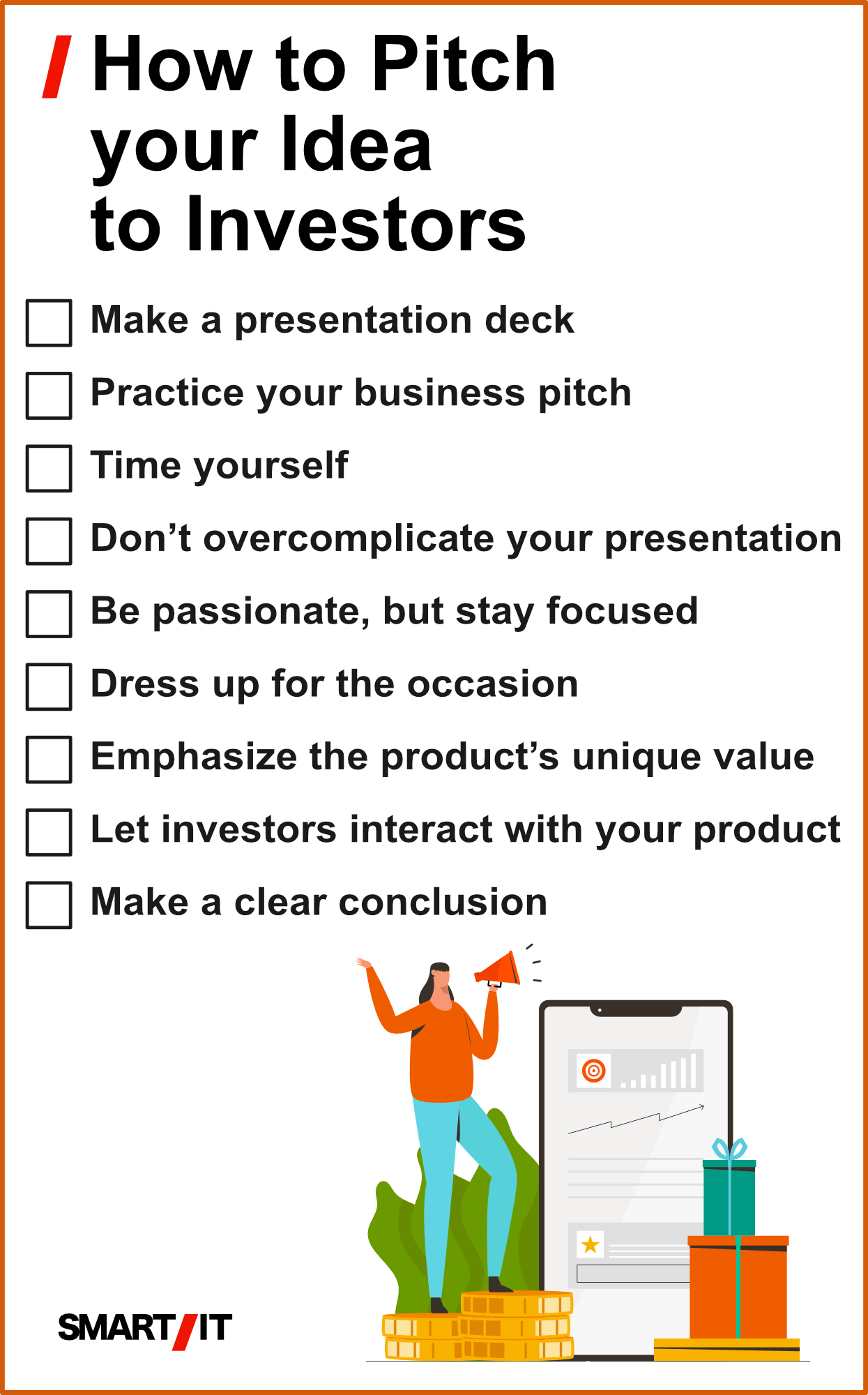
- Time Management: Aim to deliver the core deck in under 15 minutes. This leaves ample time for interactive discussion and questions, where deal terms are truly tested.
- Control the Room: Do not read slide text verbatim. Slides provide visual reinforcement, while your verbal commentary delivers context, strategic nuance, and emotional conviction.
- Pacing and Pause: Speak clearly and unhurriedly. Pausing after key metrics or strategic points signals self-assurance and allows investors to process complex data.
5. Navigating Due Diligence and Investor Q&A
The question-and-answer session following a pitch is often where funding decisions are made. Investors use Q&A sessions to test founder competence under pressure, stress-test financial assumptions, and check for hidden liabilities.
Handling Critical Questions
- Unit Economics: Be ready to defend your Customer Acquisition Cost (CAC) and Lifetime Value (LTV) formulas. Know your payback period down to the month.
- Valuation Defense: If questioned on your proposed valuation, reference comparable transaction multiples in your industry, backed by revenue growth rates, IP defensibility, and current market conditions.
- Regulatory & IP Risks: Be upfront about regulatory hurdles or patent challenges. Disclosing risks proactively builds credibility, whereas dodging risk factors signals operational unreadiness.
Preparing the Virtual Data Room
Before your first pitch meeting, organize a secure virtual data room containing supporting documentation for due diligence:
- Corporate Documents: Articles of incorporation, bylaws, cap table, and board minutes.
- Financial Records: Audited statements, detailed 3- to 5-year financial models, tax returns, and current cap table.
- Intellectual Property: Patents, trademark registrations, copyright filings, and software architecture diagrams.
- Commercial Evidence: Customer contracts, signed LOIs, customer case studies, and pipeline data.
- Legal Compliance: Material contracts, employment agreements, and regulatory filings with authorities such as the U.S. Securities and Exchange Commission.
6. Common Pitching Mistakes to Avoid
Securing capital requires avoiding errors that undermine credibility. The following pitfalls regularly cause pitches to fail:
Inflated Market Estimates
Using unverified, multi-trillion-dollar top-down market metrics creates immediate skepticism. Investors prefer realistic, bottom-up TAM derivations based on clear pricing and target customer density.
Ignoring Customer Churn
Focusing exclusively on new customer acquisition while ignoring churn hides underlying product quality or retention problems. Always present Net Revenue Retention (NRR) alongside gross growth metrics.
Unclear Capital Allocation
Pitching for capital without a clear deployment plan signals poor financial discipline. Avoid vague categories like "Marketing" or "R&D." Specify line-item expenditures, such as hiring specific engineering roles, expanding sales capacity, or securing key compliance certifications.
Misaligned Valuations
Setting an unrealistically high valuation during early rounds makes subsequent priced funding rounds difficult to close if operational performance lags. This can lead to severe down-round dilution. Realistically price your round relative to prevailing market metrics.
Pitch Preparation Checklist
[ ] Target Capital Source Identified (Angel, VC, Bank, Grant) [ ] Pitch Deck Completed (10-14 slides maximum) [ ] Financial Model Verified (3-5 year forecast with clear CAC/LTV assumptions) [ ] Bottom-Up TAM/SAM/SOM Market Calculation Prepared [ ] Virtual Data Room Populated (Cap Table, Contracts, Corporate Records) [ ] Verbal Presentation Timed (Under 15 minutes) [ ] Q&A Objections Anticipated & Defenses Practiced
Frequently Asked Questions
What is the ideal length for a pitch deck?
An institutional-grade pitch deck should typically contain between 10 and 14 slides. It must provide enough detail to prove market size, financial feasibility, product traction, and team execution capability without overwhelming investors with unnecessary operational details. Detailed technical specifications and exhaustive data belong in appendix slides or the virtual data room.
How do I pitch for funding if I have no revenue yet?
Pre-revenue founders must focus on validating market demand, founder domain authority, and technical execution capabilities. Highlight qualitative metrics such as completed working prototypes, pilot user engagement, pre-orders, signed letters of intent (LOIs), strategic industry partnerships, or proprietary intellectual property.
What is the difference between pitching to angels versus venture capitalists?
Angel investors typically invest personal funds, make investment decisions faster, and focus heavily on founder integrity, domain passion, and early product validation. Venture capitalists manage institutional funds, follow strict due diligence processes, and evaluate companies based on rapid scalability, total market opportunity, and potential fund-returning exits within a fixed investment horizon.
How do I calculate my TAM, SAM, and SOM accurately?
Avoid relying solely on broad third-party industry reports. Calculate Total Addressable Market (TAM) by determining the global number of potential customers and multiplying it by your average annual contract price. Derive Serviceable Addressable Market (SAM) based on your target geographic and operational niche. Determine Serviceable Obtainable Market (SOM) by calculating the practical market share your sales and marketing resources can capture over 3 to 5 years.
How much equity should I give up during an initial seed pitch?
While equity dilution depends on valuation and capital requirements, standard early-stage funding rounds typically dilute equity by 10% to 20%. Selling more than 25% to 30% of your company in a single early round can leave founders over-diluted for subsequent institutional rounds. This can signal poor capitalization structure to future venture capital partners.
Recommended Next Steps
To execute a successful fundraising strategy, begin by organizing your operational and financial records into a secure virtual data room. Next, build your 10-to-14 slide pitch deck, ensuring every quantitative claim is supported by bottom-up market data or internal performance metrics. Once the deck is finalized, conduct dry-run presentations before trusted mentors or advisors to refine your verbal delivery and stress-test your responses to tough due diligence questions before pitching to primary investors.
Image Gallery