When Does Boarding Close on the Stock Exchange? Order Cutoffs & Market Schedules Explained
In stock market operations, "boarding" refers to order entry cutoffs for trading sessions or operational deadlines for broker and participant onboarding. On major U.S. stock exchanges like the New York Stock Exchange (NYSE) and NASDAQ,...
In stock market operations, "boarding" refers to order entry cutoffs for trading sessions or operational deadlines for broker and participant onboarding. On major U.S. stock exchanges like the New York Stock Exchange (NYSE) and NASDAQ, regular trading closes at 4:00 PM Eastern Time (ET), but order boarding for closing auctions—specifically Market-on-Close (MOC) and Limit-on-Close (LOC) orders—closes earlier, at 3:50 PM ET on the NYSE and 3:55 PM ET on NASDAQ.
Contents
Clarifying "Boarding" in Stock Market Contexts
While the term "boarding" is most commonly associated with commercial aviation, financial market participants, institutional traders, and clearing institutions use the term across three specific trading and infrastructure processes:
- Order Onboarding & Trading Book Entry Cutoffs: The explicit cut-off times when an exchange’s automated matching engine stops accepting specific order types into the daily execution queue or closing auction pool.
- Account & Fund Onboarding Cutoffs: Daily operational deadlines enforced by broker-dealers and clearing houses for processing new customer verification (KYC/AML), wire transfer deposits, and purchasing power allocation prior to market execution windows.
- Issuer & Security Boarding: Corporate action timelines required by exchange listing departments (such as the NYSE Main Board or NASDAQ Global Select Market) to officially admit, register, and clear a company's shares for public trading.
For retail investors and institutional market participants, the primary concern is order onboarding: knowing exactly when order entry closes for regular sessions, closing cross auctions, and extended-hours trading.
Daily Trading Hours and Order Cutoff Schedules
Global stock exchanges operate within structured daily sessions designed to concentrate liquidity, maintain orderly price discovery, and facilitate multi-tiered settlement workflows. Each market enforces strict cutoffs after which standard market orders cannot be boarded onto continuous order books or auction mechanisms.
Typical U.S. Trading Day Timeline:
- 04:00 AM ET: Pre-Market Session Opens
- 09:30 AM ET: Continuous Trading Session Begins
- 03:50 PM ET: NYSE MOC Cutoff
- 03:55 PM ET: NASDAQ MOC Cutoff
- 04:00 PM ET: Regular Market Closes
New York Stock Exchange (NYSE)
The New York Stock Exchange (NYSE) operates on U.S. Eastern Time. The operational session structure includes:
- Pre-Market Session: 6:30 AM to 9:30 AM ET (with early order routing on NYSE Arca beginning at 4:00 AM ET).
- Core Trading Session: 9:30 AM to 4:00 PM ET.
- Closing Auction Boarding Cutoff: 3:50 PM ET. MOC and LOC orders intended for the official closing auction must be entered by this time. Between 3:50 PM and 4:00 PM ET, MOC and LOC orders cannot be canceled or modified except to correct a factual error, and new orders are restricted to offsetting published regulatory order imbalances.
- Extended Hours Session: 4:00 PM to 8:00 PM ET.
NASDAQ Stock Market
The NASDAQ Stock Market relies entirely on electronic execution algorithms to run its daily sessions:
- Pre-Market Session: 4:00 AM to 9:30 AM ET.
- Regular Continuous Session: 9:30 AM to 4:00 PM ET.
- Closing Cross Boarding Cutoff: 3:55 PM ET. NASDAQ enforces a strict five-minute deadline before the 4:00 PM bell for its Closing Cross. After 3:55 PM ET, MOC and LOC orders cannot be submitted, modified, or canceled, with limited exceptions for Imbalance Only (IO) orders designed to stabilize price discrepancies.
- After-Hours Session: 4:00 PM to 8:00 PM ET.
London Stock Exchange (LSE)
Operating under Greenwich Mean Time (GMT) or British Summer Time (BST), the London Stock Exchange structures its trading book cutoffs around European financial market hours:
- Regular Continuous Trading: 8:00 AM to 4:30 PM local time.
- Closing Auction Call (Order Boarding): 4:30 PM to 4:35 PM local time. Order submission remains open during this five-minute call phase, but continuous execution is halted.
- Uncrossing Phase: Random execution uncrossing occurs between 4:35 PM and 4:37 PM local time, establishing the official daily closing price.
Tokyo Stock Exchange (TSE)
The Tokyo Stock Exchange operates split daily sessions on Japan Standard Time (JST):
- Morning Session (Zenba): 9:00 AM to 11:30 AM JST.
- Midday Recess: 11:30 AM to 12:30 PM JST.
- Afternoon Session (Goba): 12:30 PM to 3:30 PM JST.
- Closing Auction (Itayose): Order entry for the afternoon closing auction occurs during the final five minutes leading up to the 3:30 PM JST close.
Global Exchange Order Cutoff Summary
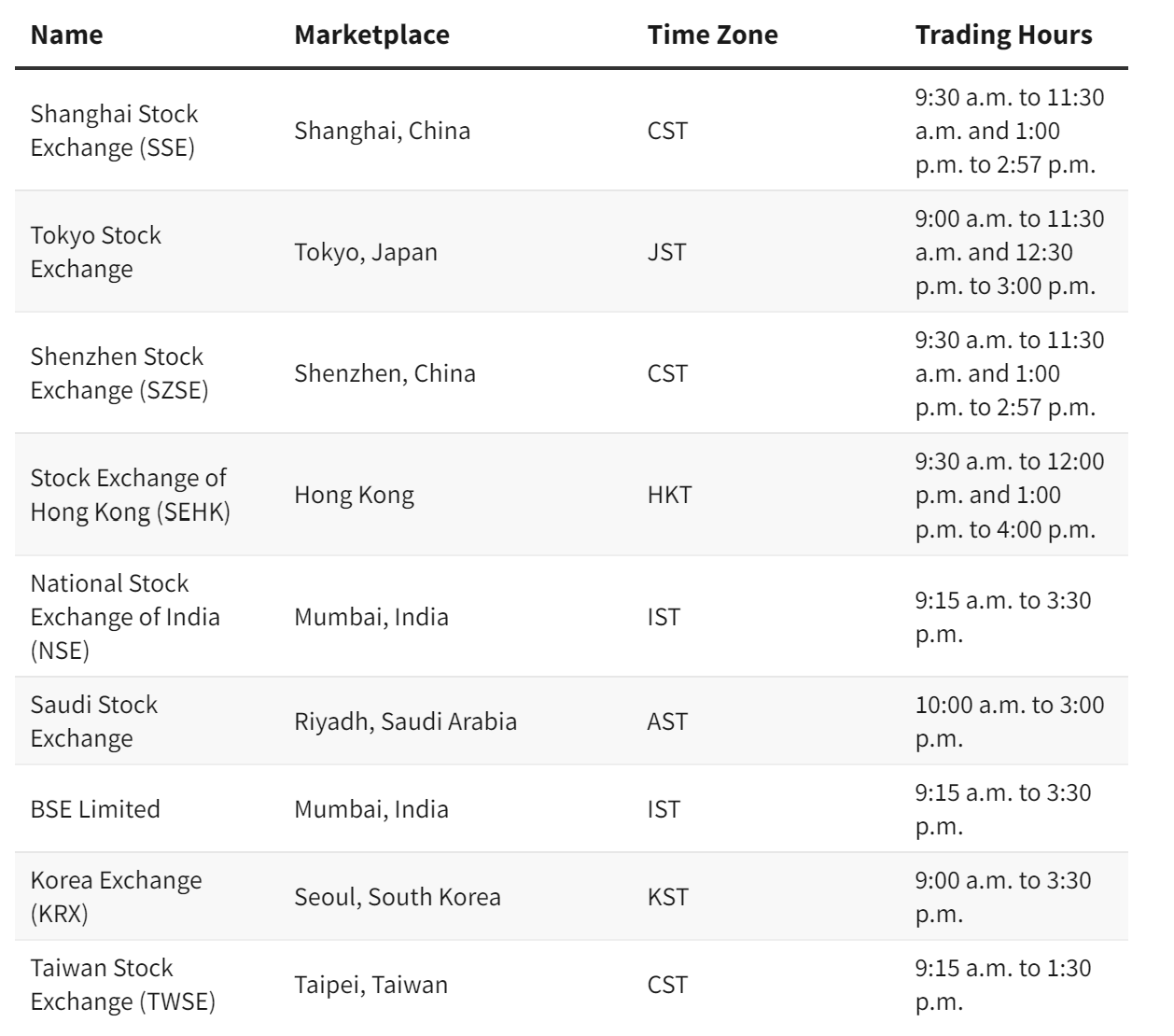
The following table summarizes regular trading hours, order boarding deadlines for closing auctions, and extended trading windows across primary international securities exchanges.
| Exchange | Country / Region | Regular Trading Hours (Local Time) | Closing Auction Order Boarding Cutoff | After-Hours / Extended Window | Daily Clearing & Settlement Cutoff |
|---|---|---|---|---|---|
| NYSE | United States (ET) | 9:30 AM – 4:00 PM | 3:50 PM ET (MOC/LOC) | 4:00 PM – 8:00 PM ET | 6:00 PM ET (DTCC Batch) |
| NASDAQ | United States (ET) | 9:30 AM – 4:00 PM | 3:55 PM ET (MOC/LOC) | 4:00 PM – 8:00 PM ET | 6:00 PM ET (DTCC Batch) |
| London Stock Exchange (LSE) | United Kingdom (GMT/BST) | 8:00 AM – 4:30 PM | 4:30 PM local (Auction Call) | 4:35 PM – 5:15 PM local | 6:00 PM local (CREST) |
| Tokyo Stock Exchange (TSE) | Japan (JST) | 9:00 AM – 11:30 AM / 12:30 PM – 3:30 PM | 3:25 PM JST | None (Off-hours ToSTNeT) | 4:00 PM JST (JSCC) |
| Hong Kong Exchange (HKEX) | Hong Kong (HKT) | 9:30 AM – 12:00 PM / 1:00 PM – 4:00 PM | 4:01 PM – 4:06 PM HKT (No-cancel after 4:06 PM) | None | 6:00 PM HKT (CCASS) |
| Euronext (Paris, Amsterdam) | Europe (CET) | 9:00 AM – 5:30 PM | 5:30 PM CET | 5:35 PM – 5:40 PM CET | 7:00 PM CET (Euroclear) |
Mechanics of Closing Auctions and MOC/LOC Cutoffs
To understand why order boarding for closing auctions closes prior to the official 4:00 PM trading bell on U.S. markets, investors must examine the mechanics of price discovery and market stability.
- Continuous Trading (09:30 AM – 03:50 PM/03:55 PM)
- Continuous Matching Engine
- Real-Time Order Book
- Imbalance Window (03:50 PM/03:55 PM – 04:00 PM)
- MOC/LOC Boarding Locked
- Imbalance Feed Disseminated
- Offsetting Orders Allowed
- Closing Cross (04:00 PM)
- Uncrossing Phase
- Single Equilibrium Price Calculated
Price Discovery and Liquidity Aggregation
The official closing price of a stock is used as the benchmark for mutual fund Net Asset Value (NAV) calculations, derivative contract settlements, index tracking calculations (such as S&P 500 or Russell 2000 rebalancing), and institutional performance metrics.
If all market participants entered large orders at 3:59:59 PM, severe volatility and order queuing bottlenecks would disrupt accurate pricing. Exchange closing auctions solve this problem by aggregating buy and sell interest into a single batch process that matches orders at one single clearing price.
Regulatory Oversight and Imbalance Dissemination
Under rules enforced by regulatory authorities like the U.S. Securities and Exchange Commission (SEC) and the Financial Industry Regulatory Authority (FINRA), exchanges publish real-time imbalance data shortly after order boarding cutoffs:
- NYSE Imbalance Information: At 3:50 PM ET, the NYSE begins broadcasting its Order Imbalance Information feed, showing net buy or sell imbalances among accumulated MOC and LOC orders.
- NASDAQ Net Order Imbalance Indicator (NOII): Starting at 3:55 PM ET, NASDAQ disseminates NOII data every second, detailing total paired shares, imbalance quantities, and indicative market-clearing prices.
Locking order boarding at 3:50 PM or 3:55 PM ET gives market makers, institutional arbitrageurs, and automated liquidity providers adequate time to evaluate these public imbalances and submit offsetting orders. This mechanism minimizes price spikes and ensures that closing prices reflect true market demand.
Brokerage & Clearinghouse Onboarding Deadlines
Beyond exchange matching engine order cutoffs, financial institutions maintain operational timelines for onboarding retail client accounts, processing settlement data, and managing margin requirements.
Retail Account Onboarding and Purchasing Power
For retail investors opening accounts or transferring capital, brokerages enforce daily processing cutoff windows:
- ACH Deposit Onboarding: Automated Clearing House (ACH) transfers requested before 4:00 PM ET are typically processed overnight for next-day availability. Requests submitted after 4:00 PM ET delay account purchasing power by an additional business day.
- Federal Wire Cutoffs: Same-day wire transfers must pass Fedwire settlement systems before 6:00 PM ET; however, most retail brokerages enforce internal deposit cutoffs of 3:00 PM or 4:00 PM ET to credit trading accounts on the same day.
T+1 Settlement Environment
Standard equity transaction settlement operates on a T+1 schedule (Trade Date plus one business day).
Under T+1 rules, institutional broker-dealers and custodians must complete post-trade allocation, trade confirmation, and continuous net settlement (CNS) batching through central clearing corporations like the Depository Trust & Clearing Corporation (DTCC) by strict evening deadlines—typically 6:00 PM to 7:30 PM ET on the trade date.
Common Pitfalls and Order Rejection Scenarios
Failing to account for exchange cutoffs leads to execution failures or unexpected order routing behavior.
1. Late Submission of Market-on-Close (MOC) Orders
If a trader attempts to enter an MOC order on NASDAQ at 3:55:05 PM ET, the order is instantly rejected by the exchange matching engine. Brokers will return an error stating that the window for closing auction entry has elapsed.
2. Unintended Execution in After-Hours Trading
If a standard day limit order is submitted after 4:00 PM ET without explicit extended-hours parameters enabled (e.g., specifying EXT or GTC + Extended), the broker's system will queue the order for execution on the next business day's 9:30 AM opening session rather than placing it immediately into the active after-hours session.
3. Order Modification Collisions During Lockout Windows
Attempting to modify the price or volume of an existing NYSE MOC order between 3:50 PM and 4:00 PM ET will result in a cancellation rejection. Once the lock-in window begins, orders cannot be adjusted unless the modification directly offsets an officially published imbalance or corrects a documented mechanical error.
Frequently Asked Questions
Can I buy or sell stock after the market closing bell?
Yes. Although regular trading session boarding closes at 4:00 PM ET on major U.S. exchanges, after-hours trading operates until 8:00 PM ET. However, extended-hours trading requires limit orders and involves lower trading volumes, wider bid-ask spreads, and increased price volatility.
What is the exact deadline to board a Market-on-Close (MOC) order?
On the NYSE, the deadline to enter an MOC order is 3:50 PM ET. On NASDAQ, the cutoff is 3:55 PM ET. After these specific times, new MOC submissions are rejected, and existing orders cannot be modified or canceled.
Why does the NYSE close MOC order boarding earlier than NASDAQ?
The NYSE utilizes a hybrid model combining electronic matching with Designated Market Makers (DMMs) on the floor to conduct manual and automated imbalance reviews. The 3:50 PM ET cutoff provides a 10-minute window for DMMs and institutional participants to evaluate complex physical and electronic order imbalances. NASDAQ operates a fully electronic matching engine (Closing Cross) that processes data within a 5-minute window starting at 3:55 PM ET.
What happens to unexecuted limit orders when trading closes at 4:00 PM ET?
Standard day orders (DAY) that remain unexecuted at the 4:00 PM ET closing bell are automatically canceled by the broker and exchange system. Good-’Til-Canceled (GTC) orders remain active in the broker’s routing infrastructure and will reopen for continuous trading during the next business day's core session.
How do holiday hours affect stock exchange order cutoffs?
On scheduled early-close trading days (such as the day after Thanksgiving or Christmas Eve in the U.S.), continuous market trading closes early at 1:00 PM ET. On these days, MOC order boarding deadlines scale back proportionally—closing at 12:50 PM ET on the NYSE and 12:55 PM ET on NASDAQ.
Practical Recommendations for Market Participants
To ensure reliable order execution and avoid exchange cutoffs:
- Schedule Closing Orders Early: Submit MOC and LOC orders well ahead of mandatory cutoffs—ideally before 3:45 PM ET for NYSE equities and before 3:50 PM ET for NASDAQ securities.
- Use Limit Orders for After-Hours Trading: If trading after 4:00 PM ET, use limit orders rather than market orders to protect against price slippage caused by lower liquidity.
- Verify Routing Parameters with Your Broker: Ensure your trading platform distinguishes clearly between standard continuous session orders, closing cross auction orders, and extended-hours orders.
- Account for Time Zone Shifts: International investors trading U.S. markets must account for Daylight Saving Time shifts (EDT vs. EST), which alter global trading hours relative to local standard times.
Disclaimer: This article is provided for informational and educational purposes only and does not constitute financial, legal, or investment advice. Market schedules, auction rules, and operational cutoffs are subject to change by respective exchange operators and governing regulatory bodies.
Image Gallery