Understanding What the USMCA Treaty Means for Trade in North America
The United States-Mexico-Canada Agreement (USMCA), which entered into force on July 1, 2020, replaces the North American Free Trade Agreement (NAFTA) as the governing framework for regional commerce. It modernizes trade rules by addres...
The United States-Mexico-Canada Agreement (USMCA), which entered into force on July 1, 2020, replaces the North American Free Trade Agreement (NAFTA) as the governing framework for regional commerce. It modernizes trade rules by addressing digital commerce, tightening automotive manufacturing requirements, and establishing stricter labor and environmental standards to ensure balanced, reciprocal trade among the three nations.
Contents
The Evolution from NAFTA to USMCA
To understand the significance of the USMCA, one must recognize it as an evolution of the 1994 NAFTA. While NAFTA succeeded in creating one of the world's largest free-trade zones, the global economy underwent radical shifts in the ensuing decades—most notably the rise of the internet, the transformation of global supply chains, and the integration of advanced manufacturing technologies.
The USMCA represents a "21st-century agreement," designed to address these realities. Unlike its predecessor, it incorporates provisions for e-commerce, intellectual property protections that keep pace with digital innovation, and updated agricultural market access. By 2026, the agreement has matured into the operational backbone for North American logistics, serving as the primary legal mechanism for cross-border movement of goods, services, and investments.
Key Pillars of the USMCA Framework
The trade treaty is structured to incentivize North American production while penalizing reliance on non-member components. Its primary impact on trade manifests through three core areas:
1. Rules of Origin and Automotive Trade
Perhaps the most technical yet consequential change in the USMCA is the updated "Rules of Origin" for the automotive sector. To qualify for duty-free treatment under the agreement, vehicles must now contain 75% of their components manufactured within North America—a significant increase from the 62.5% requirement under NAFTA.
Additionally, the USMCA mandates that 40–45% of a vehicle's content must be made by workers earning at least $16 USD per hour. This "labor value content" rule was specifically designed to bridge the wage gap between manufacturing sectors in the United States/Canada and Mexico, thereby discouraging firms from shifting production to lower-cost labor markets exclusively.
2. Digital Trade and Intellectual Property
The USMCA includes a dedicated chapter on digital trade, the first of its kind in a major trade agreement. It prohibits customs duties on digital products, such as software, e-books, and video games, distributed electronically. This ensures that the North American digital economy remains open and competitive, preventing internal tariffs from disrupting cross-border tech services.
Furthermore, the treaty strengthens intellectual property (IP) rights, providing robust protection for trademarks, patents, and copyrights. For businesses operating across borders, this reduces the legal risk associated with trade secrets and proprietary innovation, which is critical for the pharmaceutical and technology sectors.
3. Labor and Environmental Standards
The agreement introduced a "Rapid Response Mechanism" (RRM) to address labor rights violations. This allows for individual factory-level investigations regarding collective bargaining rights. If a facility is found to be in breach of labor laws, the agreement provides for the imposition of remedies, including the suspension of preferential tariff treatment for goods from that specific facility.
Comparison of Core Trade Provisions
| Provision | NAFTA (1994) | USMCA (2020–Present) |
|---|---|---|
| Auto Rules of Origin | 62.5% Regional Content | 75% Regional Content |
| Digital Trade | Not addressed | Duty-free digital goods |
| Labor Enforcement | Side agreements (weak) | Rapid Response Mechanism |
| Dairy Access | Restricted | Expanded US access to Canada |
| Sunset Clause | Indefinite | 16-year term with review |
Practical Implications for North American Businesses
For businesses operating in the United States, Mexico, or Canada, the USMCA is not merely a political document but a operational requirement. Companies must maintain meticulous records to prove their goods satisfy the "Regional Value Content" requirements. Failure to provide sufficient documentation during a customs audit can lead to the loss of duty-free status, resulting in immediate financial penalties and retroactive tariff payments.
Navigating Customs and Verification
Exporters must perform a thorough classification of their goods using the Harmonized System (HS) codes. Under the USMCA, the verification process is rigorous. Customs agencies in all three nations frequently conduct audits to ensure that the "Certificate of Origin" provided by the manufacturer is substantiated by verified supply chain data.
If a company sources raw materials from outside the North American bloc (e.g., steel or electronics from Asia), they must carefully calculate how these components impact their final product's qualification. The USMCA allows for "de minimis" thresholds, but exceeding these limits without proper regional-content accounting can lead to severe supply chain disruptions.
Challenges and Ongoing Reviews
While the USMCA provides stability, it is not without friction. Disputes over energy policies in Mexico, dairy quotas in Canada, and steel/aluminum standards remain recurring themes in 2026. These disputes are typically handled through the formal dispute settlement mechanism established by the treaty.
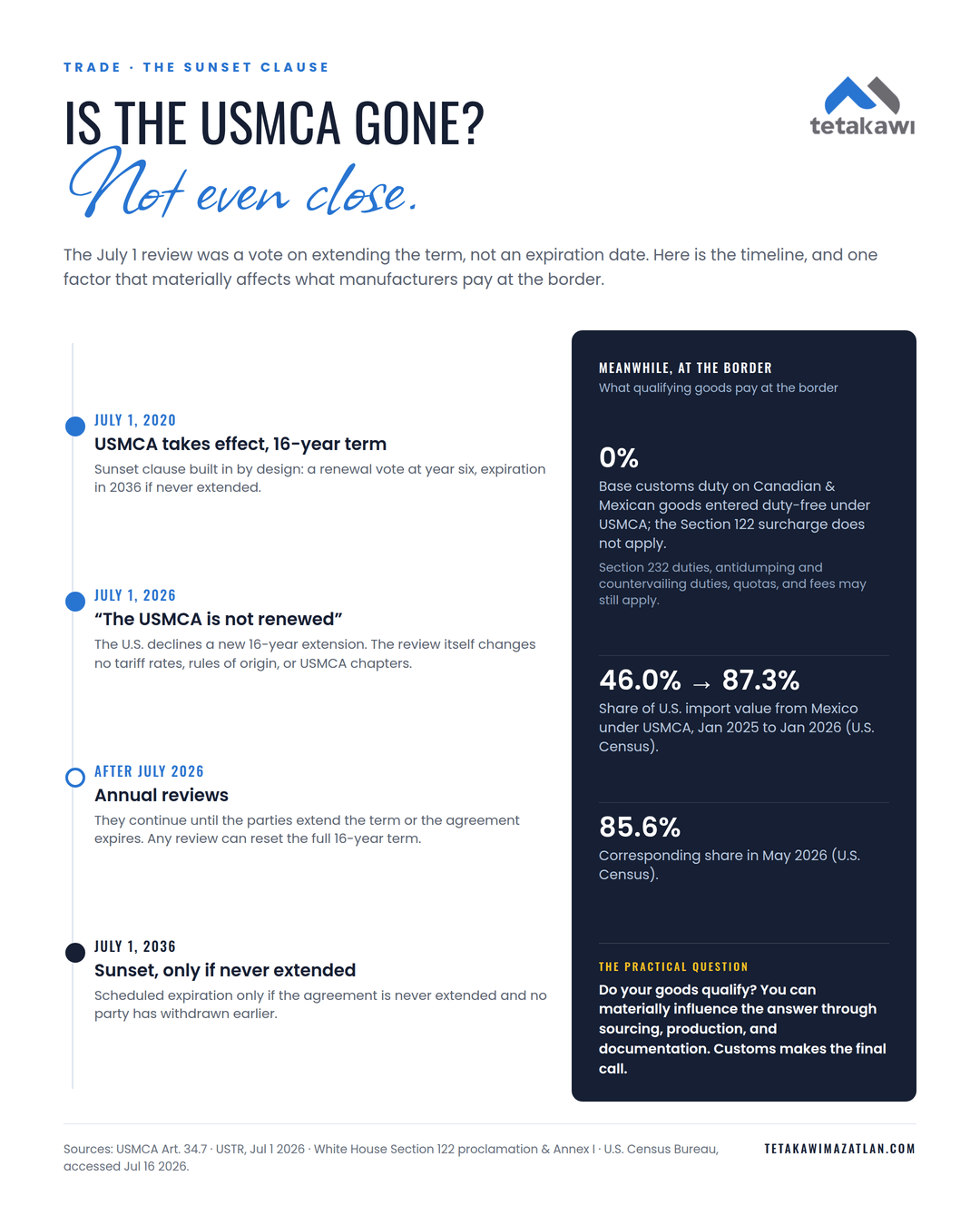
The "Sunset Clause" is another critical feature. The agreement mandates a joint review every six years, with a total duration of 16 years. This mechanism ensures that the treaty does not become obsolete. In 2026, stakeholders are focused on the effectiveness of the RRM and whether the current automotive rules are incentivizing the production of electric vehicles (EVs) effectively, or if adjustments are needed to bolster the North American battery supply chain.
Frequently Asked Questions
1. Does the USMCA remove all tariffs on trade between the three nations? Most goods that meet the specific "Rules of Origin" criteria benefit from zero tariffs. However, the agreement is not a complete removal of all trade barriers; certain sectors still face quotas, and goods that fail to meet the regional content requirements remain subject to standard duties.
2. How does the USMCA affect my small business? The agreement includes provisions specifically aimed at small and medium-sized enterprises (SMEs), such as simplified customs procedures and reduced administrative requirements for low-value shipments. However, you must still ensure your product meets the origin criteria to qualify for duty-free status.
3. What is the Rapid Response Mechanism? It is a targeted enforcement tool that allows the US or Canada to request an investigation into a specific facility in Mexico (or vice-versa) if there is suspicion that workers are being denied the right to free association and collective bargaining. It is a powerful tool for ensuring that trade advantages are not gained through the suppression of labor rights.
4. Can the USMCA be changed before its sunset date? Yes. The agreement includes a review clause every six years, which allows the three nations to discuss and negotiate amendments to the treaty. This ensures that as technologies or economic conditions evolve, the treaty remains relevant.
5. How are disputes resolved under this treaty? The USMCA established a Chapter 31 dispute settlement process. If a disagreement arises, the parties first attempt consultation. If that fails, they can request the formation of a panel to review the issue and make a binding determination, ensuring that rules are interpreted consistently across the three nations.
Strategic Next Actions
For companies looking to leverage the USMCA in 2026, the priority should be supply chain auditing. Evaluate your current list of vendors to determine the "origin" of every sub-component used in your final products. If you are a U.S.-based manufacturer relying heavily on overseas parts, consider nearshoring—shifting your supply chain to Mexico or Canada—to ensure your goods meet the 75% regional content threshold and qualify for the full benefits of the treaty. Consult with a qualified customs attorney or logistics professional to review your current documentation against updated customs requirements to avoid unexpected duties at the border.
Image Gallery