Why English Prefixes and Suffixes Matter for Campus Writing
Understanding English prefixes and suffixes allows campus writers to decode complex academic vocabulary, construct precise terms, and maintain the formal tone required in university-level essays, research papers, and lab reports. Maste...
Understanding English prefixes and suffixes allows campus writers to decode complex academic vocabulary, construct precise terms, and maintain the formal tone required in university-level essays, research papers, and lab reports. Mastering these morphological units enhances reading comprehension, prevents grammatical errors in word class selection, and improves lexical density across academic disciplines.
Contents
Morphological Awareness in Higher Education
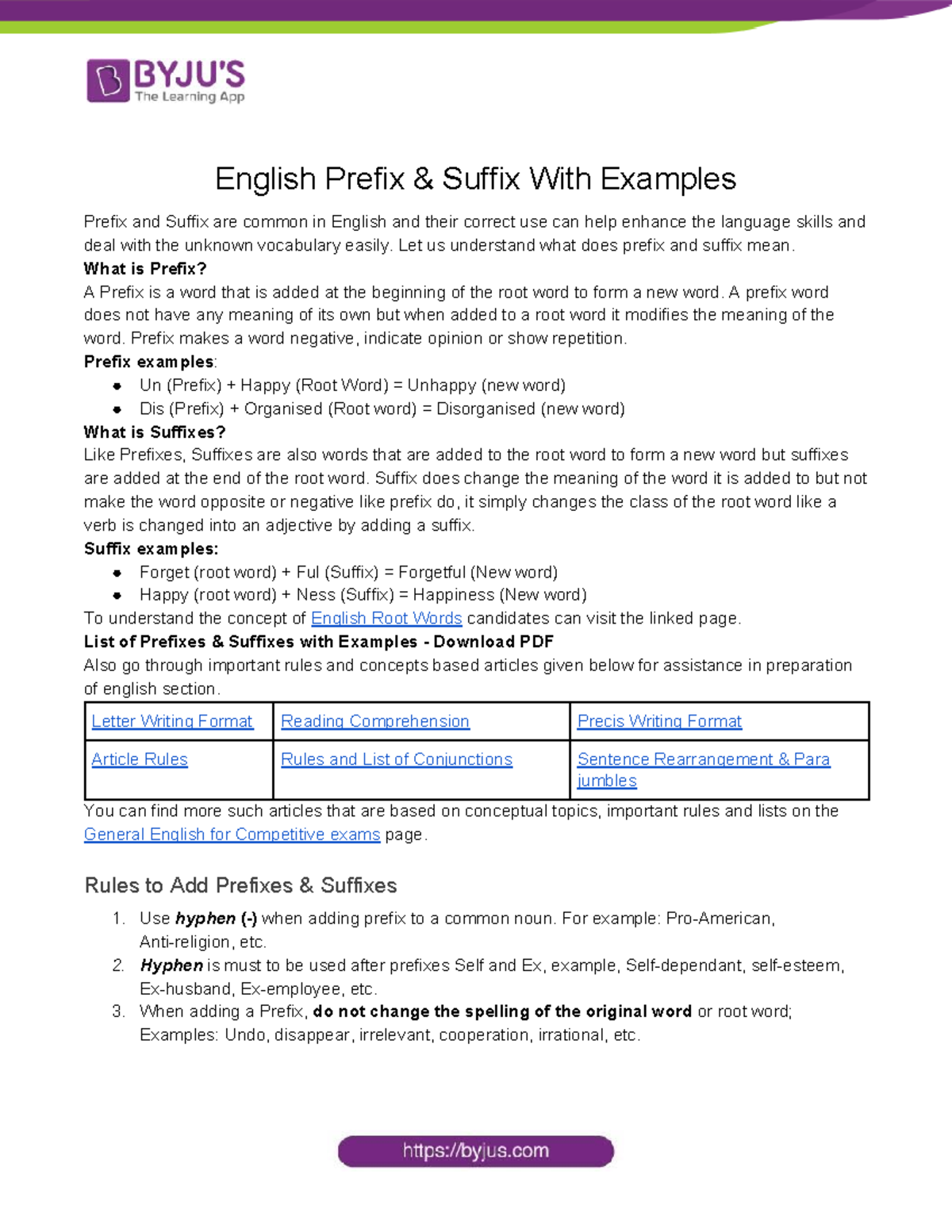
Campus writing requires a shift from informal, conversational speech to structural precision. At the heart of this transition is morphological awareness—the ability to recognize, understand, and manipulate the smallest units of meaning within words (morphemes). In academic settings, standard English draws heavily on Greek and Latin roots combined with prefixes (bound morphemes attached to the beginning of a root) and suffixes (bound morphemes attached to the end).
When students enter higher education, the vocabulary burden increases significantly. Specialized academic fields—such as molecular biology, sociological theory, and international jurisprudence—rely on dense compound terms. Rather than memorizing thousands of isolated academic words, campus writers who understand affixation can deconstruct unfamiliar terms systematically. For example, encountering the word biodegradability in an environmental science paper becomes manageable when broken into its components: bio- (life), de- (down/from), grade (step/degree), -able (capable of), and -ity (state or quality).
Beyond decoding, affixation gives student writers control over nuance. The difference between unconscious, subconscious, and nonconscious in a psychology essay hinges entirely on the prefix. Selecting the incorrect affix alters the theoretical claim, leading to ambiguity or technical inaccuracy. Mastering these subtle distinctions demonstrates academic literacy and scholarly rigor to faculty evaluators.
Transforming Word Classes with Suffixes
Suffixes serve primarily as grammatical tools that shift a word from one part of speech to another. In campus writing, this process—known as derivation—allows writers to construct complex, grammatically accurate sentences while maintaining concise syntax.
- Root: Analyze (Verb)
- Analysis (Noun)
- Analytical (Adjective)
- Analytically (Adverb)
- Analytical (Adjective)
- Analysis (Noun)
Navigating Nominalization and Lexical Density
Academic discourse demands high lexical density, meaning papers must convey substantial information using fewer, content-rich words. Derivational suffixes enable nominalization—turning verbs and adjectives into nouns. Suffixes such as -tion, -ity, -ance, -ment, and -hood convert action words into abstract concepts suitable for academic analysis.
Consider the contrast between colloquial writing and academic phrasing:
- Informal: "The committee decided to alter the policy because the researchers observed that the outcome was unstable."
- Academic: "The committee's alteration of the policy followed the researchers' observation of outcome instability."
By utilizing suffixes to form alteration, observation, and instability, the sentence adopts an objective, analytical stance. However, campus writers must balance nominalization carefully. Overusing suffixes can produce overly dense, opaque text—often called "zombie nouns"—which obscures the original subject and action.
Ensuring Grammatical Agreement Across Word Families
A frequent source of error in undergraduate essays is word-class mismatching, where a writer selects a word from the correct root family but with the wrong functional suffix.
- Incorrect: "The experimental framework showed high reliable during testing."
- Correct: "The experimental framework showed high reliability during testing."
Understanding that -able forms adjectives while -ity forms abstract nouns helps writers self-correct during revision. Recognizing these structural rules prevents syntax errors that undermine the credibility of academic arguments.
Expanding Semantic Nuance with Prefixes
While suffixes generally alter a word's grammatical class, prefixes modify its meaning. Prefixes establish logical relationships, such as negation, temporal ordering, spatial placement, direction, and magnitude. In campus writing, these modifications define hypotheses, outline methodologies, and critique existing literature.
- Spatial/Directional:
- Sub- (below)
- Inter- (between)
- Intra- (within)
- Temporal/Sequential:
- Pre- (before)
- Post- (after)
- Ante- (prior)
- Negation/Opposition:
- Un- (not)
- Anti- (against)
- Dis- (lack of)
- Quantitative:
- Mono- (one)
- Poly- (many)
- Multi- (multiple)
Precision in Literature Reviews and Methodology
In research writing, precision in spatial and temporal prefixes prevents logical fallacies. For instance, distinguishing between interdisciplinary research (collaborative work spanning multiple academic fields) and intradisciplinary work (studies conducted within a single discipline) changes the scope of a thesis statement.
Similarly, temporal prefixes clarify experimental timelines and historical analyses:
- Pre-intervention data refers to baselines established prior to an experiment.
- Post-intervention outcomes measure the effects after the variable is introduced.
- Antebellum economics restricts an analysis specifically to the period preceding a war.
Negation and Counter-Argumentation
Formulating nuanced counter-arguments requires mastery of negative prefixes, including un-, in- (and its positional variants im-, il-, ir-), non-, dis-, and a-. Each prefix carries a subtle semantic distinction:
- Amoral means completely outside the sphere of moral judgment (e.g., natural phenomena).
- Immoral implies an active violation of accepted moral codes.
- Non-moral refers to decisions where morality is irrelevant (e.g., selecting a color scheme).
Imprecise use of these prefixes can weaken an ethical analysis or philosophical essay by misrepresenting a source material's argument.
Common Morphological Challenges in Student Writing
Even experienced campus writers encounter morphological hurdles. Identifying these common errors helps students refine their editing processes.
1. Confusion of Phonetically Similar Affixes
English contains several prefixes and suffixes that sound similar but carry distinct spellings and meanings. A prominent example is the suffix pair -able and -ible. While both indicate capability, -able usually attaches to complete root words (e.g., dependable, adaptable), whereas -ible often attaches to base forms that cannot stand alone (e.g., credible, plausible).
Another frequent point of confusion occurs between the prefix in- (meaning "not" or "into") and en- / em- (meaning "to cause to be" or "put into"). Writing enflame instead of inflame, or ensure (to make certain) when insure (to protect financially) is intended, creates semantic errors that detract from scholarly tone.
2. Spelling Mutations at Morphological Boundaries
When adding suffixes to base words, specific orthographic rules apply. Dropping silent letters, changing vowels, or doubling final consonants can present challenges during drafting:
- Final 'e' Deletion: Dropping the silent -e before a suffix starting with a vowel (argue + -ment = argument; use + -able = usable).
- The 'y' to 'i' Change: Converting a final -y preceded by a consonant to an -i- before adding most suffixes (rely + -able = reliable; modify + -cation = modification).
- Consonant Doubling: Doubling the final single consonant of a stressed syllable before a vowel suffix (occur + -ence = occurrence; transfer + -ed = transferred).
3. Hyper-Correction and Invented Affixation
In an effort to sound academic, writers sometimes invent non-standard terms by attaching formal suffixes to informal roots. Words like irregardless (a double-negative combining ir- and -less), impactful, or analyzation (where analysis is the established noun form) frequently appear in student drafts. Sticking to standard dictionary forms ensures professional consistency.
Essential Prefixes and Suffixes for Campus Writing
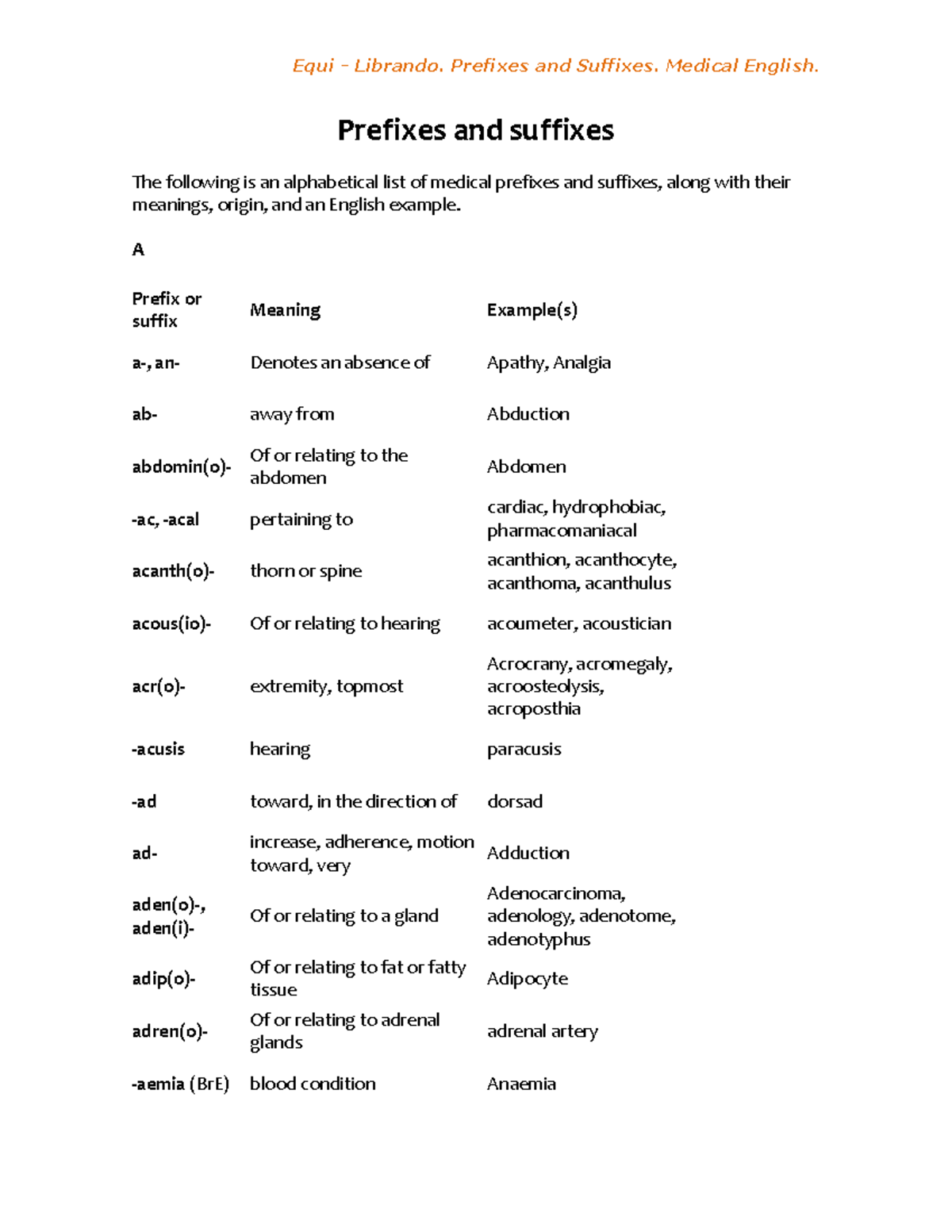
The following table details key prefixes and suffixes widely used across academic disciplines, outlining their function, meaning, and application in campus writing:
| Affix | Type | Core Meaning / Function | Academic Domain / Usage | Example in Campus Writing |
|---|---|---|---|---|
| Ante- | Prefix | Before, prior to | History / Literature | "The antecedent events outlined in the text predate the revolution." |
| Anti- | Prefix | Against, opposing | Sociology / Political Science | "The paper critiques antiglobalization movements in post-industrial states." |
| Auto- | Prefix | Self, same | Philosophy / Psychology | "Subjects demonstrated high levels of autonomous decision-making." |
| Hyper- | Prefix | Over, excessive | Medicine / Economics | "The model accounts for hyperinflationary pressures in developing markets." |
| Hypo- | Prefix | Under, deficient | Natural Sciences | "The initial hypothesis required empirical verification under lab conditions." |
| Inter- | Prefix | Between, among | International Relations | "The study measures interstate commerce regulations enacted after 1994." |
| Intra- | Prefix | Within, inside | Public Health / STEM | "Data showed significant intracellular transport during the primary phase." |
| Meta- | Prefix | Beyond, self-referential | Methodology / Research | "A comprehensive meta-analysis synthesized findings from thirty trials." |
| Mono- | Prefix | One, single | Economics / Linguistics | "The firm established a monopolistic hold on regional energy supply." |
| Poly- | Prefix | Many, multiple | Anthropology / STEM | "The compound exhibited polyvalent properties across multiple tests." |
| Sub- | Prefix | Under, secondary | Geography / Earth Sciences | "Tectonic shifting occurred in the subterranean fault lines." |
| Trans- | Prefix | Across, beyond | Literature / History | "The research traces transatlantic trade routes established in the 17th century." |
| -ance / -ence | Suffix | State or quality (Forms Nouns) | Humanities / General Academic | "The findings confirm the existence of structural economic bias." |
| -cide | Suffix | Act of killing / destroying | Biology / Environmental Studies | "The farm reduced synthetic pesticide usage to restore soil quality." |
| -ic / -ical | Suffix | Relating to (Forms Adjectives) | Social Sciences | "The author adopts an empirical approach to evaluating public policy." |
| -ify / -efy | Suffix | To make or cause (Forms Verbs) | Composition / Rhetoric | "Researchers must clarify key terminology prior to data collection." |
| -ism | Suffix | System, belief, doctrine (Forms Nouns) | Political Theory / Ethics | "The essay contrasts utilitarian consequentialism with deontological ethics." |
| -ist | Suffix | Person who practices (Forms Nouns) | Academic Disciplines | "The principal investigator logged daily observations throughout the semester." |
| -ity | Suffix | State or condition (Forms Nouns) | Hard Sciences / Math | "The material was selected due to its high thermal conductivity." |
| -ize / -ise | Suffix | To make or become (Forms Verbs) | Academic Writing | "Graduate programs encourage scholars to synthesize disparate findings." |
Practical Strategies for Mastering Affixation
Applying morphological awareness to everyday studying and drafting builds vocabulary efficiency and strengthens proofreading habits.
1. Perform Etymological Breakdowns on Course Vocabulary
When introduced to new technical terms in lectures or readings, break them into morphological components rather than memorizing whole definitions:
- Identify the root: What is the primary base word or Greek/Latin root?
- Isolate the prefix: How does it modify direction, time, number, or negation?
- Analyze the suffix: What part of speech does it create, and how does it fit into the sentence?
Maintaining a specialized glossary categorized by roots and affixes helps writers notice patterns across assigned texts.
2. Audit Word Families During Revision
During the drafting process, writers often default to repetitive vocabulary or conversational phrases. Self-editing with an eye for derivational morphology allows writers to vary syntax and improve precision.
If a paragraph feels repetitive, evaluate whether word-class shifts can streamline the text:
- Draft: "The team researched how the drug reacted. They observed the reaction and came to a conclusion that it was effective."
- Revised: "The team's investigation of the drug's reactivity yielded a conclusive assessment of its efficacy."
3. Utilize Lexicographical Resources
Online etymology dictionaries (such as the Online Etymology Dictionary or standard scholarly dictionaries like Merriam-Webster and Oxford English Dictionary) explicitly break down entries by morphological origin. Consulting these resources clarifies historical roots and ensures the correct affix is selected for academic contexts.
Frequently Asked Questions
How do prefixes and suffixes directly affect academic grades?
Professors evaluate papers based on clarity, precision, and adherence to academic conventions. Proper use of affixes ensures correct word choice (preventing confusion between nouns, adjectives, and verbs), reduces conversational wordiness, and ensures technical terms are used accurately, directly supporting higher evaluations in tone and clarity.
What is the difference between derivational and inflectional affixes?
Derivational affixes create new words or change the word's grammatical class (e.g., turning the verb observe into the noun observation). Inflectional affixes alter grammatical properties such as tense, number, or degree without changing the word class or core meaning (e.g., adding -s to form observations or -ed to form observed). Academic writing requires precise application of both, though derivational affixes have a greater impact on formal tone.
How can non-native English speakers use affixes to accelerate academic writing skills?
Non-native English speakers can leverage morphological rules to expand their passive and active vocabulary exponentially. By learning a single root word along with common prefixes (un-, re-, in-) and suffixes (-tion, -ity, -able), students can recognize and accurately use dozens of related terms without having to memorize each word independently.
Are there cases where suffixes should be avoided in campus writing?
Yes. Over-nominalization—attaching heavy suffixes to create abstract nouns when clear active verbs would be more direct—can make academic writing dense, passive, and difficult to read. Aim for a balanced style that utilizes clear abstract nouns for concepts while retaining active verbs for core actions.
Next Steps for Campus Writers
To immediately apply these morphological insights to your current writing assignments, take the following concrete actions:
- Review your current draft for repetitive root words: Use a highlighter to mark recurring roots in your writing, then check if shifting word classes via derivational suffixes improves sentence variety and flow.
- Audit your technical terminology: Double-check unfamiliar academic terms in a dictionary to ensure negative prefixes (in- vs. un- vs. non-) and structural suffixes (-able vs. -ible) are spelled correctly.
- Build a discipline-specific affix list: Record recurring prefixes and suffixes from your course readings into a dedicated reference sheet to streamline future research writing.
Image Gallery