New Dinosaur Species Discovered in South Korea: A 2026 Paleontological Overview
As of 2026, South Korea has firmly established itself as a premier global destination for Cretaceous paleontology, following the recent description of Minicursor chonhyangi and updated findings regarding the Koreanosaurus lineage. Thes...
As of 2026, South Korea has firmly established itself as a premier global destination for Cretaceous paleontology, following the recent description of Minicursor chonhyangi and updated findings regarding the Koreanosaurus lineage. These discoveries, primarily centered in the Gyeongsang Basin, reveal a diverse ecosystem of small-bodied ornithopods and basal ceratopsians that occupied unique ecological niches in East Asia approximately 120 to 80 million years ago.
Contents
For decades, the Korean Peninsula was renowned almost exclusively for its abundance of dinosaur trackways—thousands of footprints preserved in coastal mudflats. However, the 21st century has seen a dramatic shift toward skeletal discoveries. These finds are not merely additions to a global catalog; they represent transitional evolutionary stages that help scientists understand how dinosaurs migrated across the Tethys Ocean and adapted to the specific environments of the East Asian landmass.
The Geological Context: Why South Korea is a Fossil Goldmine
To understand why new dinosaur species continue to emerge in South Korea, one must look at the Gyeongsang Supergroup. This massive geological unit consists of thick layers of sedimentary rocks deposited during the Cretaceous period. During this era, the Korean Peninsula was not a peninsula but part of the interior of the Asian continent, characterized by vast river systems, seasonal lakes, and volcanic activity.
The preservation of fossils in this region is primarily found within three major formations:
- The Hasandong Formation: Dating back to the Early Cretaceous (Aptian-Albian), this layer has yielded some of the most significant skeletal remains, including the recently celebrated Minicursor.
- The Seonsan Formation: Known for its high concentration of articulated remains and diverse micro-fossils.
- The Wando and Uhangri Formations: These are more famous for their tracks, including those of pterosaurs and early birds, though occasional skeletal fragments continue to surface during 2025–2026 excavations.
The environment was a mix of floodplains and lacustrine (lake) settings. This was ideal for the rapid burial of small animals, which is why Korea is particularly famous for its "miniature" dinosaurs. Unlike the towering giants found in North America or Mongolia, many Korean species were small, agile, and adapted to dense vegetation or semi-aquatic lifestyles.
The Recent Star: Minicursor chonhyangi
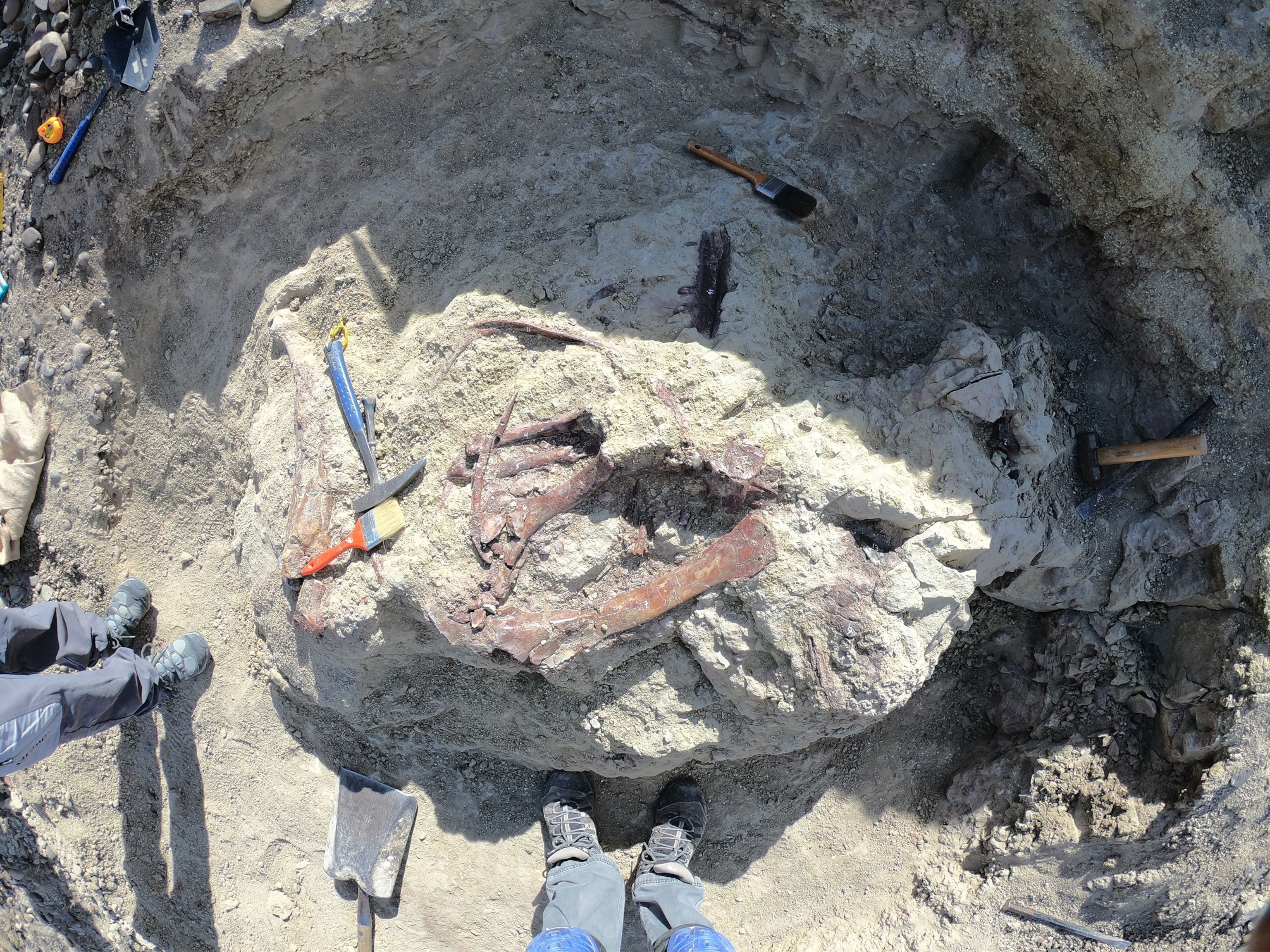
Described formally just prior to the current 2026 research cycle, Minicursor chonhyangi represents a breakthrough in understanding the diversity of basal ornithopods. Found in the Hasandong Formation of Hadong County, the specimen is remarkably complete, including nearly 50% of the skeleton with well-preserved limb bones.
Anatomy and Lifestyle
Minicursor was a small, bipedal herbivore. Its name, which translates to "small runner," is a nod to its specialized hind limbs. Analysis of the femur and metatarsals indicates that this dinosaur was built for high-speed locomotion, likely an evolutionary adaptation to evade the larger theropods that roamed the Gyeongsang Basin.
The holotype specimen is a juvenile, roughly the size of a modern turkey, though adults likely reached lengths of 1.5 to 2 meters. Its discovery is significant because it provides a "missing link" between the more primitive ornithopods of the Middle Jurassic and the more advanced iguanodontians of the Late Cretaceous.
Scientific Impact
The presence of Minicursor in the Early Cretaceous of Korea suggests that small ornithopods remained a dominant and diverse group in Asia long after they began to be replaced by larger herbivores in other parts of the world. This reinforces the theory of "Asian Refugia," where certain dinosaur lineages persisted in isolated or specialized habitats across the Asian continent.
Koreaceratops: The Swimming Ceratopsian
No discussion of Korean dinosaurs is complete without Koreaceratops hwaseongensis. While discovered earlier, 2026 research using advanced 3D modeling has provided new insights into its controversial lifestyle. Found in Hwaseong City, this species is one of the most primitive ceratopsians (horned dinosaurs) ever discovered.
The Aquatic Hypothesis
The most striking feature of Koreaceratops is its tail. The neural spines on its caudal vertebrae are exceptionally tall, forming a paddle-like structure. In 2026, biomechanical simulations conducted by the Korea Institute of Geoscience and Mineral Resources (KIGAM) suggested that this tail was likely used for propulsion in water. This makes Koreaceratops one of the few dinosaurs suspected of having a semi-aquatic lifestyle, potentially swimming across the seasonal lakes of the Cretaceous Gyeongsang Basin to reach food sources or escape land-based predators.
Koreanosaurus boseongensis: The Burrower
Found in the Late Cretaceous deposits of Boseong, Koreanosaurus boseongensis offers a different ecological perspective. This dinosaur was an ornithopod, but unlike the fleet-footed Minicursor, it was built for power.
Morphological Distinctions
Koreanosaurus possessed exceptionally strong forelimbs and a robust scapula (shoulder blade). These traits are rarely seen in bipedal ornithopods and are more characteristic of fossorial (burrowing) animals. Paleontologists believe Koreanosaurus may have used its powerful arms to dig burrows for nesting or protection against the fluctuating temperatures of the Late Cretaceous. This discovery shifted the narrative of dinosaur behavior, proving that their ecological roles were far more complex than simple browsing or hunting.
Comparison of Key Korean Dinosaur Species
The following table summarizes the primary dinosaur species discovered in South Korea that have shaped the current 2026 paleontological landscape.
| Species Name | Classification | Estimated Size | Era | Primary Location | Key Feature |
|---|---|---|---|---|---|
| Minicursor chonhyangi | Basal Ornithopod | 1 - 2 Meters | Early Cretaceous | Hadong County | Specialized runner; highly complete juvenile skeleton. |
| Koreaceratops hwaseongensis | Basal Ceratopsian | 2 Meters | Early Cretaceous | Hwaseong City | Paddle-like tail; potential semi-aquatic lifestyle. |
| Koreanosaurus boseongensis | Ornithopod | 2 - 2.5 Meters | Late Cretaceous | Boseong County | Robust forelimbs; suspected burrowing behavior. |
| Pukyongosaurus millenniumi | Sauropod | 15 - 20 Meters | Early Cretaceous | Pukyong Region | Rare Korean giant; titanosauriform characteristics. |
| Dromaeosaurid (unnamed) | Theropod | 1.5 Meters | Early Cretaceous | Various Sites | Razor-sharp "sickle" claws; evidence of pack hunting. |
The Role of Trackways in New Species Identification
While skeletal remains are the "gold standard" for identifying new species, South Korea’s trackway record is arguably the best in the world. In 2026, ichnology (the study of trace fossils) continues to be the primary method for identifying the presence of species that have not yet left behind bones.
In sites like Goseong, thousands of footprints provide evidence of:
- Small Theropods: Hundreds of "Minisauripus" tracks show that tiny, bird-like dinosaurs were the most common predators in the region.
- Pterosaurs: The Hwaseong and Haenam sites have yielded some of the world's largest and most detailed flying reptile tracks, some showing unique walking gaits that have led to the proposal of new pterosaur genera.
- Cretaceous Birds: Korea holds the record for some of the oldest and most diverse avian footprints, helping scientists map the transition from dinosaurs to birds.
The 2026 technological integration of LiDAR scanning and AI-driven gait analysis has allowed researchers to "predict" the skeletal structure of the animals that made these tracks. This has led to the tentative identification of several "ghost lineages"—groups of dinosaurs known to have lived in Korea based on their tracks but whose bones have yet to be found.
Paleontology and Technology in 2026
The search for new dinosaur species in Korea has been accelerated by the "K-Paleo" initiative, a government-funded project aimed at digitizing all fossil sites. By 2026, several key advancements have changed how discoveries are made:
Non-Invasive Excavation
Using ground-penetrating radar (GPR) and high-resolution CT scanning, paleontologists in Korea can now visualize fossils still embedded in hard sandstone. This is particularly vital in Hwaseong, where fossils are often found in extremely hard sedimentary blocks that are difficult to prep manually.
Virtual Reconstruction
The 2026 unveiling of the "Virtual Cretaceous Korea" museum allows the public to interact with 1:1 scale digital twins of Minicursor and Koreaceratops. These models are updated in real-time as new biomechanical data becomes available, making the science of paleontology more accessible and transparent.
Challenges in Korean Paleontology
Despite the wealth of discoveries, finding new species in Korea remains difficult. The primary challenge is the geological nature of the peninsula. Much of the fossil-bearing rock is located in coastal areas subject to heavy erosion or in urban zones where rapid construction can inadvertently destroy sites before they are identified.
Furthermore, Korean fossils are often "fragmentary." Due to the high-energy river environments of the Cretaceous, skeletons were frequently scattered before fossilization. This requires paleontologists to be experts in "micro-paleontology," identifying entire species from a few teeth or a single jawbone.
Future Outlook: The Next Frontier
As we move through 2026, the focus has shifted toward the offshore islands and the DMZ (Demilitarized Zone). Recent surveys along the southern islands have revealed untapped sedimentary layers that mirror the Gyeongsang Basin. There is significant optimism that these undisturbed areas may hold the remains of larger theropods—the predators that hunted Minicursor and Koreanosaurus.
Additionally, international collaboration between South Korea, China, and Mongolia is at an all-time high. By comparing the Korean "miniatures" with the Mongolian "giants," scientists are piecing together a comprehensive map of dinosaur evolution across the entire Asian continent.
FAQs About Korean Dinosaur Discoveries
Are there any T-Rex relatives found in Korea?
While a Tyrannosaurus rex has not been found in Korea, several teeth and bone fragments belonging to megalosaurids and allosauroids have been discovered. In the 2020s, evidence of smaller tyrannosauroids—the earlier, smaller cousins of T-Rex—was identified through trackway evidence and isolated teeth in the Gyeongsang Basin.
Why are many Korean dinosaurs smaller than those found in the USA?
The dinosaurs found in Korea, such as Minicursor, tend to be smaller due to the specific paleoenvironment. The region featured dense forests and complex river systems that favored agile, smaller herbivores. Additionally, many of the most famous Korean specimens found so far have been juveniles, though even adult specimens of Koreaceratops suggest a trend toward smaller body sizes compared to North American counterparts.
Can I visit the sites where these new species were found?
Yes. South Korea has developed world-class facilities for "paleo-tourism." The Hwaseong Dinosaur Egg Fossil Site and the Goseong Dinosaur Museum offer public access to trackways and replicas of the skeletal finds. The Boseong site also features an interpretive center focused on the Koreanosaurus.
What is the most common dinosaur fossil found in Korea?
Footprints are by far the most common fossil. South Korea is often called the "Dinosaur Track Capital of the World." Skeletal remains are much rarer, making every new discovery like Minicursor a major international event.
How do scientists name these new species?
Species are typically named using a combination of Latin or Greek and Korean local names. For example, Koreaceratops hwaseongensis is named after the country (Korea), the group (ceratopsian), and the specific city (Hwaseong) where it was found. Minicursor chonhyangi honors "Chonhyang," a name associated with local cultural heritage.
Practical Recommendations for Enthusiasts
For those looking to follow the latest developments in 2026, it is recommended to monitor the official publications of the Paleontological Society of Korea and the Korea Institute of Geoscience and Mineral Resources (KIGAM). If you are visiting South Korea, the National Science Museum in Daejeon currently houses the most comprehensive collection of original skeletal material, including the holotype of Koreanosaurus. Always ensure you visit official UNESCO-recognized sites to support the preservation of these rare Cretaceous landmarks.
Image Gallery