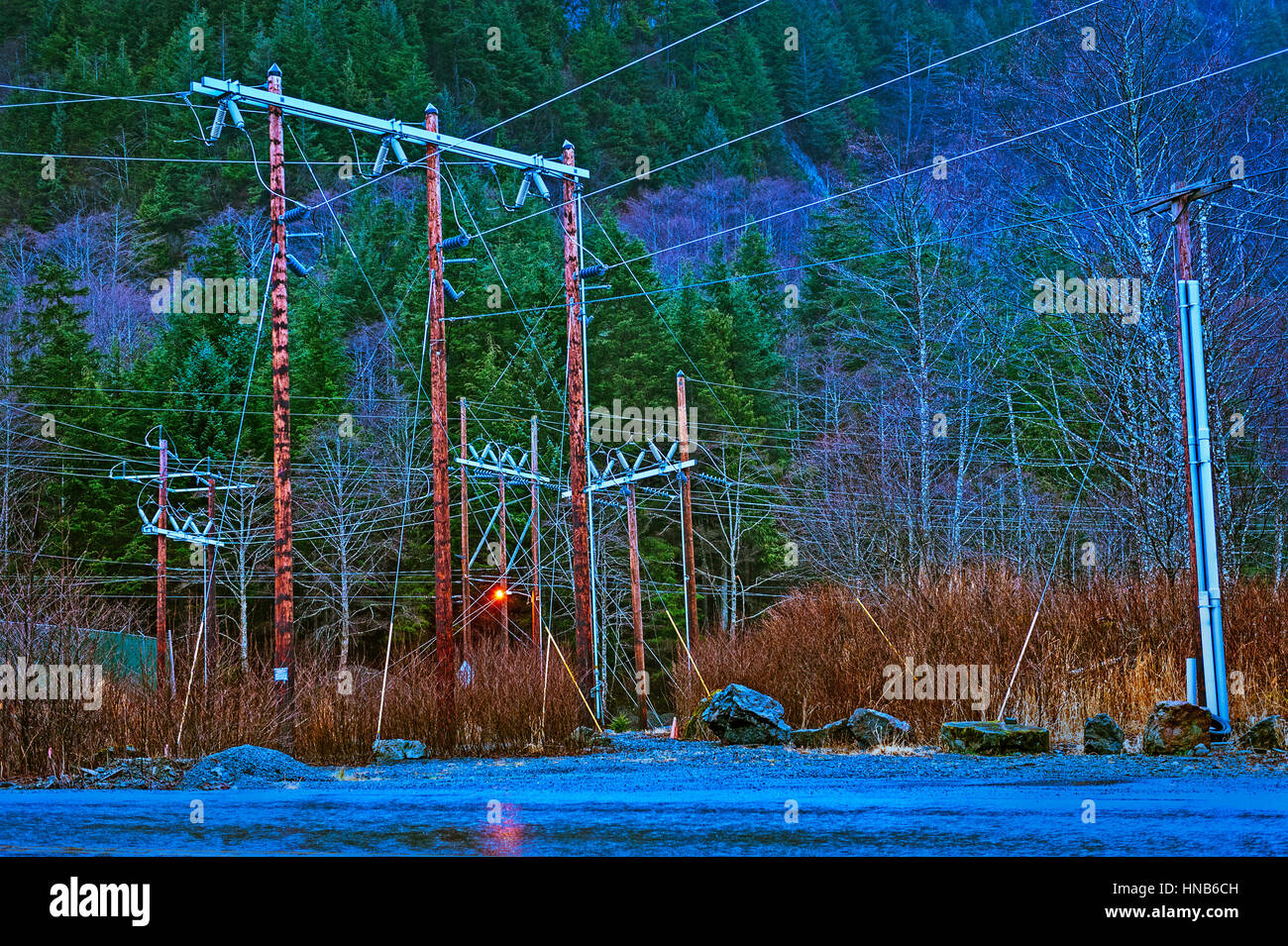
Managing Power and Ice: Alaskan Power Lines in Extreme Conditions
Alaskan utility infrastructure faces relentless challenges from severe arctic weather, where extreme temperatures and high-humidity wind events create dangerous ice accretion on power lines. Operators manage these risks through special...
Alaskan utility infrastructure faces relentless challenges from severe arctic weather, where extreme temperatures and high-humidity wind events create dangerous ice accretion on power lines. Operators manage these risks through specialized mechanical design, automated ice-melting technologies, and rigorous vegetation management to ensure grid stability across the state's vast, remote, and unforgiving landscape.
Contents
The Physics of Ice Accretion on Electrical Grids
In Alaska, ice buildup on conductors is not a singular phenomenon but a combination of atmospheric conditions. When sub-freezing temperatures coincide with high-moisture air—common in coastal regions and near mountainous passes—supercooled water droplets strike transmission lines. Upon contact, they freeze instantly, forming either rime ice (opaque, granular, and brittle) or glaze ice (clear, heavy, and extremely dense).
The danger to electrical infrastructure is twofold: mechanical stress and electrical failure. Glaze ice can accumulate to several inches in diameter, increasing the weight of a transmission line by hundreds of pounds per span. This excessive load forces towers to bear structural stresses that often exceed their original design capacity. Simultaneously, as ice builds up, it changes the aerodynamic profile of the conductor, leading to a phenomenon known as "galloping." Galloping occurs when wind flows over the iced line, causing low-frequency, high-amplitude vibrations that can snap lines, shatter insulators, and collapse support structures.
Infrastructure Design for Extreme Loads
Engineers in Alaska utilize specialized design standards to mitigate these risks. Unlike standard utility construction in lower latitudes, Alaskan power lines are frequently constructed using reinforced steel lattice towers or ductile iron poles that provide higher structural tolerance for bending moments.
Line tensioning is another critical design element. During the planning phase, utilities factor in the "ice load" based on historical regional data, adjusting the sag of the lines to accommodate the weight of ice without causing the lines to make contact with trees or the ground. Furthermore, the selection of conductor materials—such as high-strength aluminum-steel reinforced cables (ACSR)—is prioritized to ensure that the material can handle both the extreme tensile pull caused by ice and the material contraction induced by temperatures that frequently drop below -40°F.
Operational Strategies and Mitigation Technologies
When icing events occur, utilities cannot rely solely on passive design. Active mitigation strategies are deployed to clear existing ice or prevent its formation.
- High-Current De-icing: By adjusting the grid load or intentionally creating a temporary short-circuit configuration, operators can run high levels of current through the lines. The resistive heating (Joule heating) raises the temperature of the conductor, causing the ice to melt or lose its bond with the metal.
- Mechanical Removal: In accessible areas, specialized crews may use insulated rods or mechanical vibrators to knock ice off conductors. However, given Alaska’s remote terrain, this is often impractical, making automated solutions a priority.
- Hydrophobic Coatings: Some experimental applications involve the use of specialized coatings on conductors that reduce surface energy, making it difficult for ice crystals to adhere. While promising, the longevity of these coatings in high-abrasion wind conditions remains a maintenance challenge.
Vegetation Management and Right-of-Way
One of the most effective methods for preventing power outages during icing events is proactive vegetation management. In Alaska, even healthy trees can become hazards when heavy ice causes limbs to snap or whole trunks to bend into lines. Utilities maintain wide "rights-of-way"—cleared paths of land beneath power lines—to ensure that if a line drops or if a tree fails under the weight of ice, the electrical infrastructure is not compromised. In 2026, the focus has shifted toward predictive modeling, using satellite imagery and Lidar to identify high-risk vegetation zones that are most likely to fail during extreme weather events.
Comparative Analysis of Grid Hardening Techniques
| Strategy | Primary Mechanism | Best For | Operational Complexity |
|---|---|---|---|
| Structural Hardening | Reinforced towers/cables | Long-term resilience | High (Capital intensive) |
| High-Current Heating | Joule heating | Rapid ice removal | Moderate (Grid control) |
| Vegetation Management | Clearing clearance zones | Preventing physical damage | Constant (Recurring cost) |
| Grid Automation | Real-time sensor monitoring | Early warning/response | High (Technology dependent) |
Monitoring and Sensors in Remote Terrain
Because much of Alaska’s grid spans inaccessible wilderness, utilities rely heavily on sensor technology to monitor the "health" of the line. Tension sensors, accelerometers, and meteorological stations are installed at regular intervals along critical segments. These devices transmit real-time data to control centers, allowing grid operators to detect when ice accumulation reaches a threshold that threatens structural integrity.
By 2026, many operators have integrated satellite-based monitoring to complement ground sensors. This allows for a holistic view of the grid, ensuring that crews can be dispatched precisely to the locations where ice accretion is most severe, rather than relying on reactive patrolling, which is both dangerous and time-consuming in arctic conditions.
Frequently Asked Questions
Why do power lines in Alaska fall during ice storms if they are designed for cold weather? Most lines are designed for specific extreme loads. If the ice accumulation exceeds the "worst-case scenario" projection used during the design phase, the physical weight of the ice causes the conductors to snap or the towers to buckle.
How do utilities safely melt ice off a live transmission line? Utilities use "load maneuvering" to divert power from other lines into the ice-covered segment. The increased current creates heat in the wire, melting the ice. This is a delicate process that requires precise grid balancing to avoid causing outages elsewhere.
What is the difference between rime ice and glaze ice regarding power lines? Rime ice is porous and light, often blowing off easily, whereas glaze ice is dense and clings tightly to the metal. Glaze ice is significantly more dangerous because it is heavy and creates a structural bond with the conductor.
How often do Alaskan utilities clear their rights-of-way? The frequency is based on the growth rate of local species and line importance. High-voltage transmission corridors are inspected annually and cleared on a rotating cycle, usually every 3 to 7 years, to ensure that no limbs can reach the wires under heavy ice loads.
Can drone technology help manage ice on Alaskan power lines? Yes, drones are increasingly used for inspections. They allow utility crews to visualize ice levels and structural damage in remote areas without risking human lives in helicopters or on the ground during extreme winter conditions.
Next Actions for Grid Stability
For utility managers and stakeholders, the primary recommendation is the continued integration of automated weather-sensing networks. Combining real-time meteorological data with mechanical grid-hardening ensures that the response to icing is proactive rather than reactive. If you are overseeing infrastructure, prioritize the replacement of aging conductors with higher-strength, modern alloys that are specifically certified for high-ice-load regions, and continue to expand clearing zones in areas identified as high-risk by Lidar mapping.
Image Gallery