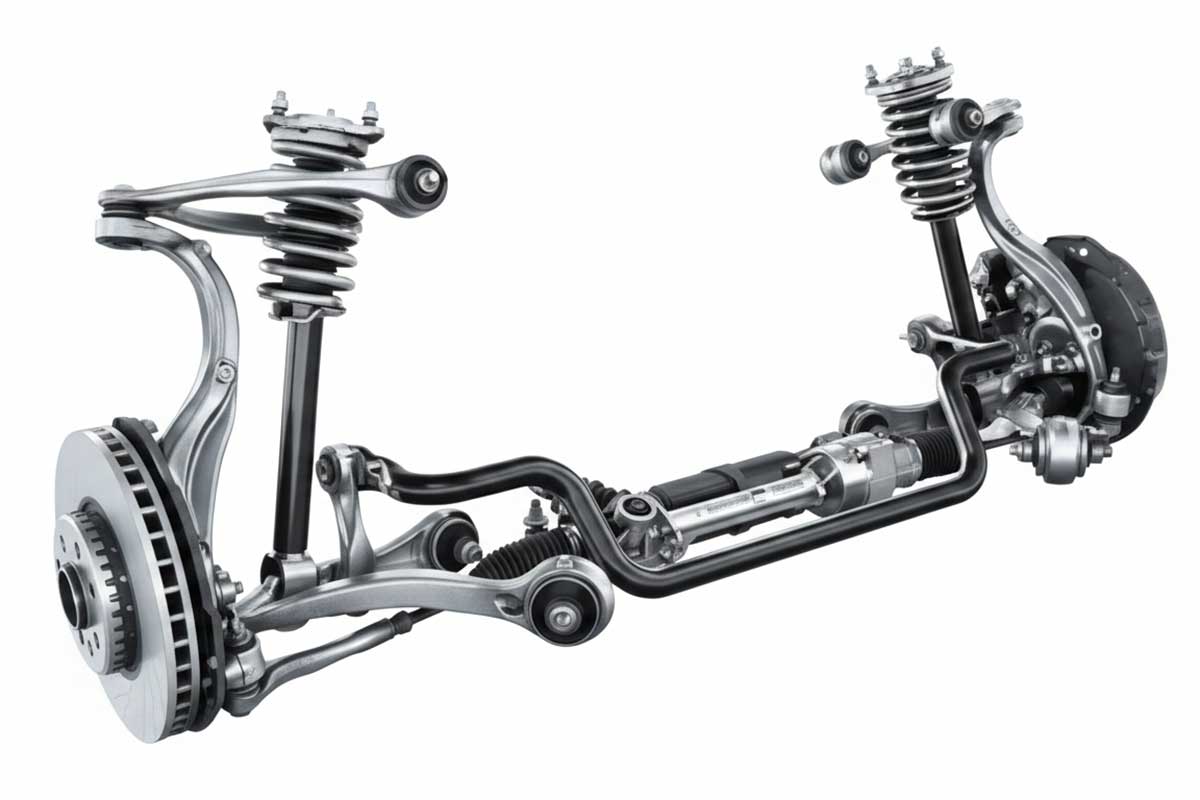
What is a Wishbone Suspension? Components, Mechanics, and Advantages
A wishbone suspension is an independent automotive suspension design that utilizes two wishbone-shaped arms (also known as A-arms) to locate the wheel. Each arm has two mounting points to the vehicle chassis and one joint at the wheel...
A wishbone suspension is an independent automotive suspension design that utilizes two wishbone-shaped arms (also known as A-arms) to locate the wheel. Each arm has two mounting points to the vehicle chassis and one joint at the wheel knuckle. This configuration allows for precise control over wheel motion, maintaining optimal tire contact with the road during cornering and suspension travel.
Contents
The wishbone suspension, particularly the "double wishbone" variant, is widely regarded by automotive engineers as one of the most effective systems for balancing ride comfort with high-performance handling. Unlike simpler systems that may compromise wheel alignment as the suspension moves up and down, the geometry of a wishbone setup can be tuned to keep the tire perpendicular to the road, maximizing grip. As of 2026, this design remains the gold standard for sports cars, luxury sedans, and heavy-duty electric vehicles (EVs) that require robust handling characteristics to manage significant battery weight.
The Anatomy of a Wishbone Suspension System
To understand how a wishbone suspension functions, one must look at its primary components. The term "wishbone" comes from the shape of the control arms, which resemble the furcula bone of a bird. In a standard double-wishbone setup, the system consists of the following key parts:
Upper and Lower Control Arms
These are the heart of the system. The upper control arm is typically shorter than the lower control arm. This "unequal length" design is intentional; it ensures that as the suspension compresses (jounce), the top of the wheel pulls inward. This creates "negative camber," which counteracts the natural tendency of a tire to roll onto its outer edge during a hard turn.
The Steering Knuckle (Upright)
The steering knuckle is the component that holds the wheel hub and allows the wheel to turn. Both the upper and lower wishbones attach to the knuckle via ball joints. These joints act as pivots, allowing the knuckle to move vertically with the road surface and rotate for steering input.
Coil Springs and Shock Absorbers
In a wishbone setup, the coil spring and shock absorber (damper) are usually combined into a single unit, often called a coil-over. This unit is typically attached to the lower wishbone and the chassis. Because the wishbones handle the lateral and longitudinal forces, the shock absorber is free to focus entirely on controlling vertical movement and damping vibrations, which leads to superior ride quality.
Bushings and Ball Joints
Bushings are used at the points where the wishbones meet the vehicle's frame. In 2026, most production vehicles use high-density rubber or polyurethane bushings to isolate the cabin from road noise and vibration (NVH). High-performance applications may use spherical bearings (pillow blocks) to eliminate deflection, providing the driver with more direct feedback at the expense of comfort.
How Wishbone Geometry Works: The Kinematics
The primary reason engineers choose a wishbone suspension is for its superior kinematic control. Kinematics refers to the motion of the components without considering the forces that cause them.
When a car enters a corner, centrifugal force causes the body to lean (roll). In a basic suspension system, this lean would cause the tires to tilt with the car, reducing the amount of tread touching the pavement. The wishbone system solves this through camber gain.
By calculating the specific lengths and mounting angles of the upper and lower arms, engineers can ensure that the wheel's angle relative to the ground remains nearly constant even as the car's body rolls. This keeps the tire's "contact patch" flat against the road, providing maximum lateral grip.
Additionally, the wishbone design allows for the independent tuning of:
- Caster Angle: The forward or backward tilt of the steering axis, which affects straight-line stability and steering feel.
- Roll Center: The theoretical point around which the body rolls. A double-wishbone setup allows engineers to place the roll center precisely to minimize body roll without needing excessively stiff springs.
- Anti-Dive and Anti-Squat: By angling the wishbone pivots, engineers can prevent the front of the car from "diving" under heavy braking and the rear from "squatting" under hard acceleration.
Double Wishbone vs. MacPherson Strut
The MacPherson strut is the most common suspension type found in modern cars due to its simplicity and low cost. However, the wishbone suspension offers several technical advantages over the strut design.
| Feature | Double Wishbone Suspension | MacPherson Strut Suspension |
|---|---|---|
| Design Complexity | High (Two arms, more joints) | Low (One arm, one strut) |
| Camber Control | Excellent (Optimized through travel) | Limited (Changes with strut angle) |
| Space Efficiency | Poor (Requires wide mounting area) | Excellent (Vertical design saves width) |
| Manufacturing Cost | High | Low |
| Handling Precision | Superior | Moderate |
| Load Distribution | Distributed across two arms | Focused on the strut tower |
The MacPherson strut uses the shock absorber as a structural member of the suspension. This means the strut must resist lateral forces, which can lead to "stiction" (friction that prevents smooth movement). In contrast, the wishbone arms handle all the side-loading, allowing the shock absorber in a wishbone system to move more freely and respond to small bumps more effectively.
Variations: SLA and Multi-Link Systems
While the classic "equal-length" wishbone exists, it is rarely used in passenger cars because it does not provide the necessary camber changes. The most common variation is the Short Long Arm (SLA) suspension.
In an SLA system, the upper arm is significantly shorter than the lower arm. This is the configuration that provides the beneficial camber gain mentioned earlier. Most high-performance vehicles and modern luxury SUVs utilize the SLA variation to handle high cornering loads.
Another evolution is the Multi-Link Suspension. While sometimes categorized separately, a multi-link system is essentially a wishbone suspension where the "A" arms are broken into individual links. Instead of two solid triangular arms, there might be five separate rods. This allows engineers even more granular control over how the wheel moves, enabling "passive rear steering" where the wheels toe-in slightly during braking to improve stability.
Performance and Ride Quality Benefits
The technical superiority of the wishbone suspension translates directly into a better driving experience. Because the system is "independent," a bump hit by the left wheel does not affect the right wheel. This is a baseline requirement for modern comfort, but the wishbone takes it further.
- Reduced Unsprung Weight: Many modern wishbones are constructed from forged aluminum rather than stamped steel. Reducing the weight of components not supported by the springs (unsprung weight) allows the suspension to react faster to road imperfections, improving both grip and comfort.
- Lower Hood Lines: Because the wishbone system is shorter vertically than a MacPherson strut, designers can create cars with lower hood profiles. This improves aerodynamics and allows for a lower center of gravity.
- Stability in 2026 Electric Vehicles: As we move through 2026, the average weight of a passenger vehicle has increased due to large battery packs. Double-wishbone front suspensions are increasingly vital in EVs to manage the immense torque and weight, preventing the front tires from wearing unevenly and ensuring the vehicle remains stable during emergency maneuvers.
Disadvantages and Maintenance Considerations
Despite its performance benefits, the wishbone suspension is not without drawbacks. The most significant is packaging. Because the wishbones extend inward toward the engine or battery bay, they require more horizontal space. This can make it difficult to package large engines or complex drive systems in small cars.
From a maintenance perspective, a wishbone system has more moving parts—more bushings to crack and more ball joints to wear out. Owners should be aware of the following signs of wear:
- Clunking noises: Usually indicates a worn ball joint or a loose bushing.
- Uneven tire wear: If the bushings perish, the carefully tuned geometry is lost, leading to rapid wear on the inside or outside of the tire.
- Vague steering: Worn upper control arm bushings can cause the car to "wander" at high speeds.
Repairing a wishbone suspension is generally more expensive than a MacPherson setup because of the labor involved in accessing the arms and the cost of the multiple specialized joints.
Summary of Technical Standards
For those looking into the engineering specifications of these systems, the Society of Automotive Engineers (SAE) provides comprehensive standards for suspension testing and terminology. Documents such as SAE J670 define the coordinate systems and suspension terminology used by manufacturers to ensure consistency in vehicle dynamics reporting.
Additionally, manufacturers like Porsche and Formula 1 teams provide extensive technical deep-dives into how they utilize carbon-fiber wishbones to reduce weight while maintaining the extreme rigidity required for racing environments.
Frequently Asked Questions
Why is it called a wishbone suspension?
The name is derived from the physical shape of the control arms. When viewed from above, the two-pronged arm with a single mounting point at the wheel resembles the furcula, or "wishbone," of a bird. In technical manuals, they are more accurately referred to as A-arms or control arms.
Can I install a wishbone suspension on a car with MacPherson struts?
It is extremely difficult and usually not cost-effective. A wishbone suspension requires specific mounting points on the chassis for both the upper and lower arms. A car designed for MacPherson struts lacks the upper mounting points and the structural reinforcement in the inner fender needed to support an upper wishbone.
Is double wishbone better than multi-link?
"Better" depends on the goal. A double wishbone is generally more robust and offers excellent camber control for racing and high-performance driving. A multi-link system offers more flexibility for engineers to tune out road noise and fine-tune wheel movements (like toe-change) for luxury and daily driving comfort.
Do all sports cars use wishbone suspension?
While many high-end sports cars (like the Chevrolet Corvette or various Ferrari models) use double wishbones at all four corners, some iconic sports cars use MacPherson struts at the front (like the Porsche 911) to save space for luggage or to maintain a specific weight balance. However, the double-wishbone remains the preferred choice for ultimate geometry control.
How does wishbone suspension affect tire life?
When properly aligned, a wishbone suspension can actually extend tire life by ensuring the tire stays flat on the road during a wider range of driving conditions. However, if the bushings or ball joints wear out, the alignment will shift constantly, leading to very rapid and uneven tire wear.
Final Recommendation
If you are evaluating a vehicle for purchase in 2026, particularly a performance-oriented car or a heavy EV, prioritize models equipped with a double-wishbone front suspension. While the maintenance may be slightly more complex over the long term, the benefits in steering precision, braking stability, and overall safety significantly outweigh the costs. For existing owners, ensure that your suspension bushings are inspected every 50,000 miles to maintain the precision of the system's geometry.
Image Gallery