Exploring kg m s⁻²: The Fundamental Physics of the Unit of Force
The unit kg m s⁻² is the dimensional definition of the Newton (N), the International System of Units (SI) derived unit of force. It represents the specific amount of physical influence required to accelerate a one-kilogram mass at a ra...
The unit kg m s⁻² is the dimensional definition of the Newton (N), the International System of Units (SI) derived unit of force. It represents the specific amount of physical influence required to accelerate a one-kilogram mass at a rate of one meter per second squared. This expression serves as the mathematical backbone of classical mechanics.
Contents
The Anatomy of a Derived Unit: Breaking Down kg m s⁻²
To understand why force is expressed as kg m s⁻², one must first look at the components of the International System of Units (SI). Physics distinguishes between "base units"—fundamental measurements like mass, length, and time—and "derived units," which are combinations of those base units used to describe more complex phenomena.
The expression kg m s⁻² is composed of three distinct base units:
- Kilogram (kg): The base unit of mass. In the current scientific framework of 2026, the kilogram is firmly defined by the Planck constant ($h$), ensuring universal stability across all scales of measurement.
- Meter (m): The base unit of length, defined by the distance light travels in a vacuum during a specific fraction of a second.
- Second (s): The base unit of time, defined by the vibration frequency of cesium atoms.
The notation s⁻² (per second squared) indicates that time is used as a divisor twice. This is because force is not a static property of an object; it is a measure of interaction that causes a change in motion. By multiplying mass by acceleration ($m/s^2$), we arrive at the unit of force. While we commonly use the shorthand "Newton" (N) to honor Sir Isaac Newton, the underlying reality of the measurement always remains kg m s⁻².
The Insight: Force as a Relationship, Not an Entity
The primary insight into kg m s⁻² as the unit of force is that force is not an independent "substance" or "thing" that exists in isolation. Instead, it is a description of a relationship between matter and motion.
When we say an object experiences 10 Newtons of force, we are actually stating that the object's mass is being influenced in a way that its velocity changes over time. This insight prevents the common misconception that force is something an object "has." An object has mass; it occupies space (length/volume); it exists through time. However, force only appears when these three fundamental dimensions interact via acceleration.
In engineering and advanced physics, viewing the Newton through its base units ($kg \cdot m/s^2$) allows for dimensional analysis. This is a critical troubleshooting step where scientists verify the validity of an equation by ensuring both sides of the "equals" sign result in the same base units. If an equation for force does not resolve to kg m s⁻², the equation is physically impossible.
Newton’s Second Law: The Mathematical Bridge
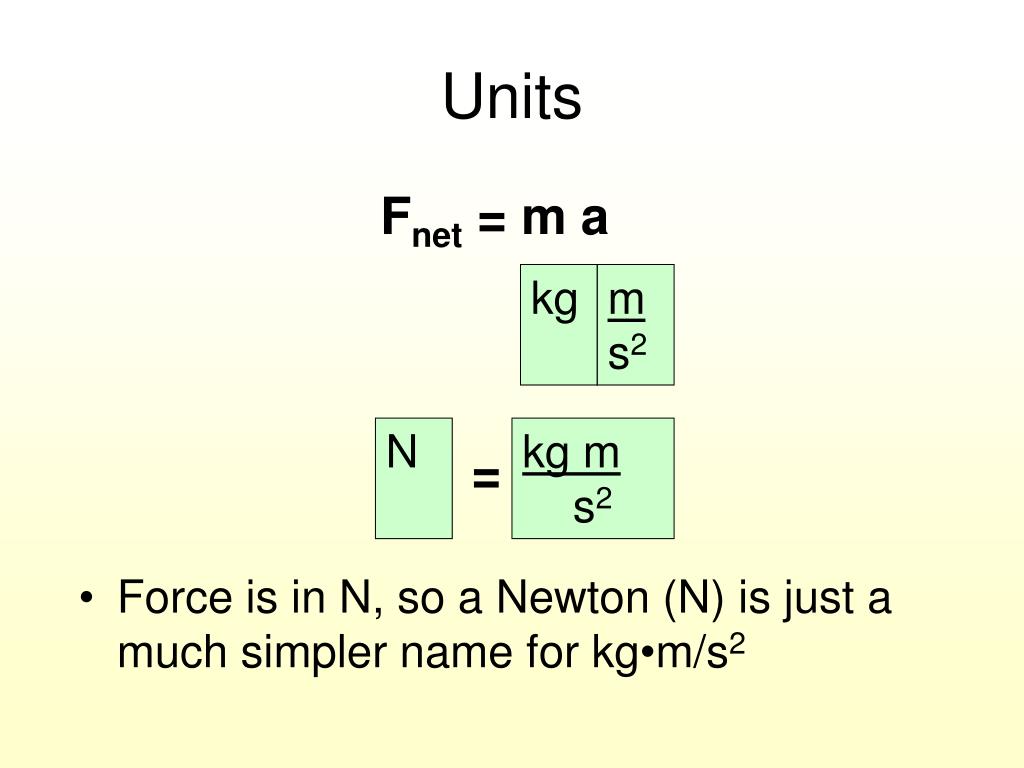
The derivation of this unit stems directly from Newton's Second Law of Motion, which is mathematically expressed as:
F = ma
Where:
- F is Force
- m is Mass
- a is Acceleration
By substituting the standard SI units into this formula, the origin of the unit becomes clear:
- Mass is measured in kilograms (kg).
- Acceleration is the change in velocity over time. Since velocity is meters per second ($m/s$), acceleration is meters per second, per second, or m/s².
- Therefore, Force = (kg) × (m/s²), which yields kg m/s², often written as kg m s⁻².
This relationship is foundational to every mechanical calculation performed in 2026, from the structural integrity of skyscrapers to the orbital maneuvers of satellites. It tells us that to achieve the same acceleration on a heavier object, we must increase the force proportionally. Conversely, if we apply the same force to a lighter object, the acceleration will increase.
Dimensional Analysis and Consistency in Physics
One of the most practical applications of understanding kg m s⁻² is the ability to perform dimensional analysis. This technique treats units as algebraic quantities. For example, if you are calculating the force of gravity between two objects using the Universal Law of Gravitation, the units of the gravitational constant ($G$), the masses ($m_1, m_2$), and the distance ($r^2$) must cancel out perfectly to leave only kg m s⁻².
Comparison of Related Mechanical Units
To see how force fits into the broader spectrum of physics, it is helpful to compare it with other derived units that share the same base components.
| Quantity | Common Unit | SI Base Unit Equivalent | Physical Definition |
|---|---|---|---|
| Force | Newton (N) | kg m s⁻² | Mass × Acceleration |
| Pressure | Pascal (Pa) | kg m⁻¹ s⁻² | Force per Unit Area ($N/m^2$) |
| Work / Energy | Joule (J) | kg m² s⁻² | Force × Distance ($N \cdot m$) |
| Power | Watt (W) | kg m² s⁻³ | Energy per Unit Time ($J/s$) |
| Momentum | kg·m/s | kg m s⁻¹ | Mass × Velocity |
The table above illustrates how adding or removing a single base unit transforms the physical meaning of the measurement. For instance, multiplying force (kg m s⁻²) by distance (m) gives us Energy (kg m² s⁻²). This shows that energy is essentially force acting over a distance.
Practical Examples of kg m s⁻² in 2026 Technology
Understanding the base units of force is not just an academic exercise; it is vital for modern technical applications.
1. Aerospace and Propulsion
In rocket science, "thrust" is the force that moves the vehicle. Engineers must calculate the mass flow rate of fuel ($kg/s$) and the exhaust velocity ($m/s$). When these are multiplied, the resulting unit is kg m/s², which is the force (thrust) required to overcome gravity. In 2026, as private lunar missions become more frequent, precise force calculations using these base units are essential for fuel efficiency and safety.
2. Robotics and Torque
Robotic arms in manufacturing plants are programmed with specific force limits to prevent damage to delicate components. These limits are calculated by determining the mass of the arm and the payload, combined with the required acceleration. If a robotic sensor detects a resistance higher than the programmed kg m s⁻² threshold, it triggers an emergency stop.
3. Structural Engineering
When designing bridges or buildings, engineers must account for "loads," which are forces acting on the structure. This includes the static load (the mass of the materials themselves under the acceleration of gravity, $9.81 m/s^2$) and dynamic loads like wind or traffic. All these are converted into Newtons (and subsequently Pascals for pressure) to ensure the materials can withstand the stress without deforming.
Common Misconceptions About the Unit of Force
Force vs. Weight
A common error is confusing mass (kg) with force (N). Weight is a specific type of force—the force of gravity acting on a mass. While your mass remains the same whether you are on Earth or the Moon, your weight (the force in kg m s⁻²) changes because the acceleration due to gravity is different.
"Per Second Squared"
Many students struggle with the concept of "seconds squared." It is helpful to remember that acceleration is the rate of change of velocity. If an object’s speed increases by 1 meter per second, every second, its acceleration is $(1 m/s) / s$, which mathematically simplifies to $1 m/s^2$. When this motion is applied to a specific mass, the "squared" component of the time unit reflects the ongoing change in speed.
Historical Evolution of the Newton
While the unit kg m s⁻² feels universal today, the path to its standardization was long. Before the International System of Units (SI) was widely adopted, various regions used different units for force, such as the "pound-force" or the "dyne."
The Newton was officially named in 1946 by the International Committee for Weights and Measures (CIPM) and adopted into the SI in 1960. By 2026, the global scientific community has moved entirely toward SI base-unit definitions to ensure that measurements are identical whether they are taken in a lab in Geneva or on a research station on Mars. The stability of the kg m s⁻² definition is what allows for international collaboration on mega-projects like the International Thermonuclear Experimental Reactor (ITER) or deep-space communication networks.
Technical Depth: Vector Nature of Force
It is important to note that while kg m s⁻² describes the magnitude (the "how much") of the force, force is actually a vector quantity. This means it has both magnitude and direction. In advanced physics equations, you will often see the unit applied to a vector variable ($\vec{F}$).
The base units remain the same, but the application requires trigonometry to resolve forces into their x, y, and z components. For example, if a force of 10 kg m s⁻² is applied at a 45-degree angle, only a portion of that force is contributing to horizontal acceleration, while the rest contributes to vertical acceleration. Regardless of the angle, the unit of each component remains the Newton.
Summary of Key Points
- Direct Definition: 1 Newton ($N$) = $1 kg \cdot 1 m/s^2$.
- Dimensional Integrity: Using the base units kg m s⁻² allows for error-checking in complex scientific formulas.
- Interconnectivity: Force is the middle ground between mass and energy. Adding a unit of distance ($m$) turns force into energy; dividing by a unit of area ($m^2$) turns it into pressure.
- Modern Relevance: In 2026, these units are the universal language for aerospace, robotics, and civil engineering.
Frequently Asked Questions
Why do we call it a Newton instead of just saying kg m s⁻²?
Using "Newton" is a matter of convenience and tribute. It is much easier for scientists and engineers to communicate using a single word than reciting the full string of base units. However, in any calculation or computer simulation, the software breaks the "Newton" back down into kg m s⁻² to process the physics correctly.
Can force be measured in units other than kg m s⁻²?
In the Imperial system, force is measured in pounds-force (lbf). However, in professional science, medicine, and engineering (even in the United States), the SI unit kg m s⁻² is the standard. Using non-SI units in high-stakes environments has historically led to catastrophic errors, such as the loss of the Mars Climate Orbiter.
How does the 2019 redefinition of the kilogram affect the unit of force?
The 2019 redefinition changed how we define the kilogram (moving from a physical metal cylinder to a definition based on the Planck constant), but it did not change the value of the kilogram. Therefore, the unit of force kg m s⁻² remains constant in value but is now based on a fundamental constant of nature rather than a physical artifact, making it more precise for 2026 quantum-scale measurements.
Is kg m s⁻² the same as kg m/s²?
Yes. In mathematical notation, a negative exponent ($s^{-2}$) is simply a different way of writing a divisor. Therefore, $kg \cdot m \cdot s^{-2}$ is identical to $kg \cdot m / s^2$. The "per second squared" notation is often preferred in scientific publishing for its cleanliness on a single line of text.
Next Actions for Mastery
To fully grasp the application of kg m s⁻², practitioners should focus on mastering dimensional analysis. Start by taking common physics formulas—such as the formula for centripetal force ($F = mv^2/r$)—and substituting the units for each variable. If the units on the right side ($kg \cdot (m/s)^2 / m$) simplify down to kg m s⁻², you have verified the formula's dimensional consistency. This practice is the hallmark of a disciplined approach to physics and engineering in 2026.
Image Gallery