Freedom of Speech on the Internet: Rights, Regulations, and the Future of Digital Expression
Freedom of speech on the internet refers to the ability to seek, receive, and impart information through digital mediums without state-sponsored interference. In 2026, this right is increasingly defined by the intersection of national...
Freedom of speech on the internet refers to the ability to seek, receive, and impart information through digital mediums without state-sponsored interference. In 2026, this right is increasingly defined by the intersection of national laws, the community guidelines of private tech platforms, and the evolving role of artificial intelligence in content moderation.
Contents
The Foundations of Digital Expression
The concept of free speech online is not a new legal category but rather an extension of existing human rights frameworks into the digital realm. The primary legal anchor is Article 19 of the Universal Declaration of Human Rights (UDHR) and the International Covenant on Civil and Political Rights (ICCPR). These documents establish that everyone has the right to hold opinions without interference and to share information through any media, regardless of frontiers.
However, the application of these rights varies significantly by jurisdiction. In the United States, the First Amendment protects citizens primarily from government overreach, whereas in the European Union, the right to expression is balanced against other fundamental rights, such as the right to privacy and the right to dignity. This tension has led to a fragmented global internet—often referred to as the "Splinternet"—where the "freedom" a user experiences depends heavily on their physical location and the server's jurisdiction.
The Distinction Between State and Private Actors
A common misconception is that the constitutional right to free speech applies to private social media platforms. In most democratic societies, private companies like Meta, X (formerly Twitter), and Google have the legal authority to set their own "Community Standards." These platforms are not government entities; therefore, removing a post or banning a user for violating a terms-of-service agreement is generally considered an exercise of the platform's own right to associate (and disassociate), rather than a violation of the user's free speech.
By 2026, this distinction has become the center of intense legal debate. Some jurisdictions have explored "common carrier" status for social media giants, arguing that these platforms are the modern-day town squares and should be required to host all legal speech regardless of viewpoint.
Major Regulatory Frameworks and Their Impact
Regulation of the internet has moved from a "hands-off" approach in the early 2000s to a highly interventionist model in 2026. Two primary frameworks dictate how speech is managed globally: Section 230 in the United States and the Digital Services Act (DSA) in the European Union.
Section 230 of the Communications Decency Act (USA)
Section 230 remains the "twenty-six words that created the internet." It provides immunity to online platforms from civil liability for content posted by their users. It also protects their ability to moderate "objectionable" content in good faith.
While there have been numerous attempts to repeal or reform Section 230 to address concerns about political bias or the spread of harmful content, it still stands as the primary reason why American platforms can host millions of posts daily without being sued for every instance of defamation or illegal activity committed by a user.
The Digital Services Act (EU)
The Digital Services Act (DSA), which became fully operational for all platforms in February 2024, has reached its peak regulatory influence by 2026. Unlike the American model, the DSA requires "Very Large Online Platforms" (VLOPs) to proactively manage systemic risks, including the spread of illegal content and disinformation.
The DSA mandates transparency in algorithmic recommendation systems and gives users the right to contest moderation decisions. It represents a shift from "platform immunity" to "platform responsibility," forcing companies to justify why they remove content or shadowban certain accounts.
| Feature | US (Section 230) | European Union (DSA) | Global South (Varies) |
|---|---|---|---|
| Liability Shield | Broad protection for platforms. | Conditional; requires "notice and action." | Often limited; state-controlled. |
| Moderation Requirement | Voluntary "Good Samaritan" acts. | Mandatory for illegal content/systemic risk. | Often mandated for political dissent. |
| Transparency | Minimal federal requirements. | High; mandatory audits and reporting. | Low to moderate. |
| User Recourse | Limited (Platform discretion). | Legally mandated appeal processes. | Varies by local judiciary. |
| Focus | Innovation and Free Marketplace. | Safety, Privacy, and Human Rights. | Stability and National Security. |
Content Moderation in the Age of AI
As of 2026, the volume of data generated online is too vast for human review. Consequently, freedom of speech is now largely governed by Automated Content Moderation (ACM) systems. These AI models are trained to identify hate speech, graphic violence, and copyright infringement in real-time.
The Problem of Algorithmic Bias
The primary technical challenge with AI moderation is its inability to understand context, irony, or cultural nuance. For example, a political activist documenting human rights abuses may have their footage removed by an AI that flags it as "glorification of violence." This "algorithmic censorship" can suppress legitimate speech unintentionally.
Furthermore, "shadowbanning"—a practice where a user's reach is restricted without their knowledge—is often an automated process. By 2026, users have demanded more "explainability" in AI, leading to the development of tools that notify users which specific rule an AI thinks they violated.
Deepfakes and Disinformation
The rise of generative AI has complicated the free speech debate. In 2026, the ability to create hyper-realistic deepfakes has forced platforms to implement stricter labels on synthetic media. While civil libertarians argue that parody and satire (including AI-generated ones) are protected speech, regulators are concerned about the "liar’s dividend"—where real evidence is dismissed as "fake" and fake evidence is used to incite real-world harm.
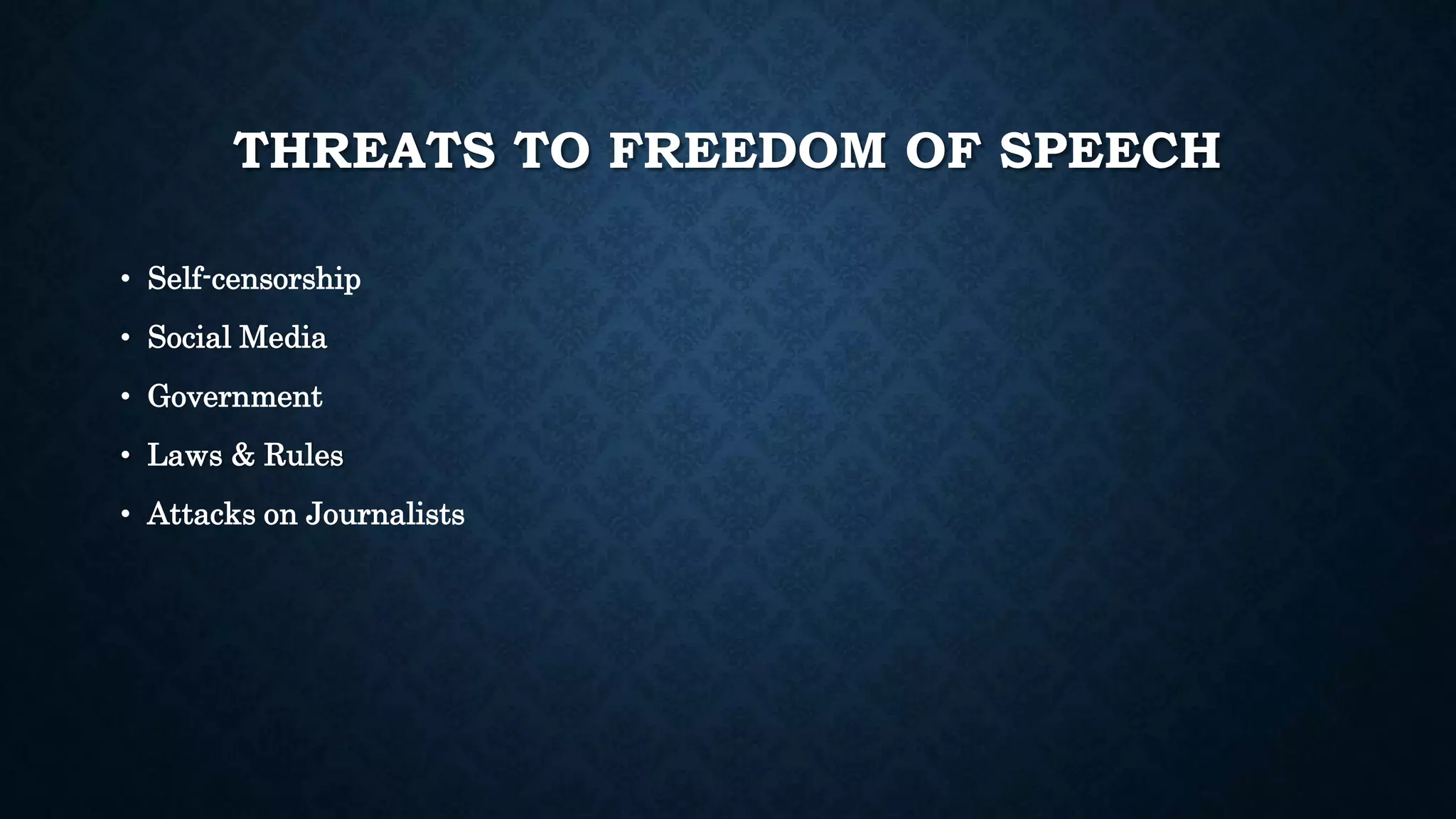
Threats to Global Digital Freedom
Beyond the debates in Western democracies, freedom of speech on the internet faces existential threats from authoritarian regimes.
- Internet Shutdowns: Governments increasingly use "kill switches" to disable internet access during protests or elections. This is the ultimate form of digital censorship, as it removes the infrastructure of speech entirely.
- State-Sponsored Surveillance: Technologies used to monitor "terrorist activity" are frequently repurposed to track journalists and dissidents. The use of invasive spyware has led to a "chilling effect," where individuals self-censor for fear of physical retaliation.
- The "Great Firewall" Model: More nations are adopting the Chinese model of a domestic, walled-off internet. By controlling the gateways to the global web, these states can curate exactly what their citizens see, effectively eliminating the concept of a "world wide" web.
Protecting Your Digital Speech
Navigating the internet in 2026 requires a proactive approach to digital rights. Users should not assume that their "right to speak" is guaranteed by the platforms they use.
- Diversify Platforms: Relying on a single centralized platform for communication makes a user vulnerable to de-platforming. Using decentralized protocols (like ActivityPub or AT Protocol) can provide more resilience.
- Use Encryption: End-to-end encrypted (E2EE) messaging services like Signal ensure that the content of your speech is private from both the government and the service provider.
- Understand Terms of Service: Reviewing the community guidelines of a platform helps users understand the "private law" they are subject to. Organizations like the Electronic Frontier Foundation (EFF) provide resources to help users understand their digital rights.
- Legal Protections: In cases of wrongful removal or account suspension in the EU, users should utilize the "out-of-court dispute settlement" mechanisms provided under the DSA.
Frequently Asked Questions
Is hate speech protected under freedom of speech online?
The answer depends on the country. In the United States, most speech that is characterized as "hate speech" is protected by the First Amendment unless it incites "imminent lawless action." In contrast, many European and South American countries have strict laws prohibiting hate speech, and platforms are legally required to remove it within these jurisdictions.
Can a private social media company censor me?
Legally, most private platforms have the right to moderate content as they see fit. This is often called "content moderation" rather than "censorship," as censorship is strictly defined as an act of the state. However, the influence of these platforms is so vast that many legal scholars argue they should be held to higher standards of transparency and fairness.
How do VPNs help with freedom of speech?
A Virtual Private Network (VPN) can help users bypass regional censorship by masking their IP address and making it appear as though they are accessing the internet from a different country. This is a vital tool for individuals in countries with restricted internet access, though some regimes have moved to ban or regulate VPN usage.
What is the "Splinternet"?
The Splinternet refers to the fragmentation of the internet into various regional networks governed by different regulations and technical standards. Instead of a single, open global network, the internet is becoming a collection of silos (e.g., the EU's regulated space, the US's market-driven space, and China's state-controlled space).
Does the "Right to be Forgotten" conflict with free speech?
Yes, this is a major point of contention. The "Right to be Forgotten" allows individuals to request the removal of outdated or irrelevant personal information from search engine results. Critics argue this can be used by public figures to hide past wrongdoings, thereby limiting the public's right to access truthful information.
Moving Forward: Next Actions for Users
To ensure the continued vitality of digital expression, users must transition from passive consumers to active participants in digital governance.
- Support Digital Rights Organizations: Groups like Article 19, the EFF, and Access Now advocate for policies that protect free expression globally.
- Verify Information: Before sharing controversial content, use fact-checking tools to ensure you are not inadvertently participating in a disinformation campaign, which often serves as a pretext for governments to implement harsher speech restrictions.
- Engage in Policy: Participate in public consultations regarding internet regulation. In 2026, many regulatory bodies are required to seek public input on how AI and algorithms should be governed.
The future of freedom of speech on the internet is not a settled matter; it is a continuous negotiation between the power of the state, the profits of corporations, and the rights of the individual.
Image Gallery