Navigating the Challenges of San Diego Medical Waste Management
Managing medical waste in San Diego presents complex challenges driven by strict enforcement under the California Medical Waste Management Act (MWMA) and local oversight by the San Diego County Department of Environmental Health and Qu...
Managing medical waste in San Diego presents complex challenges driven by strict enforcement under the California Medical Waste Management Act (MWMA) and local oversight by the San Diego County Department of Environmental Health and Quality (DEHQ). Healthcare facilities must navigate rigid waste segregation, tight storage timelines, escalating disposal costs, and stringent chain-of-custody requirements to maintain compliance and avoid heavy regulatory fines.
Contents
Regulatory Oversight: Federal, California MWMA, and San Diego DEHQ Rules
Healthcare providers, outpatient surgical centers, dental practices, biotech laboratories, and veterinary clinics in San Diego operate under one of the most stringent regulatory environments in the United States. Rather than relying solely on federal guidelines from the Occupational Safety and Health Administration (OSHA) or the Environmental Protection Agency (EPA), medical waste management in San Diego is governed primarily by state statute and enforced at the municipal level.
The primary governing law is the California Medical Waste Management Act (MWMA), codified in the California Health and Safety Code (Sections 117600–118360). The state delegates local enforcement authority to certified Unified Program Agencies (CUPAs) or local health departments. In San Diego County, the San Diego County Department of Environmental Health and Quality (DEHQ)—specifically its Hazardous Materials Division (HMD)—acts as the local enforcement agency.
Regulatory Hierarchy in San Diego
- Federal Level: EPA, OSHA, DOT (49 CFR)
- State Level: California Department of Public Health (CDPH) & MWMA Statutes
- Local Level: San Diego County DEHQ (Hazardous Materials Division)
Facilities are classified into two distinct operational tiers based on the volume of waste they generate, each with unique registration and inspection mandates:
- Small Quantity Generators (SQGs): Facilities that produce less than 200 pounds of medical waste per month. While SQGs face fewer routine inspection cycles than larger institutions, they must still register with the San Diego County DEHQ, maintain an active Medical Waste Management Plan (MWMP) on file, and strictly adhere to containment and disposal rules.
- Large Quantity Generators (LQGs): Facilities that generate 200 pounds or more of medical waste in any single calendar month. LQGs are subject to mandatory annual registration, scheduled physical inspections by DEHQ inspectors, detailed record-keeping requirements, and formal written plans outlining emergency spill response and waste minimization procedures.
Failure to align facility operations with both CDPH guidelines and local DEHQ ordinances can result in administrative enforcement actions, costly civil penalties, or the temporary suspension of operating permits.
Core Operational Challenges Facing San Diego Healthcare Facilities
Operating a compliant healthcare or life sciences facility in San Diego County requires overcoming several daily operational hurdles. These challenges stem from the physical properties of biohazardous waste, the geography and climate of Southern California, and the legal liabilities inherent in handling infectious materials.
1. Complex Waste Stream Segregation and Cross-Contamination
The California MWMA mandates strict sorting of biohazardous and medical waste at the point of generation. Mixing different types of waste not only violates state law but also creates severe financial inefficiencies. The five primary waste streams generated in medical environments require distinct packaging, labeling, and handling protocols:
- Biohazardous Waste (Red Bag): Items contaminated with liquid or semi-liquid blood, body fluids, or infectious materials. Red bags must meet ASTM tear- and impact-resistance standards and be placed inside rigid, leak-resistant secondary containers marked with the international biohazard symbol.
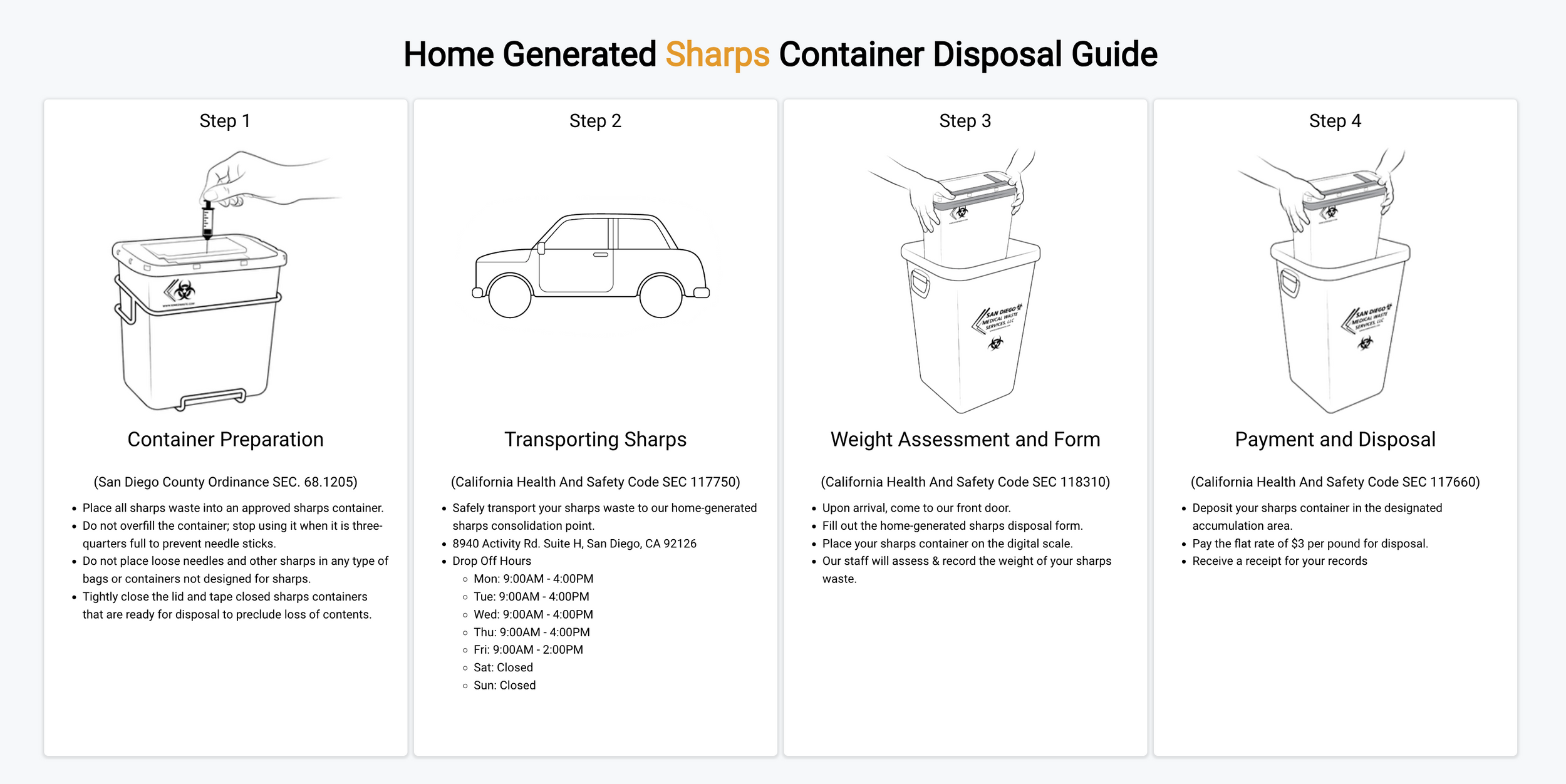
- Sharps Waste (Rigid Container): Needles, syringes, scalpels, lancets, and contaminated broken glass. Sharps must be placed immediately into puncture-resistant, rigid containers that are spill-proof and locked prior to transport.
- Trace Chemotherapy Waste (Yellow Container): Empty drug vials, IV bags, tubing, gowns, and gloves used during the administration of cytotoxic or antineoplastic agents. Trace chemo waste must be segregated into yellow containers and is mandated for high-temperature incineration.
- Pharmaceutical Waste (Black Container / RCRA): Expired, unused, or contaminated prescription medications. Hazardous pharmaceuticals subject to the Resource Conservation and Recovery Act (RCRA) and non-hazardous pharmaceuticals must be separated from general red bag biohazards and processed via specialized chemical destruction or incineration.
- Pathology Waste: Human tissues, anatomical parts, and surgical specimens. Like trace chemo, pathology waste cannot undergo standard autoclave steam sterilization; it must be kept frozen or refrigerated and transported directly for incineration.
Cross-contamination remains a frequent point of failure during routine DEHQ audits. When staff place non-hazardous municipal trash into red biohazard bags, operational costs surge because biohazard treatment rates per pound are significantly higher than standard municipal solid waste rates. Conversely, disposing of biohazardous waste in general municipal waste bins constitutes a severe environmental violation that can trigger public health investigations.
2. Strict Storage Duration and Temperature Mandates
Unlike states that permit flexible storage timelines for medical waste, California enforces strict accumulation limits tied to storage temperature and total monthly output:
- 7-Day Ambient Rule: Any facility generating 20 pounds or more of biohazardous waste per month must not store waste on-site for longer than 7 days at temperatures above 0°C (32°F).
- 90-Day Cold Storage Rule: If biohazardous waste is stored in a dedicated, secured freezer unit maintained at or below 0°C (32°F), the permissible storage duration extends up to 90 days.
- Small Quantity Allowance: Facilities generating less than 20 pounds per month may store biohazardous waste for up to 30 days at room temperature, provided it does not generate odors or harbor vectors.
In San Diego’s warm coastal and inland climate, managing ambient accumulation without adequate refrigeration creates vector control issues and odor compliance problems. Facilities with small footprints—such as downtown urban clinics or suburban medical suites—often struggle to allocate dedicated, temperature-controlled square footage solely for waste accumulation.
3. "Cradle-to-Grave" Liability and Transport Compliance
Under state and federal law, medical waste generators retain cradle-to-grave legal liability for all waste generated at their site. Liability does not end when a contracted hauler loads waste onto a truck at a clinic’s loading dock. If a transporter spills biohazardous waste on San Diego freeways or an unpermitted facility illegal dumps waste, the originating healthcare facility can be held jointly liable for environmental remediation and regulatory fines.
To mitigate this risk, San Diego facilities must verify that their contracted transport partners meet clear legal standard:
- Active registration as a Hazardous Waste / Medical Waste Transporter with the California Department of Public Health.
- Compliance with US Department of Transportation (DOT) Hazardous Materials Regulations (49 CFR).
- Issuance of official Medical Waste Tracking Documents (or Hazardous Waste Manifests) documenting every step of custody from point of origin to the final treatment, storage, and disposal facility (TSDF).
- Retention of signed tracking documents on-site for a minimum of three years.
4. Regional Economic Pressures and Infrastructure Constraints
Operating in Southern California involves elevated overhead costs. Medical waste management costs in San Diego reflect broader regional factors, including high commercial utility rates (affecting on-site autoclaving), strict regional air quality regulations set by the San Diego County Air Pollution Control District (SDAPCD), and fuel surcharges for transport trucks navigating local traffic corridors.
Because commercial medical waste incinerators are heavily restricted in California due to air quality standards, much of San Diego’s trace chemotherapy and pathology waste must be transported long distances to licensed out-of-state incineration facilities. These logistics expose local facilities to supply chain disruptions and volatile transportation surcharges.
Comparison of Medical Waste Streams under California Law
The table below outlines the operational standards, container color codes, storage time limits, and approved processing methods for standard medical waste streams generated in San Diego:
| Waste Category | Required Container & Color Code | Storage Limit (Ambient >32°F) | Storage Limit (Frozen ≤32°F) | Mandatory Treatment Method | Key Compliance Risk |
|---|---|---|---|---|---|
| Biohazardous Solid Waste | Red Bag inside rigid, leak-proof container | 7 Days (if ≥20 lbs/mo); 30 Days (if <20 lbs/mo) | Up to 90 Days | Autoclave (Steam Sterilization) or Incineration | Overfilling bags; placing non-infectious trash in red bags |
| Sharps Waste | Rigid, puncture-resistant container (Puncture-Proof) | 30 Days once container is filled to line | N/A | Autoclave followed by shredding / off-site disposal | Overfilling beyond 3/4 full line; failing to lock lids before transport |
| Trace Chemotherapy | Yellow Rigid Container (Labeled "Trace Chemo") | 7 Days (if ≥20 lbs/mo) | Up to 90 Days | High-Temperature Incineration Only | Mixing with regular red bag biohazard waste |
| Pharmaceutical Waste | Black Container (RCRA / Non-RCRA segregated) | 7 Days (standard hazardous rules apply) | N/A | Reverse Distribution or Authorized Incineration | Flushing down drains; improper DEA witness documentation |
| Pathology Waste | Rigid container with yellow/white biohazard label marked "Pathology" | Must be refrigerated immediately if stored >24 hours | Up to 90 Days | High-Temperature Incineration Only | Attempting to autoclave human tissue or anatomical parts |
Best Practices for Maintaining Compliance in San Diego
To overcome regulatory complexities and manage operational costs, healthcare administrators and facility directors in San Diego should adopt proactive risk-mitigation strategies.
Compliance Implementation Roadmap
- Conduct bi-annual internal waste audits
- Maintain site-specific Medical Waste Management Plan
- Execute mandatory OSHA & MWMA staff training
- Implement digital manifest tracking & 3-year archiving
- Perform quarterly vetting of registered waste haulers
Establish a Comprehensive Medical Waste Management Plan (MWMP)
Every Large Quantity Generator in San Diego County must maintain a written MWMP that detail facility procedures. Even Small Quantity Generators benefit from having a formalized plan. The MWMP should document:
- Types and estimated monthly volumes of waste generated.
- Specific room locations used for waste accumulation and lockable storage.
- Step-by-step containment, labeling, and internal transport protocols.
- Emergency response protocols for spills, container ruptures, or power failures affecting refrigerated storage.
- Names, registration numbers, and contact details for all contracted transporters and disposal sites.
Conduct Bi-Annual Internal Audits and Point-of-Use Sorting Training
Human error remains the leading cause of waste misclassification. Implementing quarterly or bi-annual internal audits helps identify compliance gaps before official DEHQ inspections occur. Staff should receive clear, regular training on point-of-use segregation. Placing clear visual charts above disposal stations reduces the risk of regular trash entering red biohazard bags or hazardous pharmaceuticals being disposed of improperly.
Implement Digital Manifest Tracking Systems
Relying on paper manifests increases the risk of lost records during regulatory reviews. San Diego facilities should use digital compliance portals provided by accredited medical waste vendors or maintain scanned, cloud-backed repositories of all Medical Waste Tracking Documents. Each document must show the complete chain of custody, including the generator’s signature, transporter acceptance, and final TSDF certificate of treatment.
Audit Medical Waste Vendors Thoroughly
Because of cradle-to-grave legal liability, selecting a waste management vendor based solely on price can expose a facility to legal risk. Before signing service contracts, compliance officers should verify:
- CDPH Transport Registration: Confirm the vendor holds a current, valid registration permit with the state.
- Insurance Coverage: Request Certificates of Insurance showing adequate commercial general liability, environmental pollution liability, and motor vehicle transport coverage.
- Permitted Treatment Facilities: Ensure the vendor relies on fully permitted autoclaves or incinerators that comply with California state regulations and EPA standards.
Frequently Asked Questions
What is the primary difference between an SQG and an LQG under San Diego DEHQ rules?
A Small Quantity Generator (SQG) generates less than 200 pounds of medical waste per month, whereas a Large Quantity Generator (LQG) produces 200 pounds or more in any single month. LQGs are subject to mandatory annual DEHQ physical inspections, higher registration fees, and strict requirements to submit detailed, written Medical Waste Management Plans.
How long can biohazardous waste be stored on-site in California before disposal?
Under the California MWMA, if a facility generates 20 pounds or more per month, biohazardous waste stored at ambient temperatures (above 32°F) must be removed within 7 days. If the waste is kept in a dedicated freezer unit at or below 0°C (32°F), it may be stored for up to 90 days. Facilities generating less than 20 pounds per month can store ambient waste for up to 30 days.
Are dental clinics and veterinary practices in San Diego required to comply with the same MWMA rules as hospitals?
Yes. The California Medical Waste Management Act applies to all medical, dental, veterinary, clinical research, and outpatient services that generate biohazardous materials, sharps, or pharmaceutical waste. Specific handling standards apply universally, though small dental or veterinary practices typically register as Small Quantity Generators.
Can trace chemotherapy waste be processed using a standard autoclave steam sterilizer?
No. Trace chemotherapy waste must be placed in designated yellow containers and incinerated at a permitted high-temperature facility. Autoclaving steam sterilization is insufficient because it does not destroy toxic chemical residues, which could enter the environment if autoclaved waste is sent to standard landfills.
What happens if regular municipal trash is thrown into a biohazard red bag?
Once non-hazardous municipal trash enters a red biohazard bag, it must legally be treated and billed as biohazardous waste. This unnecessary cross-contamination raises disposal costs significantly. If the reverse occurs—placing biohazardous waste into municipal solid waste bins—the facility faces severe regulatory penalties from the San Diego County DEHQ and local municipal waste authorities.
Strategic Action Items for Healthcare Administrators
To safeguard healthcare operations, lower liability, and ensure compliance in San Diego, administrators should take immediate practical steps:
- Review Generator Status: Evaluate monthly waste weight logs to verify whether the facility is correctly classified as an SQG or LQG with San Diego County DEHQ.
- Inspect Storage Units: Ensure dedicated medical waste storage rooms are secured against unauthorized access, clearly posted with warning signs in English and Spanish, and equipped with functional refrigeration units if holding waste beyond 7 days.
- Audit Paperwork: Conduct a inventory of all Medical Waste Tracking Documents from the past 36 months to ensure every pickup has a corresponding signed certificate of treatment on file.
- Re-evaluate Contracts: Review service level agreements with medical waste management vendors to confirm transparent pricing, valid CDPH registrations, and compliant transit routes.
Image Gallery