NYC Local Law 61 Mold Remediation Requirements: A Compliance Guide for Property Owners
NYC Local Law 61 of 2018 establishes mandatory mold assessment, remediation, and work practice standards for residential buildings in New York City with 10 or more dwelling units, as well as properties owned by the New York City Housin...
NYC Local Law 61 of 2018 establishes mandatory mold assessment, remediation, and work practice standards for residential buildings in New York City with 10 or more dwelling units, as well as properties owned by the New York City Housing Authority (NYCHA). The law requires property owners to engage separate, state-licensed mold assessment and remediation contractors, fix underlying moisture sources, perform contained cleanup, and secure formal post-remediation clearance to resolve Department of Housing Preservation and Development (HPD) violations.
Contents
Disclaimer: This guide is provided for educational and informational purposes only and does not constitute formal legal, engineering, or environmental compliance advice. Building owners and property managers should consult qualified legal counsel and NYS-certified environmental professionals to ensure full compliance with New York City Administrative Code and Department of Housing Preservation and Development regulations.
What Is NYC Local Law 61?
Enacted as part of New York City's broader indoor asthma allergen initiative alongside Local Law 55 of 2018, NYC Local Law 61 regulates how mold must be assessed, remediated, and documented in covered residential properties. The legislation amended Title 24 of the New York City Administrative Code by adding Chapter 5, establishing clear legal definitions, contractor standards, work practice rules, and clearance requirements for mold mitigation.
Prior to the enforcement of Local Law 61, mold remediation in many multi-family residential structures was treated as standard maintenance, often addressed with superficial surface cleaning or uncontained drywall repairs. Local Law 61 introduced strict statutory standards to ensure that mold growth is not merely covered up or bleached, but safely eliminated alongside the root moisture conditions that caused it.
Covered Properties and Scope of Law
Local Law 61 does not apply uniformly to every building type in New York City. The statutory requirements specifically govern:
- Residential Multi-Family Buildings: Buildings containing 10 or more dwelling units.
- Public Housing: All residential buildings owned or operated by the New York City Housing Authority (NYCHA), regardless of unit count.
While smaller residential buildings (under 10 units) and commercial facilities remain subject to general New York State Department of Labor (NYSDOL) mold rules under Article 32 of the NYS Labor Law, they are exempt from the specific NYC Local Law 61 HPD filing workflows unless local housing code orders dictate otherwise.
Core Statutory Requirements of NYC Local Law 61
To achieve full compliance with Local Law 61, property owners, building managers, and contractors must observe several core legal standards during any mold assessment or remediation project.
- Mold Assessment & Plan
- Licensed Mold Assessor identifies moisture source
- Develops site-specific Mold Remediation Plan
- Remediation Execution
- Independent Licensed Mold Remediator executes plan
- Implements containment, HEPA filtration, & removal
- Post-Remediation Clearance
- Licensed Assessor returns for visual inspection
- Verifies moisture repair & issues Clearance Notice
- HPD Violation Certification
- Property Owner submits signed affidavit & forms
- Clears HPD Class B / Class C housing violations
1. Mandatory Separation of Assessor and Remediator
One of the central provisions of Local Law 61 is the strict prohibition against self-policing. The entity performing the initial assessment and final clearance inspection cannot be the same entity, nor can it share common ownership, financial interest, or corporate affiliation with the remediation contractor executing the cleanup.
- Mold Assessor: Responsible for evaluating the extent of mold, identifying the underlying moisture intrusion, writing the work plan, and conducting the final clearance evaluation.
- Mold Remediator: Responsible for erecting containment, isolating the work zone, performing physical removal, cleaning, and applying antimicrobial treatments according to the assessor's work plan.
This statutory division protects property owners and tenants by preventing remediation firms from inspecting their own work or inflating the scope of remediated surfaces.
2. Mandatory State Licensing and Certification
All mold assessments, remediation work plans, physical cleanup operations, and clearance inspections performed under Local Law 61 must be conducted by professionals holding valid credentials issued by the New York State Department of Labor (NYSDOL) pursuant to Article 32 of the New York State Labor Law.
Unlicensed handymen, general maintenance staff, or uncertified contractors are legally prohibited from conducting mold assessment or remediation projects in covered buildings where the mold contamination exceeds minimal thresholds or is subject to an outstanding HPD violation notice.
3. Moisture Source Identification and Correction
Local Law 61 explicitly links mold growth to underlying moisture conditions. A mold remediation plan is legally incomplete under NYC administrative code if it does not identify and address the root cause of water infiltration.
Common moisture sources that must be corrected include:
- Active plumbing leaks behind walls or under fixtures.
- Roof leaks or compromised exterior facade masonry.
- Defective window flashings or unsealed exterior joints.
- High relative humidity caused by failing mechanical ventilation or inadequate bathroom exhaust fans.
- Steam pipe condensation and uninsulated cold water lines.
Remediation work cannot be certified as complete by the assessor until the moisture problem has been verified as repaired or stabilized.
Step-by-Step Compliance Workflow
Executing a compliant mold remediation project under Local Law 61 requires adherence to a defined sequence of professional interventions and administrative filings.
Step 1: Initial Assessment and Remediation Plan
When mold contamination is discovered—either during routine maintenance, following a tenant complaint, or via an HPD inspection—the building owner must retain a licensed Mold Assessor.
The assessor conducts a thorough visual and diagnostic inspection of the affected dwelling unit or common space. Using moisture meters, thermal imaging cameras, and air or surface sampling (where necessary), the assessor identifies:
- The spatial extent of mold growth (measured in square feet).
- The exact underlying water or moisture source fueling the growth.
- The specific containment and engineering controls required.
The assessor generates a written Mold Remediation Plan. This document defines the scope of work, safety protocols, required personal protective equipment (PPE), containment barriers, and acceptable post-remediation clearance criteria.
Step 2: Remediation Work Practice Execution
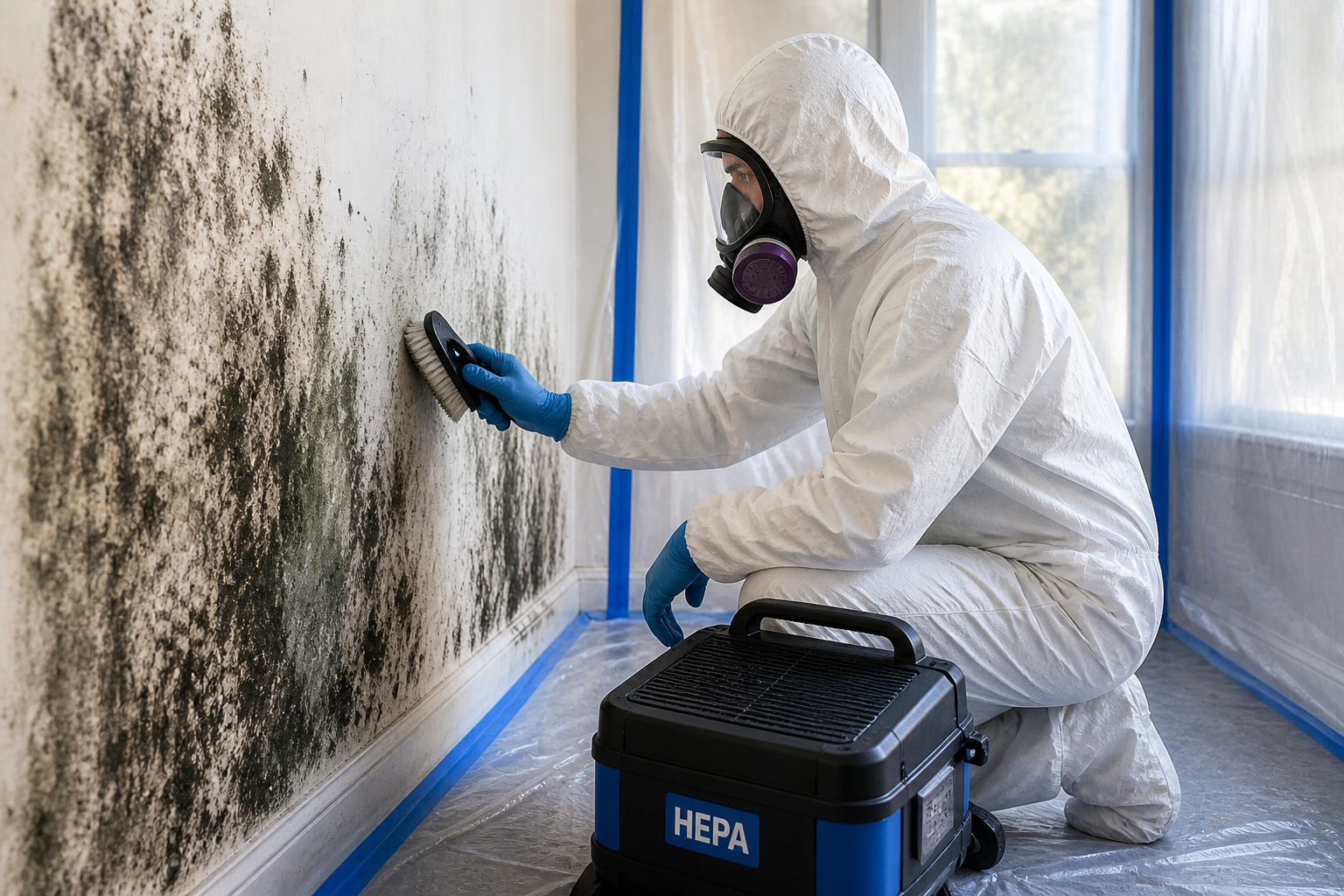
The owner hires an independent, licensed Mold Remediator to execute the assessor's plan. The remediator must implement precise work practices designed to prevent the cross-contamination of uninfected building areas:
- Containment Controls: Polyethylene plastic sheeting (typically 6-mil minimum thickness) is installed to seal doorways, HVAC vents, and plumbing penetrations, isolating the work area from adjacent living quarters.
- Engineering Controls: Negative air machines equipped with High-Efficiency Particulate Air (HEPA) filtration are installed to maintain continuous negative pressure within the containment zone, exhausting air safely outdoors or through secondary filtration.
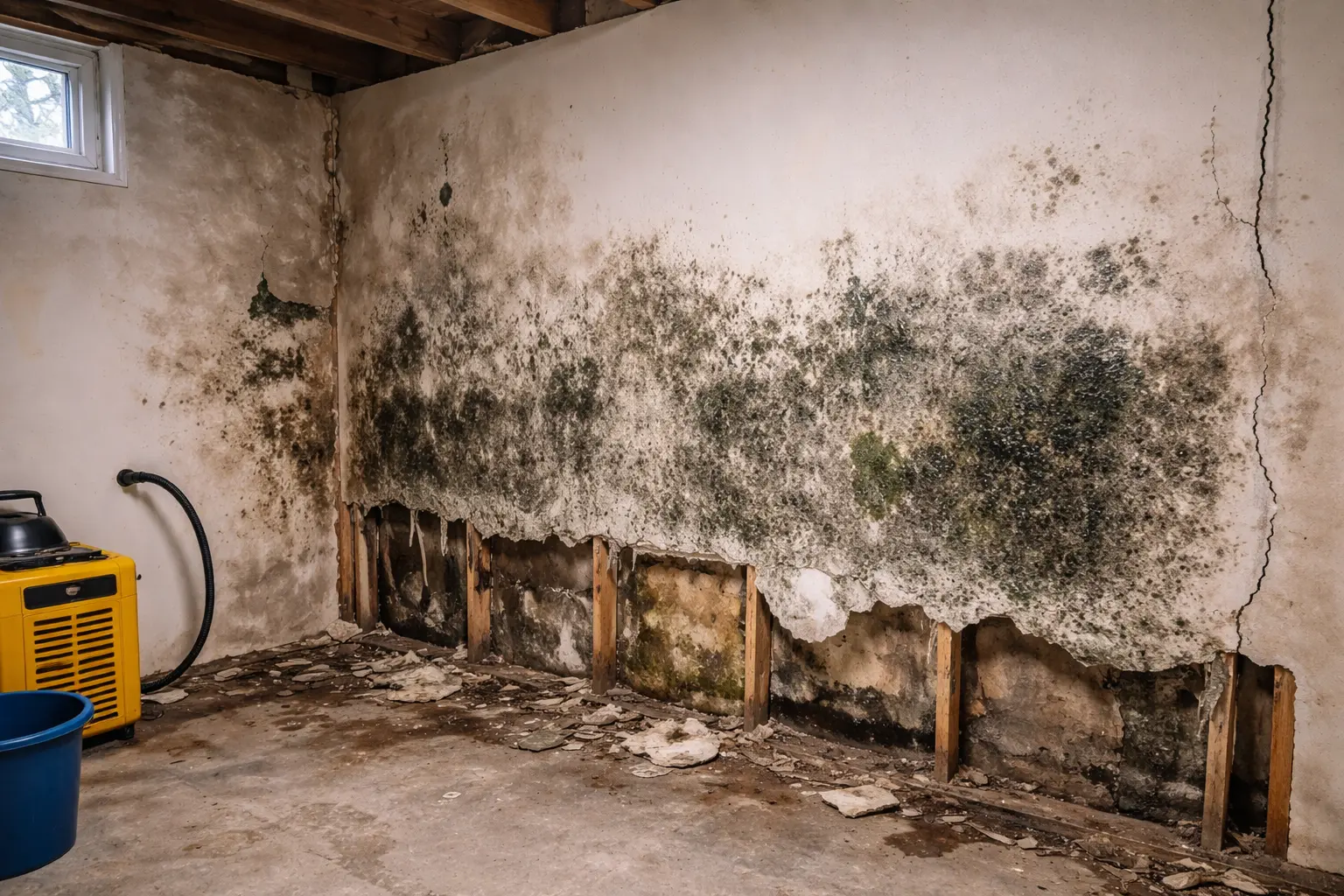
- Physical Removal: Irreparably damaged porous materials (such as water-logged drywall, insulation, or carpet) are cut out, sealed in heavy-duty poly bags, and removed from the site.
- Surface Decontamination: Non-porous and semi-porous structural elements (such as wood framing or concrete masonry) are scrubbed using HEPA vacuums, wet-wiped with EPA-registered disinfectants or fungicidal agents, and allowed to dry completely.
Step 3: Post-Remediation Assessment and Clearance
Once physical cleanup is finished, the remediator cleans the work zone and requests a post-remediation assessment. The original Mold Assessor (or another independent licensed assessor) returns to perform a comprehensive clearance evaluation before containment structures are dismantled.
The assessment consists of:
- Visual Inspection: Verifying that all visible mold, dust, debris, and damaged building materials have been removed, and confirming that structural surfaces are dry.
- Moisture Assessment: Confirming that the underlying source of moisture has been successfully repaired and that moisture levels in surrounding building materials have returned to acceptable baseline ranges.
- Clearance Certification: Upon passing the visual and moisture inspections, the assessor issues a formal Post-Remediation Assessment Report (Clearance Notice) certifying that the work area is clean, safe, and fully remediated.
Step 4: HPD Violation Certification and Filing
If the mold remediation was initiated due to a Notice of Violation issued by the NYC Department of Housing Preservation and Development (HPD), the building owner must formally submit documentation to clear the violation from the property's public record.
The owner must complete and submit HPD's required certification forms, attaching:
- A copy of the Mold Remediation Plan prepared by the licensed mold assessor.
- A copy of the Post-Remediation Assessment Report certifying successful clearance.
- The owner's signed affidavit certifying that the work was completed in full compliance with Local Law 61 and that the moisture source was corrected.
Filings must be submitted within the statutory correction timeframe specified on the HPD Notice of Violation to avoid administrative penalties and civil fines.
Technical Comparison: NYC Local Law 61 vs. NYS Labor Law Article 32
While NYC Local Law 61 operates within the framework established by New York State Labor Law Article 32, it imposes additional local administrative and municipal housing requirements. The following table highlights the key structural and procedural differences.
| Regulatory Feature | NYS Labor Law Article 32 (Statewide Baseline) | NYC Local Law 61 (NYC Municipal Standard) |
|---|---|---|
| Primary Scope & Jurisdiction | Applies statewide across all property types (commercial, residential, industrial). | Applies specifically within NYC to residential buildings with 10+ units and NYCHA properties. |
| Trigger Threshold | Applies to work involving 10 or more square feet of mold contamination. | Applies to covered buildings regardless of minimum square footage when clearing HPD violations. |
| Contractor Separation | Assessor and remediator must be separate legal entities with no shared financial interest. | Strict statutory independence enforced; verified via HPD affidavit submissions. |
| Licensing Regulator | New York State Department of Labor (NYSDOL). | NYSDOL credentials enforced locally by NYC HPD and NYC Department of Health (DOHMH). |
| Moisture Source Requirement | Requires work plan to reference underlying moisture conditions. | Explicitly mandates documented correction of moisture sources prior to HPD violation dismissal. |
| Municipal Violation Filing | No mandatory state filing; records retained by owner/contractors for 5 years. | Mandatory filing of clearance forms and affidavits directly with NYC HPD to dismiss violations. |
| Class B / C Housing Violations | Not applicable at state level. | Directly governs statutory timelines for curing Class B (Hazardous) and Class C (Immediately Hazardous) violations. |
HPD Violation Categories and Correction Timelines
Under NYC's Housing Maintenance Code, mold violations issued by HPD inspectors in covered properties are categorized based on severity, occupant risk, and building size:
- Class B Violations (Hazardous): Issued for moderate mold growth or underlying leak conditions. The statutory period for correction is typically 30 days from the date of the notice.
- Class C Violations (Immediately Hazardous): Issued for extensive mold growth, severe active water leaks, or conditions present in units occupied by vulnerable individuals (e.g., households with young children or diagnosed asthmatics under Local Law 55 rules). The statutory period for correction is 21 days.
- HPD Notice of Violation Issued
- Class B (Hazardous): 30-Day Cure Period
- Class C (Immediately Hazardous): 21-Day Cure Period
- Retain Independent NYSDOL Assessor & Remediator
- Execute Remediation & Fix Moisture Source
- Secure Post-Remediation Clearance Certification
- Submit Form AF-5 / Affidavits to HPD Portal Before Deadline
Failure to submit valid Local Law 61 clearance documentation within these specified statutory cure windows results in the violation remaining active on the building's title, exposing the property owner to civil penalties ranging from $25 to $125 per day per violation, alongside potential administrative re-inspection fees.
Common Pitfalls and Avoidable Penalties
Building managers and property owners frequently face delayed violation dismissals or rejected compliance filings due to avoidable procedural errors.
1. Using In-House Staff for Covered Remediation
Using uncertified building superintendents or general maintenance personnel to scrub mold surfaces in a covered 10+ unit building to clear an HPD violation is a direct violation of Local Law 61. HPD routinely rejects compliance affidavits if the attached license numbers for the mold assessor or remediator do not match active NYSDOL database entries.
2. Hiring Dual-Role Contracting Companies
Contracting with a single company that offers both mold assessment and mold remediation under the same corporate structure—even if different employee licenses are cited—violates the statutory independence rule. HPD will invalidate clearance filings derived from affiliated firms.
3. Painting Over Unresolved Leaks
Attempting to conceal mold growth behind fresh paint, water-resistant drywall, or sealant coatings without correcting the root moisture source (e.g., an unsealed pipe chase or facade leak) guarantees failure during post-remediation testing. The licensed assessor must explicitly certify that the moisture condition has been resolved.
4. Late Filings and Incomplete Affidavits
Submitting post-remediation certification forms past the statutory HPD cure date or omitting required documentation (such as the original remediation work plan) results in automatic rejection. Owners must monitor HPD online portals closely to ensure all documents are logged correctly.
Frequently Asked Questions
What happens if a building has fewer than 10 units?
Residential buildings with fewer than 10 units are exempt from the specific NYC Local Law 61 HPD filing workflows. However, any mold remediation involving 10 or more square feet of mold contamination anywhere in New York State remains subject to NYSDOL Article 32, which mandates hiring separate licensed assessors and remediators.
Can an owner perform their own mold assessment or remediation?
An individual who owns a single-family home may perform work on their own personal residence. However, in commercial, multi-family residential, or rental properties subject to Local Law 61, property owners cannot perform mold assessment or remediation unless they hold valid NYSDOL Mold Assessor or Remediator licenses and maintain strict separation between the assessment and cleanup roles.
Is air testing strictly required under Local Law 61?
Local Law 61 requires a comprehensive visual assessment and moisture evaluation for post-remediation clearance. While air sampling or surface swab testing is not universally mandated by statute for every residential job, the licensed Mold Assessor has full professional authority to require clearance air sampling as part of their site-specific Mold Remediation Plan.
How long must Local Law 61 records be maintained?
Property owners, licensed mold assessors, and licensed mold remediators must retain copies of all mold assessment reports, remediation plans, post-remediation clearance certificates, and HPD filing receipts for a minimum of 5 years from the date of completion.
What is the difference between Local Law 55 and Local Law 61?
Local Law 55 of 2018 sets the broad housing maintenance requirement that property owners must keep tenant apartments free from indoor asthma allergens, including mold, mice, and cockroaches. Local Law 61 specifies the exact, technical standards and contractor licensing rules for how mold assessment and remediation must be physically executed and documented in buildings with 10 or more units.
Compliance Checklist and Recommended Next Steps
To maintain full compliance with NYC Local Law 61 and keep property titles clear of HPD encumbrances, building managers should follow this action plan:
- Audit Property Portfolio: Confirm which properties in your portfolio meet the 10+ unit threshold or fall under NYCHA management.
- Establish Vetted Contractor Lists: Maintain separate, pre-screened rosters of independent NYSDOL-licensed Mold Assessors and NYSDOL-licensed Mold Remediators. Ensure there is no shared ownership between these vendors.
- Address Leaks Immediately: Train building maintenance crews to report and repair interior water leaks, steam radiator drips, and roof penetrations immediately before mold colonies develop.
- Respond Rapidly to HPD Notices: Upon receipt of a Class B or Class C mold violation, immediately schedule a licensed mold assessor to draft the remediation plan within the 21-day or 30-day cure window.
- Secure and File All Documentation: Complete the remediation, obtain the signed post-remediation clearance certificate, and submit Form AF-5 and supporting documentation to HPD before the violation cure deadline.
Image Gallery