Comprehensive Guide to Winning Free Sweepstakes Legally in 2026
To win free sweepstakes legally, you must understand that legitimate sweepstakes never require a purchase or fee to enter or claim a prize. Success depends on consistency, high-volume entry, and utilizing the "Alternative Method of Ent...
To win free sweepstakes legally, you must understand that legitimate sweepstakes never require a purchase or fee to enter or claim a prize. Success depends on consistency, high-volume entry, and utilizing the "Alternative Method of Entry" (AMOE) for purchase-based promotions, all while strictly adhering to official rules and federal tax reporting requirements.
Contents
The Legal Foundations of Sweepstakes and Contests
In the United States and many other jurisdictions, the legality of a "free" giveaway hinges on the removal of one specific element: consideration. To understand how to win legally, one must first understand what makes a promotion a sweepstakes rather than an illegal lottery.
Legally, a lottery consists of three elements: a prize, chance (luck), and consideration (payment or significant effort). Under federal law, specifically enforced by the Federal Trade Commission (FTC) and the Federal Communications Commission (FCC), private entities are prohibited from running lotteries. To remain legal, a promotion must eliminate one of these elements. Sweepstakes eliminate consideration, making them games of pure luck that are free to enter. Contests eliminate "chance" by basing the winner on skill or merit.
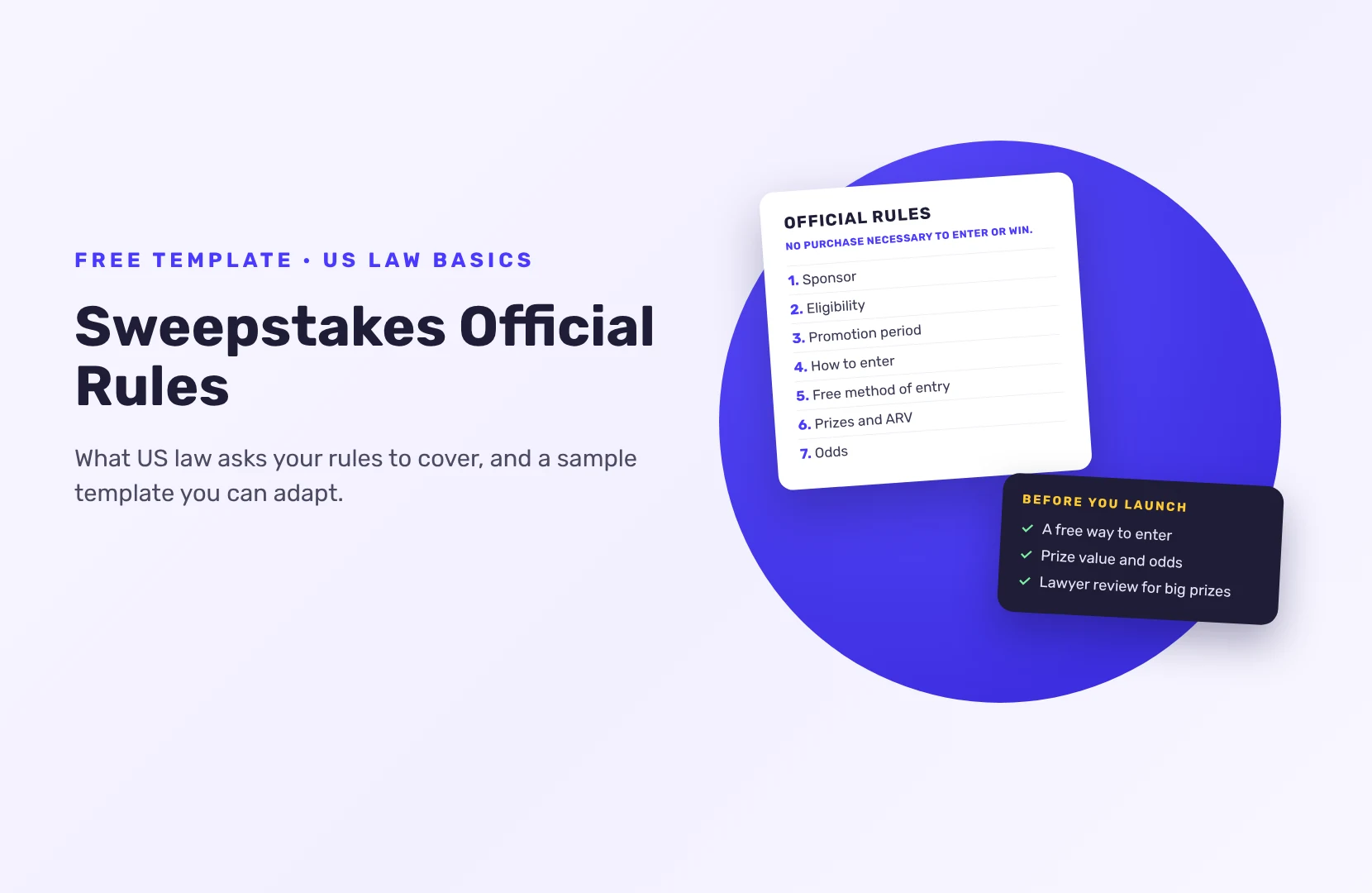
In 2026, the digital landscape has made "consideration" a more complex topic. While paying money is obvious consideration, courts and regulators have debated whether providing extensive personal data or performing arduous tasks constitutes a "cost." However, the core rule remains: No Purchase Necessary. If a company sells a product and offers a sweepstakes entry with that purchase, they are legally required to provide a free "Alternative Method of Entry" that offers the same odds of winning as the paid method.
Setting Up Your Winning Infrastructure
Winning sweepstakes consistently is not about luck in a single moment; it is about the statistical probability of multiple entries over time. To manage this effectively in 2026, you need a dedicated system to handle the high volume of communications and data entry.
Dedicated Communication Channels
Never use your primary personal or work email for sweepstakes. You will be inundated with newsletters, promotional offers, and occasional spam. Instead, create a dedicated email address specifically for "sweeping." Use a reputable provider like Gmail or Outlook, as some automated entry filters may flag "burner" email domains.
Additionally, consider a secondary VoIP phone number (such as Google Voice) for entry forms. Many sweepstakes require a phone number for winner notification, but using your primary mobile line can lead to an increase in telemarketing calls.
Automation and Organization Tools
Speed is essential when you are entering 50 to 100 sweepstakes a day. Use browser-based autofill tools or dedicated form-fill software like RoboForm. These tools securely store your name, address, and contact details, allowing you to fill out complex entry forms with a single click.
In 2026, many sweepstakes utilize biometric or "one-tap" entry through mobile apps. Ensure your mobile device is updated and that you have accounts on major social platforms (Instagram, TikTok, and X), as many "instant win" games are hosted directly within these ecosystems.
Finding Legitimate Sweepstakes Opportunities
The most successful sweepstakes entrants, often called "sweepers," do not wait for advertisements to find them. They proactively seek out opportunities where the odds are most favorable.
Aggregator Sites and Communities
Websites like Sweepstakes Advantage or Online Sweepstakes remain the gold standard for finding curated lists of active giveaways. these platforms categorize sweepstakes by entry frequency (daily, weekly, or one-time) and prize type. Community forums are particularly valuable for finding "hidden" sweepstakes that aren't widely advertised, thereby increasing your individual odds of winning.
Local vs. National Sweepstakes
While national sweepstakes for massive cash prizes or luxury cars are tempting, they also have millions of entries. Your statistical probability of winning is significantly higher in local or regional sweepstakes. Look for giveaways sponsored by local radio stations, grocery store chains, or community events. These often have a fraction of the entries of a national Coca-Cola or Pepsi promotion.
Creative and Skill-Based Contests
If you have a specific talent—photography, writing, or cooking—focus on skill-based contests. Because these require effort and talent, the barrier to entry is higher, which drastically reduces the number of participants. Legally, these do not fall under sweepstakes laws because the element of "chance" is replaced by "skill," but they remain a lucrative way to win prizes for free.
The "Alternative Method of Entry" (AMOE) Strategy
One of the most overlooked "legal secrets" to winning big prizes is the Alternative Method of Entry (AMOE). Many large-scale sweepstakes are "purchase-to-enter" on the surface—for example, a code found inside a bottle cap or on a fast-food cup.
By law, these companies must provide a free way to enter. Usually, this involves mailing a 3x5 inch card or piece of paper with your contact information to a specific address. While this requires the cost of a stamp and an envelope, it is legally considered a "free" entry.
In many cases, the AMOE entries are processed differently than digital entries. Because so few people take the time to mail in entries, the "pool" for mail-in winners can sometimes be less competitive, or at the very least, it allows you to participate in high-value "purchase" games without spending money on the products themselves.
Identifying and Avoiding Sweepstakes Scams
As a subject-matter expert, the most important advice I can provide is how to distinguish a legal sweepstakes from a fraudulent one. In 2026, scams have become more sophisticated, often using AI to mimic official corporate branding.
Red Flags of Fraud
- Fees for "Taxes" or "Shipping": A legitimate sweepstakes will never ask you to pay money to receive a prize. If you win a car, you might have to pay taxes to the IRS later, but you will never pay the sponsor to "release" the car.
- Requests for Financial Information: You should never provide a credit card number or bank account details to enter or claim a prize. The only exception is providing a Social Security number for tax purposes (Form W-9), but this only happens after you have been verified as a winner of a prize valued over $600.
- High Pressure: Scammers often claim you must act within minutes or hours. While legitimate sweepstakes have deadlines, they provide a reasonable window for prize claims.
- Unsolicited "Wins": If you receive a notification for a sweepstakes you never entered, it is almost certainly a scam.
For more information on protecting yourself, the Federal Trade Commission (FTC) provides updated resources on identifying prize scams.
Tax Compliance and Financial Responsibility
In the United States, prizes and awards are considered taxable income by the Internal Revenue Service (IRS). If you win a prize with a Fair Market Value (FMV) of $600 or more, the sponsor is legally required to issue you a Form 1099-MISC.
Managing the Tax Burden
When you win a large prize, such as $10,000 or a new vehicle, you must be prepared to pay the associated income tax. If you are in the 22% tax bracket, a $10,000 win could result in a $2,200 tax bill. It is a common mistake for winners to spend cash prizes immediately, only to be surprised by a large tax liability the following April.
Contesting Fair Market Value
Sponsors often list the "Approximate Retail Value" (ARV) in the official rules. However, you are only required to pay taxes on the "Fair Market Value" (FMV). If a sponsor claims a trip is worth $5,000, but you can prove that the same trip could be booked by the general public for $3,500, you can use the lower amount on your tax return, provided you have documented evidence.
The IRS provides specific guidance on Taxable and Nontaxable Income, which includes prizes and awards.
Comparing Entry Methods and Legality
| Feature | Sweepstakes | Contests (Skill) | Lotteries |
|---|---|---|---|
| Primary Requirement | Luck / Chance | Skill / Merit | Payment (Consideration) |
| Cost to Enter | Must be Free (or have AMOE) | Can have entry fees (varies by state) | Requires Payment |
| Legal Status | Legal if "No Purchase Necessary" | Legal if skill is primary factor | Illegal for private entities |
| Common Format | Random drawing, Instant win | Essay, Photo, Recipe contest | Powerball, Raffle, Scratch-offs |
| Winning Strategy | High volume, consistency | High quality, specific talent | No legal strategy (pure math) |
Frequently Asked Questions
Do I really have to pay taxes on prizes?
Yes, in the United States, the IRS treats all prizes as ordinary income. This applies to cash, merchandise, and travel. You must report the Fair Market Value of any prize on your federal and state tax returns. For prizes over $600, you will receive a 1099-MISC form from the sponsor, but even smaller prizes are technically taxable.
Is it legal for a sweepstakes to require me to watch an ad?
Yes. Generally, "limited" effort, such as watching a short video advertisement or following a brand on social media, is not considered "consideration" under current US law. However, if the task becomes excessively burdensome or requires a financial outlay, it may cross the legal line into an illegal lottery.
Can I use a bot to enter sweepstakes automatically?
Most sweepstakes explicitly prohibit the use of automated entry scripts or "bots" in their official rules. If a sponsor detects automated entries, they will disqualify you and may ban your IP address. Using a simple "autofill" tool that requires you to manually click "Submit" is usually acceptable, but always check the "Official Rules" section of the specific sweepstakes.
Why do some sweepstakes exclude residents of Rhode Island or Florida?
State laws vary. For example, Florida and New York require sponsors to "bond" or register sweepstakes if the total prize value exceeds a certain threshold ($5,000). Rhode Island has specific rules for retail-based games. To avoid the legal paperwork and costs of compliance in these states, some sponsors simply exclude their residents.
How do I know if a "Winner Notification" is real?
Check the sender's email address carefully. A notification from "prizewinner@gmail.com" is likely a scam, whereas one from "claims@fulfillment-house.com" or the official domain of the brand (e.g., @amazon.com) is more likely to be legitimate. Real notifications will reference the specific sweepstakes you entered and will never ask for a payment to claim the prize.
What is an "Affidavit of Eligibility"?
For large prizes, sponsors will send an Affidavit of Eligibility and Liability/Publicity Release. This is a legal document you must sign (often in front of a notary) to swear that you met all the entry requirements (age, residency) and to give the sponsor permission to use your name for promotional purposes.
Practical Recommendations for 2026
To maximize your chances of winning legally, start by setting aside 20 minutes each day for "sweeping." Focus on Daily Entry sweepstakes where you can return every 24 hours to put your name in the hat again. This consistency builds a statistical "floor" for your winning potential.
Always read the Official Rules—specifically the sections on eligibility and entry limits. Many people are disqualified simply because they entered twice when the rules allowed only one entry per household. By following the law, staying organized, and ignoring the "get rich quick" scams, you can turn sweepstakes into a rewarding and legally compliant hobby.
Image Gallery