How to Emulsify Lipids in Everyday Food: A Comprehensive Guide to Culinary Stability
To emulsify lipids in everyday food, you must combine fats with water-based liquids using a stabilizing agent, such as lecithin in egg yolks, mustard, or honey. By applying mechanical shear—like whisking or blending—while slowly drizzl...
To emulsify lipids in everyday food, you must combine fats with water-based liquids using a stabilizing agent, such as lecithin in egg yolks, mustard, or honey. By applying mechanical shear—like whisking or blending—while slowly drizzling the lipid into the aqueous base, you create a stable, homogenous mixture that resists separation.
Contents
Understanding how to manage lipids (fats and oils) is a cornerstone of professional culinary results. In 2026, home cooks are increasingly adopting techniques once reserved for industrial food science to achieve perfect textures in everything from simple vinaigrettes to complex modernist sauces. Emulsification is the process of forcing two immiscible liquids—substances that naturally repel each other, like oil and water—into a stable union.
The Science of Lipids and Aqueous Solutions
At the molecular level, lipids are hydrophobic, meaning they do not mix with water. When you attempt to combine them, the oil droplets naturally gravitate toward one another to minimize surface area contact with the water, eventually forming a separate layer. To prevent this, you need an emulsifier.
An emulsifier is a molecule that possesses a dual nature: a hydrophilic (water-loving) head and a lipophilic (fat-loving) tail. When introduced to a mixture of oil and water, these molecules position themselves at the interface of the two liquids. The lipophilic tails bury themselves in the oil droplets, while the hydrophilic heads remain in the water. This creates a protective barrier around each oil droplet, preventing them from coalescing and causing the sauce to "break."
In everyday cooking, we deal with two primary types of emulsions:
- Oil-in-Water (O/W): Small droplets of oil are dispersed throughout a continuous phase of water (e.g., mayonnaise, milk, Hollandaise).
- Water-in-Oil (W/O): Water droplets are dispersed throughout a continuous phase of fat (e.g., butter, vinaigrettes with very high oil content).
Essential Natural Emulsifiers in the Kitchen
You do not need laboratory-grade chemicals to emulsify lipids. Most everyday kitchens are already stocked with potent natural surfactants.
Egg Yolks (Lecithin)
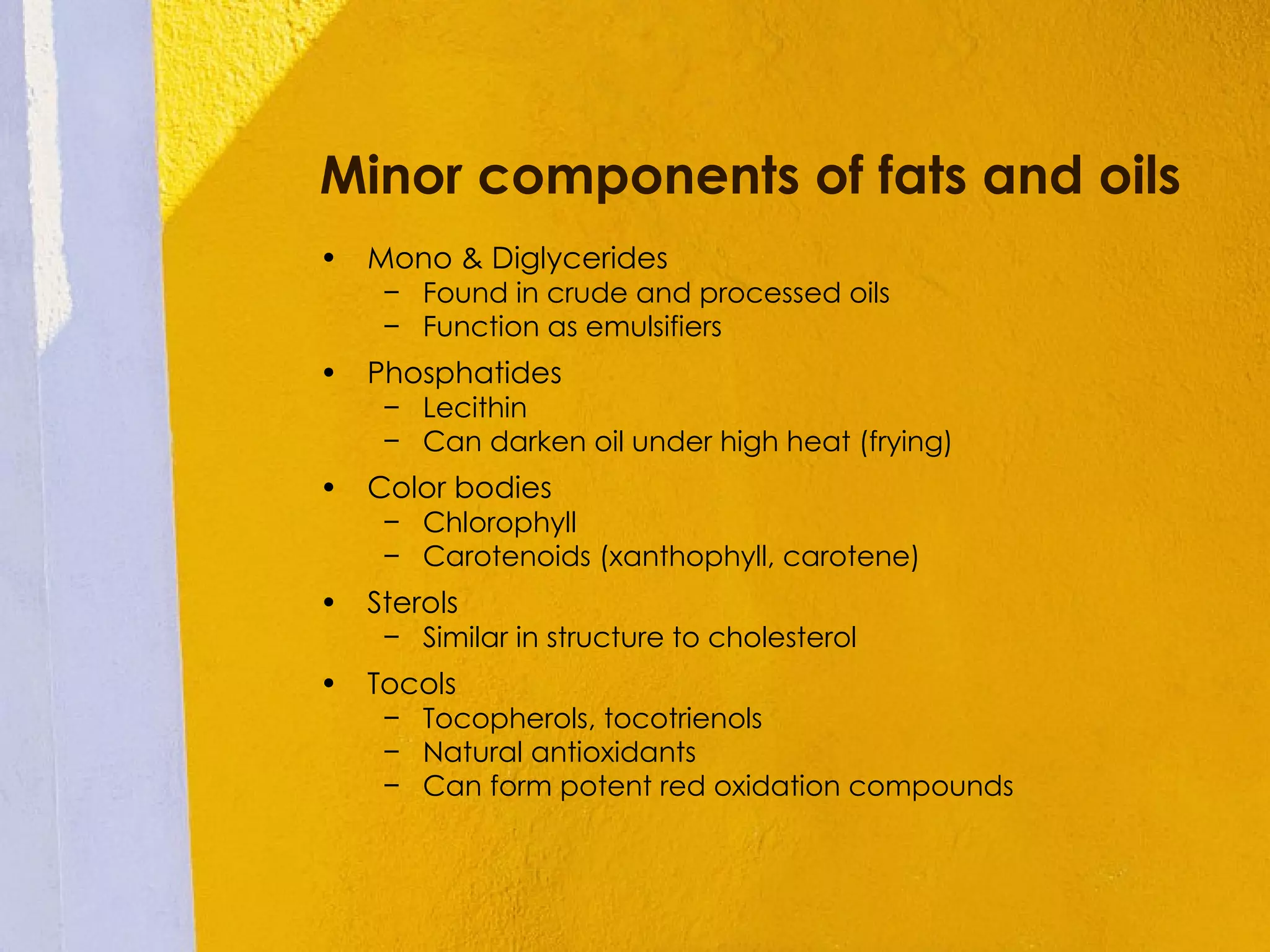
Egg yolks are perhaps the most famous culinary emulsifier. They contain lecithin, a phospholipid that is incredibly efficient at stabilizing fat droplets. Lecithin is why a few egg yolks can hold together the massive amount of oil required for a thick mayonnaise or the clarified butter in a Hollandaise.
Mustard
Mustard is more than a condiment; it is a structural necessity in vinaigrettes. The seed coat of the mustard seed contains complex polysaccharides (mucilage) that act as a stabilizer. Even a small teaspoon of Dijon mustard can prevent a balsamic dressing from separating for several hours.
Honey and Agave
High-viscosity liquids like honey or agave syrup provide physical resistance to the movement of oil droplets. While they are not "surfactants" in the same chemical sense as lecithin, they increase the viscosity of the continuous phase, making it much harder for oil droplets to find each other and merge.
Garlic and Alliums
Garlic contains natural compounds that assist in stabilization. In traditional Mediterranean cooking, "Aioli" was originally made using only garlic, oil, and salt. The mechanical breakdown of garlic cloves releases proteins and polysaccharides that coat the oil droplets.
Mechanical Techniques for Stable Emulsions
Success in emulsifying lipids depends as much on mechanical energy as it does on ingredients. You must break the lipid into the smallest possible droplets to ensure the emulsifier can coat them effectively.
The Slow Drizzle Method
The most common mistake is adding the oil too quickly. If you dump a cup of oil into a bowl with an egg yolk and start whisking, you will likely end up with a greasy mess. You must start with the aqueous phase (vinegar, lemon juice, or water) and the emulsifier. Add the oil drop by drop initially while whisking vigorously. Once a stable "nucleus" is formed, you can increase the flow to a thin, steady stream.
High-Shear Blending
In 2026, the use of high-speed immersion blenders has become the standard for "fail-proof" emulsions. These devices provide significantly more shear force than a hand whisk. The rapid rotation of the blades shatters lipids into microscopic droplets instantly. For a "Two-Minute Mayo," you can place all ingredients in a tall jar and pull the immersion blender upward; the high shear creates the emulsion in seconds.
Temperature Management
Temperature is critical for lipid stability.
- Warm Emulsions (Hollandaise/Beurre Blanc): If the mixture becomes too hot (above 145°F/63°C), the proteins in the egg or milk solids will coagulate, losing their ability to hold the fat. If it is too cold, the fat (like butter) will solidify and separate.
- Cold Emulsions (Mayonnaise): Room temperature ingredients generally emulsify more easily than refrigerator-cold ingredients because the lipids are more fluid and easier to break into droplets.
Comparison of Common Culinary Emulsifiers
| Emulsifier | Primary Component | Best Use Case | Stability Level |
|---|---|---|---|
| Egg Yolk | Lecithin | Mayonnaise, Hollandaise, Caesar Dressing | Very High (Permanent) |
| Dijon Mustard | Mucilage/Proteins | Vinaigrettes, Pan Sauces | Moderate (Semi-permanent) |
| Honey | Polysaccharides | Sweet Salad Dressings | Low to Moderate |
| Milk/Cream | Casein Proteins | Creamy Soups, Pan Gravy | Moderate |
| Tomato Paste | Pectin/Fibers | Italian-style Vinaigrettes, Stews | Low |
| Xanthan Gum | Polysaccharide | Modernist Syrups, Gluten-Free Sauces | Extreme (High Viscosity) |
Troubleshooting a Broken Emulsion
Even experienced chefs encounter "broken" sauces where the lipid has separated into an oily slick. This usually happens due to rapid oil addition, extreme temperature fluctuations, or over-saturation (adding more oil than the emulsifier can handle).
- The Water Reset: For a broken vinaigrette or mayonnaise, place a teaspoon of water (or lemon juice) in a clean bowl. Slowly whisk the broken mixture into the fresh water, drop by drop. This re-establishes the continuous phase.
- The Fresh Yolk Method: If a Hollandaise breaks, whisk a fresh egg yolk with a splash of water over a double boiler until frothy, then slowly whisk the broken sauce into the new yolk.
- Temperature Adjustment: If a butter sauce separates because it got too hot, whisking in a small ice cube can often drop the temperature quickly enough to bring the emulsion back together before the proteins fully seize.
Applications in Everyday Meals
Mastering the Vinaigrette
A standard 3:1 ratio of oil to vinegar is the baseline. To make it "everyday stable," use the following sequence:
- Whisk 1 tbsp vinegar with 1 tsp Dijon mustard and a pinch of salt.
- Slowly drizzle in 3 tbsp of extra virgin olive oil while whisking. The result is a thick, creamy dressing that clings to greens rather than puddling at the bottom of the bowl.
Creating Pan Sauces
When you sear meat, the browned bits (fond) left in the pan are full of flavor but also contain rendered lipids. By deglazing with a liquid (wine or stock) and then whisking in cold butter pieces over low heat, you are performing a "mounted" emulsion (Beurre Monté). The milk solids in the butter act as the emulsifier for the butter fat and the rendered meat fats.
Modernist Additions: Xanthan Gum
By 2026, xanthan gum has transitioned from a commercial additive to a common pantry item for those with dietary restrictions. It is a powerful stabilizer that works in very small quantities (usually 0.1% to 0.5% by weight). It is particularly useful for emulsifying lipids in thin liquids where you do not want the flavor of mustard or eggs, such as a clarified herb oil dressing.
Important Considerations and Safety
When emulsifying lipids in everyday food, consider the following:
- Food Safety: Emulsions involving raw egg yolks (like traditional mayonnaise or Caesar dressing) carry a risk of Salmonella. As of 2026, it is recommended to use pasteurized eggs for any "no-cook" emulsion intended for vulnerable populations.
- Saturation Limits: There is a limit to how much oil a specific amount of emulsifier can hold. For a single egg yolk, the limit is typically about 1 cup (240ml) of oil. Exceeding this will cause the emulsion to collapse regardless of your technique.
- Acidity: A proper balance of acid (vinegar/citrus) not only provides flavor but also helps stabilize certain proteins. However, excessive acid can eventually break down the structures holding the lipids.
Frequently Asked Questions
Why does my salad dressing always separate even when I shake it?
Shaking a jar creates a temporary emulsion. Without a surfactant like mustard or honey, the kinetic energy from shaking only breaks the oil into large droplets that quickly find each other and merge. To make it stay together, you must add an emulsifying agent that coats those droplets.
Can I emulsify fats without adding calories?
You can use mechanical high-shear blending to create a temporary emulsion, but for lasting stability without fats or sugars, many people now use small amounts of Xanthan gum or Gum Arabic. These provide stability by increasing viscosity without adding the caloric density of traditional emulsifiers like egg yolks.
Is butter an emulsion?
Yes, butter is a water-in-oil emulsion. It is roughly 80-82% milk fat, 16-17% water, and 1-2% milk solids (which act as the emulsifier). When you melt butter completely and it turns clear, you have "broken" the emulsion, resulting in clarified butter or ghee.
Why is my mayonnaise thin instead of thick?
This usually happens if the oil was added too quickly or if there wasn't enough mechanical force used during the process. If the oil droplets aren't broken down small enough, they cannot pack together tightly to create the "viscosity" or thickness associated with mayo. Adding a tiny bit more liquid and re-whisking can sometimes fix this.
What is the role of salt in emulsification?
Salt primarily affects the flavor, but it also influences the electrical charges on the surface of proteins. In some cases, salt can help "uncoil" proteins, making them more available to coat oil droplets, thus slightly improving the strength of the emulsion.
Practical Recommendation
For the most reliable results in everyday cooking, invest in a high-quality immersion blender and always include a "bridge" ingredient—mustard for vinaigrettes, egg yolks for thick sauces, or cold butter for pan gravies. When starting a new emulsion, remember the "Rule of Firsts": the first 25% of your lipid must be added slower than the remaining 75%. This ensures a strong foundation for the mixture.
Image Gallery