Understanding the Role of Local Cell Signaling
Local cell signaling is the process by which cells communicate with their immediate neighbors or themselves through the secretion of chemical messengers known as ligands. This short-range interaction is fundamental for coordinating tis...
Local cell signaling is the process by which cells communicate with their immediate neighbors or themselves through the secretion of chemical messengers known as ligands. This short-range interaction is fundamental for coordinating tissue development, regulating immune responses, and maintaining physiological homeostasis, allowing complex multicellular organisms to function as synchronized units rather than collections of isolated cells.
Contents
In the complex landscape of biological systems, communication is the currency of survival. While the endocrine system handles long-distance communication via hormones in the bloodstream, local cell signaling—comprising paracrine, autocrine, and juxtacrine pathways—manages the intricate details of a cell’s immediate environment. By 2026, our understanding of these pathways has moved beyond basic identification toward high-resolution mapping of signal gradients and the development of targeted therapies that can "rewire" these local conversations to treat diseases like cancer and chronic inflammation.
The Fundamentals of Short-Range Biological Communication
To understand the role of local cell signaling, one must first identify the components involved: the signaling cell, the ligand, and the target cell. Unlike endocrine signaling, where molecules travel through the circulatory system to distant organs, local signaling is restricted by the diffusion rates of molecules through the extracellular fluid or by the physical proximity of the cell membranes themselves.
The primary goal of local signaling is to elicit a specific functional response in a localized group of cells. This allows for high-precision control. For example, during embryonic development, a small group of cells might secrete a protein that tells only its immediate neighbors to become muscle tissue, while cells just a few micrometers further away receive a different set of instructions. This spatial specificity is what allows for the formation of complex structures like the human hand or the neural circuits of the brain.
The "language" of these signals is chemical. Ligands, which can be proteins, small peptides, amino acids, or even gases like nitric oxide, bind to specific receptors on the surface of target cells. This binding event triggers a cascade of intracellular events—signal transduction—that ultimately leads to a change in the cell’s behavior, such as gene expression, metabolic shifts, or movement.
Paracrine Signaling: The Neighborly Exchange
Paracrine signaling is perhaps the most diverse form of local communication. In this mode, a cell secretes signaling molecules into the extracellular environment, where they diffuse and influence nearby target cells. Because these molecules are often rapidly degraded by enzymes or sequestered by the extracellular matrix, their range is strictly limited, ensuring that the message stays "local."
Growth Factors and Tissue Repair
A primary example of paracrine signaling is the action of growth factors. When you sustain a skin injury, platelets and damaged cells release growth factors like Platelet-Derived Growth Factor (PDGF). These molecules signal neighboring fibroblasts to migrate to the wound site and proliferate, creating the new tissue necessary for healing. Without this localized paracrine loop, wound healing would be systemic and uncontrolled, potentially leading to unnecessary cellular growth across the body.
Synaptic Signaling: A Specialized Paracrine Pathway
The nervous system utilizes a highly specialized form of paracrine signaling known as synaptic signaling. Here, a neuron releases neurotransmitters into a synapse—a microscopic gap between the neuron and its target (another neuron or a muscle cell). Because the distance is so small, the signal travels almost instantaneously, allowing for the rapid processing of information that defines animal life. This is a prime example of how local signaling achieves both speed and precision.
Autocrine Signaling: The Feedback Loop
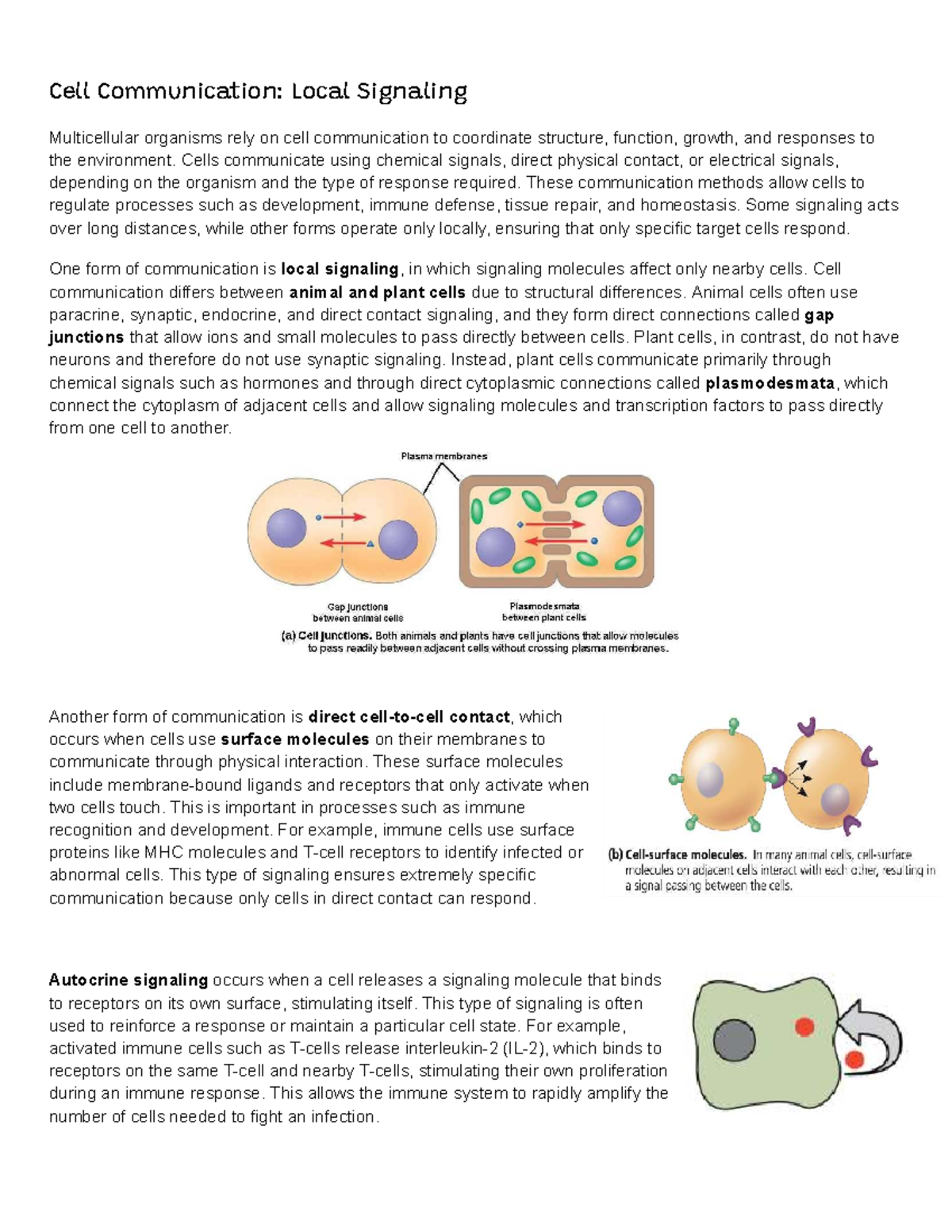
Autocrine signaling occurs when a cell secretes a ligand that binds to receptors on its own surface. While it may seem redundant for a cell to talk to itself, this mechanism is essential for reinforcing cellular identity and managing population-level behavior.
Strengthening Cellular Decisions
In the early stages of development, autocrine signaling helps a cell "commit" to a specific pathway. Once a cell begins to differentiate into a specific type, it may release signals that reinforce that same developmental path. This creates a positive feedback loop that ensures the cell completes its transformation successfully.
The "Community Effect"
Autocrine signaling also plays a role in the "community effect," where a group of identical cells reinforces a collective state. If a single cell secretes a signal, the concentration may be too low to trigger a response. However, if a whole cluster of neighboring cells secretes the same signal, the local concentration rises, and all cells in the group respond simultaneously. This is vital in the immune system, particularly in the activation of T-cells. When T-cells detect a pathogen, they secrete Interleukin-2 (IL-2), an autocrine signal that triggers their own rapid proliferation to fight the infection.
Juxtacrine Signaling: Communication via Direct Touch
Juxtacrine signaling, or contact-dependent signaling, requires physical contact between the signaling and target cells. There is no diffusion of a secreted ligand; instead, the signaling molecule is a protein anchored in the plasma membrane of the sender, and it binds to a receptor anchored in the membrane of the receiver.
Notch Signaling and Cell Fate
One of the most studied juxtacrine pathways is the Notch signaling pathway. This system is critical in determining cell fate during neurogenesis. When one cell "decides" to become a neuron, it expresses a ligand called Delta on its surface. Delta binds to Notch receptors on adjacent cells, sending a signal that inhibits those neighbors from also becoming neurons. This ensures that the brain has the correct balance of neurons and supporting glial cells.
Gap Junctions: Direct Cytoplasmic Connections
In some tissues, juxtacrine signaling is even more direct through gap junctions. These are protein channels that connect the cytoplasm of adjacent cells, allowing small molecules and ions to flow freely between them. In the human heart, gap junctions allow the rapid spread of electrical signals (ions), ensuring that all heart muscle cells contract in a perfectly timed sequence to pump blood efficiently.
Comparison of Local Signaling Mechanisms
The following table summarizes the key differences between the three primary modes of local cell signaling:
| Feature | Paracrine Signaling | Autocrine Signaling | Juxtacrine Signaling |
|---|---|---|---|
| Target | Nearby cells of a different or same type | The same cell that secreted the signal | Immediately adjacent cells in physical contact |
| Medium | Diffusion through extracellular fluid | Diffusion through extracellular fluid | Direct membrane-to-membrane contact |
| Primary Use | Growth, inflammation, neurotransmission | Cell differentiation, immune reinforcement | Embryonic development, cardiac coordination |
| Range | Short (micrometers to millimeters) | Extremely short (the cell's surface) | Zero (requires contact) |
| Key Example | Neurotransmitters in a synapse | Interleukin-2 in T-cell activation | Notch signaling in nerve development |
The Role of Local Signaling in Disease and 2026 Therapeutics
When local signaling pathways malfunction, the results are often catastrophic. Many of the most challenging diseases in modern medicine are fundamentally "communication disorders" at the cellular level.
Cancer and Autocrine Loops
One of the hallmarks of cancer is the "self-sufficiency" of growth signals. Many tumors develop autocrine loops where they secrete their own growth factors. For example, some lung cancer cells produce Transforming Growth Factor-alpha (TGF-α), which binds to receptors on the same cells, driving continuous, uncontrolled division. By 2026, many oncology treatments focus on small-molecule inhibitors that specifically block these autocrine receptors, effectively cutting off the "self-talk" that keeps the tumor growing.
Chronic Inflammation and Paracrine Overload
Chronic inflammatory diseases, such as rheumatoid arthritis, involve a paracrine system gone wrong. Immune cells in the joints secrete excessive amounts of cytokines (paracrine signals) like Tumor Necrosis Factor (TNF). These signals tell neighboring bone and cartilage cells to break down, leading to joint destruction. Modern biological therapies—monoclonal antibodies—act by intercepting these paracrine messengers before they can reach their target cells.
Regenerative Medicine and Local Signaling
In 2026, the field of regenerative medicine relies heavily on manipulating local signaling environments to heal damaged organs. By using bioengineered scaffolds "seeded" with specific paracrine factors, scientists can trick stem cells into migrating to a damaged heart or spinal cord and differentiating into the specific cell types needed for repair. This "niche engineering" is only possible because we have decoded the local signaling language cells use to build tissues in the first place.
Frequently Asked Questions
How does a cell distinguish between local and systemic signals?
Cells distinguish signals based on the specific receptors they express and the concentration of the ligand. Local signals (paracrine/autocrine) are usually present in high concentrations near the source but dilute quickly. Systemic signals (hormones) are often present in very low concentrations in the blood but have extremely high affinity for their receptors, allowing cells to pick them up even from far away.
Can a single molecule act in both paracrine and autocrine ways?
Yes. Many cytokines in the immune system, such as Interleukin-2, act as autocrine signals to stimulate the secreting T-cell and as paracrine signals to stimulate other nearby immune cells. This allows for a coordinated and amplified immune response.
What happens if local signaling is blocked during development?
Blocking local signaling during embryonic development usually results in severe congenital disabilities or non-viability. Because local signaling provides the spatial "blueprint" for where organs and limbs should grow, disrupting these pathways leads to disorganized tissue growth or the complete absence of specific structures.
Is synaptic signaling faster than other paracrine signaling?
Yes, primarily because the distance the neurotransmitter must diffuse is incredibly small (about 20-40 nanometers). Additionally, the signaling cell (neuron) uses electrical impulses to trigger the release, and the target cell often has ionotropic receptors that open immediately upon binding, making it one of the fastest communication events in the body.
How is a local signal turned "off"?
To prevent overstimulation, local signals must be removed quickly. This happens through three main mechanisms: enzymatic degradation (where enzymes break down the ligand), reuptake (where the secreting cell pumps the ligand back inside), or binding to the extracellular matrix, which traps the molecule and prevents it from reaching more receptors.
Next Actions for Further Understanding
To deepen your understanding of local cell signaling, consider the following steps:
- Study Signal Transduction: Research how a ligand binding to a receptor (the "message") is converted into a cellular action through pathways like the cAMP or MAPK cascades.
- Explore Targeted Biologicals: Investigate how 2026-era medications, such as kinase inhibitors or monoclonal antibodies, are designed to interrupt specific local signaling loops in autoimmune diseases.
- Review Developmental Biology: Look at the role of "morphogen gradients," which are paracrine signals that tell cells their position in an embryo based on the concentration of the signal they receive.
Image Gallery