Orthopaedic Engineering: Advanced Principles, Materials, and Clinical Applications in 2026
Orthopaedic engineering is a specialized branch of biomedical engineering that applies principles of physics, material science, and mechanical engineering to the musculoskeletal system. As of 2026, it focuses on the design, analysis, a...
Orthopaedic engineering is a specialized branch of biomedical engineering that applies principles of physics, material science, and mechanical engineering to the musculoskeletal system. As of 2026, it focuses on the design, analysis, and manufacture of implants, prosthetics, and surgical tools to restore function to bones, joints, and ligaments damaged by trauma or disease.
Contents
The discipline bridges the gap between clinical medicine and technical innovation. It involves understanding the complex mechanics of the human body and developing synthetic solutions that can survive the harsh, corrosive environment of the internal physiological system. From the micro-scale of tissue engineering to the macro-scale of robotic-assisted joint replacement, orthopaedic engineering is essential for improving the quality of life in an aging global population.
The Fundamentals of Musculoskeletal Biomechanics
At the core of orthopaedic engineering lies biomechanics—the study of the structure and function of biological systems using the methods of mechanics. To design a successful implant, an engineer must first understand how the healthy human body distributes loads and manages motion. This requires a deep dive into kinematics (the study of motion without regard to forces) and kinetics (the study of the forces that produce or change motion).
The human skeletal system is a marvel of structural efficiency. Bones are not static; they are dynamic, living tissues that remodel themselves in response to mechanical stress—a principle known as Wolff’s Law. Orthopaedic engineers must account for this when designing hardware. If an implant is too rigid, it may carry all the mechanical load, leading the surrounding bone to atrophy due to a lack of stimulation. This phenomenon, known as stress shielding, is a primary cause of long-term implant failure.
In 2026, computational modeling has become a prerequisite for design. Finite Element Analysis (FEA) allows engineers to simulate how a new hip stem or spinal cage will interact with various bone densities before a single prototype is manufactured. These models incorporate anisotropic properties—meaning the material’s strength varies depending on the direction of the load—which is a hallmark of natural bone.
Biomaterials: Selection and Biological Integration
The selection of materials for orthopaedic applications is governed by three primary factors: biocompatibility, mechanical properties, and wear resistance. In the physiological environment, materials are subjected to cyclic loading (millions of steps per year) and a saline-rich environment that promotes electrochemical corrosion.
Metallic Alloys
Metals remain the backbone of load-bearing implants. Titanium alloys, particularly Ti-6Al-4V, are favored for their excellent biocompatibility and high strength-to-weight ratio. Their elastic modulus is closer to that of bone than stainless steel, which helps mitigate stress shielding. Cobalt-chromium (CoCr) alloys are frequently used in the articulating surfaces of knee and hip replacements due to their extreme hardness and resistance to abrasive wear.
Polymers and Ceramics
Ultra-High-Molecular-Weight Polyethylene (UHMWPE) is the industry standard for the "plastic" liner in joint replacements. Modern cross-linked versions of this polymer, often infused with Vitamin E as an antioxidant, have drastically reduced wear debris, which was a leading cause of inflammatory bone loss (osteolysis) in previous decades.
Ceramics, such as alumina-toughened zirconia, offer the lowest friction coefficients and highest scratch resistance. They are increasingly utilized in "ceramic-on-ceramic" or "ceramic-on-polyethylene" bearings for younger, more active patients who require their implants to last 25 years or more.
Smart Materials and 3D Bioprinting
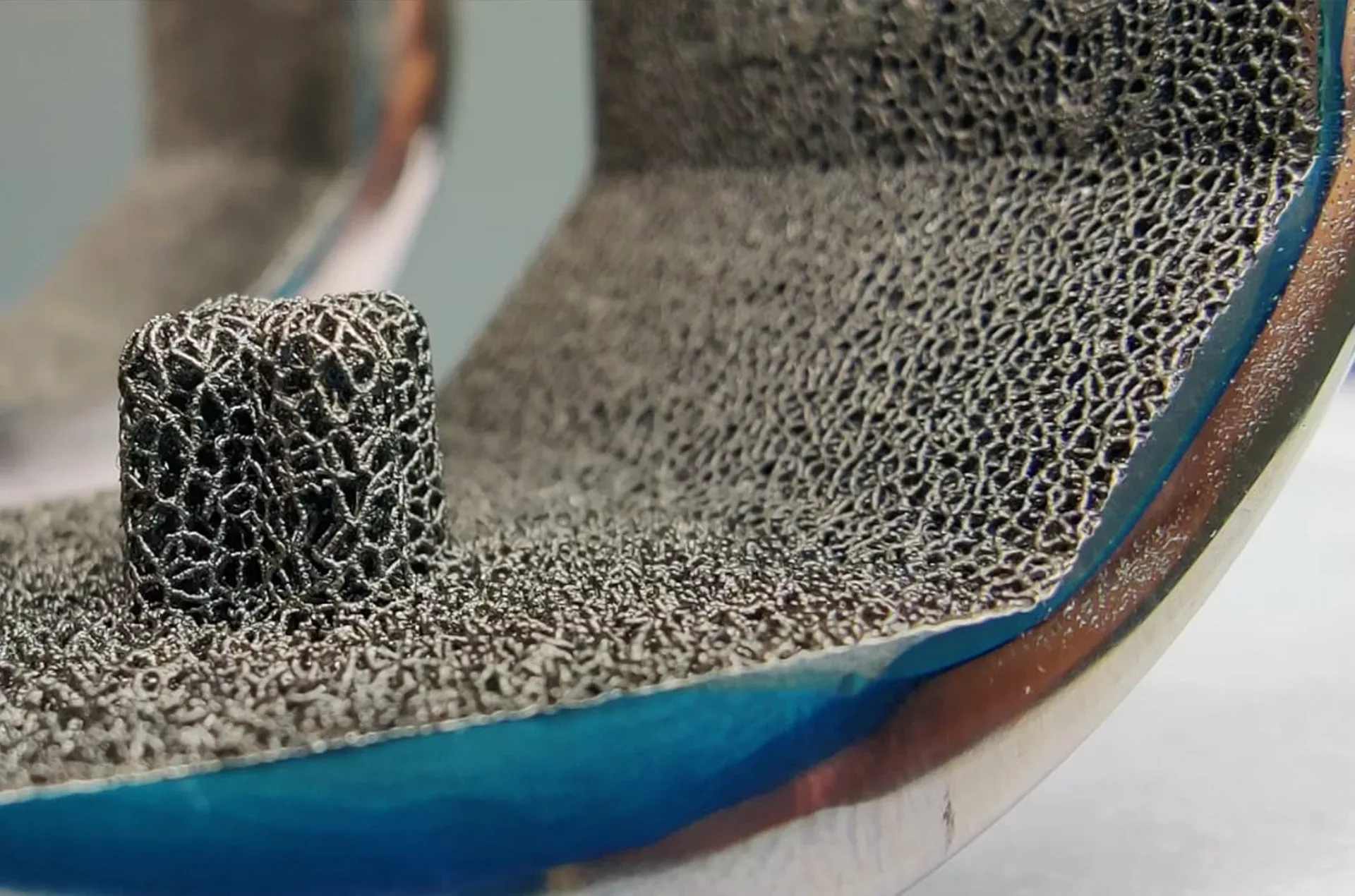
By 2026, the industry has shifted toward "smart" biomaterials. These include shape-memory alloys like Nitinol for minimally invasive spinal procedures and porous titanium structures created through Additive Manufacturing (3D printing). These porous scaffolds mimic the architecture of trabecular bone, encouraging "osseointegration"—where the patient's natural bone grows directly into the implant pores, creating a biological bond rather than a simple mechanical fit.
Orthopaedic Implant Design and Performance Standards
Designing an orthopaedic device is a multi-year process involving rigorous testing. Every device must meet international standards, such as those set by ISO (International Organization for Standardization) and ASTM International. These standards dictate how fatigue testing, corrosion analysis, and wear testing must be conducted.
| Material Type | Young's Modulus (GPa) | Key Application | Primary Advantage |
|---|---|---|---|
| Cortical Bone | 15–25 | Biological baseline | Optimized for natural loading |
| Titanium Alloy (Ti6Al4V) | 105–115 | Hip stems, dental implants | High biocompatibility, lower stiffness |
| Cobalt-Chrome (CoCrMo) | 210–240 | Knee femoral components | Superior wear resistance |
| Alumina/Zirconia Ceramic | 350–400 | Joint bearing surfaces | Lowest friction, no metal ions |
| PEEK Polymer | 3–4 | Spinal fusion cages | Radiolucency (visible on X-rays) |
A critical design consideration is the Tribology of the joint—the science of friction, lubrication, and wear. In a healthy joint, synovial fluid provides nearly frictionless movement. In a prosthetic joint, engineers must design the geometry and surface finish to minimize the generation of "wear particles." If these particles reach a certain concentration, the body’s immune system attempts to digest them, inadvertently destroying the surrounding bone in the process.
Robotic-Assisted Surgery and Navigation Systems
Orthopaedic engineering is not limited to what stays inside the patient; it also encompasses the technology used to perform the surgery. In 2026, robotic-assisted platforms have become standard in many healthcare systems. These systems allow for "pre-operative planning" based on a patient's specific CT scan.
Engineers develop the software and haptic feedback systems that guide the surgeon’s hand. During a total knee replacement, for example, the robot ensures that the bone cuts are precise to within half a millimeter. This precision ensures the prosthetic components are perfectly aligned with the patient's mechanical axis, which significantly reduces the risk of premature wear and improves the "natural feel" of the joint.
Navigation systems utilize infrared cameras and trackers attached to the patient's bone to provide real-time feedback on joint stability and range of motion. This data-driven approach allows for a shift from "one-size-fits-all" implants to customized surgical plans that account for individual anatomical variations.
Regulatory Landscape and Quality Assurance in 2026
The regulatory environment for orthopaedic devices is stringent, overseen by bodies such as the FDA (Food and Drug Administration) in the United States and the EMA (European Medicines Agency) under the Medical Device Regulation (MDR).
In 2026, the focus has intensified on Post-Market Clinical Follow-up (PMCF). Manufacturers are now required to track the long-term performance of their implants more rigorously than ever before. This is facilitated by national joint registries, which collect data on every joint replacement performed. If a specific design shows a higher-than-average failure rate, engineering teams must investigate the root cause—whether it be a material flaw, a design error, or a surgical technique issue.
ISO 13485 remains the gold standard for quality management systems in orthopaedic manufacturing. It ensures that every step of the process, from raw material sourcing to final sterilization (usually via gamma radiation or ethylene oxide gas), is documented and repeatable.
Future Frontiers: Tissue Engineering and Mechanobiology
The ultimate goal of orthopaedic engineering is to move away from permanent synthetic replacements and toward biological repair. This field, known as tissue engineering or regenerative medicine, involves creating scaffolds that are seeded with the patient's own cells.
By 2026, significant progress has been made in Mechanobiology—the study of how physical forces affect cellular behavior. Engineers are developing bioreactors that "exercise" lab-grown cartilage or bone by applying cyclic pressure, mimicking the environment of the human body. This mechanical stimulation is crucial for teaching the cells to produce the correct extracellular matrix, resulting in tissue that is strong enough for implantation.
Current research also focuses on "Bio-resorbable" materials. These are implants designed to provide temporary structural support and then slowly dissolve as the body replaces them with natural tissue. This is particularly valuable in pediatric orthopaedics, where traditional metal implants cannot accommodate the growth of a child's skeleton.
Common Challenges and Troubleshooting in Device Design
Despite technological leaps, orthopaedic engineers still face significant hurdles:
- Infection Control: Bacteria can form biofilms on the surface of metal implants. These films are highly resistant to antibiotics. Current engineering solutions include silver-ion coatings or "bactericidal" surface textures that physically rupture bacterial cell walls.
- Aseptic Loosening: This is the most common cause of long-term failure. It occurs when the bond between the bone and implant fails without infection. Engineers address this by optimizing the "micromotion" at the bone-implant interface.
- Metal Sensitivity: A small percentage of patients develop allergies to nickel or cobalt. Engineers must provide alternative solutions, such as titanium-nitride coatings or all-ceramic options.
Frequently Asked Questions
What educational background is required for a career in orthopaedic engineering?
Most professionals hold a degree in Biomedical Engineering, Mechanical Engineering, or Material Science. Advanced roles usually require a Master’s or PhD, focusing on biomechanics or biomaterials. Clinical exposure—observing surgeries and understanding the needs of surgeons—is considered essential for design roles.
How long do modern orthopaedic implants last?
As of 2026, most hip and knee replacements are expected to last 20 to 25 years in 90% of patients. Longevity depends on the patient's activity level, weight, and the precision of the surgical placement. Advances in cross-linked polymers and ceramic materials have significantly extended these lifespans compared to the 10-15 year expectations of the early 2000s.
Is AI used in orthopaedic engineering?
Yes, AI is integrated into two primary areas: predictive modeling and diagnostics. AI algorithms analyze thousands of X-rays and MRI scans to help engineers design "average" anatomical models for off-the-shelf implants. In the clinical setting, AI helps predict which patients are at a higher risk of implant failure based on their bone quality and lifestyle factors.
What is the role of 3D printing in this field?
3D printing, or additive manufacturing, allows for the creation of complex, porous geometries that were impossible to manufacture with traditional casting or milling. This is used both for custom "patient-specific" implants (e.g., for complex oncology cases where a large section of bone is removed) and for standard implants with enhanced bone-ingrowth surfaces.
Final Recommendations for Stakeholders
For engineers and manufacturers, the priority remains the balance between innovation and clinical evidence. While 3D-printed, custom-coated implants offer theoretical advantages, they must be backed by long-term durability data. For patients and clinicians, the focus should be on choosing devices with a proven track record in national registries. As the field moves toward 2030, the integration of biological components with traditional mechanical hardware—the "bio-hybrid" approach—will likely be the next major shift in orthopaedic care.
Image Gallery