Why Noble Gases Do Not Form Chemical Bonds: The Science of Atomic Stability
Noble gases do not form chemical bonds under standard conditions because they possess a full valence shell of electrons, creating a highly stable electronic configuration. This "octet" of electrons represents a state of minimum potenti...
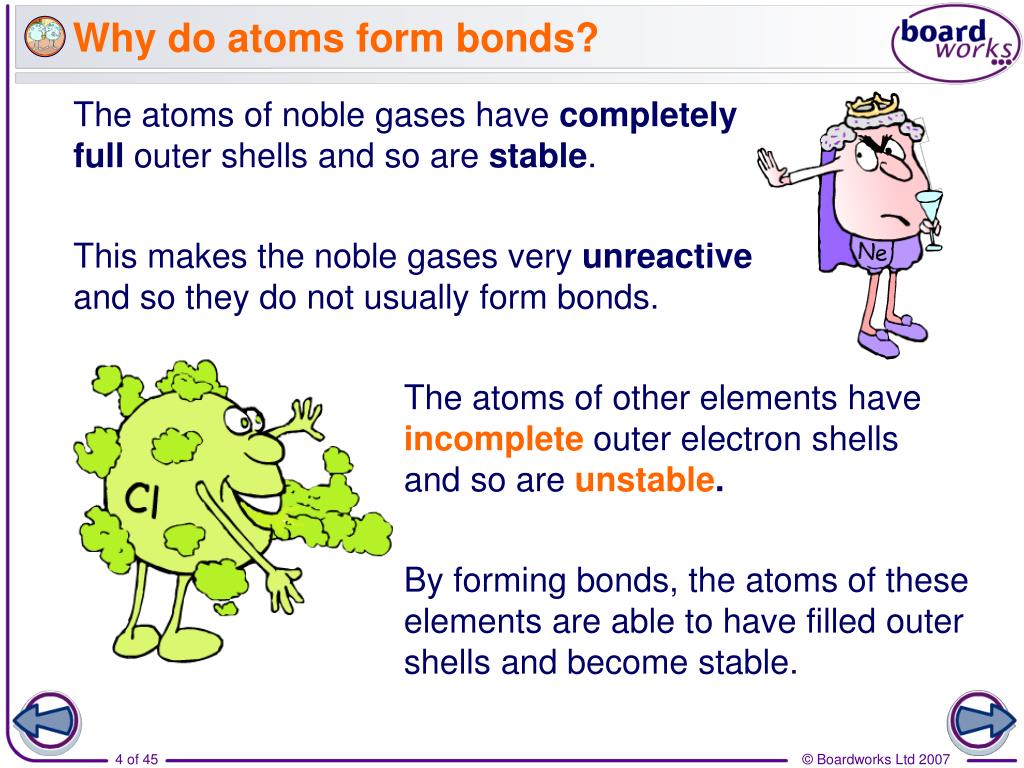
Noble gases do not form chemical bonds under standard conditions because they possess a full valence shell of electrons, creating a highly stable electronic configuration. This "octet" of electrons represents a state of minimum potential energy, meaning these atoms have no energetic incentive to gain, lose, or share electrons with other elements.
Contents
The Foundation of Atomic Stability: The Octet Rule
To understand why noble gases—Helium (He), Neon (Ne), Argon (Ar), Krypton (Kr), Xenon (Xe), and Radon (Rn)—are chemically inert, we must first examine the fundamental principles of atomic structure. In the early 20th century, chemists Gilbert N. Lewis and Walther Kossel observed that atoms tend to react in ways that allow them to achieve the electron configuration of the noble gas nearest to them in the periodic table. This observation became known as the octet rule.
The valence shell is the outermost electron shell of an atom. For most elements, this shell is incomplete. For instance, Oxygen has six valence electrons and seeks two more to reach a stable count of eight. Sodium has one valence electron and seeks to shed it to reveal a full underlying shell. In contrast, noble gases (with the exception of Helium, which has a full "duet") already possess eight electrons in their outermost $s$ and $p$ orbitals ($ns^2 np^6$).
This specific arrangement provides a unique level of symmetry and stability. In quantum mechanical terms, a full subshell results in a spherically symmetric charge distribution, which minimizes the internal energy of the atom. Because they are already at a "low energy" state, they do not need to form bonds to reach stability. In chemistry, systems naturally progress toward the lowest energy state possible; for noble gases, that state is achieved in isolation.
Ionization Energy and Electron Affinity
The resistance of noble gases to chemical bonding can be quantified through two primary periodic trends: ionization energy and electron affinity.
High Ionization Energy
Ionization energy is the amount of energy required to remove an electron from an atom. Noble gases possess the highest first ionization energies in their respective periods. Because the valence electrons are part of a full shell, they are held very tightly by the positively charged nucleus. The effective nuclear charge—the net positive charge experienced by valence electrons—is at its maximum for noble gases within any given row of the periodic table.
As of 2026, experimental data continues to confirm that stripping an electron from Neon, for example, requires significantly more energy than any other element in the second period. This massive energy barrier prevents noble gases from acting as electron donors in typical chemical reactions.
Negative Electron Affinity
Electron affinity measures the energy change when an electron is added to a neutral atom. For most elements, adding an electron releases energy (exothermic), making the process favorable. However, noble gases have a zero or even positive electron affinity. Because their valence shells are entirely occupied, any incoming electron would have to occupy a new, higher-energy orbital in a different principal quantum shell. This is energetically unfavorable; the atom would essentially have to "pay" energy to take on an extra electron, rather than gaining stability from it.
The Role of Intermolecular Forces
Because noble gases do not form primary chemical bonds (ionic or covalent) under normal conditions, they exist as monatomic gases. Unlike Oxygen ($O_2$) or Nitrogen ($N_2$), which form diatomic molecules to achieve stability, a single atom of Neon is perfectly stable on its own.
The only forces acting between noble gas atoms are weak London dispersion forces, a type of van der Waals force. These forces arise from temporary fluctuations in electron density that create instantaneous dipoles. Because these forces are exceptionally weak, noble gases have very low boiling and melting points. Helium, for instance, has the lowest boiling point of any known substance ($4.22$ K), remaining a gas until it is nearly at absolute zero. This physical state is a direct macroscopic consequence of their microscopic refusal to form strong chemical bonds.
The Exception to the Rule: When Noble Gases Do React
The long-held belief that noble gases are completely "inert" was shattered in 1962. Chemist Neil Bartlett noticed that the compound platinum hexafluoride ($PtF_6$) was powerful enough to oxidize molecular oxygen. He realized that the ionization energy of Xenon was nearly identical to that of oxygen and hypothesized that Xenon might also react. He successfully synthesized Xenon hexafluoroplatinate ($XePtF_6$), the first noble gas compound.
This discovery highlighted that "inertness" is relative. While noble gases do not bond easily, the heavier noble gases (Krypton, Xenon, and Radon) can be forced to form bonds under specific conditions. This is due to several factors:
- Atomic Size: Larger atoms like Xenon have valence electrons that are much further from the nucleus than those in Neon or Helium.
- Shielding Effect: The inner electrons "shield" the outer electrons from the nucleus's pull, making them slightly easier to remove or share.
- Electronegative Partners: Noble gases will only react with the most "aggressive" elements—typically Fluorine or Oxygen—which have extremely high electronegativities and can pull the noble gas electrons into a shared bond.
By 2026, researchers have documented hundreds of noble gas compounds, including $XeF_2$, $XeF_4$, $XeF_6$, and even $HArF$ (Argon fluorohydride), though the latter is only stable at extremely low temperatures.
Comparative Properties of Noble Gases (Group 18)
The following table outlines the physical and atomic properties that contribute to the chemical behavior of Group 18 elements.
| Element | Symbol | Atomic Number | Valence Configuration | First Ionization Energy (kJ/mol) | Boiling Point (°C) |
|---|---|---|---|---|---|
| Helium | He | 2 | $1s^2$ | 2372.3 | -268.9 |
| Neon | Ne | 10 | $2s^2 2p^6$ | 2080.7 | -246.1 |
| Argon | Ar | 18 | $3s^2 3p^6$ | 1520.6 | -185.8 |
| Krypton | Kr | 36 | $4s^2 4p^6$ | 1350.8 | -153.2 |
| Xenon | Xe | 54 | $5s^2 5p^6$ | 1170.4 | -108.1 |
| Radon | Rn | 86 | $6s^2 6p^6$ | 1037.0 | -61.7 |
As shown in the table, the First Ionization Energy decreases as we move down the group. This explains why Xenon (1170.4 kJ/mol) is more reactive than Helium (2372.3 kJ/mol). The lower energy requirement allows highly electronegative elements to overcome the "inert" nature of the larger noble gases.
Practical Applications of Non-Reactivity
The refusal of noble gases to form bonds is not just a theoretical curiosity; it is a property that makes them indispensable in modern industry and technology.
- Protective Atmospheres: In arc welding, Argon is used to shield the weld area from atmospheric Oxygen and Nitrogen. Because Argon will not react with the hot metal, it prevents oxidation and ensures a high-quality weld.
- Lighting: Neon, Argon, and Krypton are used in gas-discharge lamps. Their inability to bond ensures that the gas remains in its atomic state even when subjected to high-voltage electricity, providing a consistent glow.
- Cryogenics: Liquid Helium is essential for cooling the superconducting magnets in MRI machines. Its chemical inertness ensures it won't react with the equipment, even in the event of a leak.
- Deep-Sea Diving: Heliox (a mixture of Helium and Oxygen) is used by divers to prevent nitrogen narcosis. Helium is chosen specifically because it does not react with the body's tissues or bloodstream.
Thermodynamic Barriers to Bonding
From a thermodynamic perspective, chemical bonds form because the resulting molecule is at a lower Gibbs free energy than the separate atoms. For a noble gas to form a bond, the energy required to promote an electron or disrupt the stable octet must be compensated for by the energy released during bond formation.
In the case of Helium or Neon, the "cost" of disrupting the valence shell is so high that no potential bond with another atom could ever release enough energy to make the process spontaneous. This is why, despite decades of advanced chemical synthesis, no stable neutral compounds of Helium or Neon have been created at room temperature and pressure. The thermodynamic barrier is simply too high for the laws of physics to allow for spontaneous bonding.
Frequently Asked Questions
Why is Helium's valence shell full with only two electrons?
Helium's valence shell is the first principal energy level ($n=1$). This level contains only one orbital, the $1s$ orbital, which can hold a maximum of two electrons. Once these two electrons are present, the shell is entirely full, satisfying the requirement for stability without needing an octet.
Can noble gases form bonds under extreme pressure?
Yes. Under the extreme pressures found in planetary cores, noble gases can be forced into chemical interactions that do not occur at standard pressure. Recent research suggests that at millions of atmospheres, Helium can form stable compounds with Sodium ($Na_2He$), although these are held together by different electronic mechanisms than standard covalent bonds.
Is Radon reactive because it is radioactive?
Radon's radioactivity is a nuclear property, not a chemical one. Chemically, Radon follows the same patterns as Xenon and can form compounds like Radon difluoride ($RnF_2$). However, because Radon decays so quickly, studying its chemical bonding is exceptionally difficult and hazardous.
Are noble gases completely useless in chemical synthesis?
On the contrary, while they don't form many stable products, they are excellent "carriers" or "diluents." Additionally, noble gas compounds like Xenon difluoride are used in specialized applications as powerful oxidizing and fluorinating agents because they "want" to revert to their stable, monatomic gaseous state.
Which noble gas is the most "reactive"?
Xenon is considered the most reactive of the naturally occurring noble gases that are stable enough to study. While Oganesson (Element 118) is predicted to be more reactive due to relativistic effects on its electron shells, its extremely short half-life makes experimental confirmation nearly impossible.
Final Recommendation for Students and Educators
When studying atomic behavior, it is essential to view "inertness" as a spectrum rather than an absolute rule. For most practical purposes in introductory chemistry, noble gases can be treated as non-bonding. However, for advanced applications or understanding the limits of chemical theory, one should recognize that the stability of the octet is the primary driver of their behavior, and only the most extreme energy conditions or the most reactive partners can break that stability. To further explore this topic, research the work of Neil Bartlett or look into modern high-pressure crystallography studies involving Group 18 elements.
Image Gallery