Understanding Half Addresses in International Mail: Standards, Formatting, and Delivery Solutions
In international mail, a half address refers either to a physical fractional house number (such as 104 ½) created by property subdivision or to a truncated, incomplete address caused by character cut-offs in shipping software. Deliveri...
In international mail, a half address refers either to a physical fractional house number (such as 104 ½) created by property subdivision or to a truncated, incomplete address caused by character cut-offs in shipping software. Delivering these packages reliably requires standardizing fractional entries, eliminating field truncation, and adhering strictly to international postal addressing guidelines.
Contents
Defining "Half Addresses" in Global Logistics
The term "half address" carries two distinct meanings within the shipping and postal industries. In physical real estate and domestic postal management, a half address refers to a legitimate fractional street number—such as "742 ½ Main Street" or "10-½ Maple Avenue." These identifiers originate when a property owner subdivides a single lot or constructs an auxiliary dwelling unit (ADU) after the local municipality has already assigned sequential integer street numbers to the block.
In modern cross-border e-commerce and international logistics operations, however, "half address" is frequently used by technical operations teams to describe a partial or incomplete address payload. This structural data issue occurs when an international address string is truncated or split improperly across database fields. When a recipient's full address exceeds the character limits of international shipping software or single-line carrier labels, essential details—such as apartment numbers, sub-districts, or building names—are effectively cut in half or dropped entirely.
- Physical Fractional Address
- Real estate subdivision
- Examples: 104 ½, 12B, 18-1/2
- Needs ASCII character standard
- Systemic Truncated Address
- Character limit cut-offs
- Missing line 2 or sub-unit
- Needs API payload optimization
Both scenarios present severe logistical challenges during international transport. While a local domestic mail carrier might rely on neighborhood familiarity to deliver a package with a missing unit code or a unusual fractional number, international mail relies on automated optical scanners, strict customs declarations, and inter-carrier handoffs. An ambiguous or incomplete address line routinely leads to delayed customs clearance, failed delivery attempts, and costly return-to-sender (RTS) processing.
Fractional Street Numbers vs. Truncated International Addresses
To correct and format address data effectively, shippers must distinguish between physical fractional identifiers and system-generated truncation issues.
Physical Fractional House Numbers
Fractional numbers are recognized legal addresses in several countries, including the United States, Canada, the United Kingdom, and parts of the Caribbean. They usually represent secondary structures, basement apartments, converted commercial spaces, or infill housing built between established street numbers.
When generating cross-border shipping labels, formatting fractional numbers presents technical challenges:
- Special Character Failures: Unicode fraction symbols like
½,⅓, or¾are frequently corrupted when passed through international Electronic Data Interchange (EDI) streams, converting into unreadable control characters or blank spaces (e.g., "104 Main St"). - Delimiter Confusion: Using slashes (
/) in address fields can confuse carrier parsing algorithms, which may misinterpret12 1/2as a division operator, a unit separator, or an incorrect postal district code. - Database Field Restrictions: Many international address verification systems only accept standard numeric characters in the street number field, causing validation errors for users trying to enter fractional inputs.
Systemic Address Truncation
Address truncation is a software integration failure that strips necessary location data from international mail. This occurs primarily because addressing conventions vary dramatically across global regions. For example, a complete address in Germany or Japan may include detailed sub-district names, building wings, and floor numbers that far exceed the 35-character limit standard on standard shipping labels.
When an online checkout system or Enterprise Resource Planning (ERP) platform limits entry fields to fewer characters than required by foreign postal networks, the tail end of the address is discarded. This leaves destination postal workers with only "half" of the information required to locate the recipient's door.
How Global Postal Networks Process Complex and Partial Addresses
International mail movement relies on technical standards set by the Universal Postal Union (UPU) addressing standards, specifically the UPU S42 international addressing framework. The S42 standard defines how national postal operators map local address elements into a universally recognizable XML structure containing elements like thoroughfare, premise number, sub-premise, post code, and locality.
- Sender Checkout
- API Validation
- EDI / Customs Pre-Clearance
- High-Speed OCR Hub Sorting
- Destination Post
- Final Delivery
Automated Sorting and Optical Character Recognition (OCR)
When an international parcel arrives at a destination exchange office (DEO), high-speed OCR scanners read the physical label to route the item to the appropriate local delivery depot.
- Database Matching: The OCR engine attempts to match the printed address string against the destination country's official address reference database.
- Ambiguity Flags: If a fractional street number is formatted incorrectly (e.g., written without proper spacing or containing unreadable symbols), the system cannot verify the premise identifier and flags the parcel for manual review.
- Missing Sub-Premise Drop-offs: If truncation has removed a secondary unit number, the OCR system may successfully route the parcel to the correct street, but the final carrier will be unable to complete delivery, resulting in a "Premise Inaccessible" or "Insufficient Address" return code.
Electronic Advance Data (EAD) Requirements
Modern customs regulations require postal operators and commercial couriers to transmit Electronic Advance Data (EAD) prior to shipping physical goods. Under international agreements, EAD manifests must contain complete, un-truncated recipient addresses. If an electronic manifest contains a half address due to software truncation, destination customs agencies may reject the shipment electronically before it even leaves the origin country.
Risks and Costs of Incomplete Address Data in Cross-Border Shipping
Failing to properly capture and print full address details on international mail carries significant financial, operational, and regulatory penalties.
Regulatory Customs Holds and Border Penalties
Global security protocols mandate high-quality address data for risk analysis. Regulatory frameworks such as the European Commission Import Control System 2 (ICS2) enforce strict safety and security requirements on all goods entering or transiting the European Union. Under ICS2 guidelines, incomplete recipient information—such as missing building numbers or truncated street details—can trigger mandatory customs holds, detailed physical inspections, or administrative fines for the importing carrier.
Return to Sender (RTS) Logistics Costs
When an international package cannot be delivered due to an address defect, returning it to the merchant or sender is far more costly than domestic RTS handling:
- Two-Way Freight Charges: The original shipper is often billed for both the outbound transport and the return transit costs.
- Customs Clearance Fees: Re-entering the origin country requires additional customs filings, reverse duty applications, and administrative processing.
- Inventory Abandonment: For low-margin or time-sensitive retail items, the cost of international return freight frequently exceeds the value of the product, forcing merchants to abandon the inventory at foreign hubs.
| Cost Component | Amount |
|---|---|
| Outbound Freight Cost | $25.00 |
| Return Freight Surcharge | $30.00 |
| Customs Re-Entry Processing | $15.00 |
| Warehouse Restocking / Loss | $10.00 |
| TOTAL LOSS PER INCIDENT | $80.00 (vs. normal $25 shipment) |
Best Practices for Formatting Half Addresses on International Mail
Merchants, software developers, and logistics professionals can eliminate half-address delivery failures by adopting standardized formatting practices across all sales and shipping channels.
Standardizing Fractional Street Numbers
To prevent database syntax errors and character corruption, fractional numbers must be converted into standard ASCII representations:
- Replace Unicode Fractions: Never use pre-composed Unicode fraction glyphs (like
½). Convert all entries to plain text using a space or hyphen (e.g., use104 1/2or104-1/2). - Follow Destination Postal Conventions: Adhere to country-specific standards. For example, refer to USPS Postal Addressing Standards for guidelines on how fractional street numbers should be separated from primary numbers to ensure proper OCR recognition.
- Use Secondary Designators When Applicable: If the "half" represents a separate apartment or rear building rather than an official fractional lot, convert the input to standard unit designators, such as
Apt 2,Unit B, orRear.
Eliminating Field Truncation Across Systems
Software systems must be configured to accommodate long international address structures without cutting off text:
- Maintain Adequate Buffer Lengths: Set database address fields to support at least 50 to 60 characters per line, rather than legacy 30-character limits.
- Prioritize Address Line 1: Never place essential street or house numbers on Address Line 2 if Address Line 1 contains space. Many carrier label templates compress or omit Address Line 2 on physical thermal labels.
- Implement Dynamic Line Wrapping: Ensure that checkout software dynamically wraps long address inputs across multiple standard fields rather than truncating the text payload at fixed character boundaries.
Handling Non-Latin Scripts and Character Sets
Cross-border shipping labels destined for countries using non-Latin alphabets (such as Kanji, Cyrillic, Greek, or Arabic) must comply with both international transit standards and destination carrier capabilities:
- Mandatory Romanization: International postal networks require recipient names and primary city/country fields to be rendered in standard Latin characters (ASCII) to enable transit hub sorting.
- Dual-Language Labeling: The optimal approach for shipments to regions with non-Latin scripts is to print a dual-language label: Latin characters for international freight routing, alongside the localized native-script address for local destination carriers.
Regional Addressing Requirements Comparison Table
Addressing formats vary significantly between international destinations. The following table outlines how different regions process complex, fractional, and multi-line address structures:
| Destination Region / Country | Fractional Number Support | Primary Address Ordering | Common Truncation Risk Point | Recommended Best Practice Formatting |
|---|---|---|---|---|
| United States | High (e.g., 104 1/2 Main St) |
Number + Street Name + Unit | Truncation of Address Line 2 (Apt/Suite dropped) | Keep fractional number on Line 1; use ASCII 1/2 with a space separating the main number. |
| United Kingdom | Moderate (e.g., 14A or Flat 1/2) |
Building Name/Number + Street | Omission of Dependent Locality or Building Name | Put Flat/Unit info first; do not truncate locality lines. |
| European Union (e.g., Germany) | Low (Uses letter suffixes like 14b) |
Street Name + House Number + Annex | Cutting off rear house (Hinterhaus) details | Place street name first, followed by house number and letter suffix on Line 1. |
| Japan | Rare (Uses block-building numbers) | Prefecture + City + District + Block + Building | Dropping sub-district numbers (Chome-Ban-Go) | Retain exact numerical block sequence (3-2-1) without converting to Western street formats. |
| Australia | Moderate (e.g., 2/14 or 14A) |
Unit Number + / + House Number + Street |
Transposition of Unit and Street numbers | Use the standard slash format (Unit/Number Street) recognized by Australia Post. |
Automated Address Verification (AVS) and API Integration
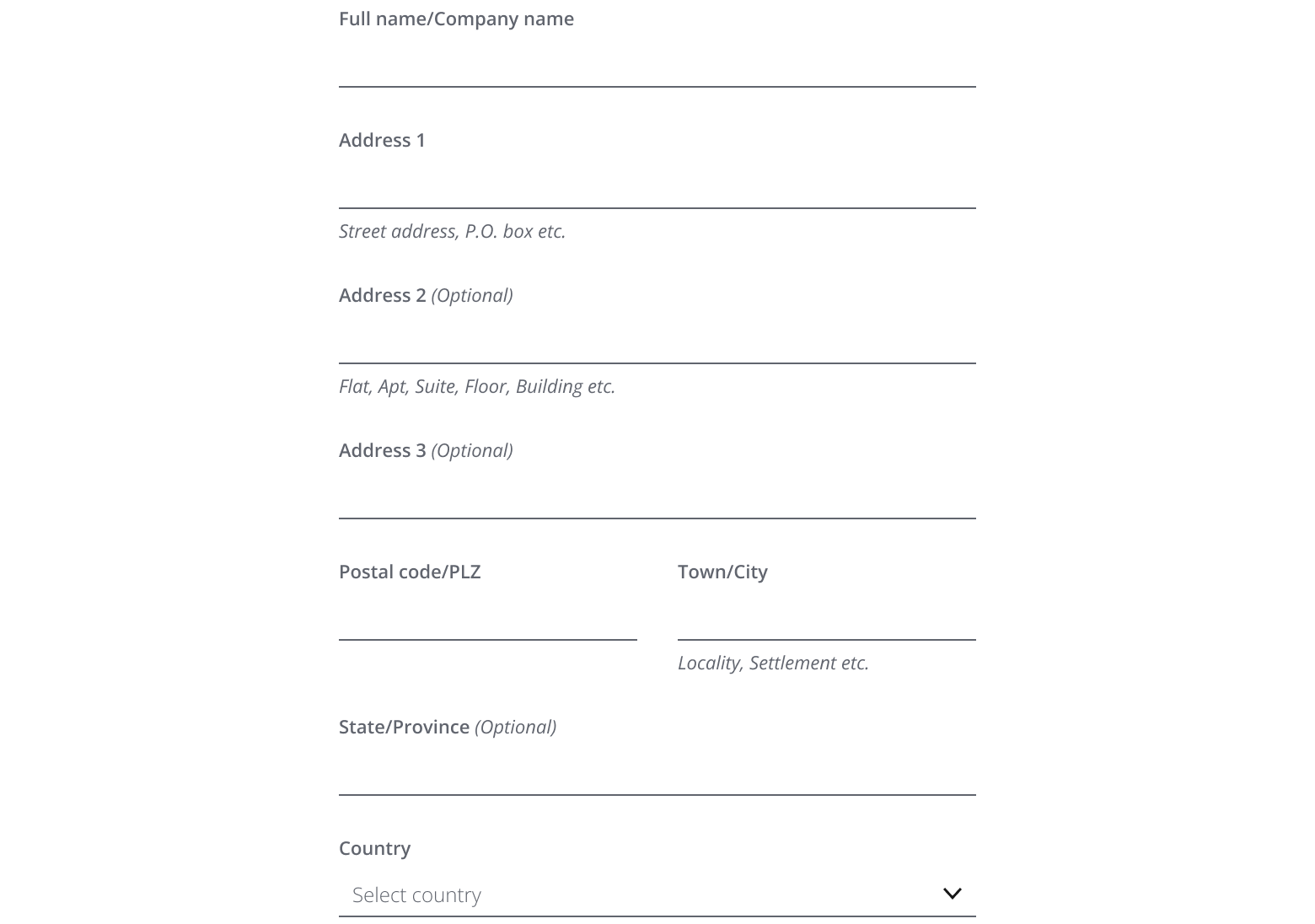
Manually inspecting every international shipment for partial or fractional address errors is impractical for modern high-volume e-commerce businesses. Operating efficiently requires integrating automated Address Verification Systems (AVS) into checkout and fulfillment workflows.
- Customer inputs unformatted address string
- AVS API parses input against national postal database
- System standardizes fractional characters to ASCII
- Validated, complete address is stored & printed on shipping label
Real-Time Validation at Checkout
Integrating an address validation API at the point of purchase prevents half addresses before data enters the logistics chain. Leading global verification APIs validate addresses directly against official reference datasets maintained by national postal authorities:
- Parsing & Normalization: Verification engines parse unformatted inputs, strip illegal control characters, and convert ambiguous fractions (like
1/2) into standardized postal formats. - Interactive Correction Prompts: If a customer enters a street address but omits a mandatory secondary unit number, the API prompts the user to supply the missing information before completing the order.
Warehousing and ERP Data Payload Alignment
Even if an address is captured correctly at checkout, internal software integrations can re-introduce truncation errors if system data schemas are misaligned:
- Field Mapping Alignment: Ensure that database fields in the e-commerce storefront match the exact character capacities of the Warehouse Management System (WMS) and carrier label generation software.
- API Payload Validation: Configure middleware connectors to validate JSON and XML payloads for structural completeness before generating shipping labels, preventing silent character cut-offs during system-to-system data transfers.
Frequently Asked Questions (FAQs)
What is a half address in international mail?
A half address refers either to an official fractional house number (such as 104 ½) created when a property is subdivided, or to an incomplete address caused by character cut-offs in cross-border shipping software. Both instances require specific data formatting to pass through automated postal sorting systems cleanly.
How should fractional house numbers like "1/2" be written on international packages?
Fractional house numbers should always be entered using standard ASCII text characters (e.g., 104 1/2 or 104-1/2) rather than single Unicode fraction symbols (like ½). This prevents cross-border shipping software and Electronic Data Interchange (EDI) systems from corrupting the characters during label printing.
Will an international parcel be returned if Address Line 2 is truncated?
Yes. If critical delivery details—such as apartment, suite, or building numbers—are placed on Address Line 2 and subsequently truncated by carrier label generators, final delivery carriers are often unable to locate the recipient. This frequently leads to "Insufficient Address" delivery failures and immediate Return to Sender (RTS) processing.
How do customs authorities handle partial or incomplete recipient addresses?
Modern customs frameworks, including the European Union's Import Control System 2 (ICS2), mandate complete, verified recipient data on Electronic Advance Data (EAD) manifests. Parcels submitted with truncated or partial addresses may be held at border hubs, subjected to manual inspection, rejected, or returned to origin at the carrier's expense.
How can e-commerce businesses prevent international address truncation errors?
Businesses can prevent address truncation by implementing real-time international Address Verification System (AVS) APIs at checkout, expanding internal database field character limits to at least 50–60 characters per line, and ensuring critical house and street details are captured together on primary address lines.
Practical Recommendations for Shippers and Businesses
To minimize delivery failures, eliminate address truncation, and streamline international shipments, organizations should execute the following operational steps:
- Audit Checkout and ERP Character Limits: Ensure database schemas allow at least 50 to 60 characters per address line. Eliminate legacy 30-character restrictions that silently truncate long international addresses.
- Standardize Input Rules for Fractional Numbers: Program checkout validation logic to automatically convert special fraction characters (e.g.,
½) into standardized ASCII characters (1/2) with proper spacing. - Prioritize Primary Line Placement: Configure label creation templates to keep house numbers, fractional designators, and primary street names together on Address Line 1, reserving Address Line 2 strictly for non-critical supplemental instructions.
- Deploy Real-Time Global AVS Integration: Integrate a modern address verification API that validates inputs against official national postal datasets at the point of sale, capturing missing unit or premise details before order fulfillment.
- Enforce Dual-Language Labeling for Non-Latin Destinations: For shipments bound for regions using non-Latin scripts, configure printing workflows to include Romanized ASCII text for international transit hubs along with local script rendering for destination carriers.
editorial metadata exception:
Image Gallery