How to Incorporate in Florida: A Step-by-Step Guide for 2026
To incorporate in Florida in 2026, you must file Articles of Incorporation with the Florida Department of State’s Division of Corporations, typically via the Sunbiz portal. The process involves selecting a distinguishable name, appoint...
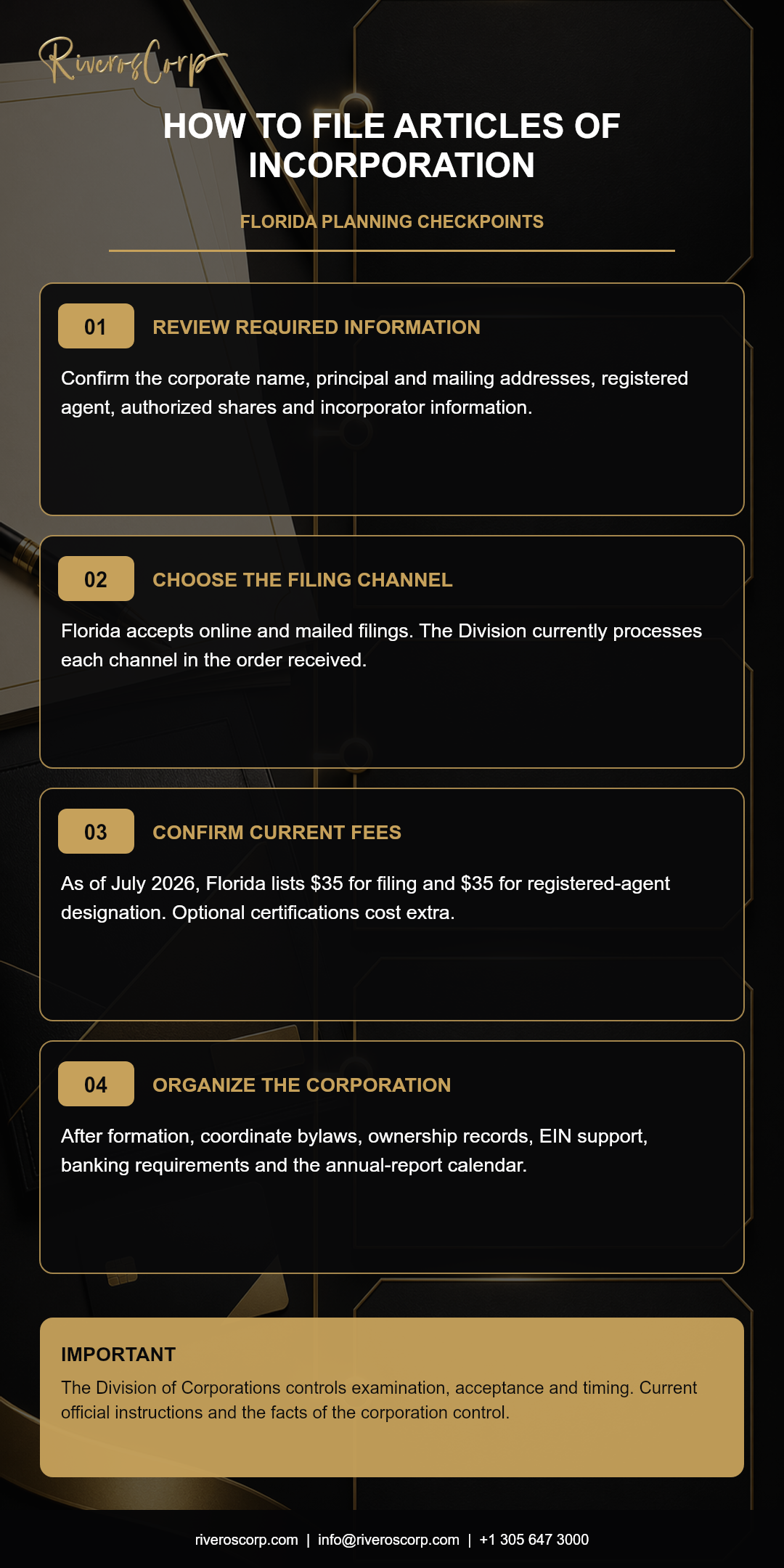
To incorporate in Florida in 2026, you must file Articles of Incorporation with the Florida Department of State’s Division of Corporations, typically via the Sunbiz portal. The process involves selecting a distinguishable name, appointing a registered agent, defining share structures, and paying a $70 filing fee to establish your legal entity.
Contents
Incorporating a business in Florida offers significant benefits, including limited liability protection for shareholders and potential tax advantages. As of 2026, Florida remains one of the most popular states for business formation due to its lack of personal income tax and a sophisticated electronic filing system. However, the process requires strict adherence to Florida Statutes Chapter 607 (the Florida Business Corporation Act). Following a precise sequence ensures that your corporation is legally recognized and remains in good standing with state and federal authorities.
Step 1: Selecting a Distinguishable Corporate Name
The first legal requirement under Florida law is choosing a name that is "distinguishable" from all other entities registered with the Department of State. This means the name cannot be identical or deceptively similar to an existing corporation, LLC, or partnership already on file.
Legal Suffix Requirements
In Florida, a corporation's name must contain a specific legal indicator. You must include one of the following words or abbreviations:
- Corporation (Corp.)
- Incorporated (Inc.)
- Company (Co.)
Failure to include these indicators will result in the rejection of your filing. Furthermore, the name cannot contain language stating or implying that the corporation is organized for a purpose other than what is permitted by its articles of incorporation or the law.
Conducting the Search
Before submitting any paperwork, navigate to the official Sunbiz website to use the Search Records database. Search for your desired name to ensure it is available. It is advisable to search for variations of the name as well. While Florida does not have a formal "name reservation" process for corporations in the same way some other states do, filing your Articles of Incorporation immediately secures the name upon approval.
Step 2: Appointing a Florida Registered Agent
Every Florida corporation is legally required to designate a registered agent. This is an individual or a business entity authorized to receive service of process (legal notices, summons, and subpoenas) and official government correspondence on behalf of the corporation.
Qualifications for a Registered Agent
To serve as a registered agent in Florida in 2026, the individual or entity must meet the following criteria:
- Residency: If an individual, they must reside in Florida. If a business entity, it must be authorized to transact business in Florida.
- Physical Address: The agent must provide a physical Florida street address, known as the "registered office." P.O. Boxes are strictly prohibited for this purpose.
- Availability: The agent must be available at that address during normal business hours to accept legal documents.
Acceptance of Appointment
The registered agent must sign the filing (electronically or physically) to signify their acceptance of the appointment. Operating without a valid registered agent can lead to the administrative dissolution of the corporation, making this one of the most critical steps for long-term compliance.
Step 3: Filing the Articles of Incorporation
The core of the incorporation process is the filing of the Articles of Incorporation. In 2026, the Division of Corporations prefers electronic filing through the Sunbiz portal, which offers faster processing times—typically 2 to 5 business days—compared to paper filings sent to Tallahassee.
Required Information
When filling out the Articles of Incorporation, you must provide:
- Corporate Name: The name verified in Step 1.
- Principal Place of Business: The street address of the corporation’s main office (can be outside Florida).
- Mailing Address: Where the state should send official notices (can be a P.O. Box).
- Registered Agent Details: Name and physical address, plus their signature of acceptance.
- Purpose: Most corporations use a "general purpose" clause, stating they are organized for "any and all lawful business."
- Number of Shares: You must state the total number of shares the corporation is authorized to issue. Florida does not require you to list a par value for these shares.
- Officers and Directors: While not strictly required in the initial filing for all types, providing at least one director or officer (President, Vice President, Secretary, or Treasurer) is standard practice and often required for opening bank accounts.
- Incorporator: The person or entity filing the documents.
Filing Fees
As of 2026, the standard fees for a Florida profit corporation are:
- Filing Fee: $35.00
- Registered Agent Designation: $35.00
- Total: $70.00
- Optional Certified Copy: $8.75
- Optional Certificate of Status: $8.75
Step 4: Obtaining a Federal Tax ID (EIN)
Once the State of Florida confirms your incorporation, you must obtain an Employer Identification Number (EIN) from the Internal Revenue Service (IRS). An EIN is essentially a Social Security number for your business and is required for nearly all corporate activities.
Why You Need an EIN
- Banking: Most financial institutions require an EIN to open a corporate checking or savings account.
- Hiring: If you plan to have employees, an EIN is necessary for payroll tax reporting.
- Taxes: The EIN is used on federal income tax returns.
- S-Corp Election: If you intend to have your corporation taxed as an S-Corporation rather than a C-Corporation, you must have an EIN to file IRS Form 2553.
You can apply for an EIN for free through the IRS website. The online application provides the number immediately upon completion.
Step 5: Drafting Corporate Bylaws and Holding an Initial Meeting
While the state does not require you to file your bylaws, Florida Statute 607.0206 mandates that the incorporators or board of directors adopt initial bylaws for the corporation.
The Function of Bylaws
Bylaws are the internal rules that govern how the corporation is managed. They typically cover:
- The frequency and location of shareholder and board meetings.
- Voting procedures and quorum requirements.
- The roles and responsibilities of officers.
- Procedures for issuing additional stock.
- The process for amending the bylaws.
The Initial Organizational Meeting
After filing, the board of directors named in the Articles (or the incorporator, if directors weren't named) should hold an initial meeting. During this meeting, the board should officially adopt the bylaws, authorize the issuance of stock certificates, and approve a corporate resolution to open a bank account. Minutes of this meeting should be recorded and kept in the corporate records book.
Step 6: Florida Annual Report and Maintenance
Incorporating is not a one-time event; it requires ongoing maintenance to shield owners from liability. The most important recurring requirement is the Florida Annual Report.
Deadlines and Penalties
Every corporation must file an annual report between January 1 and May 1 of each year following the year of incorporation. The report is filed online via Sunbiz and is used to update the corporation's records (such as officer names or addresses).
- Standard Filing Fee: $150.00
- Late Fee: $400.00 (Mandatory and non-negotiable if filed after May 1).
Failure to file by the third Friday of September will result in the administrative dissolution of the corporation. Reinstating a dissolved corporation is significantly more expensive than the annual filing fee.
Comparison of Florida Corporate Entities
Choosing the right structure is vital for tax and operational efficiency. The following table compares the most common corporate forms in Florida for 2026.
| Feature | Profit Corporation (C-Corp) | S-Corporation Election | Non-Profit Corporation | Professional Corporation (PA) |
|---|---|---|---|---|
| Primary Purpose | Profit for shareholders | Profit for shareholders | Charitable/Educational | Professional services (Law, Medicine) |
| Taxation | Double (Corporate & Individual) | Pass-through to shareholders | Tax-exempt (if 501(c)(3) approved) | Pass-through or Corporate |
| Shareholder Limits | Unlimited | Max 100 (US citizens/residents) | None (Members instead) | Licensed professionals only |
| Annual Report Fee | $150.00 | $150.00 | $61.25 | $150.00 |
| State Filing Fee | $70.00 | $70.00 | $70.00 | $70.00 |
Frequently Asked Questions
Can I be my own registered agent in Florida?
Yes, an individual who resides in Florida and is at least 18 years old can serve as the registered agent for their own corporation. However, you must provide a physical street address where you are personally available during business hours. Many business owners prefer to hire a professional registered agent service to maintain privacy and ensure they never miss a legal notice while away from the office.
How long does it take to incorporate in Florida?
In 2026, electronic filings through Sunbiz are typically processed within 2 to 5 business days. If you choose to mail in paper documents, the process can take 3 to 4 weeks depending on the volume of filings at the Division of Corporations. There is currently no "expedited" service fee that guarantees 24-hour processing in Florida, so online filing is the most efficient route.
What is the difference between a C-Corp and an S-Corp in Florida?
Technically, they are both the same legal entity at the state level (a corporation). The difference lies in federal tax treatment. A C-Corp is taxed at the corporate level, and shareholders are taxed again on dividends. An S-Corp is a tax election made with the IRS that allows corporate income, losses, and credits to pass through to shareholders' personal tax returns, avoiding double taxation.
Do I need a lawyer to incorporate in Florida?
There is no legal requirement to use an attorney to file Articles of Incorporation. The Sunbiz portal is designed for self-service. However, consulting with a legal professional is highly recommended for drafting complex bylaws, shareholder agreements, or if you are issuing multiple classes of stock.
Are my personal assets protected once I incorporate?
Incorporating creates a "corporate veil" that generally protects your personal assets from the corporation's debts and legal liabilities. However, this protection is not absolute. To maintain it, you must keep business and personal finances separate, maintain adequate capital in the business, and comply with all corporate formalities (like filing annual reports and holding meetings).
Practical Recommendation
Before filing, ensure your corporate name is truly unique to avoid rejection and the forfeiture of filing fees. Once your Articles of Incorporation are approved, immediately apply for your EIN and open a dedicated business bank account. Do not commingle funds, as this is the most common reason the "corporate veil" is pierced in Florida courts, potentially exposing your personal assets to business creditors. Finally, set a calendar reminder for January 1st each year to file your Florida Annual Report and avoid the $400 late penalty.
Disclaimer: This information is for educational purposes and does not constitute legal or financial advice. Jurisdictional rules and fees are subject to change. Consult with a licensed Florida attorney or CPA for specific guidance.
Image Gallery