Understanding the Quasi-Experimental Research Definition and Application
A quasi-experimental research design is an empirical study used to estimate the causal impact of an intervention on target populations without random assignment. While true experiments rely on random allocation to separate treatment an...
A quasi-experimental research design is an empirical study used to estimate the causal impact of an intervention on target populations without random assignment. While true experiments rely on random allocation to separate treatment and control groups, quasi-experiments use pre-existing groups, naturally occurring events, or practical constraints that prevent complete randomization, making them essential for real-world social, educational, and medical evaluations.
Contents
Introduction to Quasi-Experimental Research
In the landscape of scientific inquiry, researchers strive to establish definitive cause-and-effect relationships between variables. The gold standard for achieving this is the randomized controlled trial (RCT), where participants are assigned to treatment or control conditions purely by chance. However, in many applied settings—such as classrooms, hospitals, or entire communities—random assignment is ethically, logistically, or legally impossible. This reality creates the need for alternative methodologies.
The quasi-experimental research definition centers on study designs that mimic the structure of true experiments by introducing an intervention and measuring its outcomes, but lacking the critical element of random assignment. Because participants are not randomized, researchers must carefully account for confounding variables and alternative explanations for their findings. Understanding this methodology requires examining its core components, how it contrasts with other designs, and why it remains a cornerstone of applied research across diverse disciplines.
Core Characteristics and Defining Elements
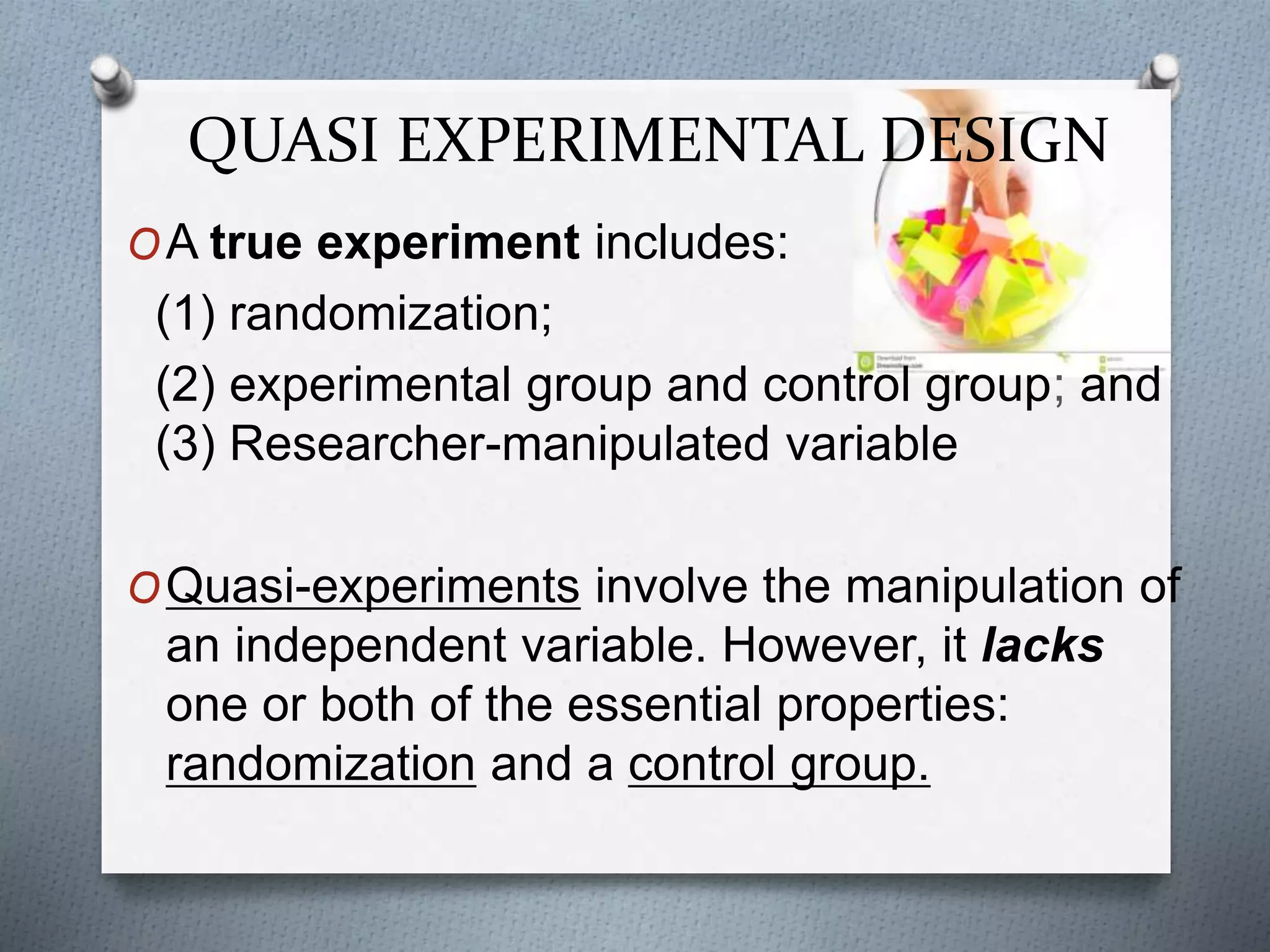
To properly identify and execute a study of this type, researchers must understand the foundational pillars that separate it from purely observational research on one side and true experimental research on the other.
At its core, a quasi-experimental design features an independent variable (the intervention or treatment) manipulated by the researcher or occurring naturally, along with a dependent variable (the outcome) that is measured. Unlike purely observational studies—where researchers simply watch and record without intervening—quasi-experiments involve active implementation of a program, policy, or treatment.
However, the defining distinction lies in group assignment. In a true experiment, a researcher uses a random number generator or coin flip to place individuals into a treatment or control group. In a quasi-experiment, assignment occurs through self-selection, administrative decisions, or geographic boundaries. For instance, if a school district introduces a new reading curriculum in three elementary schools while three neighboring schools continue using the traditional curriculum, the students are part of a quasi-experiment. The researchers did not randomly assign students to schools; rather, the students were already enrolled in those facilities.
Key Differences: True Experiments vs. Quasi-Experiments
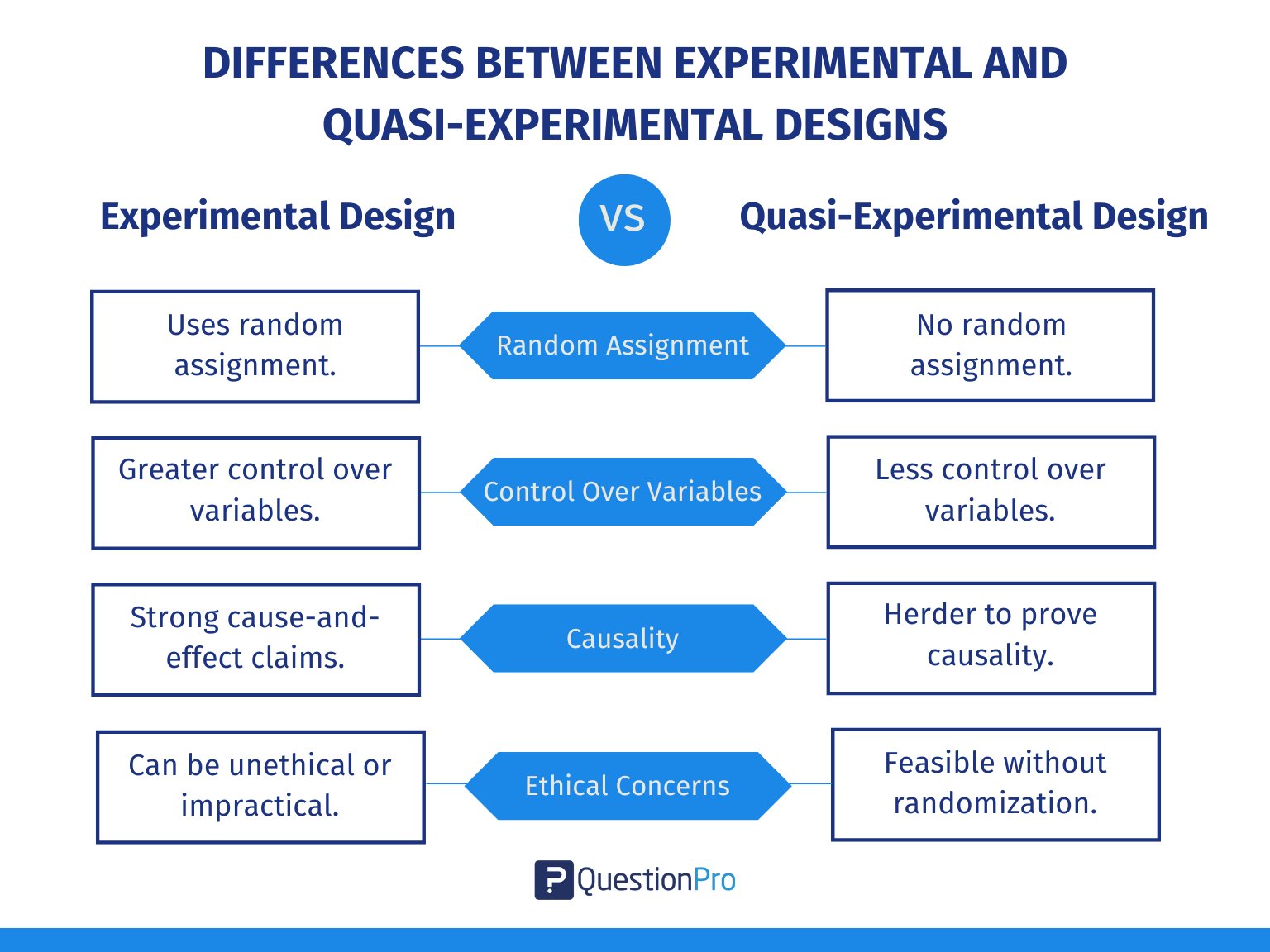
Evaluating the validity of research findings requires a clear comparison between true experiments and quasi-experiments. The primary differences revolve around control, internal validity, and generalizability.
| Feature | True Experiments (RCTs) | Quasi-Experiments |
|---|---|---|
| Random Assignment | Essential; participants are randomized to groups. | Absent; groups are pre-existing or self-selected. |
| Internal Validity | High; randomization minimizes confounding variables. | Moderate to lower; vulnerability to selection bias. |
| External Validity | Can be lower due to artificial laboratory settings. | Often higher because they occur in real-world settings. |
| Ethical Feasibility | Often limited (cannot withhold beneficial treatments randomly). | High; allows evaluation of existing policies and programs. |
| Causal Inference | Strongest possible demonstration of causation. | Plausible, but requires statistical adjustment for confounders. |
Internal validity represents the degree of confidence that the observed effect is caused only by the independent variable rather than extraneous factors. True experiments score exceptionally high here because randomization theoretically distributes known and unknown confounding variables evenly across groups. Quasi-experiments face threats to internal validity, such as selection bias, history, maturation, and regression to the mean.
Conversely, quasi-experiments often excel in external validity—the extent to which findings can be generalized to real-world populations and environments. Because quasi-experiments frequently take place in natural settings like workplaces, communities, and classrooms, the results reflect authentic human behavior rather than artificial laboratory responses.
Common Types of Quasi-Experimental Designs
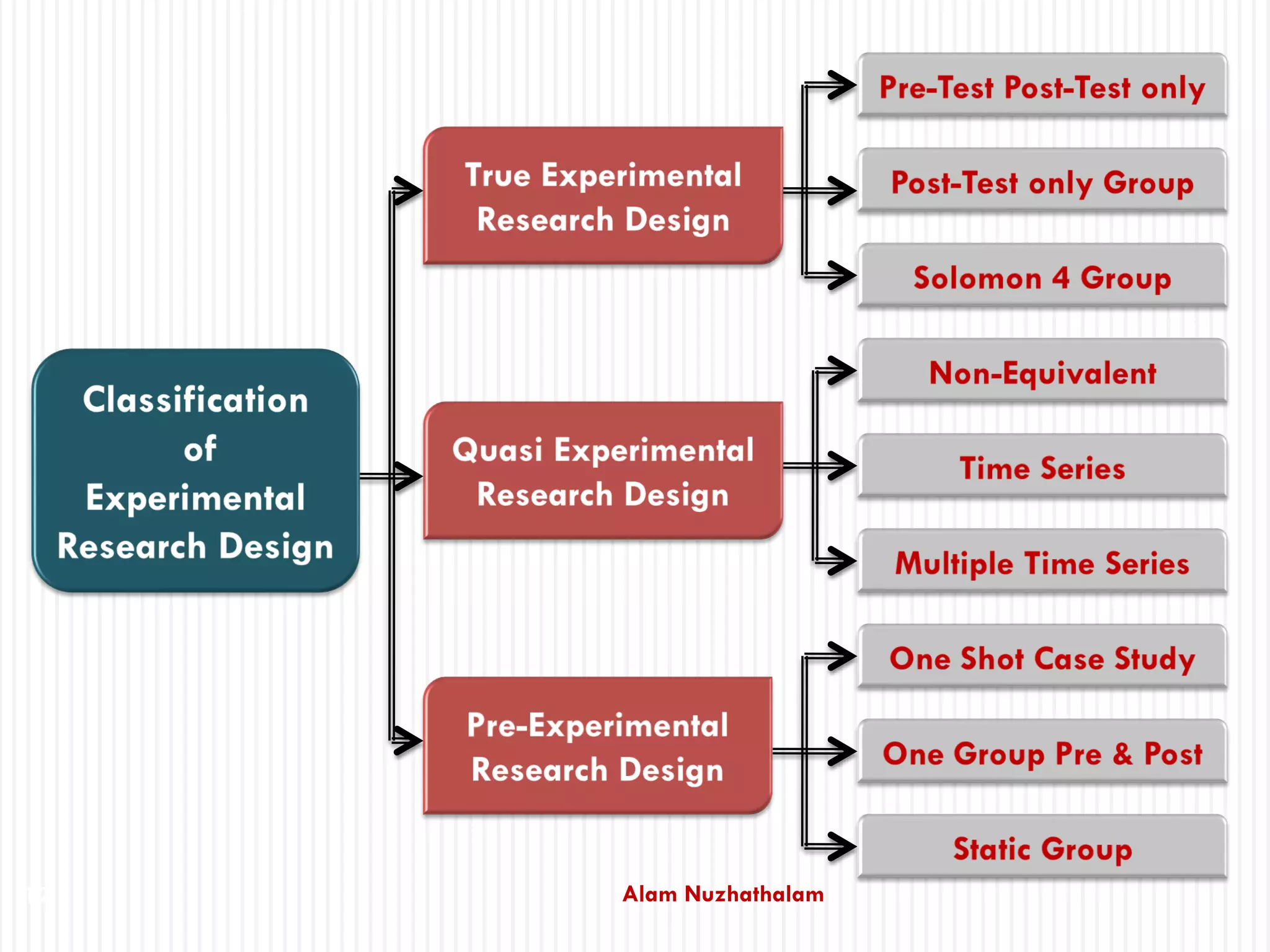
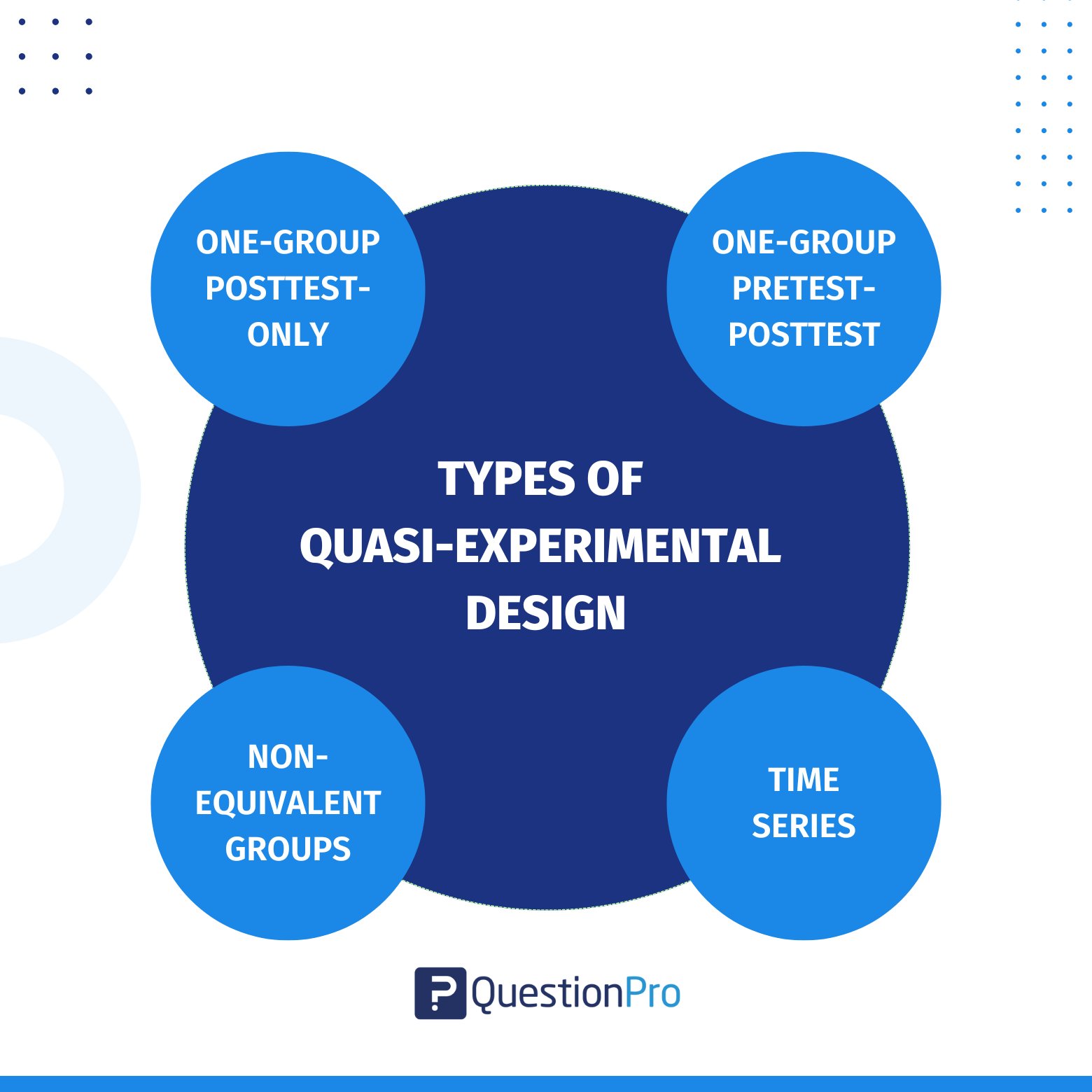
Researchers employ several standard structural variations depending on data availability, access to control groups, and timing constraints. Selecting the correct design directly influences how data is analyzed and interpreted.
Nonequivalent Control Group Design
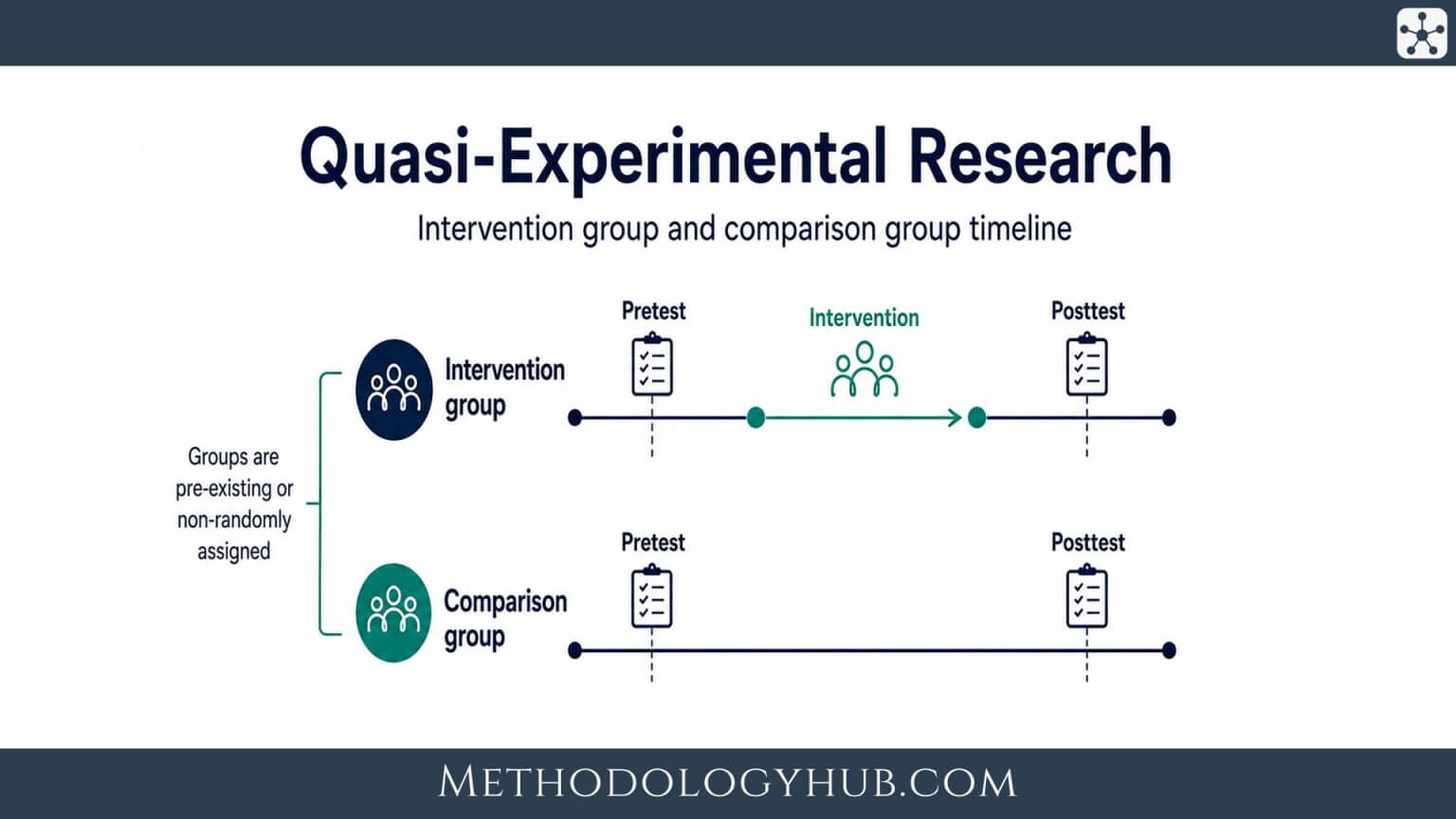
This is perhaps the most common quasi-experimental framework. It involves a treatment group and a comparison group that are measured before and after the intervention (pretest-posttest). Because the groups are not formed by random assignment, researchers cannot assume they are identical initially.
For example, a hospital might introduce a new patient-safety protocol in its north wing (treatment group) and compare patient recovery rates to the south wing (control group) before and after implementation. Statistical techniques, such as analysis of covariance (ANCOVA) or propensity score matching, are often used to control for pre-existing differences between the groups.
Interrupted Time-Series Design
An interrupted time-series design involves tracking a single group of participants over multiple intervals before and after an intervention is introduced. This approach allows researchers to observe underlying trends and determine whether a policy change or program causes a sharp deviation from that trend.
For instance, if a state implements a strict distracted-driving law in 2024, researchers might analyze monthly traffic accident data from 2020 through 2026. By examining data points across an extended timeline, the design helps rule out seasonal fluctuations or random year-to-year noise as explanations for any observed changes in accident rates.
Regression Discontinuity Design
Regression discontinuity is a sophisticated quasi-experimental design used when assignment to a treatment group is determined by whether an individual falls above or below a specific numerical threshold or cutoff score.
Consider a scholarship program awarded exclusively to students scoring above 85% on a standardized entrance exam. Students who score 86% receive the scholarship, while those scoring 84% do not. By comparing the academic performance of students just above the cutoff to those just below it, researchers can estimate the causal impact of the scholarship, assuming students right around the threshold are otherwise comparable.
Advantages of Quasi-Experimental Research
Despite lacking random assignment, quasi-experimental research offers profound practical benefits that make it indispensable across scientific and policy-making communities.
- Ethical Feasibility: Many questions cannot be answered with true experiments due to ethical barriers. For example, researchers cannot ethically assign pregnant women to smoke or not smoke to study health outcomes. However, they can study the effects of a smoking cessation campaign by comparing communities that adopted the program to those that did not.
- Real-World Applicability: Quasi-experiments integrate naturally into functioning environments like businesses, government agencies, and educational institutions, capturing authentic human responses that laboratory settings may miss.
- Cost and Logistical Efficiency: Setting up an RCT requires immense administrative overhead to manage randomization protocols. Quasi-experiments frequently leverage existing administrative data, natural policy rollouts, or pre-existing institutional boundaries, saving time and financial resources.
- Scalability: Large-scale social and economic interventions—such as nationwide educational reforms or regional healthcare adjustments—are inherently quasi-experimental because policies rarely roll out via random lottery.
Limitations and Threats to Validity
To interpret quasi-experimental findings accurately, researchers must acknowledge and mitigate inherent methodological vulnerabilities.
The primary vulnerability is selection bias. Because participants choose their groups or are placed into them based on specific characteristics, the treatment and control groups may differ in ways that influence the outcome. If a wellness program is offered to employees who voluntarily sign up, those employees may already be more health-conscious than non-participants, confounding the program's actual efficacy.
Other significant threats include:
- Maturation: Participants naturally change, grow, or fatigue over time, which can be mistaken for intervention effects, especially in studies lacking a control group.
- History: External events occurring during the study period—such as an economic downturn or a sudden public health crisis—can influence the dependent variable independently of the intervention.
- Attrition: Participants dropping out of treatment and control groups at different rates can skew final results, rendering the remaining cohorts non-comparable.
Frequently Asked Questions
What is the primary difference between a true experiment and a quasi-experiment?
The primary difference is the presence of random assignment. True experiments randomly allocate participants to treatment and control groups to eliminate selection bias. Quasi-experiments utilize pre-existing or naturally formed groups where randomization is impossible, requiring statistical adjustments to control for confounding variables.
When should a researcher choose a quasi-experimental design over an RCT?
A quasi-experimental design is chosen when random assignment is unethical, illegal, or logistically impossible. This frequently occurs in educational research, public policy evaluations, and healthcare administration where programs must be deployed based on organizational need or existing geographic boundaries.
Can quasi-experiments prove causation?
While no observational or quasi-experimental design can establish causation with the absolute certainty of a well-executed RCT, quasi-experiments provide strong plausible evidence of causal relationships when robust research designs—such as interrupted time series or matched control groups—are paired with rigorous statistical controls.
What are common examples of quasi-experimental studies?
Common examples include evaluating the impact of a newly implemented traffic law by comparing accident rates before and after the policy, studying the performance outcomes of students in charter schools versus traditional public schools, or assessing hospital recovery rates after introducing a new nursing protocol in specific wards.
How do researchers control for confounding variables in quasi-experiments?
Researchers use advanced statistical methods such as propensity score matching, analysis of covariance (ANCOVA), multivariable regression, and difference-in-differences estimation to balance non-equivalent groups and isolate the specific impact of the intervention.
Practical Next Actions for Researchers
When planning or evaluating a quasi-experimental study, researchers should begin by clearly identifying the specific constraints preventing a true randomized trial. Next, select a structural design—such as a nonequivalent control group or interrupted time series—that best aligns with available data sources and timelines. Prioritize identifying potential confounding variables early in the design phase, and consult with biostatisticians or methodologists to integrate appropriate analytical controls like propensity score matching before data collection concludes.
Image Gallery