What Orthodontic Technology Is Changing Tooth Alignment
Modern orthodontic technology has fundamentally transformed tooth alignment, shifting the practice away from traditional metal braces and lengthy, manual processes toward digital treatment planning, 3D printing, and accelerated biomech...
Modern orthodontic technology has fundamentally transformed tooth alignment, shifting the practice away from traditional metal braces and lengthy, manual processes toward digital treatment planning, 3D printing, and accelerated biomechanics. These innovations provide predictable precision, shorter clinical appointment times, and more discreet patient experiences.
Contents
The Evolution from Analog to Digital Orthodontics
For decades, orthodontic treatment relied almost exclusively on plaster dental impressions, hand-bent stainless steel wires, and two-dimensional cephalometric X-rays. While effective, this analog workflow was prone to human error, material distortion, and patient discomfort. The transition to digital dentistry has replaced these legacy methods with high-resolution imaging and virtual modeling suites.
Intraoral scanners have largely replaced traditional putty impressions. These handheld optical devices capture thousands of frames per second, stitching them together to create a full-color, three-dimensional digital model of the patient’s dental arch. This eliminates the gag reflex associated with alginate impressions and provides orthodontists with immediate, highly accurate data.
Once the intraoral scan is complete, proprietary treatment planning software allows practitioners to visualize the final tooth position before a single bracket is placed or aligner is fabricated. This software utilizes advanced algorithms to simulate root and crown movement, predict bone remodeling limits, and sequence the optimal path for each individual tooth. Consequently, treatment plans are no longer static guesses; they are dynamic, data-driven roadmaps designed to minimize root resorption and periodontal stress.
Clear Aligners and Advanced Polymer Science
Clear aligner therapy represents one of the most visible shifts in modern orthodontics. Originally limited to minor dental corrections, modern thermoplastic aligners now treat complex malocclusions, including deep bites, open bites, and moderate skeletal discrepancies, thanks to improvements in material science and engineering.
Early aligners were manufactured from single-layer generic plastics that quickly lost their elastic force retention during a two-week wear cycle. Today, manufacturers utilize specialized multi-layer thermoplastic polyurethane and copolyester materials. These engineered polymers deliver a consistent, continuous, and gentle force over extended periods, which optimizes cellular response in the periodontal ligament and reduces patient discomfort.
Furthermore, the integration of precision attachment technology—small, tooth-colored composite shapes bonded to specific teeth—allows aligners to exert controlled three-dimensional forces. These attachments act as mechanical handles, enabling roots to be tipped, rotated, and torqued with a degree of precision that was previously difficult to achieve without fixed multi-bracket appliances.
3D Printing and In-House Manufacturing
The democratization of high-resolution stereolithography (SLA) and digital light processing (DLP) 3D printers has revolutionized how orthodontic appliances are produced. Historically, all custom appliances had to be outsourced to centralized laboratories, introducing shipping delays and high manufacturing costs.
Today, many orthodontic practices maintain in-house digital laboratories. Using desktop 3D printers and biocompatible resins, clinicians can print physical dental models, indirect bonding trays, custom retainers, and even clear aligners directly on-site. This capability drastically reduces turnaround times from weeks to hours.
| Technology | Primary Function | Clinical Advantage |
|---|---|---|
| Intraoral Scanners | Capturing 3D digital dental maps | Eliminates putty impressions; instant data transfer. |
| Multi-Layer Aligners | Applying continuous, gentle force for tooth movement | Treats complex malocclusions with predictable biomechanics. |
| In-House 3D Printing | Fabricating models, trays, and appliances on-site | Reduces turnaround times and lowers laboratory costs. |
| Photobiomodulation (PBM) | Stimulating cellular metabolism via low-level light therapy | Accelerates bone remodeling and minimizes discomfort. |
In-house printing also allows for rapid troubleshooting. If a patient loses an aligner or breaks a retainer, a replacement can be printed immediately from the existing digital file without requiring a new impression or scan.
Accelerated Orthodontics and Biomechanical Enhancements
Patients frequently seek ways to reduce the overall duration of orthodontic treatment. To address this demand, researchers have developed various modalities designed to accelerate tooth movement safely by stimulating biological cellular activity in the alveolar bone.
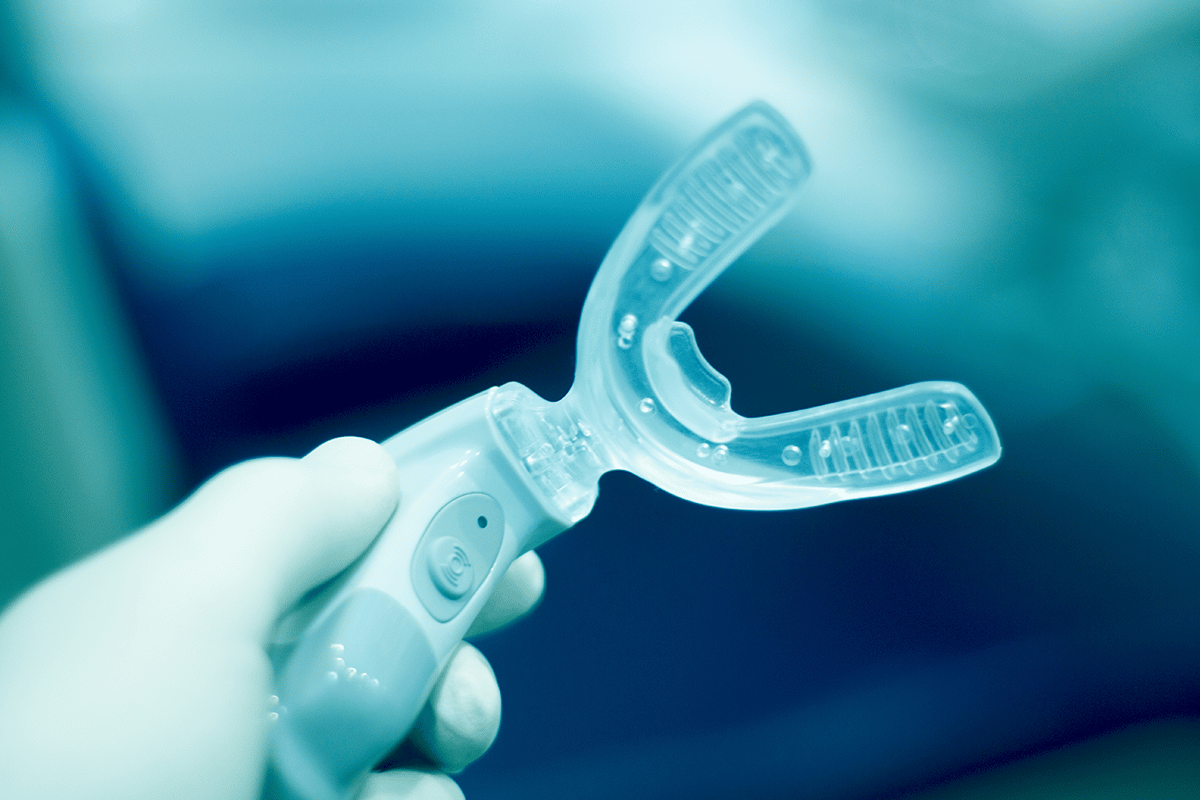
Photobiomodulation (PBM), often delivered via handheld devices utilizing low-level near-infrared light, has gained prominence. PBM is theorized to increase adenosine triphosphate (ATP) production in cellular mitochondria, enhancing cellular proliferation and osteoclastic-osteoblastic activity necessary for bone remodeling. Clinical studies suggest that this increased metabolic activity can help decrease overall treatment times and manage post-adjustment discomfort.
Micro-osteoperforation (MOP) is another surgical adjunct used to accelerate alignment. By creating small, controlled perforations in the alveolar bone adjacent to the teeth undergoing movement, clinicians trigger a regional acceleratory phenomenon (RAP). This natural healing response temporarily decreases bone density around the affected teeth, allowing them to move more rapidly through the bone matrix under orthodontic force.
Remote Monitoring and Teleorthodontics
The management of orthodontic treatment has expanded beyond the physical dental chair through remote monitoring platforms. These systems utilize smartphone applications paired with cheek retractors and scanning attachments, allowing patients to capture weekly images of their teeth at home.
Artificial intelligence algorithms analyze these submissions for tracking accuracy, oral hygiene compliance, and appliance fit. If a tooth lags behind its projected digital movement path, the software alerts the orthodontist, who can then intervene remotely. This technology reduces the frequency of routine in-office check-ins, reserving physical visits for necessary clinical adjustments, wire changes, or milestone checks. It offers enhanced convenience for patients while maintaining rigorous clinical oversight.
Frequently Asked Questions
Can clear aligners fix complex bite issues like traditional braces?
Yes, modern clear aligner systems utilize advanced polymers, precise attachments, and sophisticated software staging to treat complex malocclusions. However, the success of aligner therapy depends heavily on patient compliance, wearing the trays for the recommended 20 to 22 hours per day, and the clinical expertise of the treating orthodontist.
How accurate are intraoral scanners compared to traditional impressions?
Intraoral scanners have demonstrated equal or superior accuracy compared to traditional alginate and PVS impressions for most orthodontic applications. They eliminate dimensional instability caused by material shrinkage or expansion and allow for immediate verification of scan quality before the patient leaves the chair.
Does accelerated orthodontic technology increase the risk of root resorption?
When used according to evidence-based clinical guidelines, accelerated orthodontic techniques do not inherently increase the risk of pathological root resorption. However, continuous monitoring via periodic radiographic imaging is necessary to assess root health, especially when forces are applied to speed up tooth movement.
How do in-house 3D printers affect the cost of orthodontic treatment?
In-house 3D printing can reduce overhead laboratory expenses for practices by eliminating third-party manufacturing fees for certain appliances. While the initial capital investment in hardware, software, and validated resins is substantial, these savings can sometimes translate into more competitive pricing or faster turnaround times for patients.
What is the role of artificial intelligence in orthodontic treatment planning?
Artificial intelligence assists orthodontists by automatically segmenting digital dental models, predicting root positions beneath the gumline, and analyzing remote monitoring scans to detect tracking errors. While AI streamlines the workflow, human clinical judgment remains essential for final treatment design, diagnosis, and safety oversight.
Choosing the Right Path Forward
When evaluating modern orthodontic options, patients should consult with a qualified specialist—such as a certified orthodontist—to determine which technology best suits their anatomical requirements. Whether opting for advanced clear aligners, accelerated bone stimulation, or self-ligating fixed braces, a comprehensive clinical examination utilizing digital diagnostics ensures that both aesthetic goals and long-term oral health objectives are safely achieved.
Image Gallery