Unveiling Stellar Populations: The Category That Contains the Most Stars Is
Red dwarf stars form the category that contains the most stars in the universe, representing roughly 70 to 75 percent of all stellar bodies in our galaxy and dominating cosmic populations due to their low mass, cool temperatures, and r...
Red dwarf stars form the category that contains the most stars in the universe, representing roughly 70 to 75 percent of all stellar bodies in our galaxy and dominating cosmic populations due to their low mass, cool temperatures, and remarkable longevity.
Contents
When astronomers gaze into the night sky, they are presented with a dazzling array of luminous points, ranging from brilliant blue giants to faint, amber specks. However, human eyes are heavily biased toward the brightest objects rather than the most common ones. Understanding stellar demographics requires looking past visual splendor and examining the underlying physics, mass distributions, and observational biases that dictate how stars populate the cosmos. By breaking down stellar classifications by mass, spectral type, and luminosity, scientists can accurately map the galactic census and answer fundamental questions about the composition of the universe.
Understanding Stellar Classification Systems
To determine which category holds the numerical majority of stars, astrophysicists rely on the Morgan-Keenan (MK) spectral classification system, which sorts stars based on their spectral characteristics and surface temperatures. This system uses the letters O, B, A, F, G, K, and M, ordered from hottest and most massive to coolest and least massive.
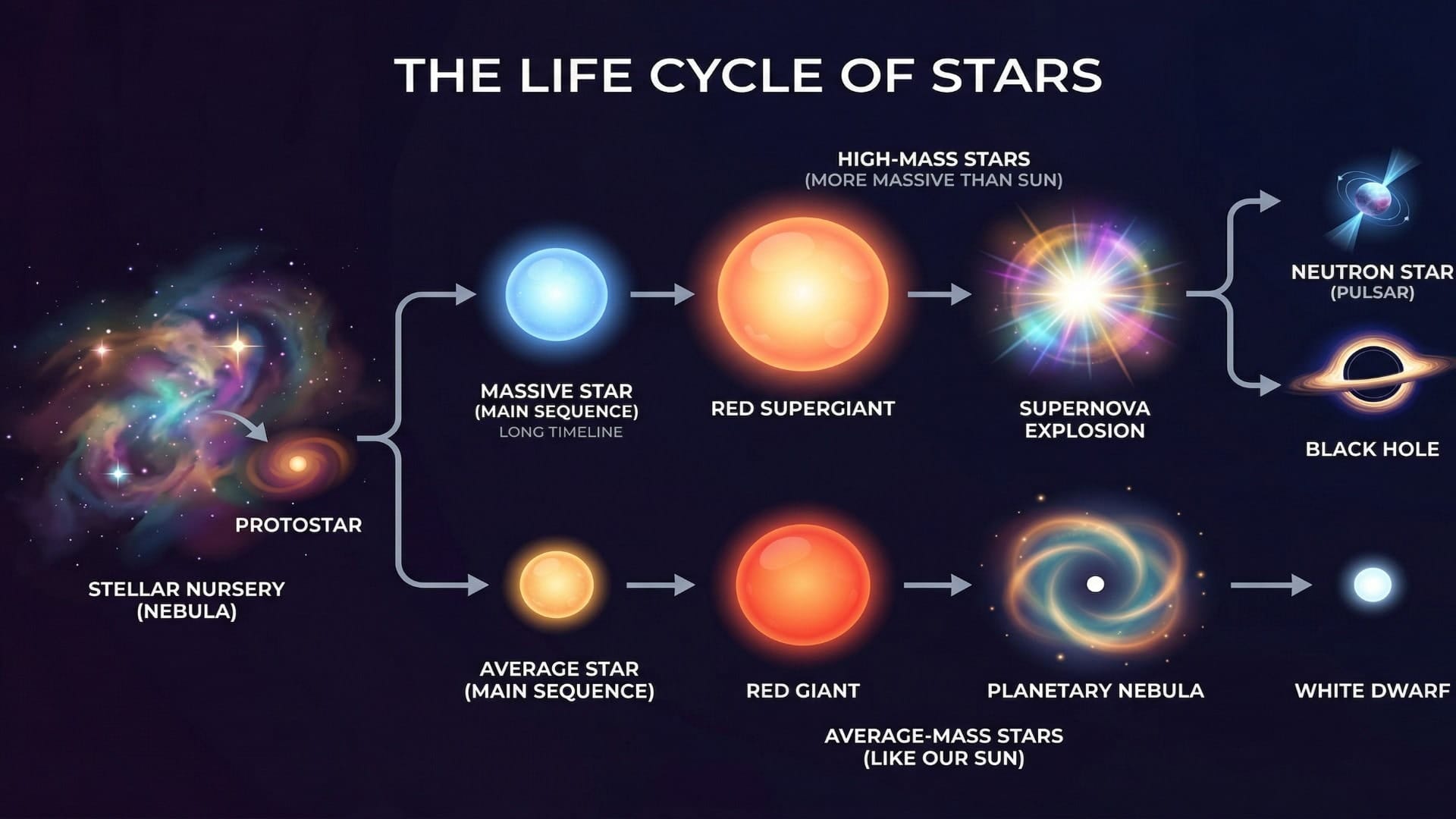
In this framework, O and B stars represent massive, short-lived behemoths that burn through their nuclear fuel in millions of years, whereas M stars represent the coolest and lowest-mass end of the main sequence. Beyond this primary sequence, stars also diverge into various luminosity classes, spanning supergiants, bright giants, regular giants, subgiants, and white dwarfs.
However, sorting stars by category is not merely an exercise in cataloging; it reflects the fundamental laws of star formation. When giant molecular clouds of gas and dust collapse under gravity, they do not produce an equal distribution of all sizes. The initial mass function (IMF), a mathematical function that describes the initial distribution of masses for a population of newly born stars, consistently shows that nature favors the creation of low-mass objects over high-mass monsters. Consequently, smaller categories dominate the numerical census of the galaxy.
The Dominance of Red Dwarfs (Spectral Class M)
Red dwarfs, classified as spectral type M, are small, dim main-sequence stars with masses ranging from about 0.08 to 0.60 times the mass of the Sun. Because they sit at the lower end of stellar mass, they have internal temperatures cool enough for molecules like titanium oxide to form in their atmospheres, giving them their characteristic reddish hue.
The primary reason red dwarfs constitute the category containing the most stars is their extreme longevity coupled with high birth rates. Massive stars consume their hydrogen fuel rapidly through the CNO cycle, causing them to explode as supernovae or fade quickly. In contrast, red dwarfs burn their hydrogen through proton-proton chains at a remarkably slow rate. Because they are fully convective—meaning helium does not build up in a core and starve the fusion process—they can cycle virtually all of their hydrogen fuel over trillions of years.
To contextualize this demographic imbalance, consider the immediate neighborhood of the Sun. Within a radius of 10 parsecs (about 32.6 light-years), the vast majority of known stellar systems consist of red dwarfs. Proxima Centauri, the closest stellar neighbor to the Solar System, is a classic example of this category.
| Stellar Spectral Type | Approximate Mass Range (Solar Masses) | Approximate Surface Temperature (Kelvin) | Estimated Galactic Population Share |
|---|---|---|---|
| O & B | 2.1 to 90+ | 10,000 to 30,000+ | Less than 0.1% |
| A & F | 1.0 to 2.1 | 6,000 to 10,000 | Roughly 3% to 4% |
| G (Solar-type) | 0.8 to 1.0 | 5,200 to 6,000 | Roughly 7.5% |
| K | 0.45 to 0.8 | 3,700 to 5,200 | Roughly 12% to 15% |
| M (Red Dwarfs) | 0.08 to 0.60 | 2,400 to 3,700 | 70% to 75% |
Observational Bias and the Illusion of Brightness
A common misconception among casual stargazers is that large, luminous stars are the most common simply because they are the easiest to see. This phenomenon is a textbook example of observational selection bias, specifically Malmquist bias, which skews statistical samples toward brighter objects.
Rigel, Betelgeuse, and Deneb are frequently cited stars in popular astronomy, yet they belong to rare categories. Supergiants like Deneb possess absolute magnitudes that can outshine the Sun tens of thousands of times over, allowing them to be detected across immense interstellar distances. If a star like Deneb were placed near the center of the galaxy, it would be a landmark beacon.
Conversely, the vast majority of red dwarfs are completely invisible to the naked eye from Earth, even when they are relatively close. Proxima Centauri has an apparent magnitude of roughly 11.1, requiring at least a modest amateur telescope or binoculars under dark skies to spot. If the average red dwarf were moved to the distance of brighter stars, it would vanish from view entirely. Therefore, human perception of the night sky is heavily skewed toward rare stellar anomalies rather than the quiet, dim majority that fills the galactic volume.
Alternative Categories: Brown Dwarfs and Stellar Remnants
When evaluating what constitutes a "star," astrophysicists draw precise lines between true hydrogen-fusing stars and sub-stellar objects or stellar corpses. These adjacent categories help clarify the boundaries of the stellar census.
Brown Dwarfs
Brown dwarfs occupy the mass gap between the heaviest gas giant planets and the lightest red dwarfs, spanning roughly 13 to 80 times the mass of Jupiter. While they can briefly fuse deuterium in their cores early in their lives, they lack the mass required to sustain regular hydrogen fusion. Because they never achieve stable hydrogen-burning states, they are technically excluded from standard stellar classifications, though they are often studied alongside them. Theoretical models suggest that brown dwarfs are extremely numerous, potentially outnumbering main-sequence stars in certain galactic environments, but their low luminosity makes them exceptionally difficult to detect.
White Dwarfs
White dwarfs represent the end state of stars like our Sun once they have exhausted their nuclear fuel and shed their outer layers. Composed mostly of degenerate carbon and oxygen, white dwarfs are dense remnants that slowly cool over billions of years. Because stars of intermediate and low mass make up the bulk of galactic history, white dwarfs form a massive category of stellar corpses accounting for a significant percentage of all stellar objects in the Milky Way, second only to active main-sequence red dwarfs.
The Role of Metallicity and Galactic Environments
The distribution of stellar categories is not uniform across all cosmic structures. The proportion of stars in each category depends heavily on the metallicity—the abundance of elements heavier than hydrogen and helium—of the primordial gas cloud from which they formed.
In the early universe or in distant globular clusters, gas clouds possessed very low metallicity (population II environments). Low-metallicity environments tend to alter the initial mass function slightly, though red dwarfs remain predominant. In contrast, younger galactic disks rich in heavy elements (population I environments) facilitate efficient cooling during cloud collapse, which consistently fosters the creation of lower-mass stellar bodies.
Furthermore, stellar populations vary significantly between spiral galaxies, elliptical galaxies, and dwarf galaxies. Spiral galaxies like the Milky Way feature active star-formation regions along their spiral arms, continually generating new stars across all mass spectra, while elliptical galaxies are dominated by older, cooler stellar populations where massive stars have long since died out, leaving behind dense congregations of low-mass stars and remnants.
Frequently Asked Questions
Why aren't red dwarfs visible to the naked eye if they are the most common stars?
Red dwarfs have very low intrinsic luminosity, often emitting less than one-tenth of one percent of the Sun's energy output. Because of their faintness, their light diminishes rapidly over distance, making them impossible to see without optical aid unless they are exceptionally close to Earth.
Can a red dwarf ever evolve into a brighter star category?
No. Red dwarfs lack the internal mass and gravitational pressure required to trigger helium fusion or expand into giant phases. Instead, they remain stable on the main sequence for trillions of years before gradually shrinking into helium-rich white dwarfs at the end of their lifecycles.
Are brown dwarfs considered part of the stellar majority?
Brown dwarfs are sub-stellar objects rather than true stars because they cannot sustain hydrogen fusion. While they are hypothesized to be extremely numerous, they are classified separately from main-sequence stars in official astronomical censuses.
How do astronomers count stars they cannot directly see?
Astronomers use statistical modeling, infrared surveys, and gravitational microlensing techniques to estimate the population of dim stars. By measuring the gravitational effects of unseen masses and extrapolating from local stellar density samples, scientists build comprehensive models of galactic mass distribution.
Next Steps for Exploration
For those looking to deepen their understanding of stellar demographics, exploring official resources provided by organizations like the International Astronomical Union (IAU) or accessing public databases from missions such as the European Space Agency's Gaia satellite offers precise astrometric data. Reviewing observational astronomy guides can also help amateur astronomers identify nearby red dwarf systems using basic telescopic equipment, bridging the gap between theoretical astrophysics and practical stargazing.
Image Gallery