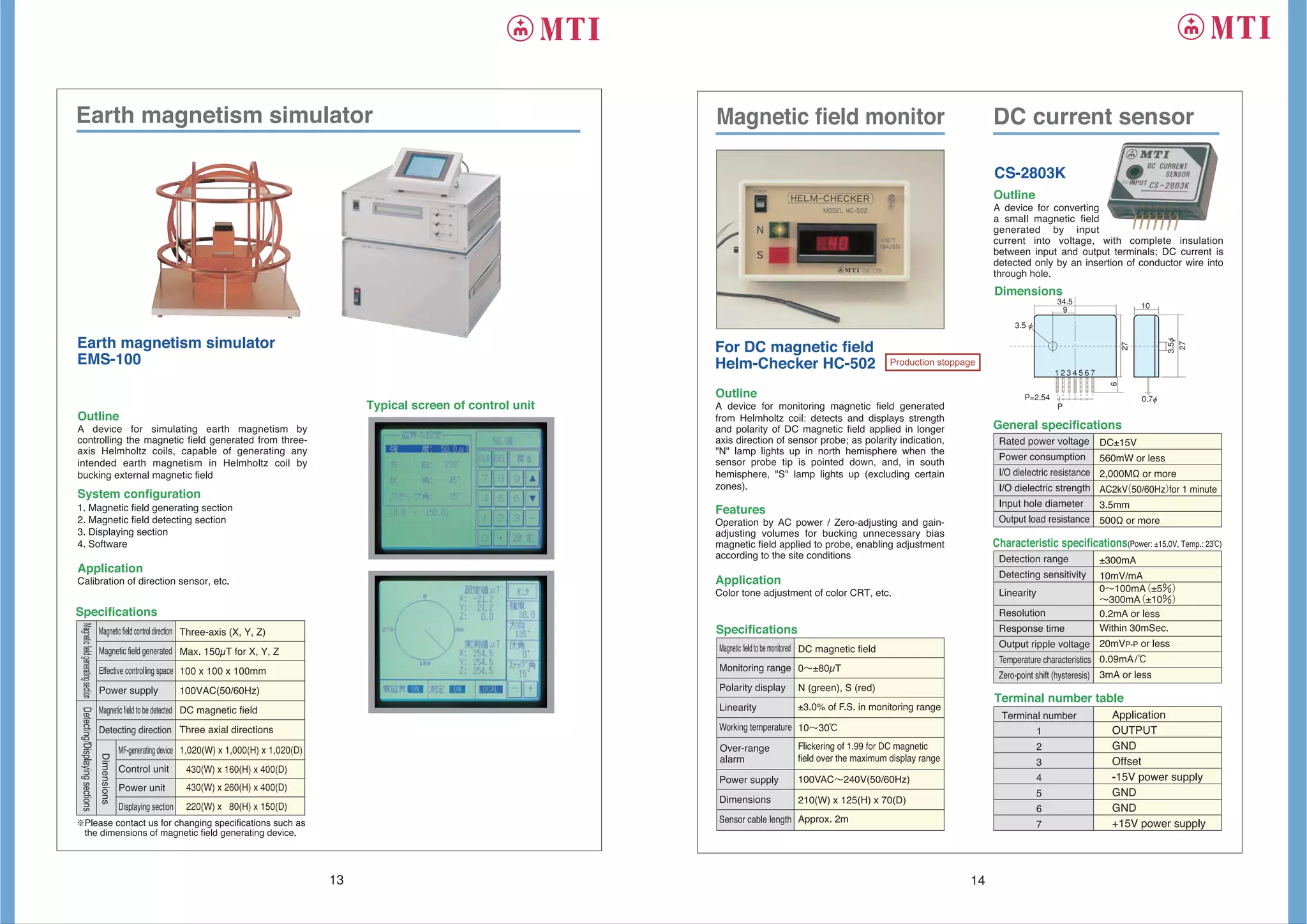
Understanding the Magnetic Field Measurement Unit: A Comprehensive Guide
The primary units used to measure magnetic fields are the Tesla (T) and the Gauss (G) for magnetic flux density, and Ampere per meter (A/m) or Oersted (Oe) for magnetic field strength. In the International System of Units (SI), the Tes...
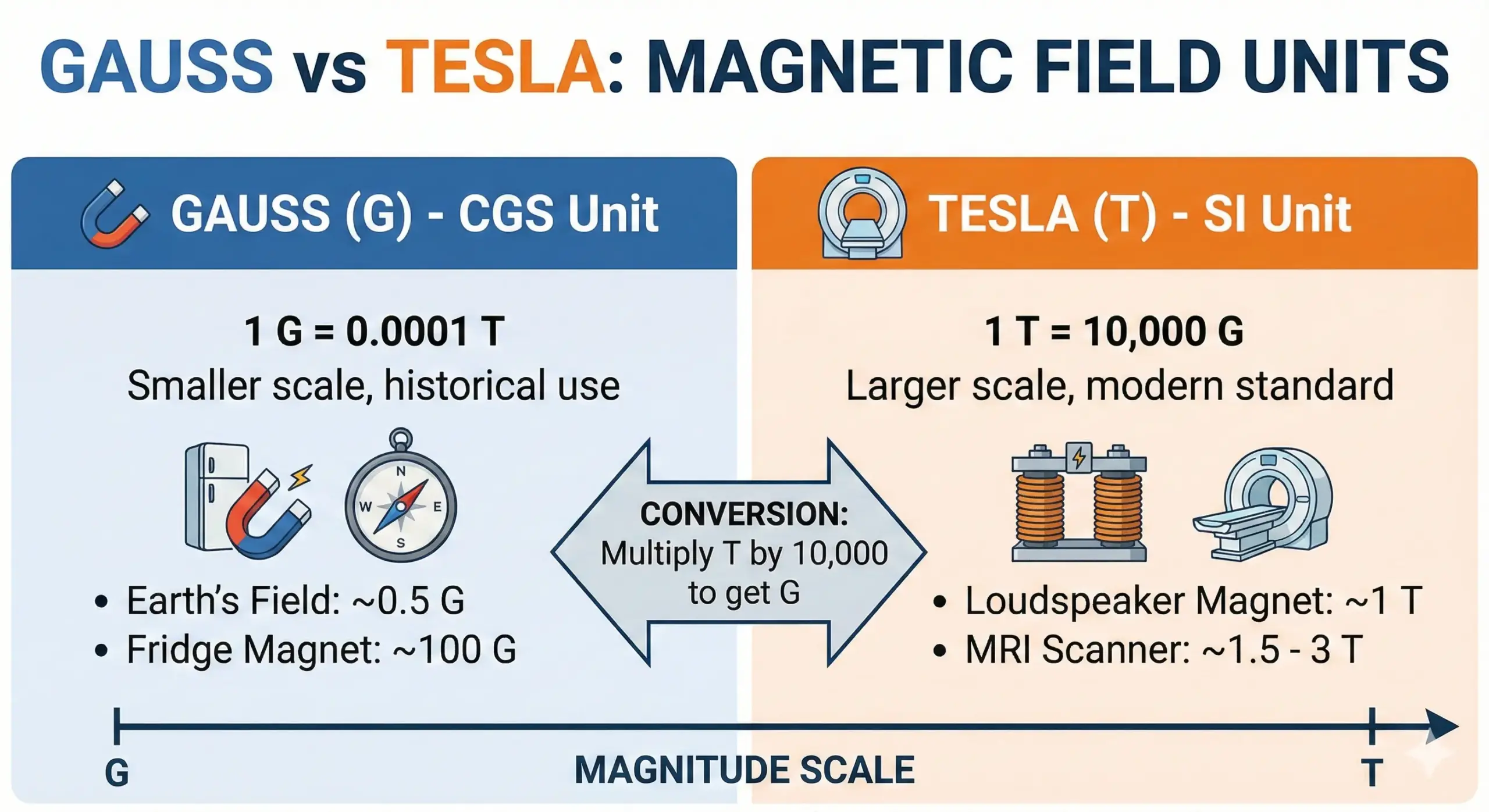
The primary units used to measure magnetic fields are the Tesla (T) and the Gauss (G) for magnetic flux density, and Ampere per meter (A/m) or Oersted (Oe) for magnetic field strength. In the International System of Units (SI), the Tesla is the standard, where one Tesla equals 10,000 Gauss.
Contents
Magnetic fields are invisible forces that influence moving electric charges and magnetic materials. To quantify these forces accurately in 2026, scientists and engineers rely on a specific set of units that distinguish between the "intensity" of the source and the "density" of the resulting field. Understanding these units requires a clear grasp of the two primary ways a magnetic field is defined: as Magnetic Flux Density ($B$) and Magnetic Field Strength ($H$).
The Fundamental Distinction: B-Field vs. H-Field
Before diving into specific units, it is essential to resolve a common point of confusion in electromagnetism: the difference between the $B$-field and the $H$-field. Although both are often referred to as "the magnetic field," they represent different physical perspectives.
Magnetic Flux Density (B)
The $B$-field, measured in Tesla, represents the actual magnetic influence within a medium. It accounts for how a material responds to a magnetic force. When you measure the strength of a permanent magnet or the field inside an MRI machine, you are measuring Magnetic Flux Density. It is defined by the force it exerts on a moving charge, governed by the Lorentz force law: $F = q(v \times B)$.
Magnetic Field Strength (H)
The $H$-field, measured in Ampere per meter, represents the "driving" magnetic force produced by an electric current or a permanent magnet, independent of the medium's properties. It describes the magnetic field as it is generated by the source.
The relationship between the two is defined by the equation: $B = \mu H$ Where $\mu$ (mu) is the magnetic permeability of the material. In a vacuum, the relationship is constant, but in materials like iron or nickel, the $B$-field becomes significantly stronger than the $H$-field due to the material's internal alignment.
The SI Standard: The Tesla (T)
The Tesla is the official unit of magnetic flux density in the International System of Units (SI). Named after the inventor Nikola Tesla in 1960, it is a "derived" unit, meaning it is defined by its relationship to other base units like meters, kilograms, and seconds.
One Tesla is defined as the field intensity generating one Newton of force per Ampere of current per meter of conductor ($1 T = 1 N / (A \cdot m)$). In practical terms, one Tesla represents a very high magnetic density. For perspective:
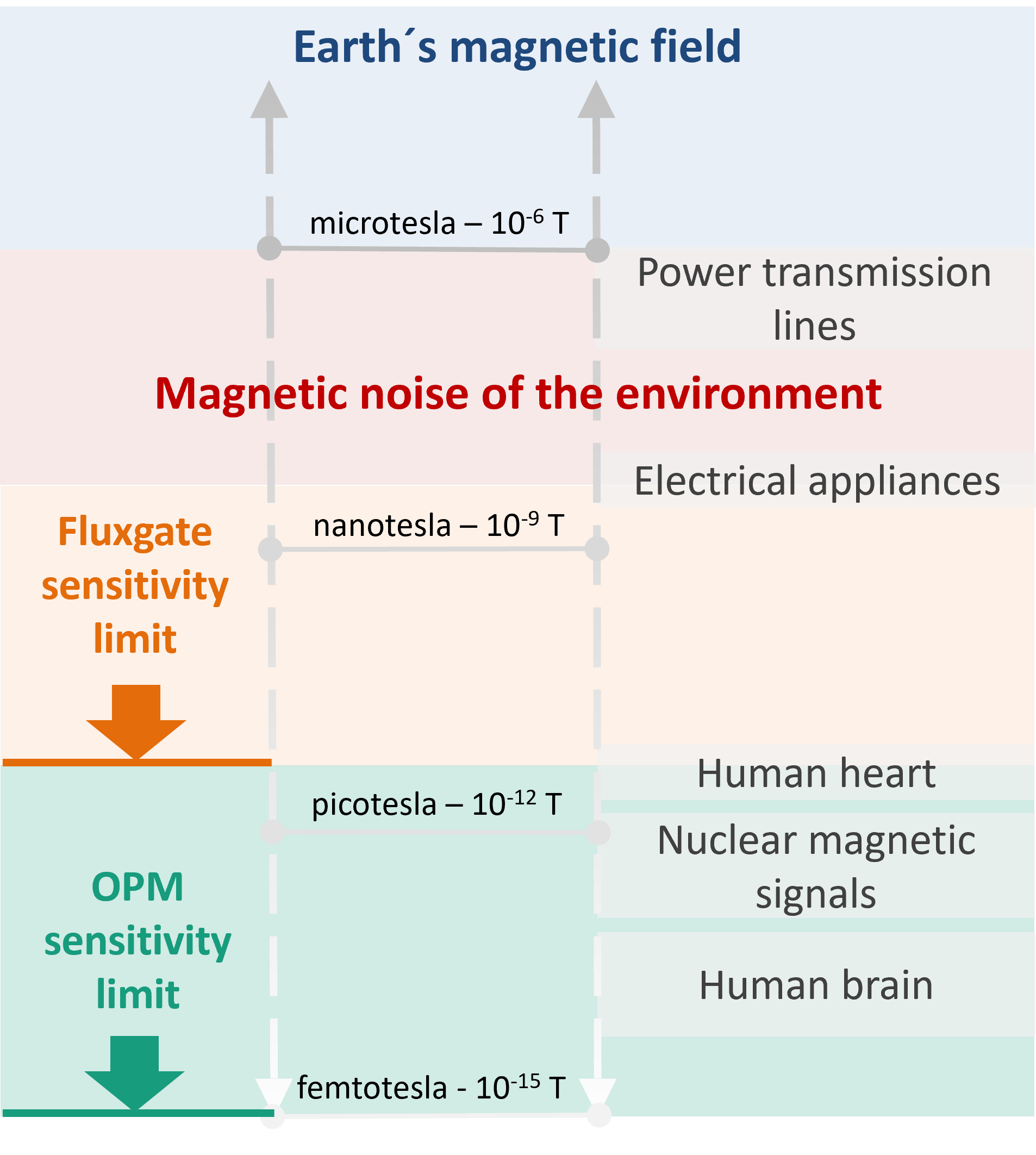
- Earth’s magnetic field: Approximately 31 to 58 microtesla ($\mu T$).
- Refrigerator magnet: Approximately 5 millitesla ($mT$).
- Standard Medical MRI: Typically 1.5 to 3 Tesla.
- High-strength Laboratory Magnets: Can exceed 25 to 45 Tesla.
Because a full Tesla is so powerful, many applications use prefixes like microtesla ($\mu T$) or millitesla ($mT$) for everyday measurements.
The CGS Alternative: The Gauss (G)
While the Tesla is the official scientific standard, the Gauss remains widely used in commercial manufacturing, electronics, and small-scale physics. The Gauss belongs to the Centimeter-Gram-Second (CGS) system, which predates the modern SI system.
The primary reason for the continued popularity of the Gauss is its scale. For small permanent magnets and consumer electronics, the Gauss provides "human-sized" numbers that are easier to handle than tiny fractions of a Tesla.
The conversion is straightforward:
- 1 Tesla = 10,000 Gauss
- 1 Gauss = 100 microtesla ($\mu T$)
If a manufacturer states that a neodymium magnet has a "surface gauss" of 3,500, you can quickly determine that it has a flux density of 0.35 Tesla.
Measuring Field Strength: Ampere per Meter and Oersted
While $B$ (Tesla/Gauss) measures the output, $H$ measures the input or the "effort" of the magnetic source.
Ampere per Meter (A/m)
In the SI system, the unit for $H$ is the Ampere per meter. This unit is intuitive for electrical engineers because it directly relates to the current flowing through a wire. For a long straight wire, the field strength at a distance $r$ is proportional to the current in Amperes divided by the circumference ($2\pi r$).
Oersted (Oe)
The CGS equivalent of A/m is the Oersted. It was named after Hans Christian Ørsted, who discovered the connection between electricity and magnetism. In a vacuum, 1 Oersted of field strength ($H$) results in 1 Gauss of flux density ($B$), which simplifies calculations for physicists working in non-magnetic environments.
Summary of Magnetic Units and Conversions
The following table provides a quick reference for the most common units encountered in magnetic measurement as of 2026.
| Property | Symbol | SI Unit (Standard) | CGS Unit (Legacy/Common) | Conversion Factor |
|---|---|---|---|---|
| Magnetic Flux Density | $B$ | Tesla (T) | Gauss (G) | $1 T = 10,000 G$ |
| Magnetic Field Strength | $H$ | Ampere per meter (A/m) | Oersted (Oe) | $1 A/m \approx 0.01257 Oe$ |
| Magnetic Flux | $\Phi$ | Weber (Wb) | Maxwell (Mx) | $1 Wb = 10^8 Mx$ |
| Magnetomotive Force | $F$ | Ampere (A) | Gilbert (Gb) | $1 A \approx 1.257 Gb$ |
Practical Tools for Measuring Magnetic Fields
Measuring these units requires specialized sensors. The choice of tool depends on whether you are measuring static (DC) fields or varying (AC) fields.
- Hall Effect Sensors: These are the most common sensors used in handheld "Gaussmeters." They work on the principle that a magnetic field exerts a force on electrons moving through a semiconductor, creating a measurable voltage. They are excellent for measuring the $B$-field of permanent magnets.
- Fluxgate Magnetometers: These are far more sensitive than Hall effect sensors and are used to measure very weak fields, such as the Earth's magnetic field or magnetic signatures of submerged objects. They can measure in the nanotesla ($nT$) range.
- Proton Precession Magnetometers: Often used in geology, these measure the resonance of hydrogen nuclei to determine the total absolute magnetic field strength with extreme precision.
- SQUID (Superconducting Quantum Interference Device): These are the most sensitive instruments available, used in medical applications like magnetoencephalography (MEG) to measure the tiny magnetic fields produced by brain activity.
Common Pitfalls in Measurement
When working with magnetic field units, several common errors can lead to inaccurate data or safety risks.
- Distance Sensitivity: Magnetic field strength drops off rapidly with distance (often following an inverse-square or inverse-cube law depending on the source shape). A measurement taken 1 mm away from a magnet will be vastly different from one taken at 5 mm.
- Air Gaps and Permeability: If you are measuring the field of an electromagnetic coil, placing a piece of iron near the sensor will "concentrate" the flux, giving a higher Tesla reading without changing the Ampere-per-meter input.
- Orientation (Polarity): Most magnetic sensors are directional. If a Hall probe is not held perpendicular to the flux lines, it will report a lower-than-actual value. This is known as the "cosine error."
- AC vs. DC: Ensure your meter is set to the correct mode. A standard Gaussmeter designed for permanent magnets (DC) may provide completely false readings if used near a high-frequency transformer (AC).
FAQ
What is the difference between a Weber and a Tesla?
A Weber (Wb) measures Magnetic Flux, which is the total magnetic field passing through a specific area. A Tesla (T) measures Magnetic Flux Density, which is the amount of flux per square meter ($1 T = 1 Wb/m^2$). Think of the Weber as the total amount of water flowing through a pipe, while the Tesla is the pressure or velocity at a single point.
Is the Earth's magnetic field measured in Tesla or Gauss?
It can be measured in both, but scientists typically use nanotesla (nT) or microtesla ($\mu T$). For example, the Earth's field is roughly 50,000 nT or 0.5 Gauss. Using nanotesla allows for more precision when tracking small fluctuations caused by solar activity.
Why do some people use "Gamma" as a unit?
"Gamma" ($\gamma$) is a legacy unit used primarily in geophysics and space science. One Gamma is exactly equal to one nanotesla (1 nT). While the term is becoming less common in 2026, it still appears in older geological surveys and historical data.
How many Gauss are dangerous for humans?
Static magnetic fields under 20,000 Gauss (2 Tesla) are generally considered safe for short-term exposure for most people. However, those with pacemakers or metallic implants must avoid much lower levels (often as low as 5 Gauss) because the field can interfere with electronics or exert mechanical force on the implant.
Can a smartphone measure magnetic fields?
Yes, most smartphones contain a 3-axis magnetometer used for the compass feature. Apps can display this data in microtesla ($\mu T$). While useful for detecting large metal objects or basic orientation, they are not calibrated for scientific or industrial precision.
Next Steps for Precise Measurement
To master magnetic field measurement, your next action should be to identify the specific requirements of your project. If you are working on industrial safety or magnet grading, invest in a calibrated Hall-effect Gaussmeter that provides readings in both Tesla and Gauss. For those in electrical design, focus on the relationship between current and field strength by studying NIST guidelines on magnetic units. Always ensure your sensors are calibrated annually to maintain accuracy against international standards.
Image Gallery