Self-Healing Technology: Emerging Materials and Automotive Applications
Self-healing technology in automotive applications uses advanced polymers, composites, and coatings that autonomously repair physical micro-damage, cracks, and structural fatigue. By incorporating intrinsic dynamic chemical bonds or ex...
Self-healing technology in automotive applications uses advanced polymers, composites, and coatings that autonomously repair physical micro-damage, cracks, and structural fatigue. By incorporating intrinsic dynamic chemical bonds or extrinsic microencapsulated healing agents, these emerging materials extend component lifespans, preserve vehicle aesthetics, prevent catastrophic structural failures, and enhance safety across EV battery systems, exterior coatings, structural body panels, and elastomeric components.
Contents
Technical Architecture: Core Mechanisms of Self-Healing Materials
Self-healing materials operate through two primary chemical classifications: extrinsic mechanisms and intrinsic mechanisms. Each architecture dictates how a material responds to physical damage, the requirement for environmental triggers, and whether the material can undergo repeated repair cycles over time.
| Extrinsic Systems (Single or Finite Repair) | Intrinsic Systems (Repeatable/Reversible) |
|---|---|
| Microencapsulated Agents (Monomer + Liquid Catalyst) | Dynamic Covalent Bonding (Diels-Alder Reactions) |
| Vascular / Capillary Networks (Continuous Fluid Delivery) | Non-Covalent Interactions (Hydrogen & Ionic Bonds) |
| Sacrificial Micro-Vessels | Shape Memory Polymer Matrix |
Extrinsic Self-Healing Systems
Extrinsic systems rely on pre-embedded sequestered healing agents within the bulk material matrix. When damage ruptures these embedded containers, the liquid healing agent releases into the crack volume through capillary action, coming into contact with embedded catalysts to initiate polymerization.
- Microencapsulated Healing Agents: Core-shell microcapsules containing liquid monomers (such as dicyclopentadiene or epoxy resins) are distributed throughout the polymer matrix. When a microcrack propagates, it fractures the capsule wall. The monomer flows into the fissure and reacts with dispersed catalyst particles (such as Grubbs' catalyst), rapidly solidifying to seal the crack. Because the core content is consumed upon rupture, microcapsule healing is localized and finite for any specific damage site.
- Vascular Networks: Modeled after biological circulatory systems, vascular materials utilize 1D, 2D, or 3D interconnected capillary networks. These channels continually transport liquid monomers and curing agents through the component. Vascular systems support repeated healing cycles at a single damage site because fluid can be replenished from an external reservoir, though manufacturing complex vascular channels within structural composites presents significant processing challenges.
Intrinsic Self-Healing Systems
Intrinsic materials heal via reversible chemical bonds within the parent matrix without requiring distinct sequestered agents. These systems can typically heal the exact same location multiple times.
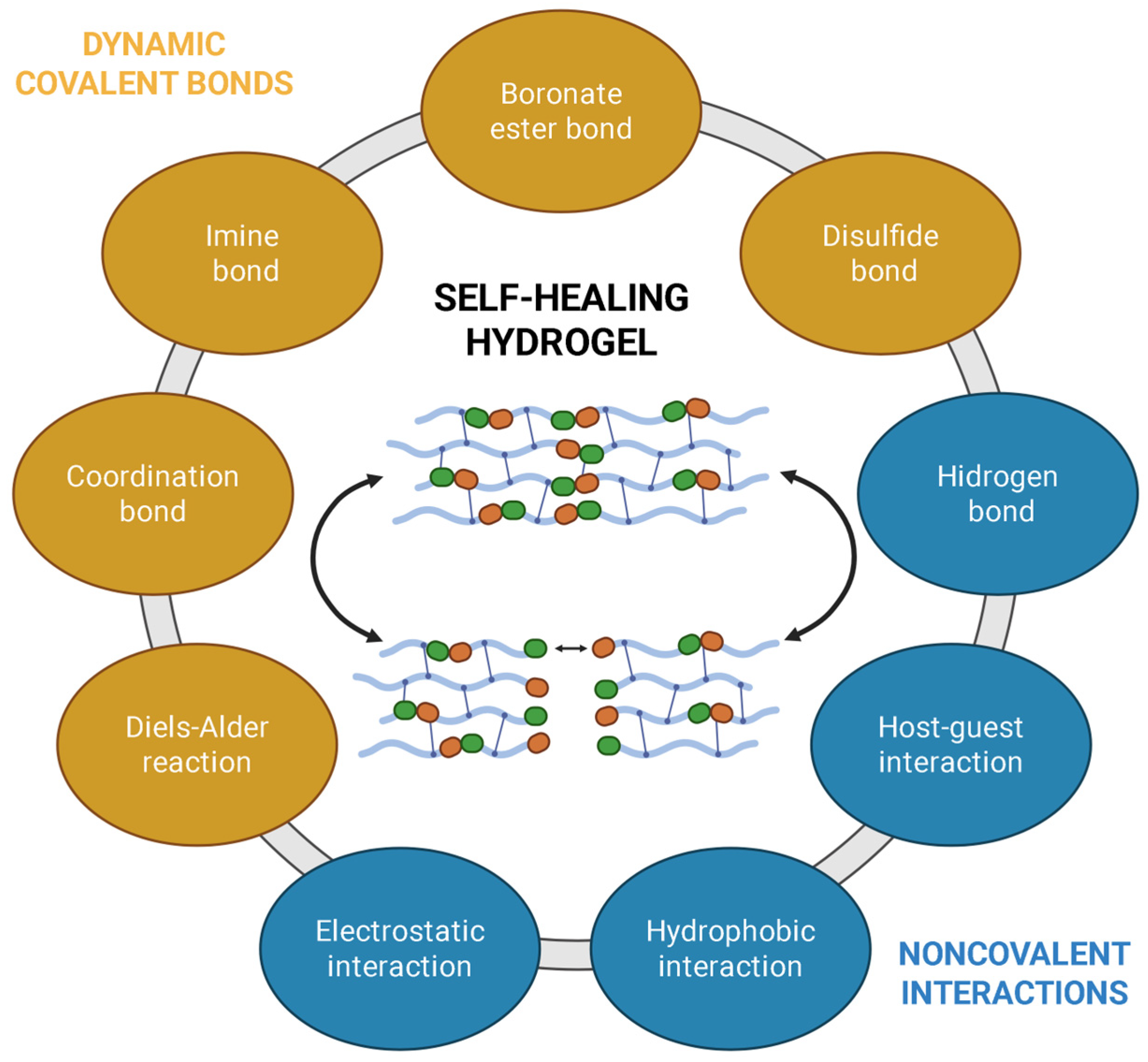
- Dynamic Covalent Bonds: Reversible covalent reactions, such as the thermally reversible Diels-Alder (DA) and retro-Diels-Alder (rDA) cycloadditions (often utilizing furan and maleimide functional groups), break open upon mechanical stress and reform under thermal stimulus. Transesterification and disulfide exchange reactions also operate under dynamic covalent frameworks, restoring original tensile strength when exposed to moderate heat.
- Non-Covalent Supramolecular Interactions: These networks utilize weaker, dynamic bonds such as hydrogen bonding networks, metal-ligand coordination bonds, ionic interactions, and hydrophobic associations. Because these non-covalent interactions possess lower bond activation energies, supramolecular materials can often heal at ambient temperatures (-20°C to 40°C) without external energy inputs, though they generally exhibit lower structural rigidity than covalent matrices.
- Shape Memory Polymers (SMPs): SMPs serve as localized mechanical actuators. Upon exposure to heat or light, the polymer matrix undergoes a phase transition, driving macro-scale crack closure. This mechanical closure brings crack faces into atomic contact, enabling secondary intrinsic bonding reactions (like hydrogen bonding) to re-establish mechanical integrity.
Automotive Applications Across Key Vehicle Systems
Modern automotive design demands materials that endure extreme thermal cycling, mechanical vibration, UV exposure, and chemical attack. Integrating self-healing functional materials across vehicle subsystems addresses specific degradation modes.
- Automotive Subsystem Integration
- Exterior Coatings: Micro-scratch restoration via UV/Solar
- Tires & Elastomers: Puncture sealing & dynamic vulcanization
- EV Batteries: Anode binder healing & solid-electrolyte
- Structural Panels: Delamination & micro-crack suppression
- Sensors & Circuits: Flex-circuit restoration & conductivity
1. Exterior Coatings and Clear Coats
Automotive clear coats are continuously exposed to environmental degradation, stone chips, micro-abrasions, and wash-rack swirls. Advanced clear coats integrate polyurethane networks modified with dynamic hydrogen-bonded supramolecular networks or dynamic thiourethane linkages.
When scratched, solar radiation or engine-generated heat elevates the surface temperature past the material's glass transition temperature ($T_g$). This thermal mobility allows the polymer chains to re-orient, closing micro-scratches within minutes to hours. OEM clear coats utilizing thermal- and UV-activated shape memory polymers maintain gloss levels and prevent underlying sheet metal corrosion without requiring abrasive compounding or respraying.
2. Lithium-Ion and Solid-State Battery Systems
Energy storage devices undergo severe volumetric expansion and contraction during charge-discharge cycling. This expansion degrades battery components:
- Silicon Anodes: High-capacity silicon anodes expand by up to 300% during lithiation, causing particle pulverization and severe capacity fading. Self-healing polymer binders based on dynamic hydrogen-bonding or ionic networks stretch and reform around silicon nanoparticles, preserving structural and electrical contact across thousands of charge cycles.
- Solid-State Electrolytes: Solid-state batteries suffer from lithium dendrite propagation, which causes internal short circuits. Self-healing solid polymer electrolytes (SPEs) and hybrid gel-polymer electrolytes automatically repair micro-cracks and voids at the lithium-metal anode interface, suppressing dendrite growth and extending battery operational lifetime.
3. Structural Composites and Lightweight Body Panels
Carbon Fiber Reinforced Polymers (CFRP) and Glass Fiber Reinforced Polymers (GFRP) offer exceptional strength-to-weight ratios for vehicle chassis, hoods, and structural tubs. However, internal microcracks and delamination caused by road impact or fatigue are difficult to detect and repair.
Incorporating dynamic epoxy matrices containing vitrimers—polymers that undergo thermal transesterification reactions—allows carbon fiber composite panels to repair internal micro-cracks under controlled infrared baking cycles. Furthermore, vascular networks embedded within structural composite laminates can distribute low-viscosity resin into interior crack sites, restoring up to 85% to 90% of original interlaminar fracture toughness.
4. Tires, Sealants, and Elastomeric Components
Tire tread puncture remains a primary cause of roadside disablement. Modern self-sealing tires integrate a viscoelastic inner liner composed of lightly crosslinked polyisobutylene (butyl rubber) combined with dynamic chemical crosslinks.
When a nail pierces the tread, high internal inflation pressure forces the viscous, tacky self-healing compound into the cavity around the object. Upon removal of the penetrating object, the dynamic dynamic bonds within the sealant flow together, sealing the aperture instantaneously against air pressure loss up to operational speeds.
5. Autonomous Sensors and Flexible Electronics
Advanced Driver Assistance Systems (ADAS) rely on radar housings, lidar covers, printed flexible circuits, and exterior sensor surfaces. Scratches on sensor housings degrade optical and radio-frequency signal transmission.
Flexible conductive polymers enriched with liquid metal micro-droplets or conductive carbon nanotubes feature self-healing substrates. If an exterior sensor flex-circuit fractures due to mechanical strain or collision impact, the self-healing substrate bridges the gap, while liquid metal inclusions reform electrical paths, restoring circuit continuity instantly.
Technical Comparison of Self-Healing Architectures
Evaluating materials for automotive integration requires balancing mechanical properties against functional healing capabilities.
| Healing Mechanism | Primary Material Chemistry | Typical Activation Triggers | Representative Automotive Application | Mechanical Strength (Tensile) | Repeatability at Single Site | Typical Recovery Efficiency (%) |
|---|---|---|---|---|---|---|
| Microencapsulation | Epoxy / Dicyclopentadiene in Polyurethane | Mechanical Fracture / Rupture | Structural Composites, Underbody Coatings | High (50–100 MPa) | Non-repeatable (Single-use) | 75% – 90% |
| Vascular Networks | Microfluidic Epoxy / Cyanoacrylates | Mechanical Stress / Rupture | Body Structural Panels, Chassis Rails | High (40–80 MPa) | Multi-use (Supply limited) | 80% – 95% |
| Dynamic Covalent (Diels-Alder) | Furan-Maleimide Adducts | Heat (80°C – 120°C) | Exterior Clear Coats, Bumpers | Moderate to High (30–60 MPa) | Highly Repeatable | 80% – 100% |
| Supramolecular Networks | Hydrogen-bonded Polyurethanes / Ureas | Ambient Temperature / Solar UV | Clear Coats, Interior Trims | Low to Moderate (5–30 MPa) | Indefinitely Repeatable | 90% – 100% |
| Dynamic Vitrimers | Transesterified Epoxy Resins | Elevated Heat (>150°C) | CFRP Chassis, Structural Battery Enclosures | Very High (>100 MPa) | Highly Repeatable | 85% – 95% |
| Self-Sealing Elastomers | Modified Polyisobutylene / Dynamic Rubbers | Mechanical Displacement / Pressure | Self-Sealing Tire Liners, Hose Gaskets | Low (1–10 MPa) | Multi-use | 95% – 100% |
Engineering Challenges, Limitations, and Manufacturing Integration
While self-healing materials present clear operational advantages, several technical hurdles limit universal implementation across volume production vehicles:
- Manufacturing & Lifecycle Barriers
- Property Trade-Offs: High healing efficiency lowers modulus
- Thermal Triggers: OEM paint booths operate up to 140°C
- Aging & Contamination: Road salt/dirt blocks reactive sites
- Economic Viability: Raw material premiums of 200% - 500%
Mechanical Property Trade-offs
High-efficiency intrinsic healing often relies on low bond-dissociation energies or high chain mobility. As a rule, polymers engineered for ambient-temperature self-healing exhibit lower glass transition temperatures ($T_g$), reduced Young's modulus, and decreased abrasion resistance. Engineering high-modulus structural components that maintain rapid self-healing capabilities requires complex interpenetrating polymer networks (IPNs) that balance rigidity with molecular mobility.
Thermal and Environmental Trigger Dependency
Many intrinsic dynamic covalent reactions require targeted thermal activation (often between 80°C and 140°C). Generating these temperatures in operational vehicles requires dedicated heat sources, such as embedded resistive heating elements, integrated carbon nanotube heaters, or directed infrared baking systems. Materials that rely on solar activation may fail to perform in cold winter climates (-40°C) or under dark conditions.
Chemical Degradation, Contamination, and Aging
Self-healing surfaces are continuously exposed to environmental pollutants, including road salt ($NaCl$), acid rain, oil residues, and intense UV radiation. Contaminants entering a microcrack can physically block dynamic bonds from contacting opposite crack faces, reducing recovery efficiency. Furthermore, continuous exposure to moisture and oxygen can permanently oxidize or hydrolyze active functional groups, decreasing self-healing capability over an 8 to 15-year vehicle lifespan.
Processability and High-Volume Scale
Integrating microcapsules or vascular channels into existing automotive manufacturing lines introduces processing complications:
- High-shear mixing during injection molding or extrusion can prematurely rupture fragile microcapsules.
- Autoclave temperatures and pressures used for structural carbon fiber composite curing can degrade self-healing chemistry before the component enters service.
- Manufacturing costs for specialty monomers, catalysts, and engineered microcapsules remain higher than standard automotive grade resins.
Testing Protocols and Standardized Verification Guidelines
To validate self-healing components for vehicle integration, automotive OEMs and tier-1 suppliers utilize established standards from bodies such as SAE International and ISO. Standard testing regimes must verify both initial mechanical performance and the recovery ratio after induced damage.
1. Mechanical Recovery Evaluation
- Scratch and Gloss Recovery: Evaluated via standardized scratch testing (such as ISO 1518 and ASTM D7027). Optical profiling and micro-reflectometry measure specular gloss before scratching, immediately after micro-indentation, and following designated heat/UV exposure cycles.
- Tensile Strength and Fracture Toughness: Measured using Compact Tension (CT) specimens or T-peel tests adhering to ASTM D5045 guidelines. Specimens are loaded to fracture, re-aligned, subjected to the self-healing trigger cycle, and re-tested to failure to calculate the healing efficiency ($\eta$):
$$\eta = \left( \frac{K_{IC,\text{healed}}}{K_{IC,\text{virgin}}} \right) \times 100$$
Where $K_{IC}$ represents the critical stress intensity factor (fracture toughness).
2. Environmental Cycling and Durability Validation
- Thermal Shock and Cycling: Testing per ISO 16750-4 subjects healed components to extreme thermal swings (typically -40°C to +85°C or up to +125°C for engine compartment applications) across hundreds of hours to confirm that restored interfaces do not de-bond.
- Corrosion Resistance: Salt spray corrosion testing (ASTM B117) verifies that healed exterior coatings prevent moisture ingress and underlying substrate rusting after scratch repair cycles.
Implementation Strategy for Automotive Materials Engineers
For automotive OEMs and Tier-1 suppliers evaluating self-healing materials integration, the following phased approach helps balance material performance, processing constraints, and cost:
- OEM Material Adoption Roadmap
- Phase 1: Low-Risk Non-Structural Coatings & Interior Trim Surfaces
- Phase 2: Functional Components (Self-sealing tires, battery beds)
- Phase 3: High-Stress Structural Vitrimers & Sensing Arrays
- Map Damage Modes to Healing Mechanisms:
- For recurring micro-damage (exterior clear coats, interior high-touch surfaces), specify supramolecular or dynamic covalent polymers capable of indefinite healing cycles.
- For localized, high-impact structural micro-cracking where high stiffness is essential, specify vitrimer epoxy matrices or microencapsulated systems.
- Verify Processing Compatibility:
- Ensure microencapsulated additives can withstand peak shear rates in injection molding machines or resin transfer molding (RTM) pressures without premature rupture.
- Confirm that dynamic network activation temperatures align with existing paint shop curing ovens (e.g., E-coat and clear coat bake ovens operating between 120°C and 140°C).
- Specify Thermal Activation Architecture:
- If relying on intrinsic dynamic bonds, evaluate whether ambient heat (solar radiation) is sufficient or if active heating elements (such as embedded micro-resistive grids) are necessary for cold-weather operational reliability.
- Enforce Standardized Recovery Metrics:
- Require Tier-1 suppliers to provide residual strength data after multiple damage-healing cycles, validated under ASTM/ISO standards, rather than relying solely on initial surface visual recovery metrics.
Frequently Asked Questions
What is the fundamental difference between intrinsic and extrinsic self-healing materials?
Intrinsic self-healing materials repair damage through dynamic, reversible chemical bonds (such as hydrogen bonds or Diels-Alder reactions) built directly into the main polymer structure, allowing them to heal the exact same location multiple times. Extrinsic materials store secondary healing agents inside embedded microcapsules or vascular networks; when damaged, these structures break open and release the agent to fix the crack once at that specific location.
How do self-healing clear coats repair scratches on vehicles?
Self-healing clear coats use flexible polymer networks with dynamic chemical bonds. When scratched, solar UV radiation, ambient sunlight, or engine heat warms the clear coat above its activation temperature. This thermal energy allows the polymer chains to move, reform interrupted dynamic bonds, and physically flow back together, erasing light surface scratches and swirl marks automatically.
Can self-healing technology be used for structural vehicle frames and carbon fiber components?
Yes. High-strength structural composites utilize dynamic vitrimer epoxies or microencapsulated curing resins. When micro-cracks form inside carbon fiber panels due to fatigue or impact, applied thermal treatment or released microencapsulated resins bridge internal fractures and delaminations, restoring up to 90% of the material's original mechanical strength.
How does self-healing technology improve EV battery longevity?
In electric vehicle batteries, self-healing polymer binders are used in high-capacity silicon anodes to cushion severe volumetric expansion during charging. Dynamic ionic or hydrogen-bonding networks stretch and re-seal, preventing the anode material from pulverizing. Additionally, self-healing solid-state electrolytes fill micro-cracks automatically, suppressing lithium dendrite growth and preventing internal short circuits.
Do self-healing materials eliminate the need for traditional auto body repairs?
No. Self-healing materials are engineered to repair micro-scale damage, deep surface scratches, internal delaminations, and micro-cracks. They cannot restore major structural deformation, shattered panels, or large metal tears resulting from high-energy vehicle collisions.
Strategic Summary and Next Steps
Self-healing technology shifts automotive material design from passive damage tolerance to active lifetime preservation. To successfully adopt these emerging materials, engineering teams must carefully match the chemical mechanism to the functional subsystem requirements:
- For Exterior Surfaces: Prioritize thermally responsive supramolecular polyurethane coatings to maintain finish quality and prevent corrosion.
- For Powertrain and Energy Storage: Implement dynamic self-healing binder networks in battery cell production to increase cycle life and preserve electrochemical capacity.
- For Chassis and Body Engineering: Pilot dynamic vitrimer matrices within structural composite parts to reduce structural fatigue risks without increasing overall component weight.
By incorporating standardized testing procedures early in the material qualification process, automotive OEMs can integrate self-healing materials into volume production, reducing warranty costs and extending vehicle operational lifespans.
Image Gallery