Comprehensive Triple Jump Training Schedule Explained for 2026
A successful triple jump training schedule balances explosive power, technical precision, and reactive strength. By integrating sprinting, plyometrics, and phase-specific drills across a periodized cycle, athletes can maximize their ho...
A successful triple jump training schedule balances explosive power, technical precision, and reactive strength. By integrating sprinting, plyometrics, and phase-specific drills across a periodized cycle, athletes can maximize their hop, step, and jump distances while minimizing the high injury risks associated with the intense impact forces of the event.
Contents
Understanding the Biomechanical Demands of the Triple Jump
The triple jump is widely considered one of the most physically demanding events in track and field. Unlike the long jump, which focuses on a single explosive take-off, the triple jump requires the athlete to maintain horizontal velocity across three distinct phases. In 2026, training methodologies have shifted toward a "velocity maintenance" model, where the goal is to minimize deceleration between the hop and the step.
During the landing of the hop and step phases, an athlete's body can experience forces up to 15 times their body weight. Consequently, a training schedule cannot simply focus on jumping; it must prioritize the structural integrity of the joints (specifically the ankles and knees) and the ability of the nervous system to handle rapid eccentric loading.
The Hop Phase (First Phase)
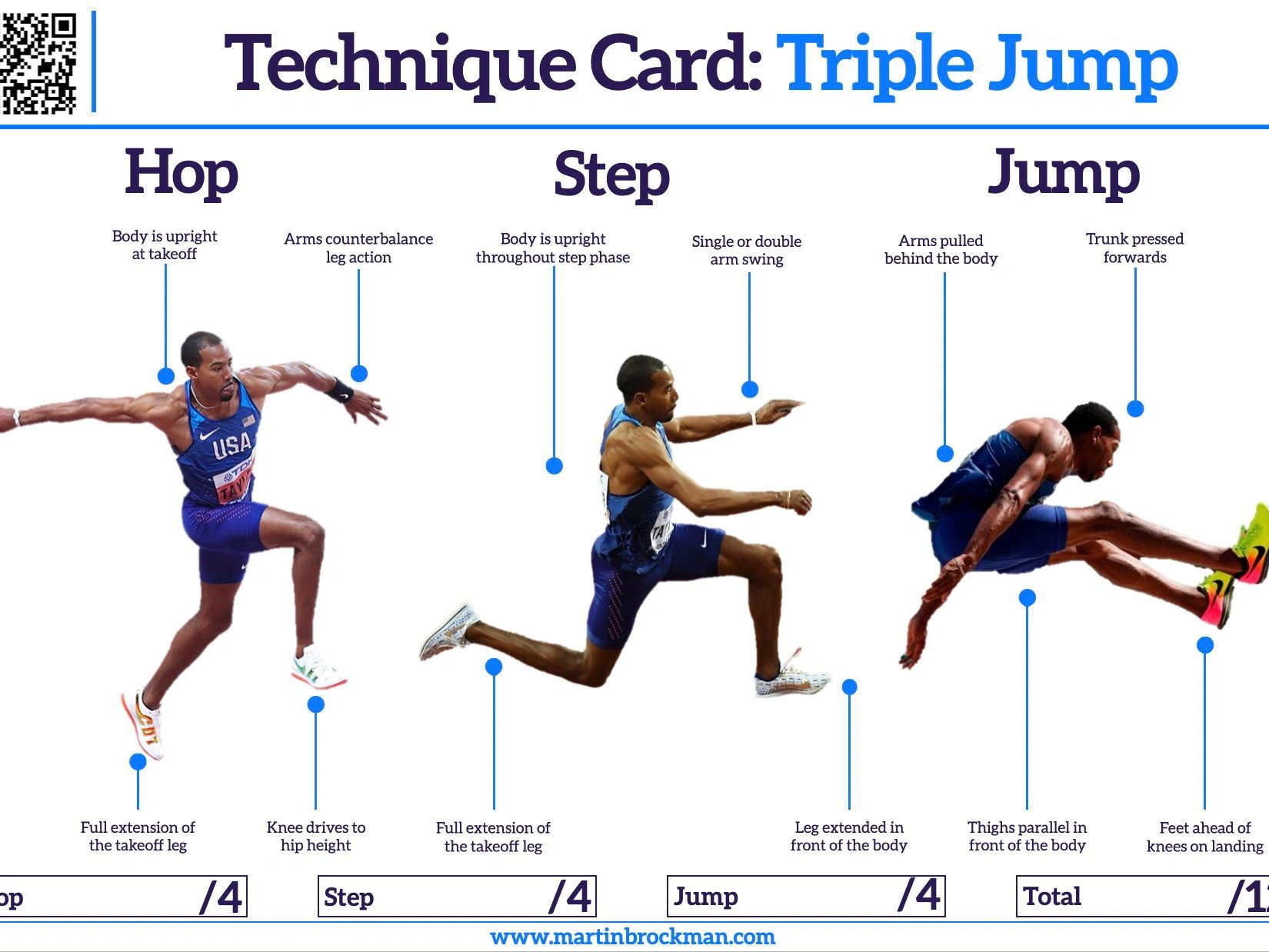
The hop begins with a take-off from the board and ends with a landing on the same foot. The primary objective is to achieve a high horizontal flight path without losing speed. Training for this phase focuses on "active" landings, where the foot "claws" at the ground to prepare for the next phase.
The Step Phase (Second Phase)
The step is the most challenging transition. The athlete must jump from the take-off foot and land on the opposite foot. This requires immense core stability and "switch" speed in the hips. Training schedules often emphasize the "Step-Phase" because it is where most novice athletes lose their momentum.
The Jump Phase (Third Phase)
The final phase is essentially a long jump. At this point, the athlete has lost a significant portion of their initial runway velocity, so the focus shifts to maximizing vertical lift and using a proper landing technique in the sand pit to squeeze out every last centimeter.
The Pillars of a 2026 Training Schedule
To build a schedule that works, coaches must categorize training into four main pillars: speed, plyometrics, strength, and technique.
Speed Development and Approach Mechanics
Horizontal velocity is the greatest predictor of triple jump success. If an athlete cannot run fast, they cannot jump far. A 2026-standard training program incorporates "flying 30s" and resisted sprinting (using sleds or bands) to build top-end speed. Furthermore, the approach run—usually 14 to 20 strides—must be hyper-consistent. Training sessions often include "approach work" where the athlete runs down the runway and hits the board without jumping, ensuring their rhythm is perfect.
Plyometric Progression
Plyometrics (jump training) are the engine of the triple jump. However, they must be progressed carefully to avoid shin splints or stress fractures.
- Extensive Plyometrics: Lower intensity drills like skipping, ankle hops, and light bounding. These are used in the early season to build tendon stiffness.
- Intensive Plyometrics: High-impact drills like depth jumps (jumping off a box and immediately leaping upward) and "stadium hops." These are performed when the athlete has a solid strength base.
Specialized Strength Training
In the weight room, triple jumpers do not train like bodybuilders. They focus on "Rate of Force Development" (RFD). Key exercises include:
- Olympic Lifts: Cleans and snatches to develop total-body explosiveness.
- Back Squats and Split Squats: To build the raw force necessary for the take-off.
- Isometric Holds: Holding a lunge position with heavy weight to strengthen the tendons for the impact of landing.
Periodization: The Yearly Training Cycle
A triple jump training schedule is typically divided into three or four macrocycles. In 2026, most elite programs follow a "block periodization" model to ensure peak performance during the championship season.
- General Preparation (Off-Season): Focuses on building a massive aerobic base and general strength. This is where athletes perform high-volume, low-intensity plyometrics and heavy lifting.
- Specific Preparation (Pre-Season): The focus shifts to power and speed. Sprint distances shorten, and plyometrics become more event-specific (e.g., actual bounding over 30-40 meters).
- Competition Phase (In-Season): Training volume drops significantly, but intensity remains high. The goal is to keep the central nervous system (CNS) fresh for meets.
- Transition Phase (Post-Season): Active recovery. Athletes engage in different sports or light movement to heal from the season's rigors.
The Weekly Training Schedule (2026 Standard)
This table outlines a typical "Specific Preparation" week for a collegiate or advanced high school triple jumper.
| Day | Primary Focus | Training Activities |
|---|---|---|
| Monday | Max Velocity & Technique | 30m Flys, Full Approach Runs, Short-run Triple Jumps (6-8 strides). |
| Tuesday | Heavy Strength | Back Squats (85% 1RM), Power Cleans, Weighted Lunges, Core work. |
| Wednesday | Active Recovery | Mobility flow, swimming, or 20-minute light jog. Focus on ankle/hip flexibility. |
| Thursday | Plyometrics & Speed Endurance | Bounding (RR-LL), Depth Jumps, 150m intervals at 80% effort. |
| Friday | Power & Explosiveness | Hang Snatch, Box Jumps, Medicine Ball throws, Weighted Step-ups. |
| Saturday | Event Specificity | Full approach jumps into the pit, video analysis, technical drills. |
| Sunday | Full Rest | Complete CNS recovery. |
Technical Drills and Skill Acquisition
A schedule is only effective if the technical execution is sound. Athletes should dedicate at least two sessions a week specifically to "drilling." These are low-impact movements that reinforce the "muscle memory" of the jump.
- A-Skips and B-Skips: Essential for upright sprinting posture.
- Cycle Drills: Practicing the "cycling" motion of the legs during the hop and step phases while moving slowly.
- The "Box" Drill: Jumping off a small 6-inch box to practice the landing and immediate transition into the next phase. This teaches the body to handle "eccentric" shock.
Injury Prevention and Load Management
Because the triple jump is so taxing, monitoring "workload" is critical. In 2026, many athletes use the Reactive Strength Index (RSI) to determine if they are ready for a high-intensity session. By performing a simple drop-jump on a force plate or using a mobile app, an athlete can see if their jump height vs. ground contact time is optimal. If the RSI is low, it indicates CNS fatigue, and the training session should be shifted to recovery.
Common Injury Sites
- Patellar Tendon: Often called "jumper's knee." Prevention includes eccentric slant-board squats.
- Calcaneal Stress: The heel takes a beating. Using "heel cups" in spikes and ensuring the "pawing" action (landing on the midfoot, not the heel) is vital.
- Lower Back: Usually caused by poor core stability during the step phase.
Frequently Asked Questions
How many days a week should I jump into the pit?
You should only perform full-intensity jumps into the pit 1–2 times per week. The triple jump is extremely taxing on the joints. Doing it too often leads to "diminishing returns" where your technique fails because your muscles are too tired to stabilize your joints. On other days, focus on sprinting or strength.
What is the ideal "phase ratio" for a triple jump?
While it varies by athlete, the "Balanced Technique" is often cited by World Athletics as the most efficient. This usually looks like a 35% hop, 30% step, and 35% jump. If your step is significantly shorter than 30%, your training schedule should prioritize single-leg strength and "switch" mechanics.
How long should the triple jump approach be?
For beginners, 8–12 strides are sufficient to learn the rhythm. For advanced athletes in 2026, approach runs typically range from 16 to 22 strides. The goal is to reach about 95% of your maximum sprinting speed before hitting the board.
Can I train triple jump and long jump on the same schedule?
Yes, they are highly complementary. Most triple jump training schedules naturally improve long jump performance because they both require high-end speed and vertical lift. However, you must be careful with the total volume of jumps to avoid overuse injuries.
Should I lift weights before or after jumping?
Ideally, you should lift after your jumping or sprinting session, or on a separate day entirely. Jumping requires a fresh central nervous system. If you fatigue your muscles with heavy squats first, your jump technique will suffer, and your risk of injury will increase significantly.
What equipment is necessary for 2026 training?
Beyond standard track spikes, triple jumpers should invest in spikes specifically designed with extra heel cushioning. Additionally, using resistance bands for glute activation and foam rollers for recovery are standard components of a modern training kit.
Practical Recommendation
If you are just starting, do not attempt a full-intensity weekly schedule immediately. Begin with a "Base Phase" focusing on sprinting and general strength for 4–6 weeks. Once your body is accustomed to the impact of sprinting, introduce "extensive" plyometrics (light skipping and hopping). Only move to "intensive" bounding and full-approach jumps once you have built the necessary tendon stiffness. Always prioritize quality of movement over quantity; in the triple jump, one perfect rep is worth more than ten sloppy ones.
Image Gallery