Navigating Participating vs Nonparticipating Whole Life Insurance: Which Fits Your Needs?
Choosing between participating and nonparticipating whole life insurance depends on whether you prefer the potential for fluctuating policy dividends through a mutual insurer or the predictability of fixed premiums and guaranteed cash...
Choosing between participating and nonparticipating whole life insurance depends on whether you prefer the potential for fluctuating policy dividends through a mutual insurer or the predictability of fixed premiums and guaranteed cash value without external market adjustments. Evaluating your financial risk tolerance, long-term goals, and budget determines the most appropriate path forward.
Contents
Understanding Whole Life Insurance Basics
Whole life insurance is a form of permanent life insurance designed to remain active for the entirety of the insured’s life, provided that required premiums are paid. Unlike term life insurance, which expires after a specified number of years, whole life policies combine a guaranteed death benefit with a savings component known as cash value. A portion of each premium payment is allocated to this cash-value account, where it grows on a tax-deferred basis according to a schedule determined by the issuing insurance company.
The structure of whole life insurance offers a high degree of certainty for long-term financial planning. Policyholders lock in their premium rates when they purchase the policy, meaning costs do not increase as they age or if their health declines. Furthermore, the cash value can serve as a financial resource during the policyholder's lifetime, allowing them to take policy loans or withdrawals for various financial needs. However, these policies generally feature higher initial premium costs than term insurance alternatives. Within this category, insurers divide products into two main structural types: participating and nonparticipating policies.
What is Participating Whole Life Insurance?
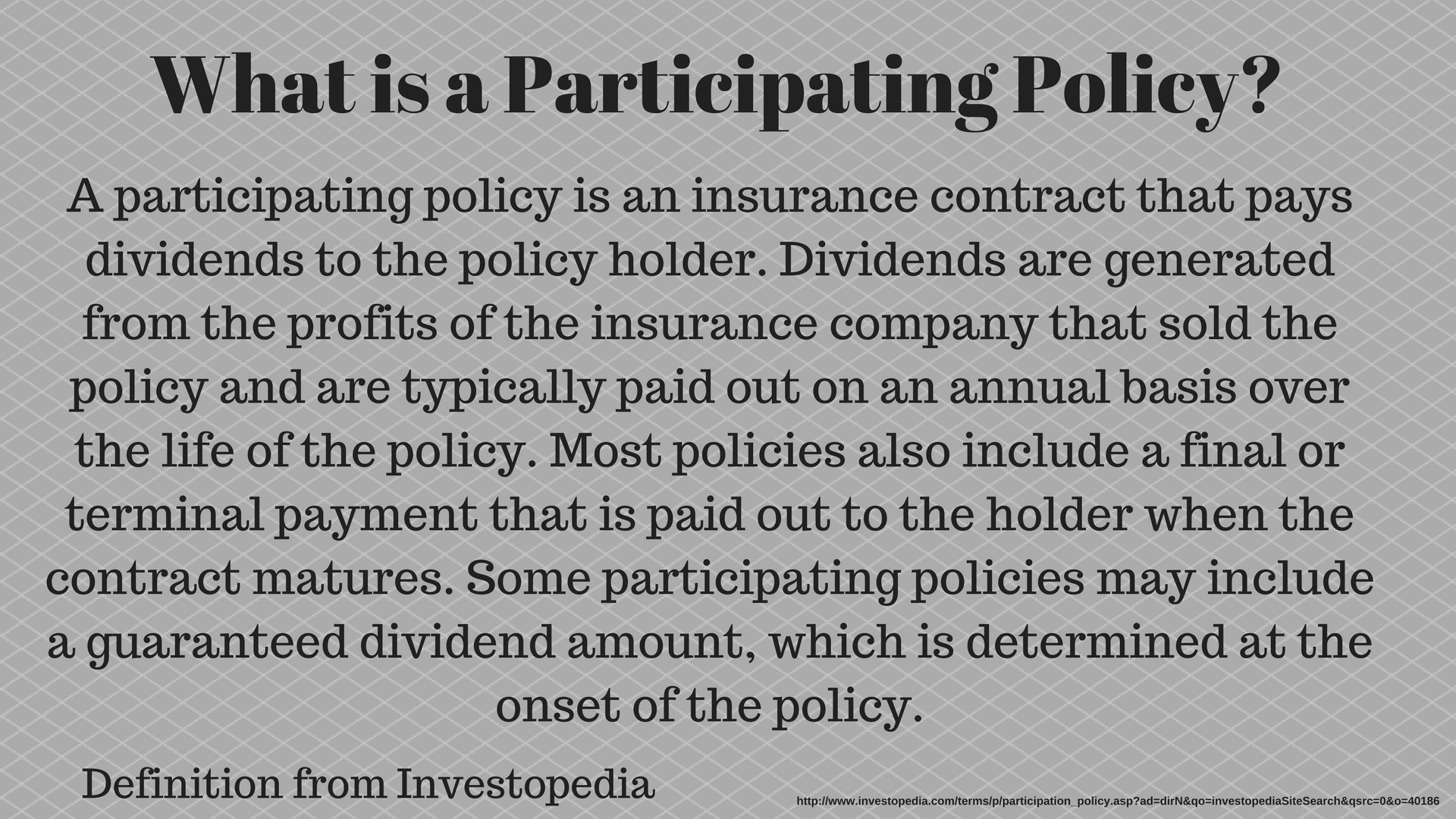
Participating whole life insurance is typically issued by mutual insurance companies. Under this model, the policyholder is considered a member or owner of the mutual company, granting them the right to participate in the financial performance of the insurer through annual dividends. These dividends are declared by the insurance company’s board of directors and are derived from divisible surplus earnings, which stem from three primary sources: mortality savings (fewer policyholders dying than expected), expense savings (operating costs running lower than anticipated), and investment gains (stronger-than-predicted returns on the insurer's general investment portfolio).
While dividends are never guaranteed by law or contract, many established mutual insurers have a long history of paying them consistently, even through economic downturns. When policyholders receive dividends, they usually have several flexible options for how to utilize them:
- Cash: Receive the dividend amount directly as a payout.
- Premium Reduction: Apply the dividend toward lowering the next premium payment due.
- Paid-Up Additions (PUAs): Use the dividend to purchase small amounts of additional paid-up permanent insurance, which increases both the total death benefit and the underlying cash value.
- Accumulation at Interest: Leave the dividend with the insurance company to earn a specified rate of interest, creating a side fund that can be accessed later.
What is Nonparticipating Whole Life Insurance?
Nonparticipating whole life insurance is typically offered by stock insurance companies, which are owned by shareholders rather than policyholders. As the name suggests, a nonparticipating policy does not give the owner a share in the divisible surplus or financial performance of the company. Consequently, these policies do not pay dividends.
Instead of dividend variability, nonparticipating whole life insurance relies entirely on fixed, contractually guaranteed values. The premiums, death benefit, and cash-value growth rate are established at the time of purchase and remain static for the life of the contract. This creates an environment of absolute certainty. The policyholder knows down to the penny how much their premium will be, what their cash value will grow to by a specific year, and what the final death benefit will be. This predictability makes nonparticipating whole life insurance a straightforward instrument for those who want fixed budgeting without any moving parts or reliance on insurer performance metrics.
Key Differences: Participating vs Nonparticipating Whole Life Insurance
Comparing the operational mechanics of both types of whole life insurance highlights fundamental distinctions in ownership, cost, risk distribution, and long-term potential. While both provide lifelong protection and guaranteed cash-value accumulation, the way they handle financial surpluses dictates their long-term trajectory.
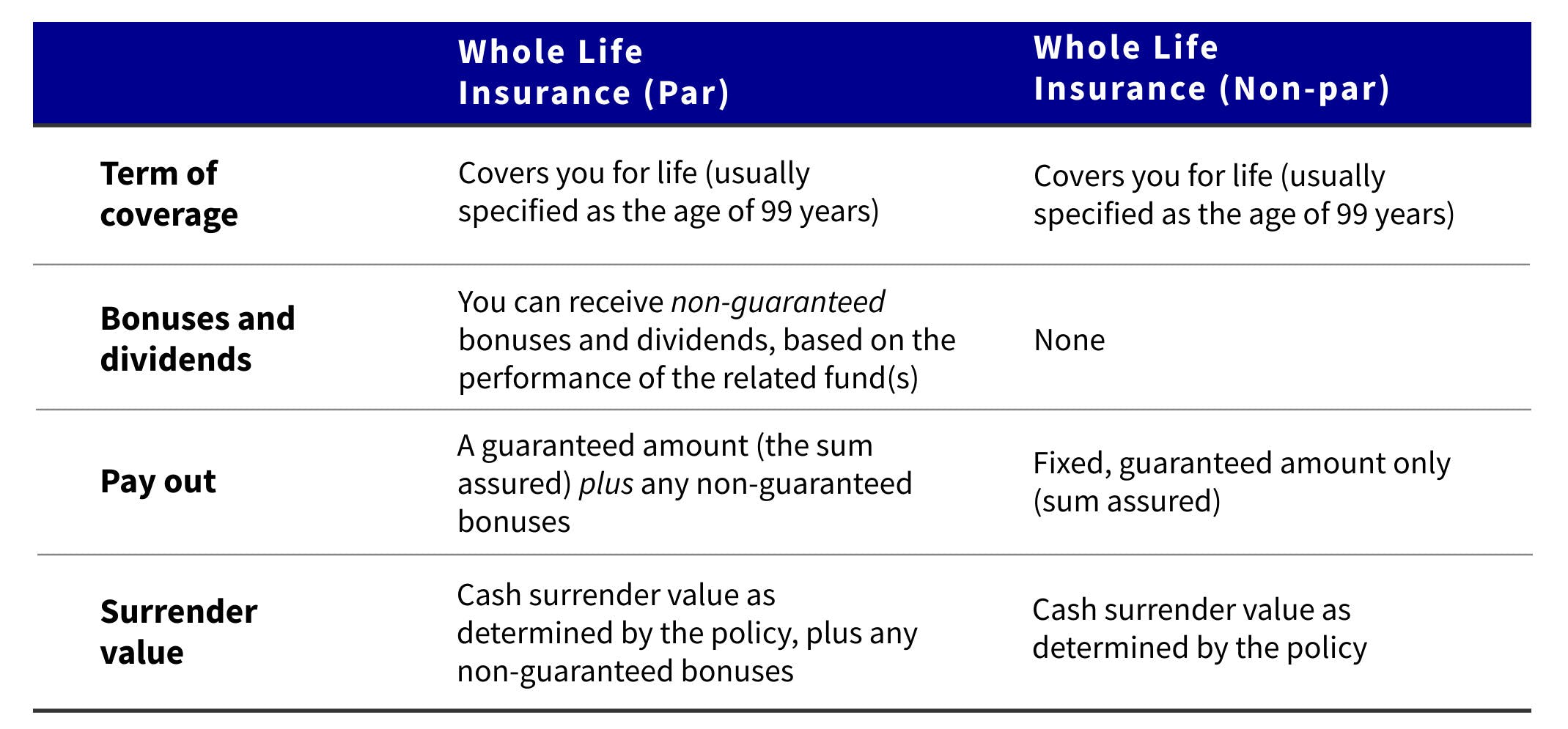
| Feature | Participating Whole Life Insurance | Nonparticipating Whole Life Insurance |
|---|---|---|
| Insurer Type | Mutual companies (owned by policyholders) | Stock companies (owned by shareholders) |
| Dividends | Eligible for annual, non-guaranteed dividends | No dividends paid |
| Cash Value Growth | Guaranteed minimum plus potential dividend additions | Strictly guaranteed baseline growth schedule |
| Initial Premium Cost | Generally higher due to built-in dividend margins | Often lower initially compared to participating peers |
| Flexibility | Multiple dividend options (PUAs, premium offsets) | Fixed and rigid structure with no options to alter performance |
The initial cost structure often surprises buyers. Because participating policies include conservative margins to safely account for economic fluctuations, their initial baseline premiums are frequently higher than those of nonparticipating policies with identical death benefits. However, if dividends are consistently earned and applied to purchase paid-up additions, a participating policy can eventually outpace a nonparticipating policy in both total cash value and total death benefit over a multi-decade horizon.
Evaluating Financial Goals and Risk Tolerance
Determining which policy fits your needs requires a careful assessment of your personal financial philosophy, time horizon, and risk tolerance. Financial products are rarely one-size-fits-all, and whole life insurance demands a long-term commitment that can span decades.
If your primary objective is absolute cost containment and mathematical certainty, a nonparticipating policy aligns well with your preferences. Because stock insurers do not factor dividend distribution cushions into the same operational style, the fixed premium may consume less of your immediate cash flow. This makes nonparticipating insurance attractive for business-owned life insurance (such as split-dollar arrangements or key-person coverage where exact, unfluctuating accounting figures are required) or for individuals on fixed retirement incomes who cannot absorb fluctuating premium offset strategies.
Conversely, if you view permanent life insurance as a long-term wealth accumulation vehicle and inflation hedge, participating whole life insurance offers greater upside potential. Although dividends are never guaranteed, the ability to compound wealth via paid-up additions allows the policy to grow more robustly over 20, 30, or 40 years. This growth potential helps offset long-term inflationary pressures on the death benefit and provides a larger pool of cash value for policy loans during retirement years.
Note: Permanent life insurance involves complex financial contracts with high initial costs and surrender charges during the early years of the policy. Consumers should consult with a licensed fiduciary, fee-only financial planner, or independent insurance advisor before committing to a permanent life insurance contract.
Common Mistakes to Avoid When Choosing
Navigating the permanent life insurance market can be challenging, and buyers frequently encounter pitfalls that compromise the long-term efficacy of their coverage. Avoiding these common errors ensures that the policy you purchase actually aligns with your stated objectives.
- Chasing Projected Dividend Scales: Some illustrations for participating policies show high historical dividend rates continuing indefinitely. Insurers are required to show alternate scales, including lower rates. Never rely on the highest projection column when making a purchasing decision; evaluate whether the guaranteed minimum values alone meet your threshold for security.
- Focusing Solely on Initial Price: Choosing a nonparticipating policy exclusively because its initial quote is lower than a participating competitor can shortchange your long-term growth. Failing to factor in how paid-up additions compound over decades can result in lower overall wealth accumulation.
- Treating Insurance as a Short-Term Investment: Whole life insurance incurs heavy administrative and distribution costs during the first several years. Surrendering a policy early almost always results in a financial loss. Ensure you have the financial stability to maintain premium payments for the long haul before entering into either contract.
- Neglecting Insurer Financial Strength: Because whole life contracts span decades, the financial stability and credit rating of the issuing company are paramount. Always verify the financial strength ratings of the insurer through independent rating agencies such as A.M. Best, Moody's, or Standard & Poor's.
Frequently Asked Questions
Can a participating whole life policy ever pay zero dividends?
Yes. Dividends are declared annually by the insurer’s board of directors based on actual economic experience. If investment returns are poor, mortality rates spike, or operating expenses increase significantly, the insurer may reduce dividends or declare zero dividends for that year. However, the guaranteed cash-value growth specified in the contract remains unaffected.
Are whole life insurance dividends taxable?
Generally, no. Dividends paid out by a life insurance policy are treated as a return of a portion of the premium you previously paid. Therefore, they are typically considered tax-free up to the total amount of premiums you have paid into the policy (known as the policy's cost basis). Once dividends exceed your total premium payments, any further distributions may become subject to taxation.
Can I switch from a nonparticipating policy to a participating policy later?
You cannot typically convert an existing nonparticipating policy into a participating policy within the same contract. Doing so would require surrendering or exchanging the existing policy (often via a 1035 exchange) for a new participating policy. This process requires going through a new underwriting evaluation, which means higher premiums due to advanced age or changes in health status.
Which type of policy provides a higher death benefit?
Over the long term, a participating policy has the potential to provide a higher death benefit if dividends are consistently used to purchase paid-up additions. However, a nonparticipating policy provides a fixed, guaranteed death benefit that will not fluctuate based on company performance, ensuring predictability from day one.
Do mutual insurance companies always outperform stock insurance companies?
Not necessarily. While many prominent mutual insurers have historical track records of strong financial performance and consistent dividend distribution, individual company management, investment strategies, and underwriting discipline dictate performance. Stock companies can also offer highly competitive guaranteed products that outperform poorly managed mutual insurers.
Next Steps for Buyers
Selecting the right whole life insurance policy requires balancing the absolute certainty of nonparticipating contracts against the long-term growth potential of participating policies. To move forward effectively, request detailed, side-by-side policy illustrations from an independent insurance broker who represents multiple mutual and stock carriers. Review the guaranteed columns, examine the insurer's historical dividend performance and credit ratings, and align the cost structure with your household or business budget before signing any contract.
Image Gallery