What Defines Energy in Physics: The Fundamental Capacity for Work and Transformation
In physics, energy is defined as the scalar quantitative property transferred to a body or physical system to perform work on it or to heat it. It measures a system's capacity to induce physical changes or cause motion, governed strict...
In physics, energy is defined as the scalar quantitative property transferred to a body or physical system to perform work on it or to heat it. It measures a system's capacity to induce physical changes or cause motion, governed strictly by conservation laws that dictate energy cannot be created or destroyed, only transformed.
Contents
The Classical Definition of Energy: Work, Forces, and Displacement
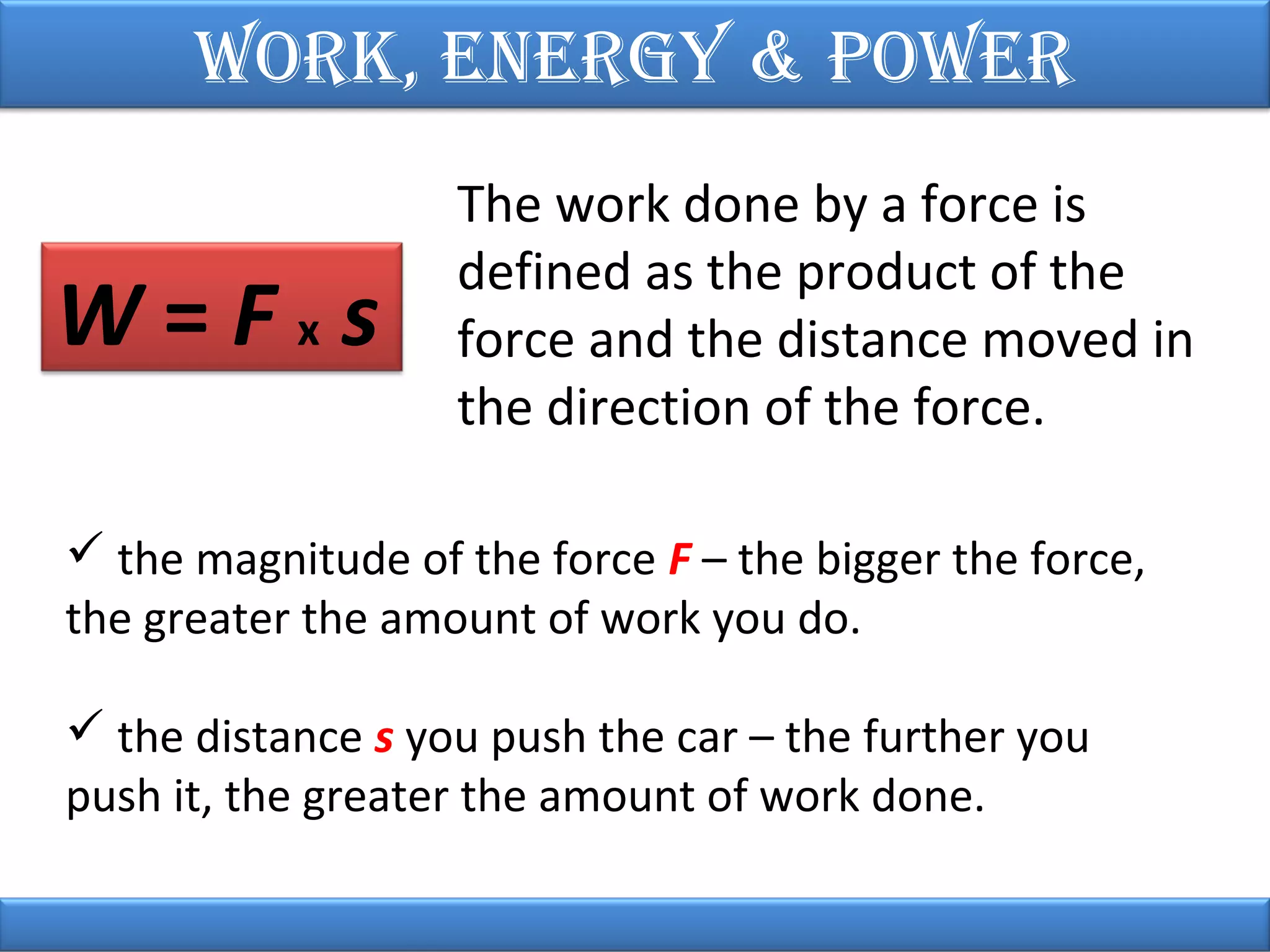
At its foundational level in classical mechanics, energy is intrinsically linked to the concept of mechanical work. Work occurs whenever a force acts upon an object over a distance. Therefore, energy is operationalized as the capacity to exert a force across a displacement.
Mathematically, when a constant force vector $\mathbf{F}$ acts on an object, causing a displacement vector $\mathbf{d}$, the work $W$ performed on the system is expressed by the dot product:
$$W = \mathbf{F} \cdot \mathbf{d} = |\mathbf{F}| |\mathbf{d}| \cos(\theta)$$
where $\theta$ represents the angle between the force vector and the direction of movement. Because work is defined as energy transferred by a force, work and energy share identical physical dimensions and units of measurement.
In the International System of Units (SI), the derived unit for both work and energy is the Joule (J). One joule represents the quantity of work completed when a force of one newton moves an object through a distance of one meter ($1\text{ J} = 1\text{ N}\cdot\text{m} = 1\text{ kg}\cdot\text{m}^2/\text{s}^2$).
Unlike vector quantities such as velocity or force, which require both magnitude and direction, energy is a scalar quantity. A system possesses a total amount of energy, but that energy does not point toward a specific spatial coordinate. Whether considering a falling weight, a hot engine, or a charged capacitor, the scalar nature of energy allows physicists to sum diverse physical phenomena into a single unified accounting balance for any isolated system.
Time Translation Symmetry: Noether’s Theorem and Energy Conservation
While early physics defined energy purely through mechanical interactions, modern theoretical physics anchors the definition of energy in fundamental symmetry principles. The law of conservation of energy—stating that the total energy of an isolated system remains constant over time—is not merely an empirical observation; it is a mathematical consequence of nature's structural geometry.
In 1915, mathematician Emmy Noether proved a seminal theorem establishing that every differentiable symmetry of the action of a physical system corresponds to a conserved quantity. Energy conservation arises specifically from time translation symmetry.
- Time Translation Invariance (Laws of Physics do not change over time)
- Noether's Theorem Applied to Time Dimension
- Conserved Quantity: Energy (E)
Time translation symmetry means that the fundamental laws of physics are invariant under shift in time: an experiment conducted today under specific initial conditions yields the exact same basic physical result as the identical experiment conducted tomorrow or a century ago.
When the equations governing a physical system exhibit continuous invariance with respect to time, the system's total Hamiltonian—representing its total energy—must remain constant throughout its evolution. This insight elevated energy from an empirical bookkeeping parameter to a primary geometric property of spacetime dynamics. If time invariance holds, energy cannot be spontaneously generated or annihilated.
Primary Classifications and Formulations of Energy
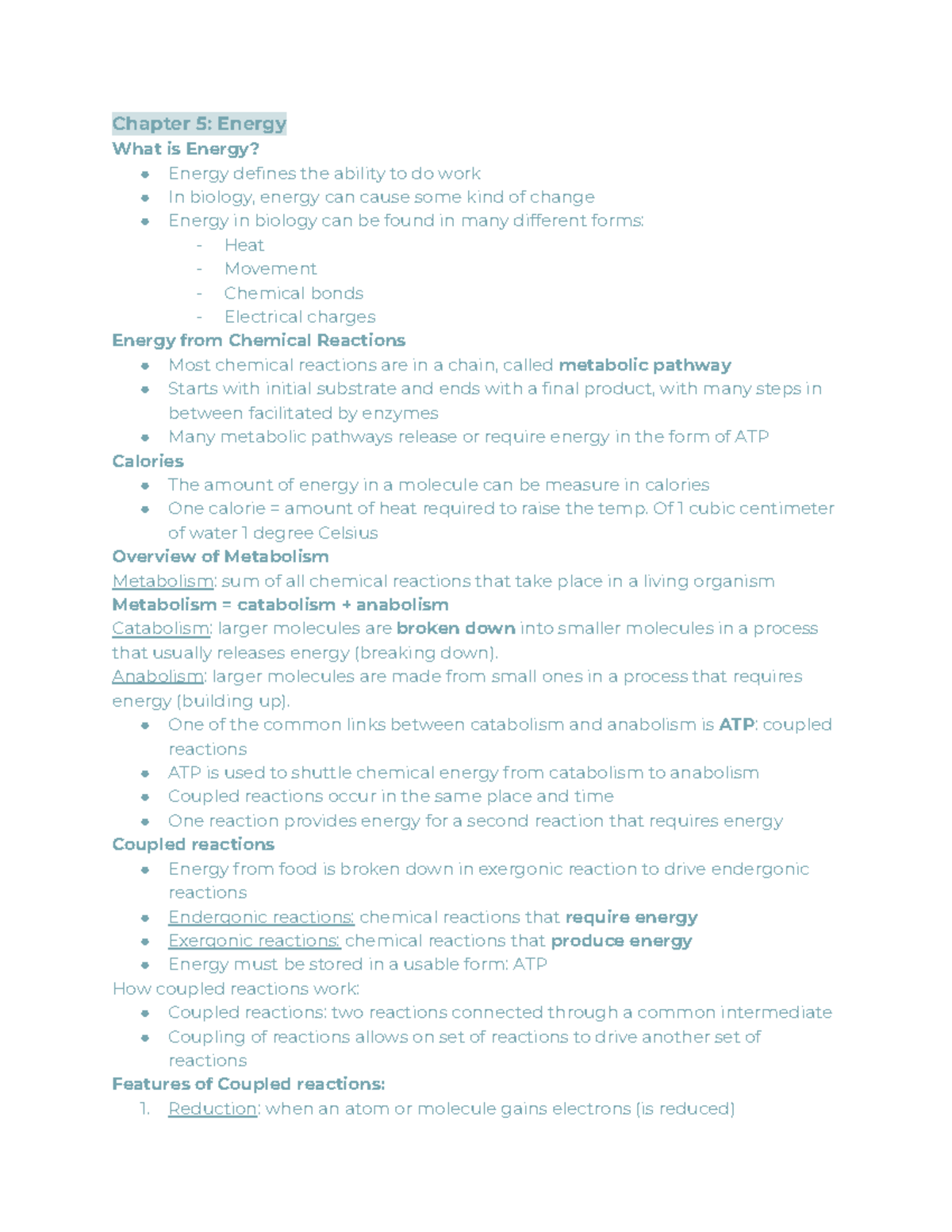
Energy presents itself across numerous manifestations, yet all forms fit into two foundational states: kinetic energy (the energy of motion) and potential energy (the energy of position or configuration within a field).
Kinetic Energy
Kinetic energy ($E_k$) is the energy possessed by an object due to its motion. For a non-relativistic point mass $m$ moving at velocity $v$, classical mechanics expresses kinetic energy as:
$$E_k = \frac{1}{2}m v^2$$
In rotational dynamics, kinetic energy takes the form $E_{k,\text{rot}} = \frac{1}{2}I\omega^2$, where $I$ is the moment of inertia and $\omega$ is the angular velocity.
Potential Energy
Potential energy ($E_p$) is stored energy dependent on the relative positions of interacting entities within a force field. Common forms include:
- Gravitational Potential Energy: $E_p = mgh$ near Earth's surface, or $U = -G\frac{m_1 m_2}{r}$ for celestial interactions.
- Elastic Potential Energy: $E_p = \frac{1}{2}k x^2$, describing energy stored in a spring compressed or stretched by distance $x$ with spring constant $k$.
- Electrostatic Potential Energy: Energy resulting from the positions of electrically charged particles within an electric field, governed by Coulomb's Law.
Thermodynamic and Internal Energy
In macroscopic systems containing trillions of atoms, physicists define internal energy ($U$), which sums all microscopic kinetic energy (thermal vibration and translation of molecules) and microscopic potential energy (intermolecular bonding forces). The First Law of Thermodynamics formalizes energy conservation for thermal processes:
$$\Delta U = Q - W$$
Here, $\Delta U$ is the change in internal energy, $Q$ represents net heat added to the system, and $W$ is the work performed by the system on its environment.
| Energy Form | Primary Physical Mechanism | Standard Mathematical Formulation | Key Physical Variables |
|---|---|---|---|
| Translational Kinetic | Mass in linear movement | $E_k = \frac{1}{2}m v^2$ | Mass ($m$), Velocity ($v$) |
| Gravitational Potential | Position within a gravitational field | $E_p = mgh$ | Mass ($m$), Field strength ($g$), Height ($h$) |
| Elastic Potential | Deformation of elastic material | $E_p = \frac{1}{2}k x^2$ | Spring constant ($k$), Displacement ($x$) |
| Electrostatic | Arrangement of electric charges | $U_e = \frac{1}{4\pi\varepsilon_0} \frac{q_1 q_2}{r}$ | Charges ($q_1, q_2$), Separation distance ($r$) |
| Radiative (Photon) | Oscillating electromagnetic field | $E = h\nu$ | Planck's constant ($h$), Frequency ($\nu$) |
| Rest-Mass Energy | Intrinsic energy of invariant mass | $E_0 = m c^2$ | Invariant mass ($m$), Speed of light ($c$) |
Energy in Relativity and Quantum Mechanics
As physics advanced beyond Newtonian mechanics, definitions of energy expanded to accommodate high velocities, gravitational fields, and subatomic scales.
Special and General Relativity
In Albert Einstein’s theory of Special Relativity, energy and mass are not distinct physical entities; rather, mass is a concentrated form of energy. The relation between total energy ($E$), momentum ($p$), and rest mass ($m$) is captured by the relativistic energy-momentum dispersion relation:
$$E^2 = (pc)^2 + (m c^2)^2$$
For an object at rest ($p = 0$), this simplifies to the famous equivalence statement:
$$E_0 = m c^2$$
This relation demonstrates that even stationary matter possesses intrinsic rest-mass energy. In General Relativity, energy and momentum act as the physical sources that curve spacetime itself. The distribution of energy and momentum is encoded mathematically within the stress-energy tensor ($T_{\mu\nu}$), which serves as the primary source term in Einstein's field equations.
Quantum Physics
In quantum mechanics, energy is quantized—meaning it often exists in discrete wave-packets or levels rather than a continuous spectrum. Energy corresponds to the eigenvalues of the Hamiltonian operator ($\hat{H}$) acting on a system's state vector $|\Psi\rangle$, expressed in the time-independent Schrödinger equation:
$$\hat{H}|\Psi\rangle = E|\Psi\rangle$$
Furthermore, quantum field theory and quantum optics demonstrate that light energy is carried by localized quanta called photons. The energy of a single photon depends directly on its electromagnetic frequency $\nu$:
$$E = h\nu = \frac{hc}{\lambda}$$
Even in absolute zero temperature states where classical systems would lack kinetic motion, quantum systems retain zero-point energy, a minimal residual energy dictated by the Heisenberg Uncertainty Principle.
Distinguishing Energy from Power, Force, and Entropy
To accurately evaluate physical systems, energy must be kept distinct from closely related physical quantities.
| Quantity | Definition / Meaning |
|---|---|
| Force | A push or pull vector (Newtons) |
| Work | Energy transferred by a force (Joules) |
| Energy | Stored capacity to perform work (Joules) |
| Power | Rate of energy transfer (Watts = J/s) |
- Energy vs. Force: A force is a vector quantity describing an interaction (a push or a pull measured in Newtons). Energy is a scalar quantity measuring the accumulated capacity to do work (measured in Joules). Sustaining a static force against an unyielding wall transfers zero energy because no spatial displacement occurs ($W = 0$).
- Energy vs. Power: Power is the instantaneous time rate at which energy is transferred, converted, or consumed. While energy is measured in Joules, power is measured in Watts (W), where $1\text{ W} = 1\text{ Joule per second}$. A 100-watt lightbulb does not represent a quantity of energy, but rather an energy consumption rate of 100 Joules every second.
- Energy vs. Entropy: While energy measures quantity, entropy measures the microscopic dispersion or quality of that energy. According to the Second Law of Thermodynamics, while total energy remains strictly conserved during natural processes, usable energy degrades over time as entropy increases, diminishing the system's capacity to perform useful work.
Frequently Asked Questions
Can energy ever be created or destroyed?
No. The First Law of Thermodynamics and Noether’s Theorem state that total energy in an isolated system is strictly conserved. Energy continually changes forms—such as chemical energy converting into thermal energy and kinetic work—but the total sum of energy remains constant.
What is the difference between kinetic energy and potential energy?
Kinetic energy is the energy an object possesses due to its physical movement or rotation. Potential energy is stored energy resulting from an object’s spatial position, structural configuration, or state within a force field (such as a gravitational, electrostatic, or magnetic field).
Is energy a physical substance?
No, energy is not a physical substance, fluid, or tangible material entity. It is an abstract, quantifiable scalar property and mathematical attribute of physical systems that quantifies their state, motion, interactions, and capacity to perform work.
How does Einstein's $E=mc^2$ equation define energy?
Einstein’s equation defines mass as a highly concentrated form of energy. It shows that mass can be converted into kinetic or radiative energy (as seen in nuclear fission and fusion processes) and that an object's relativistic mass increases as its energy content grows.
What unit is used to measure energy?
The standard International System of Units (SI) measure for energy is the Joule (J). Alternative units used in specialized contexts include the kilowatt-hour (kWh) for electrical usage, the electronvolt (eV) for atomic and subatomic physics, and the calorie (cal) for thermal and metabolic processes.
Practical Takeaways and Next Steps
To apply energy principles effectively in scientific calculation, engineering, or conceptual physics, follow these fundamental analytical steps:
- Define System Boundaries Clearly: Before writing energy equations, state whether the target physical system is open (exchanges mass and energy), closed (exchanges energy only), or isolated (exchanges neither mass nor energy).
- Establish Reference Frame and Zero Levels: Because potential energy is calculated relative to a reference position, explicitly establish your zero-potential baseline ($E_p = 0$) at the start of your calculation.
- Apply Energy Balance Equations: Use conservation laws to equate initial total energy to final total energy plus losses: $$E_{\text{initial}} + W_{\text{in}} = E_{\text{final}} + E_{\text{dissipated}}$$
- Verify Dimensional Consistency: Ensure all terms match in unit dimensions. Convert non-SI values (such as calories, electronvolts, or British thermal units) to Joules prior to executing complex multi-domain evaluations. For standardized guidelines on measurements and constants, refer to standards provided by organizations such as the National Institute of Standards and Technology (NIST).
Image Gallery