Understanding Counter-Strike Ranks: A Comprehensive Guide to CS2 Matchmaking Systems
In Counter-Strike 2 (CS2), ranks are divided into two primary systems: the numerical CS Rating used in Premier Mode and the traditional Skill Groups (Silver to Global Elite) used in map-specific Competitive Mode. These systems measure...
In Counter-Strike 2 (CS2), ranks are divided into two primary systems: the numerical CS Rating used in Premier Mode and the traditional Skill Groups (Silver to Global Elite) used in map-specific Competitive Mode. These systems measure player proficiency, determine matchmaking balance, and provide a structured path for competitive progression.
Contents
The transition from Counter-Strike: Global Offensive (CS:GO) to Counter-Strike 2 introduced a fundamental shift in how Valve quantifies player skill. While the iconic rank icons still exist, the centerpiece of the modern competitive experience is the CS Rating—a precise, transparent numerical value that places players on global and regional leaderboards. Understanding these systems is essential for any player looking to navigate the tactical landscape of CS2 in 2026.
The Prerequisite: Prime Status and Calibration
Before a player can earn a rank or rating, they must possess Prime Status. This is a one-time account upgrade that serves as a barrier against cheating and smurfing. Players with Prime Status are matched exclusively with other Prime players, ensuring a higher level of competitive integrity.
To "reveal" your rank in any mode, you must undergo a calibration period. In Premier Mode, this requires winning 10 placement matches. In the standard Competitive Mode, you must win 10 matches on a specific map to receive a rank for that individual map. During this calibration phase, the system uses a hidden Matchmaking Rating (MMR) to test you against various skill levels, adjusting your potential starting point based on your win-loss ratio and the caliber of your opponents.
CS Rating: The Premier Mode System
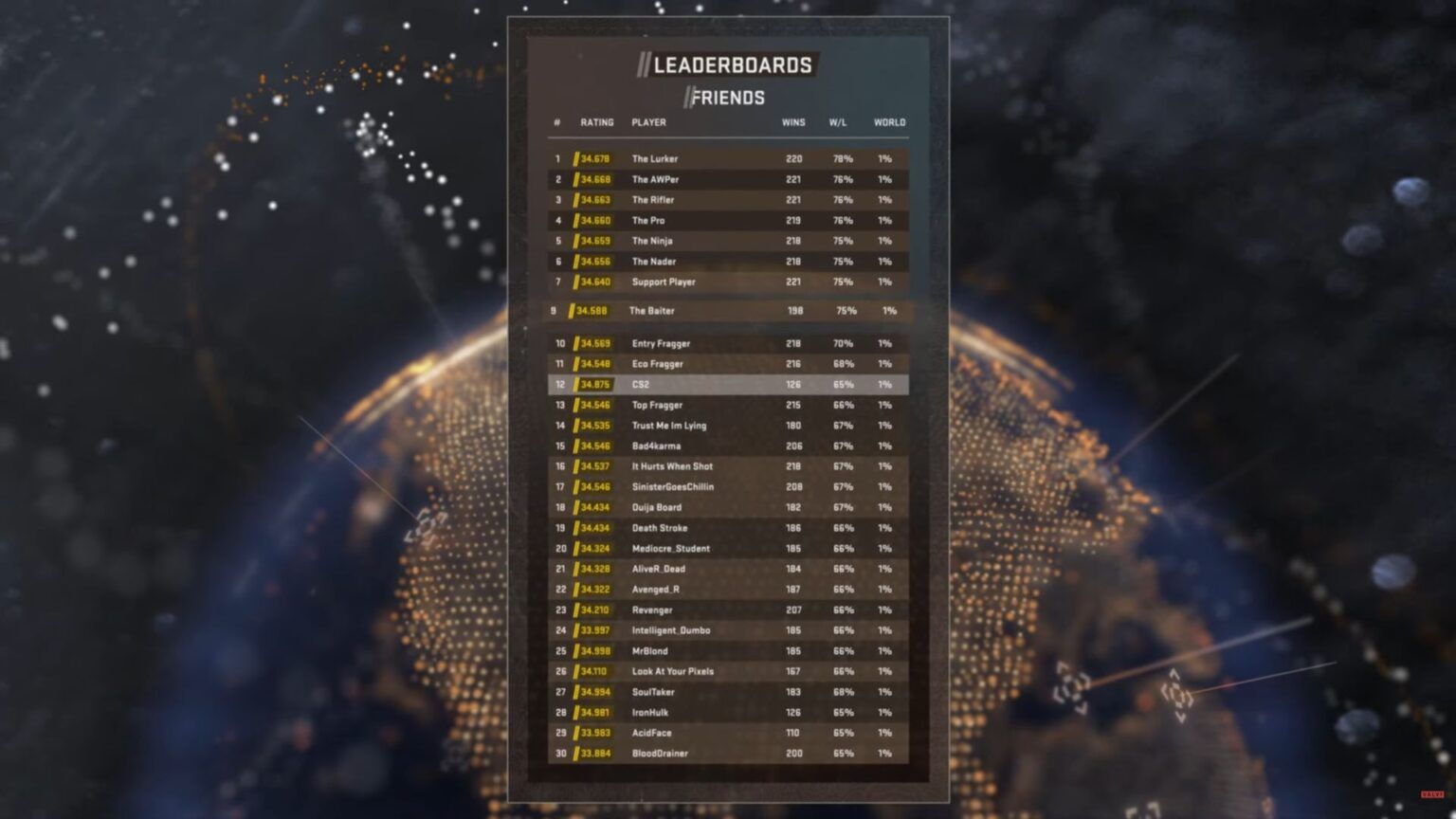
Premier Mode is the flagship competitive environment in CS2. It utilizes a "Pick-Ban" phase for maps, similar to professional tournaments, and uses the CS Rating to track progress. Unlike the opaque ranking systems of the past, CS Rating is a visible number ranging from 0 to over 35,000.
The Color-Coded Tiers
The CS Rating is divided into seven distinct color tiers, each representing a specific skill bracket. These tiers allow players to quickly gauge the general skill level of their teammates and enemies.
- 0 – 4,999 (Grey): This bracket includes beginners and those still learning the fundamental mechanics of utility usage and movement.
- 5,000 – 9,999 (Light Blue): Players here typically have a basic grasp of aim and common map callouts but may struggle with consistency.
- 10,000 – 14,999 (Blue): This represents the "average" to "above-average" player base. Tactical execution becomes more prevalent here.
- 15,000 – 19,999 (Purple): At this level, players exhibit strong mechanical skills and a deeper understanding of economy management.
- 20,000 – 24,999 (Pink): This tier is reserved for highly skilled players who often play in coordinated stacks and understand advanced set-pieces.
- 25,000 – 29,999 (Red): These players are among the top 1% of the population, often bordering on semi-professional skill levels.
- 30,000+ (Gold): The elite tier. This bracket is populated by professional players, high-level streamers, and the top performers on the global leaderboard.
How Points Are Calculated
In Premier Mode, the amount of CS Rating gained or lost is determined before the match begins. When you press "Tab" during a match, you can see the stakes. If the system perceives your team as the underdog, you may stand to gain 300+ points for a win while losing only 100 for a loss. Conversely, if you are the favorite, the risk-reward ratio flips.
A critical mechanic in this system is the Promotion and Relegation match. These occur at every 5,000-point interval. For example, if you are at 14,999 points, your next game is a "Promotion Match." You must win to break into the 15,000+ Purple tier. If you lose, you remain in the Blue tier and must win again to earn another shot at promotion.
Competitive Skill Groups: Map-Specific Ranking
The traditional Skill Groups—ranging from Silver I to The Global Elite—still exist in CS2, but their implementation has changed significantly from the CS:GO era. They are now map-specific. This means you can be a "Global Elite" on Mirage while being a "Gold Nova III" on Nuke.
The Standard Rank Hierarchy
The hierarchy remains familiar to long-time players, divided into four main clusters:
- Silver (Silver I to Silver Elite Master): The entry-level ranks where players focus on learning the core "stop-and-shoot" mechanics.
- Gold Nova (Gold Nova I to Gold Nova Master): The mid-tier where most of the active player base resides. Here, players start to learn specific smoke lineups and flashbang timings.
- Master Guardian (MG1, MG2, MGE, DMG): The "advanced" tier. Aim becomes significantly more lethal, and mistakes are punished more frequently.
- Elite Ranks (LE, LEM, Supreme, Global Elite): The highest traditional ranks. Achieving Global Elite on a map signifies a complete mastery of its timings, angles, and strategies.
This map-specific approach was designed to encourage players to broaden their map pool without fear of losing their "main" rank on their favorite map. It also helps the matchmaking system prevent "one-map wonders" from being overwhelmed when playing a less familiar environment.
The Underlying Mechanics: MMR and Trust Factor
While the CS Rating and Skill Groups are what players see, the matchmaking engine relies on two hidden components: MMR (Matchmaking Rating) and Trust Factor.
Matchmaking Rating (MMR)
MMR is a hidden numerical value that represents the system's "true" confidence in your skill. In Premier Mode, your CS Rating usually tracks closely with your MMR. However, if you go on a massive winning streak, your MMR might climb faster than your visible rating, leading the system to award you more points per win to "pull" your rating up to your actual skill level.
Trust Factor
Trust Factor is a backend system that evaluates the "health" of your account. Factors including account age, hours played in various games, frequency of being reported for griefing or cheating, and your interactions with the Steam community all influence this score. Players with a "Green" Trust Factor will rarely encounter cheaters or toxic players, whereas a "Red" Trust Factor often results in a poor matchmaking experience.
Third-Party Ranking Systems (Faceit)
Despite the robustness of the in-game Premier system, many high-level players and aspiring professionals in 2026 still utilize third-party platforms like Faceit. Faceit uses its own proprietary ranking system, primarily centered around "Elo" points and Levels 1 through 10.
- Levels 1–3: Comparable to Silver and Gold Nova.
- Levels 4–7: Comparable to Master Guardian and Legendary Eagle.
- Levels 8–10: Comparable to Global Elite and high-tier Premier (20k+).
- Faceit Challenger/FPL: The "Faceit Pro League" is where professional players compete for prize pools and scouting opportunities.
Faceit is often preferred by the hardcore community due to its more aggressive anti-cheat measures and the use of 128-tick (or equivalent sub-tick optimized) servers, which some players feel provide a more responsive experience than the standard Valve servers.
Comparison of Counter-Strike Ranking Systems
The following table compares the three primary ways players are categorized in the CS2 ecosystem.
| Feature | Premier Mode (CS Rating) | Competitive Mode (Skill Groups) | Faceit (Elo/Level) |
|---|---|---|---|
| Measurement | Numerical (0 – 35,000+) | Visual Icons (Silver to Global) | Levels 1 – 10 / Elo |
| Scope | Global/Regional Leaderboards | Individual Map Mastery | Third-party Platform |
| Map Selection | Active Duty Pick/Ban | User-selected | Platform Queue / Veto |
| Visibility | Fully Transparent Points | Hidden (Only Icons shown) | Fully Transparent Elo |
| Primary Audience | Competitive/Serious Players | Casual Competitive/Practice | Semi-pro / Professional |
| Ranking Update | Every Match | Periodic (Based on Wins/Performance) | Every Match |
How to Rank Up: Strategies for 2026
Climbing the ranks in Counter-Strike is not solely about "aiming better." It is a combination of mechanical skill, tactical knowledge, and mental fortitude.
- Utility Mastery: In the current meta, "winging it" with utility is no longer viable. Players in the 15,000+ CS Rating range are expected to know "God Flashes" and essential smokes for every site.
- Economy Management: Understanding when to "save" (Eco), when to "Force Buy," and when a "Full Buy" is necessary is the difference between winning a half and being steamrolled.
- Communication: CS2 is a team game. Accurate, concise callouts are more valuable than a high kill count. Use your microphone to relay enemy positions, health, and utility usage.
- Specialization vs. Generalization: For map-specific ranks, focus on mastering one map at a time. For Premier, ensure you have at least 4-5 maps where you feel comfortable, as the ban phase might force you off your favorite map.
Frequently Asked Questions
Why did I lose more points than I gained in Premier?
The system believes your team was the favorite to win based on the average CS Rating of both teams. If the system expects you to win and you lose, the penalty is harsher. Additionally, if you are on a losing streak, the system may increase the points lost to help you reach your "correct" skill bracket faster.
Can my rank expire?
Yes. If you are inactive for an extended period (typically 28 days), your rank or CS Rating will become hidden. You will need to win one match to recalibrate. During this time, your rank may "decay" slightly, meaning you might return at a lower tier than where you left.
Does individual performance (K/D ratio) affect my rank?
In Premier Mode, the primary factor for rating change is the win or loss. However, hidden MMR in both Competitive and Premier modes does take individual impact into account to a degree, especially during placement matches. Consistently being the "MVP" can help the system identify you as a high-impact player, potentially leading to higher point gains during win streaks.
What is the "Red" tier in Premier?
The Red tier represents players with a CS Rating between 25,000 and 29,999. These players are effectively the "Global Elites" of the Premier system. Breaking into the Gold tier (30,000+) usually requires consistent performance against professional-level opposition.
Is the Skill Group system still relevant?
While Premier is the "official" competitive mode, Skill Groups are vital for practice. Many players use Competitive Mode to learn new maps or test new strategies in a ranked environment that is less high-stakes than Premier.
Practical Recommendation
If you are a new or returning player, start with the map-specific Competitive Mode. Select one or two maps (like Mirage or Dust II) and play until you earn a rank. This allows you to learn the flow of the game without the pressure of the Global Leaderboard. Once you feel confident in your utility and aim, move to Premier Mode to test yourself against the broader community. For those aiming for a professional career, consistent play on Faceit remains the gold standard for visibility in the esports scene.
Image Gallery