The Mystery and Legacy of Jesse James’s Coffin: History, Exhumation, and Truth
Jesse James was originally buried in 1882 in an expensive, state-of-the-art metallic coffin on his family’s farm in Kearney, Missouri. To prevent grave robbery and verify his identity against historical impostors, his remains were rein...
Jesse James was originally buried in 1882 in an expensive, state-of-the-art metallic coffin on his family’s farm in Kearney, Missouri. To prevent grave robbery and verify his identity against historical impostors, his remains were reinterred in 1902 and later exhumed in 1995 for definitive mitochondrial DNA testing, confirming his death and the authenticity of his remains.
Contents
For over a century, the final resting place and the physical contents of Jesse James’s coffin were subjects of intense speculation, conspiracy theories, and Western folklore. The story of his burial is not merely a post-script to a life of crime; it is a complex narrative involving 19th-century funerary technology, desperate family security measures, and modern forensic science. As of 2026, the site of his burial remains one of the most visited historical landmarks in the American Midwest, serving as a testament to the enduring fascination with the James-Younger Gang.
The Death of Jesse James and the 1882 Funeral
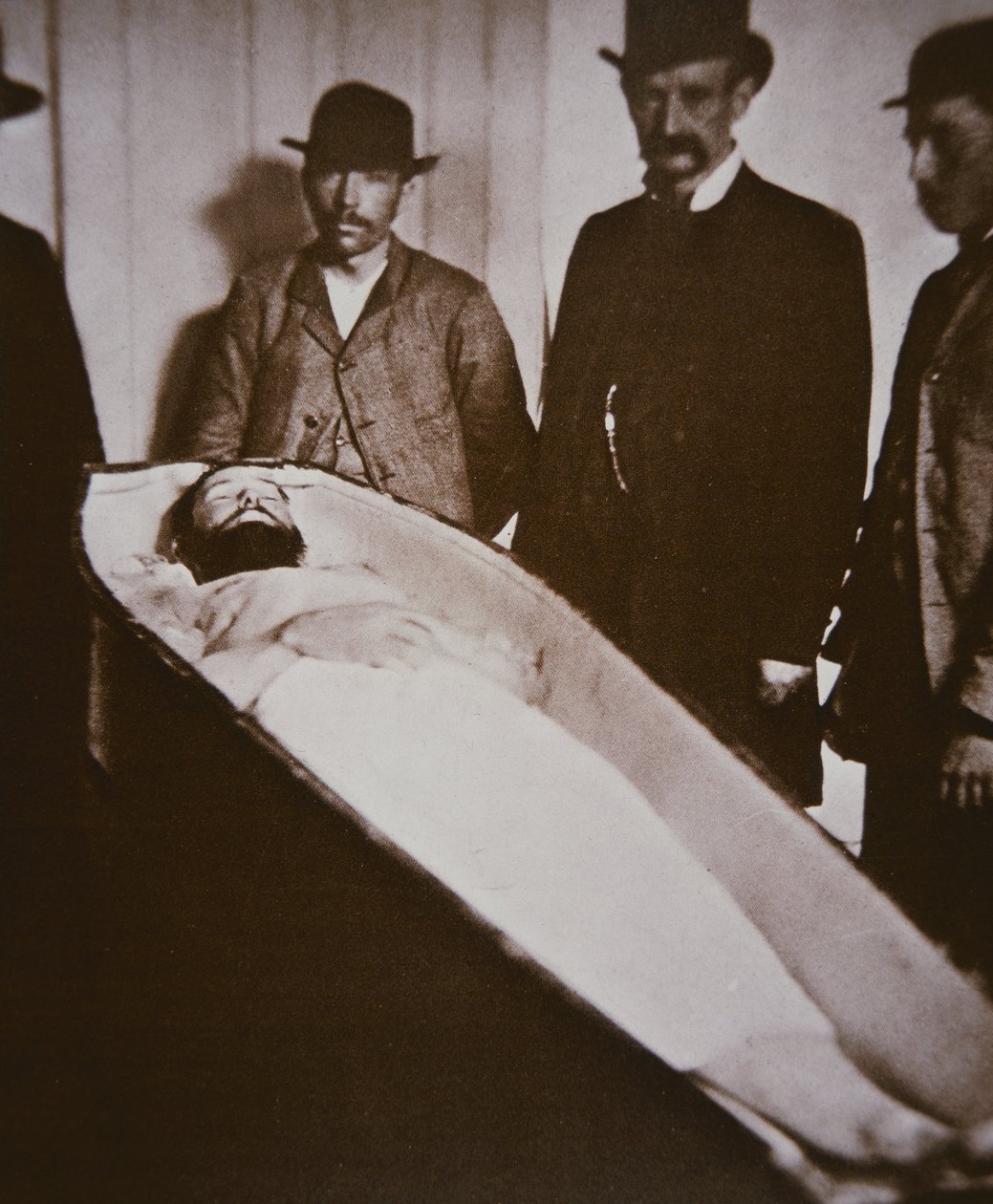
The story of Jesse James’s coffin begins on April 3, 1882, in St. Joseph, Missouri. Living under the alias "Thomas Howard," the most wanted man in America was shot in the back of the head by Robert Ford, a new recruit to his gang who had conspired with Missouri Governor Thomas T. Crittenden for the bounty.
The assassination immediately transformed the outlaw into a folk hero for many Southerners, and his funeral was a massive public event. His mother, Zerelda James, and his wife, Zee, were terrified that bounty hunters or "resurrectionists" (grave robbers) would steal Jesse’s body to put it on display or sell his skull. This fear dictated the high-quality selection of his first coffin and the unusual location of his first grave.
The Original 1882 Metallic Coffin
In the late 19th century, burial technology was evolving. The family chose a high-end, silver-trimmed, metallic burial case for Jesse. This was not a standard wooden "pine box." It was an expensive investment, costing approximately $500 in 1882—a small fortune at the time.
Metallic coffins, often referred to as "Fisk" style or airtight cases, were designed to preserve the body and prevent "miasma" or odors. For the James family, the metal construction offered a more practical benefit: security. It was far more difficult to break into or move than a wooden casket. The coffin featured a glass viewing plate over the face, allowing mourners to see the deceased without exposing the body to the air.
Protecting the Outlaw: The Yard Burial
Jesse James was not initially buried in a public cemetery. Following the funeral service at the Mount Olive Baptist Church, his body was taken to the James family farm in Kearney. Zerelda James insisted that he be buried in the front yard, specifically under a large coffee bean tree, within sight of the house's windows.
This decision was purely tactical. Zerelda frequently sat on her porch with a shotgun to deter anyone attempting to tamper with the grave. Over the following two decades, she turned the grave into a morbidly successful tourist attraction. She charged visitors 25 cents for a pebble from the grave and told stories of her son’s "martyrdom." Because the "original" pebbles were constantly being sold, she frequently replenished the grave site with new gravel from a nearby creek, essentially selling thousands of "authentic" relics.
The 1902 Reinterment at Mount Olivet Cemetery
By 1902, Zerelda James was aging, and Jesse’s wife, Zee, had already passed away (buried in Kansas City). The family decided it was time to move Jesse’s remains to a formal cemetery where he could be buried alongside his wife.
When the body was disinterred from the farmhouse yard in 1902, the metallic coffin showed signs of wear, but the remains were still largely intact. The body was moved to Mount Olivet Cemetery in Kearney, Missouri. At this stage, the original metallic coffin was placed inside a new, larger container for the reburial. This 1902 move was documented by local witnesses, yet it did not stop the growing rumors that the man killed in 1882 was actually a "stand-in" named Charlie Bigelow, and that the real Jesse James had escaped to live a long life elsewhere.
The 1995 Exhumation: Science vs. Folklore
The most significant event in the history of Jesse James’s coffin occurred in 1995. For decades, men like J. Frank Dalton claimed to be the real Jesse James, asserting that the body in the Kearney grave was a hoax. To settle the matter, a team of forensic scientists led by Professor James Starrs of George Washington University received permission from the James descendants to exhume the body.
Forensic Findings and State of the Remains
When the team reached the 1995 burial depth, they found that the original 1882 metallic coffin had largely succumbed to the pressure of the earth and the passage of time. The glass viewing plate had shattered, and the metal had rusted through in several places. However, the forensic team was able to recover:
- A significant portion of the skull, including the teeth.
- Hair samples.
- Two large thigh bones (femurs).
- Small fragments of the original metallic coffin handles.
The most critical find was the teeth and hair. Scientists extracted mitochondrial DNA (mtDNA) from these remains and compared it with DNA from modern-day descendants of Jesse’s sister, Susan James.
The DNA Confirmation
In 1995, the results were definitive. The mtDNA from the remains in the coffin matched the James family line with a 99.7% certainty. Furthermore, the skull showed evidence of the gunshot wound behind the right ear, consistent with the historical account of Robert Ford’s shot. This discovery effectively ended the legitimate historical debate regarding whether Jesse James had faked his death.
| Feature | 1882 Burial Details | 1902 Reinterment Details | 1995 Exhumation Findings |
|---|---|---|---|
| Location | James Farm Yard, Kearney, MO | Mount Olivet Cemetery, Kearney, MO | Mount Olivet Cemetery (Temporary) |
| Coffin Type | Ornate Metallic Burial Case | Original inside a new wooden box | Deteriorated metal and wood fragments |
| Security | Guarded by Zerelda James | Standard cemetery plot | Scientific observation/Armed guard |
| Condition | Intact, Viewable glass plate | Partially oxidized | Significant decay; skeletal remains only |
| Key Outcome | Initial preservation and protection | Consolidation of family remains | DNA verification of identity |
Condition of the Grave and Artifacts in 2026
As of 2026, the remains of Jesse James reside in a third coffin—a modern, secure vault within Mount Olivet Cemetery. The site remains a focal point for historians and true crime enthusiasts. While the actual remains are interred, several museums in Missouri, including the Jesse James Bank Museum and the Jesse James Farm & Museum, hold artifacts related to the various burials.
Some fragments of the 1882 coffin handles and small pieces of the original metallic casing that were deemed too fragile to be reburied in 1995 are archived for historical study. These artifacts provide insight into 19th-century metallurgy and the lengths to which the James family went to protect the outlaw's body.
Common Myths Surrounding the Coffin
Despite the 1995 DNA evidence, several myths persist in popular culture:
- The "Empty Coffin" Theory: Before the 1995 dig, many believed the 1902 move had been a ruse and the coffin was filled with stones. The exhumation proved there were indeed skeletal remains.
- The Gold Myth: Rumors often circulated that Jesse was buried with his "stolen gold." No such treasures were found in the 1882 or 1995 excavations; the only "treasures" were the personal effects and the silver-trimmed coffin hardware.
- The Wrong Body: Believers in the J. Frank Dalton theory argued the DNA was faked. However, independent laboratories have since verified the 1995 findings, confirming that the body in the coffin is indeed that of the son of Zerelda James.
Technical Specifications of 19th-Century Metallic Burial Cases
To understand why Jesse's coffin survived as long as it did, one must look at the technical specifications of the era. The Fisk airtight metallic burial case, patented in 1848, was the precursor to the casket Jesse was buried in.
- Material: Cast iron or heavy-gauge steel.
- Sealing: Lead solder or rubber gaskets were used to create an airtight seal.
- Purpose: These were used primarily for the wealthy or for bodies that needed to be transported over long distances via train, as they prevented decomposition gases from escaping.
- Weight: An empty metallic case could weigh between 200 and 300 pounds, making it a formidable object for grave robbers to handle.
Frequently Asked Questions
Was Jesse James buried with his guns?
No. Historical records and the 1995 exhumation confirm that Jesse James was not buried with his famous Colt .45 or any other firearms. His weapons were kept by the family or sold shortly after his death to cover expenses. The contents of the coffin were limited to his remains, clothing fragments, and burial hardware.
Can you visit Jesse James’s grave today?
Yes. The grave is located in Mount Olivet Cemetery in Kearney, Missouri. The original burial site on the James Farm is also marked with a commemorative stone where the coffee bean tree once stood. Both sites are open to the public and are frequently visited by tourists in 2026.
Why was he moved from the farm to the cemetery in 1902?
The primary reason was the death of Jesse’s wife, Zee, in 1900. She was buried in Kansas City, but the family wanted the couple to be reunited. Additionally, Zerelda James was no longer able to guard the farm grave, and the family felt a traditional cemetery provided better long-term security and dignity.
Did the 1995 exhumation damage the remains?
The exhumation was conducted with extreme care by professional forensic anthropologists. While the remains were already in a fragile state due to natural decay, the process was designed to preserve as much as possible for DNA sampling and subsequent reinterment. The remains were reburied in a modern protective vault to prevent further deterioration.
What happened to the man who claimed to be Jesse James (J. Frank Dalton)?
J. Frank Dalton died in 1951 at the age of 103. He was buried in Granbury, Texas, under a headstone that reads "Jesse Woodson James." His own grave was exhumed in 2000, but the results did not support his claim. The 1995 DNA results from the Missouri grave remain the "gold standard" for historical accuracy regarding Jesse James’s death.
Practical Recommendation for Historians
For those researching the burial of Jesse James or 19th-century forensic archaeology, it is recommended to consult the official reports published following the 1995 Starrs exhumation. These documents provide the most detailed measurements and chemical analyses of the remains and the coffin fragments. Visitors to Kearney, Missouri, should visit both the Jesse James Farm & Museum and Mount Olivet Cemetery to get a full understanding of how the burial transitioned from a private security measure to a public historical monument.
Image Gallery