When Was the First Refrigerator Invented? A Complete History of Cooling Technology
The first practical vapor-compression refrigerator was invented by Jacob Perkins in 1834. However, the history of refrigeration spans centuries, beginning with William Cullen’s 1755 demonstration of artificial cooling. It wasn’t until...
The first practical vapor-compression refrigerator was invented by Jacob Perkins in 1834. However, the history of refrigeration spans centuries, beginning with William Cullen’s 1755 demonstration of artificial cooling. It wasn’t until 1913 that Fred W. Wolf invented the first electric refrigerator for domestic use, paving the way for modern home appliances.
Contents
The Scientific Foundations of Artificial Cooling (1755–1800)
The quest to conquer heat did not begin with a machine, but with a scientific observation. For millennia, humans relied on harvesting natural ice or using evaporation to keep food cool. The shift toward "artificial" refrigeration began in the mid-18th century when scientists started exploring the relationship between pressure, evaporation, and temperature.
In 1755, Scottish professor William Cullen conducted the first documented demonstration of artificial refrigeration at the University of Glasgow. Cullen used a pump to create a partial vacuum over a container of diethyl ether. As the ether boiled, it absorbed heat from its surroundings, effectively creating a small amount of ice. While Cullen’s experiment was a breakthrough in thermodynamics, he did not pursue a commercial or practical application for his discovery. His work remained a laboratory curiosity, proving that mechanical means could indeed lower temperatures.
By the late 1700s, other inventors and scientists began to build upon Cullen’s work. The primary challenge was moving from a one-time laboratory experiment to a continuous cycle that could maintain a cold environment. This required a closed system where a refrigerant could be evaporated to absorb heat and then condensed back into a liquid to repeat the process.
The Birth of Mechanical Refrigeration: Evans and Perkins (1805–1834)
The transition from theory to design is often attributed to Oliver Evans, an American inventor known as the "father of refrigeration." In 1805, Evans described a closed-cycle vapor-compression refrigeration system. His design used volatile fluids that would evaporate under a vacuum to cool an area and then be compressed back into a liquid state by a piston.
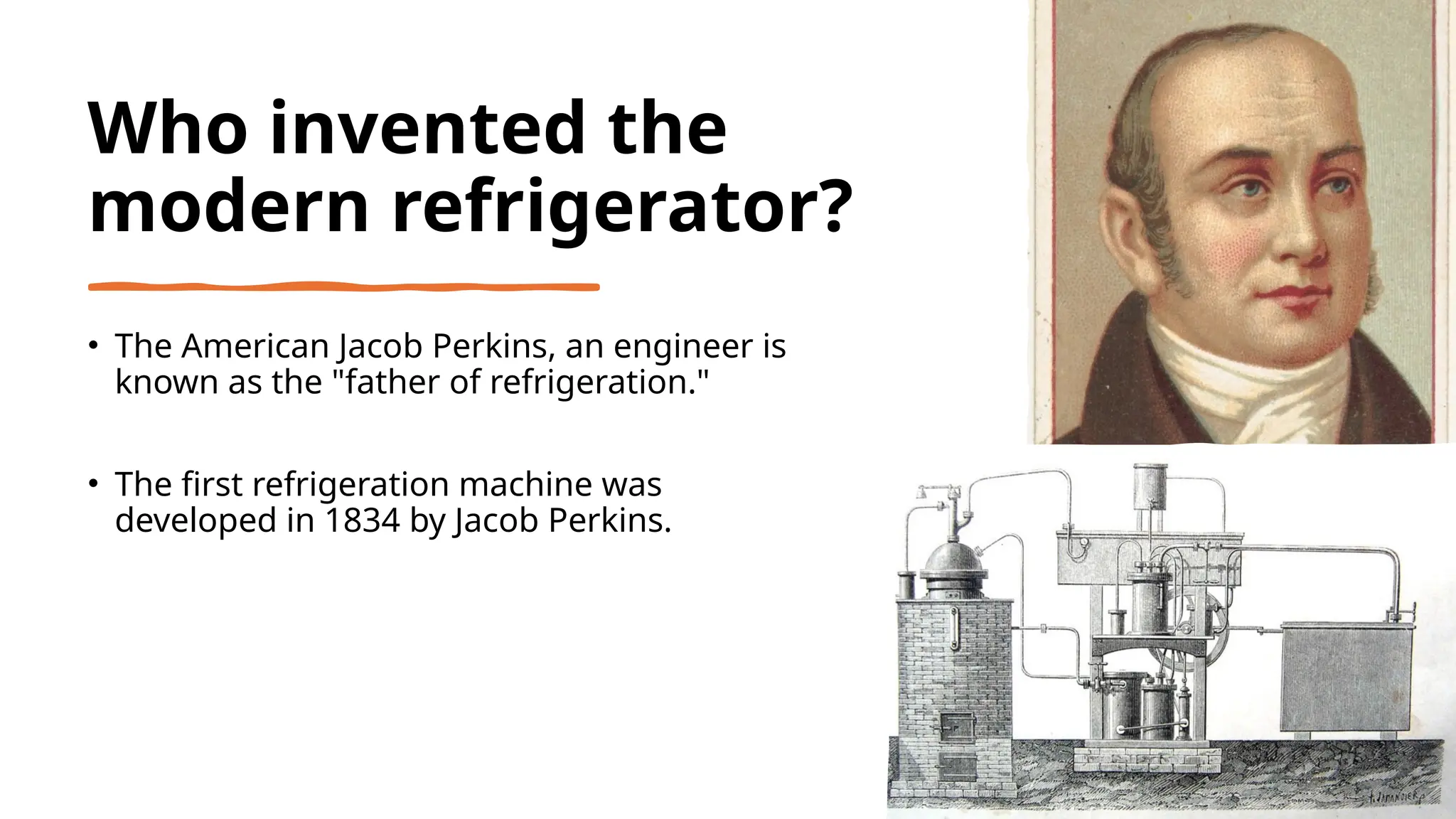
However, Evans focused his energy on steam engines and never actually built the refrigeration machine he designed. It took another three decades for his ideas to be realized. In 1834, Jacob Perkins, an American living in London, took Evans' basic concept and built the first working vapor-compression system.
Perkins’ machine used ethyl ether as a refrigerant and successfully produced ice. He received the first patent for such a device (British Patent No. 6662). Despite its technical success, the "Perkins Machine" was not a commercial hit. The world was still heavily reliant on the natural ice trade, and the machine was seen more as a mechanical marvel than a necessary industrial tool. Nevertheless, Perkins’ work established the mechanical blueprint that almost every modern refrigerator uses today.
Industrial Expansion and the Fight for Clean Ice (1840s–1890s)
In the mid-19th century, the motivation for refrigeration shifted from scientific interest to public health and industrial necessity. John Gorrie, an American physician in Florida, sought a way to cool the rooms of patients suffering from yellow fever and malaria. In 1842, he designed a machine that compressed air, cooled it with water, and then expanded it to lower the temperature.
Gorrie’s 1851 patent for a "machine for the artificial production of ice" was a landmark, but he faced intense opposition from the "Ice King," Frederic Tudor, who controlled the lucrative natural ice industry. Gorrie died in poverty, but his efforts demonstrated that refrigeration had vital medical and localized applications beyond simple food storage.
Simultaneously, inventors in other parts of the world were perfecting different methods:
- James Harrison: An English-born Australian who, in the 1850s, adapted Perkins’ design for the brewing and meatpacking industries. His ether-based vapor-compression machines were among the first to be sold commercially for industrial use.
- Ferdinand Carré: In 1859, the French inventor developed the first absorption refrigeration system. Unlike Perkins' mechanical compression, Carré’s system used gaseous ammonia dissolved in water. This was a critical development because it did not require a mechanical pump for the cooling cycle, making it a precursor to early gas-powered refrigerators.
- Carl von Linde: In the 1870s, this German engineer patented a process for liquefying gas. His improvements to the efficiency of the vapor-compression cycle, using ammonia as a refrigerant, made portable and large-scale industrial refrigeration much more viable.
The Domestic Revolution: Bringing the Fridge Home (1913–1927)
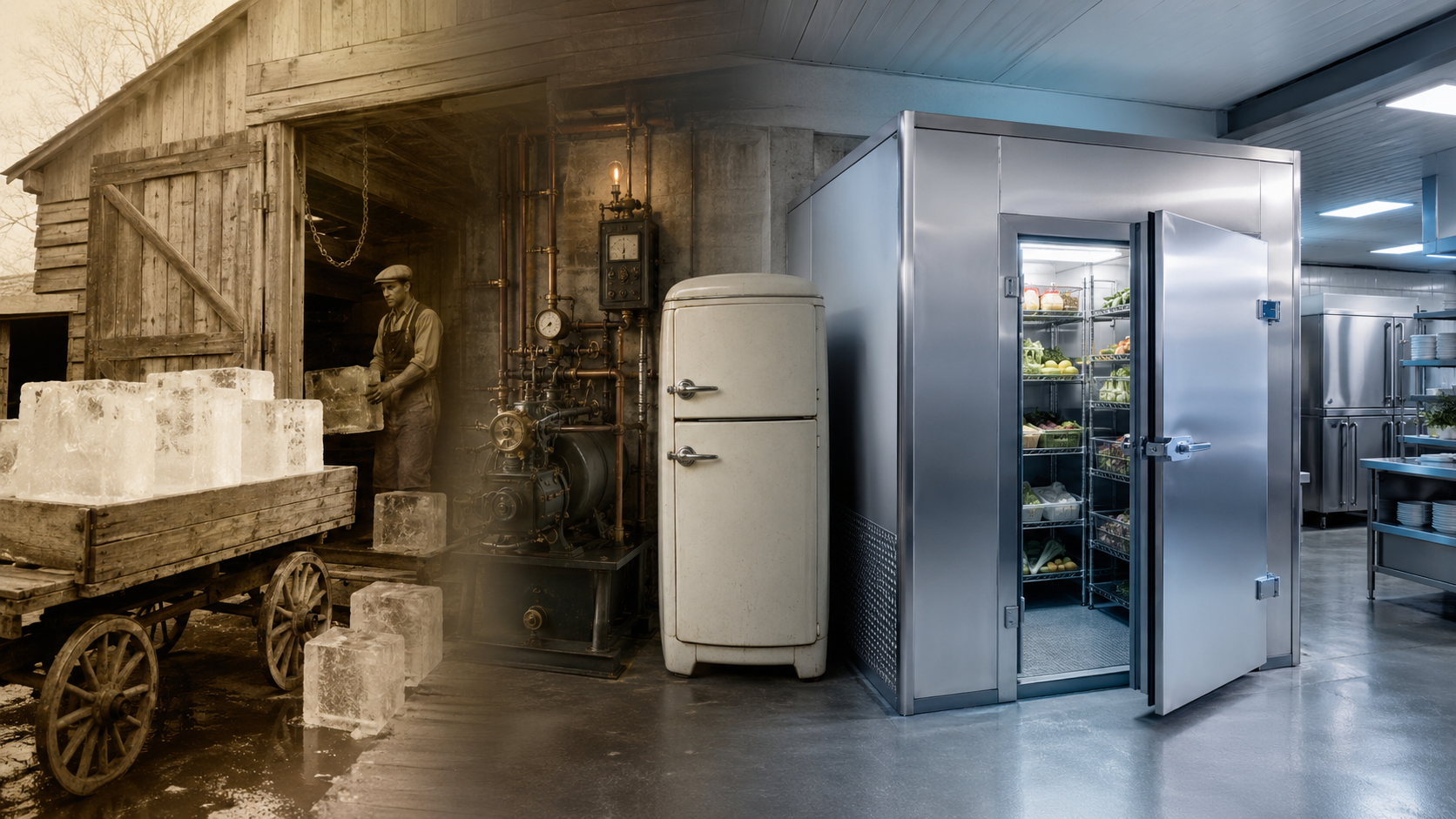
Until the early 20th century, refrigeration remained a large-scale industrial process. Ordinary households relied on "iceboxes"—insulated wooden crates lined with zinc or tin that held a large block of harvested ice. This changed in 1913 when Fred W. Wolf invented the DOMELRE (Domestic Electric Refrigerator).
The DOMELRE was a cooling unit designed to be placed on top of an existing icebox. It was the first household electric refrigerator to be sold to the public. While it was innovative, it was also expensive and inefficient. In 1916, Alfred Mellowes developed a self-contained refrigerator with a compressor located at the bottom of the cabinet. His company, the Guardian Refrigerator Company, was later purchased by William Durant of General Motors, who renamed it Frigidaire.
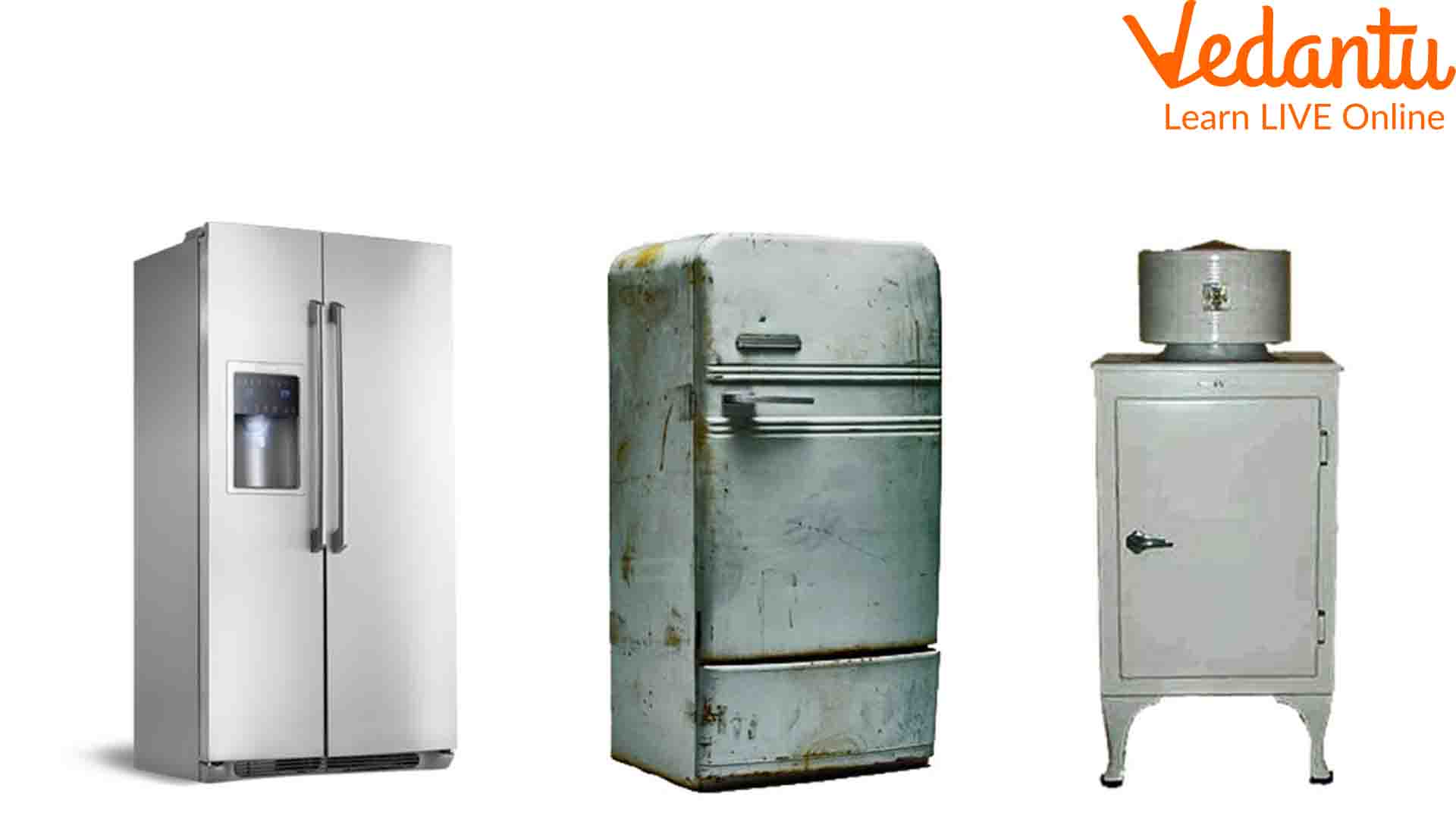
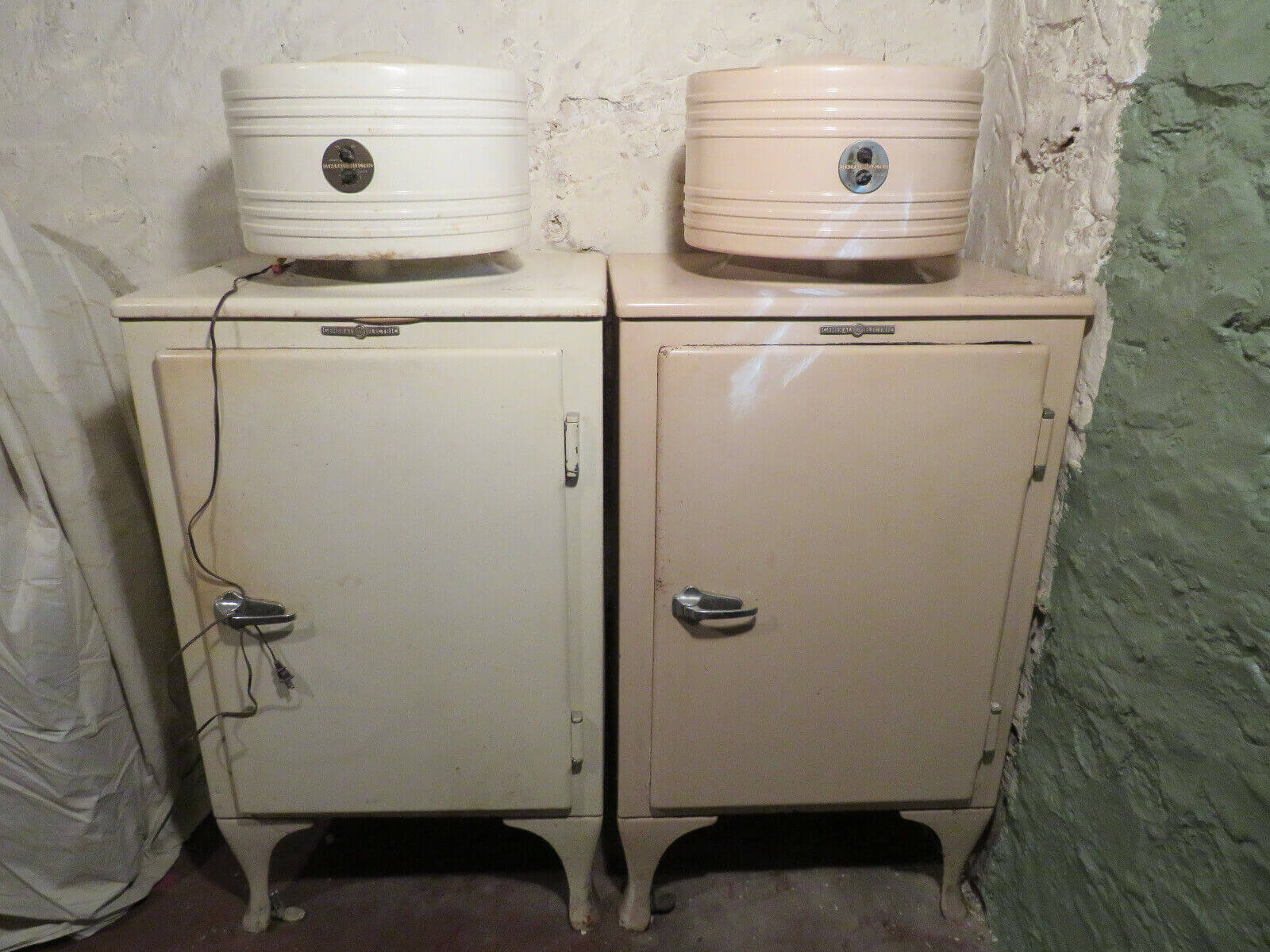
The true "tipping point" for home refrigeration arrived in 1927 with the introduction of the General Electric "Monitor-Top". This was the first refrigerator to see widespread success, with over a million units produced. It was named for its resemblance to the turret of the ironclad warship USS Monitor. While these units were revolutionary, they often used dangerous gases like sulfur dioxide or methyl formate as refrigerants, which could be fatal if the unit leaked.
Historical Timeline of Refrigeration Milestones
| Year | Inventor | Milestone | Technology Used |
|---|---|---|---|
| 1755 | William Cullen | First demonstration of artificial cooling | Diethyl ether vacuum |
| 1805 | Oliver Evans | First design for vapor-compression | Closed-cycle vapor |
| 1834 | Jacob Perkins | First working vapor-compression machine | Ethyl ether |
| 1851 | John Gorrie | First U.S. patent for mechanical ice making | Compressed air |
| 1859 | Ferdinand Carré | Invention of absorption refrigeration | Ammonia and water |
| 1876 | Carl von Linde | Improved ammonia compression | Ammonia liquefaction |
| 1913 | Fred W. Wolf | First domestic electric refrigerator (DOMELRE) | Electric-powered cooling |
| 1918 | Frigidaire | First mass-produced self-contained unit | Electric compression |
| 1927 | General Electric | The "Monitor-Top" mass-market success | Sulfur dioxide |
| 1930 | Thomas Midgley | Synthesis of Freon (CFCs) | Chlorofluorocarbons |
The Chemical Evolution: From Toxic Gases to Eco-Friendly Cooling
One of the most significant, though often overlooked, aspects of the refrigerator's invention is the evolution of refrigerants. Early mechanical refrigerators were essentially ticking time bombs. They used toxic, corrosive, or flammable gases such as ammonia, methyl chloride, and sulfur dioxide. Leaks in home units led to several high-profile accidental deaths in the 1920s.
In 1928, Thomas Midgley Jr., working for Frigidaire (a division of General Motors), led a team to find a safer alternative. They synthesized Freon (dichlorodifluoromethane), the first of the chlorofluorocarbons (CFCs). Freon was non-toxic and non-flammable, making refrigerators significantly safer for home use. This breakthrough triggered a massive surge in refrigerator adoption throughout the 1930s and 40s.
However, the story of refrigerants took another turn in the late 20th century. Scientists discovered that CFCs were responsible for depleting the Earth's ozone layer. Following the Montreal Protocol of 1987, these chemicals were phased out in favor of hydrofluorocarbons (HFCs) and, more recently, hydrofluoroolefins (HFOs) and natural refrigerants like isobutane, which have a lower global warming potential.
How the Refrigerator Transformed Modern Society
The invention of the refrigerator did more than just provide cold drinks; it fundamentally altered human civilization. Before mechanical cooling, urbanization was limited by the distance food could travel before spoiling.
- Dietary Diversity: Refrigeration allowed for the transport of perishable goods—such as meat, dairy, and fresh produce—across continents. This eliminated seasonal food shortages and improved general nutrition.
- Public Health: By slowing the growth of bacteria like Salmonella and E. coli, refrigeration drastically reduced the incidence of foodborne illnesses. It also enabled the storage of temperature-sensitive medicines and vaccines.
- Economic Shift: The rise of the "supermarket" was only possible because of large-scale commercial refrigeration. This moved the economy away from daily trips to local butchers and greengrocers toward a weekly bulk-shopping model.
- Urbanization: Refrigeration facilitated the growth of large cities in hot climates (like the American Sun Belt or Middle Eastern hubs), where food storage and air conditioning (a derivative of refrigeration technology) were prerequisites for dense populations.
Frequently Asked Questions
Who is officially credited with inventing the first refrigerator?
There is no single "inventor" of the refrigerator. Jacob Perkins is generally credited with inventing the first working mechanical refrigeration system in 1834. However, William Cullen demonstrated the principle in 1755, and Fred W. Wolf invented the first unit intended for home use in 1913.
Why did it take so long for refrigerators to become common in homes?
The primary barriers were cost, size, and safety. Early units were expensive—often costing more than a car—and used toxic gases. It wasn't until the mass production of the GE Monitor-Top in 1927 and the invention of safer Freon in 1930 that they became practical for the average family.
Was the first refrigerator electric?
No. The earliest experimental and industrial refrigerators were powered by steam engines or hand-cranked mechanisms. The transition to electricity only occurred in the early 20th century as domestic power grids became more common in urban areas.
What did people use before refrigerators were invented?
People used icehouses, root cellars, and "iceboxes." Icehouses were underground structures packed with snow or ice harvested from lakes in the winter. Iceboxes were insulated cabinets that required regular deliveries of ice blocks from "icemen" who harvested and distributed natural ice.
How does a refrigerator actually "create" cold?
A refrigerator does not "create" cold; it removes heat. It uses a refrigerant that cycles between liquid and gas states. As the liquid evaporates inside the fridge, it absorbs heat from the air. The compressor then squeezes the gas, turning it back into a liquid and releasing that absorbed heat into the kitchen through coils on the back or bottom of the unit.
Next Steps for Consumers
If you are researching the history of refrigerators to better understand modern appliance maintenance or purchasing, it is important to note that technology has moved toward high-efficiency inverter compressors and eco-friendly R-600a (isobutane) refrigerants. When disposing of an old unit, always contact a certified professional to ensure the refrigerant is recovered safely according to environmental regulations.
Image Gallery