How to Opt Out of Workers Compensation in Massachusetts: Legal Realities and Employer Obligations
In Massachusetts, employers generally cannot simply "opt out" of workers' compensation insurance if they have employees, as the state Department of Industrial Accidents (DIA) mandates coverage for almost all businesses. However, specif...
In Massachusetts, employers generally cannot simply "opt out" of workers' compensation insurance if they have employees, as the state Department of Industrial Accidents (DIA) mandates coverage for almost all businesses. However, specific exemptions exist for sole proprietors, corporate officers, and members of limited liability companies who meet strict statutory criteria and file the appropriate waiver forms.
Contents
Navigating the intersection of Massachusetts labor law, mandatory insurance requirements, and corporate structuring demands careful attention to detail. For business owners seeking to understand their obligations, the question of how to opt out of workers compensation in massachusetts requires looking closely at who qualifies as an employee under state law, which corporate roles are permitted to opt out, and what alternative financial protections must be considered. Because workers' compensation is designed to provide a guaranteed source of benefits to injured workers while shielding employers from costly civil tort lawsuits, state regulators maintain strict oversight over compliance. Failing to secure proper coverage or improperly attempting to waive requirements can result in severe stop-work orders, steep financial penalties, and personal liability for business owners.
Understanding Massachusetts Workers Compensation Mandates
The Massachusetts Department of Industrial Accidents enforces the state's workers' compensation act, codified primarily under Massachusetts General Laws (MGL) Chapter 152. Under this statute, every employer engaged in any business enterprise in the commonwealth is required to provide workers' compensation insurance for all employees.
Unlike some jurisdictions that permit small businesses with fewer than a certain number of employees to remain uninsured, Massachusetts law requires coverage as soon as a business hires its very first employee, even if that individual works only part-time or is a family member. The definition of an "employee" under MGL c. 152 is broad. It encompasses virtually anyone in the service of another under any contract of hire, written or oral, express or implied. Independent contractor classifications are heavily scrutinized by the DIA, the Attorney General's Office, and the Department of Revenue through strict independent contractor tests. An employer cannot simply label a worker an independent contractor to bypass insurance mandates; if the worker fails the statutory independent contractor test, they are legally deemed an employee, and coverage must be provided.
Who Is Eligible to Opt Out of Coverage?
While standard W-2 employees cannot opt out of workers' compensation protection, Massachusetts law provides specific statutory exemptions for business owners, corporate officers, and members of certain business entities. These exemptions recognize that owners and executive managers often control their own workplace safety and may choose to assume the financial risk of workplace injuries rather than purchase commercial insurance policies for themselves.
Corporate Officers and Directors
Under Massachusetts law, an executive officer of a corporation may elect to be excluded from coverage under the corporation's workers' compensation insurance policy, provided they meet specific ownership thresholds. Specifically, the officer must own at least 25% of the voting stock of the corporation. If an officer owns less than 25% of the voting stock, they generally cannot opt out of coverage.
Limited Liability Company (LLC) Members and Managers
For businesses organized as limited liability companies, members and managers may also be eligible to opt out. To qualify for an exemption, the individual must be a member of the LLC and hold a specified ownership interest, or be a manager who meets statutory definitions.
Sole Proprietors and Partnerships
Sole proprietors and partners in a traditional partnership are not considered employees of their own businesses under Massachusetts workers' compensation law. Because they are not employees, they are automatically excluded from the mandatory coverage requirements for themselves. They do not need to "opt out" because they were never mandated to cover themselves in the first place. However, the moment a sole proprietor or partnership hires an external employee, the requirement to secure a policy for that employee takes effect immediately.
Step-by-Step Process to File for Corporate or LLC Exemptions
When corporate officers or LLC members meet the statutory ownership thresholds and wish to opt out of workers' compensation coverage, they cannot simply stop paying premiums or notify their insurance agent verbally. They must follow a formal administrative process recognized by the Massachusetts Department of Industrial Accidents and the insurer.
| Entity Type | Ownership / Role Requirement | Action Required | Form / Documentation |
|---|---|---|---|
| Corporation | Minimum 25% voting stock ownership | Execute waiver with insurer and file with DIA | Form DIA or Insurer-Specific Waiver |
| LLC | Member with matching operating agreement stake | Update operating agreement and file waiver | LLC Exemption Form / Endorsement |
| Sole Proprietorship | Owner / Operator (no employees) | None required for self; purchase policy if hiring | Proof of independent status / Policy for staff |
| Partnership | General Partner (no employees) | None required for self; purchase policy if hiring | Partnership Agreement / Policy for staff |
To execute an official exemption, follow these operational steps:
- Verify Ownership Percentages: Review corporate bylaws, stock certificates, or operating agreements to ensure that the individual seeking the exemption officially meets the minimum ownership threshold (typically 25% or greater for corporate officers).
- Contact Your Insurance Carrier: Notify your workers' compensation insurance provider or broker of the intent to exclude eligible officers or members. Insurers require specific written notification and endorsement forms to adjust payroll calculations and premium ratings.
- Complete Exemption Endorsements: Fill out the appropriate waiver or endorsement forms provided by your insurance carrier or the DIA. These documents typically require notarized signatures and attestations regarding ownership status.
- Submit to the Insurer and DIA: Return the executed forms to your insurance carrier so they can issue a policy endorsement excluding the named individuals. Keep copies of all filings in your corporate records to verify compliance during audits or state inquiries.
Financial and Operational Implications of Opting Out
Opting out of workers' compensation for eligible owners alters both your insurance costs and your exposure to legal risk. Business owners must weigh these factors carefully before executing a waiver.
Premium Reductions vs. Personal Risk
When corporate officers or LLC members exclude themselves from a workers' compensation policy, the insurer removes their payroll from the rating calculation. Because workers' compensation premiums are determined largely by total payroll multiplied by classification-specific rate codes, removing high-earning executives can noticeably reduce annual premium costs.
However, this savings comes with a significant trade-off. If an excluded officer or member is injured while performing job duties, they cannot collect medical benefits or wage replacement through the workers' compensation system. They must rely on personal health insurance, disability policies, or out-of-pocket funds. Furthermore, health insurance carriers frequently deny coverage for injuries sustained on the job if a workers' compensation policy was legally required or available, leaving the injured owner with substantial medical debt.
Subcontractor and General Contractor Liability
Business owners who operate as general contractors or subcontractors in Massachusetts must also consider how exemptions impact downstream compliance. Under Massachusetts law, general contractors can be held liable for workers' compensation benefits owed to employees of uninsured subcontractors working on their projects. If an owner of a subcontractor business has opted out of coverage for themselves but employs other workers without verifying their insurance status, the general contractor's insurer may step in, leading to premium disputes, contract cancellations, or indemnification claims.
Common Misconceptions and Compliance Pitfalls
Misunderstandings regarding Massachusetts workers' compensation laws frequently lead to severe penalties for business owners. Navigating this regulatory environment requires separating myth from statutory fact.
- The Independent Contractor Myth: Many employers believe that having workers sign an independent contractor agreement exempts the business from providing workers' compensation coverage. The DIA and Massachusetts courts apply a rigorous three-prong ABC test. If a worker fails any part of this test, they are an employee, regardless of what the contract states.
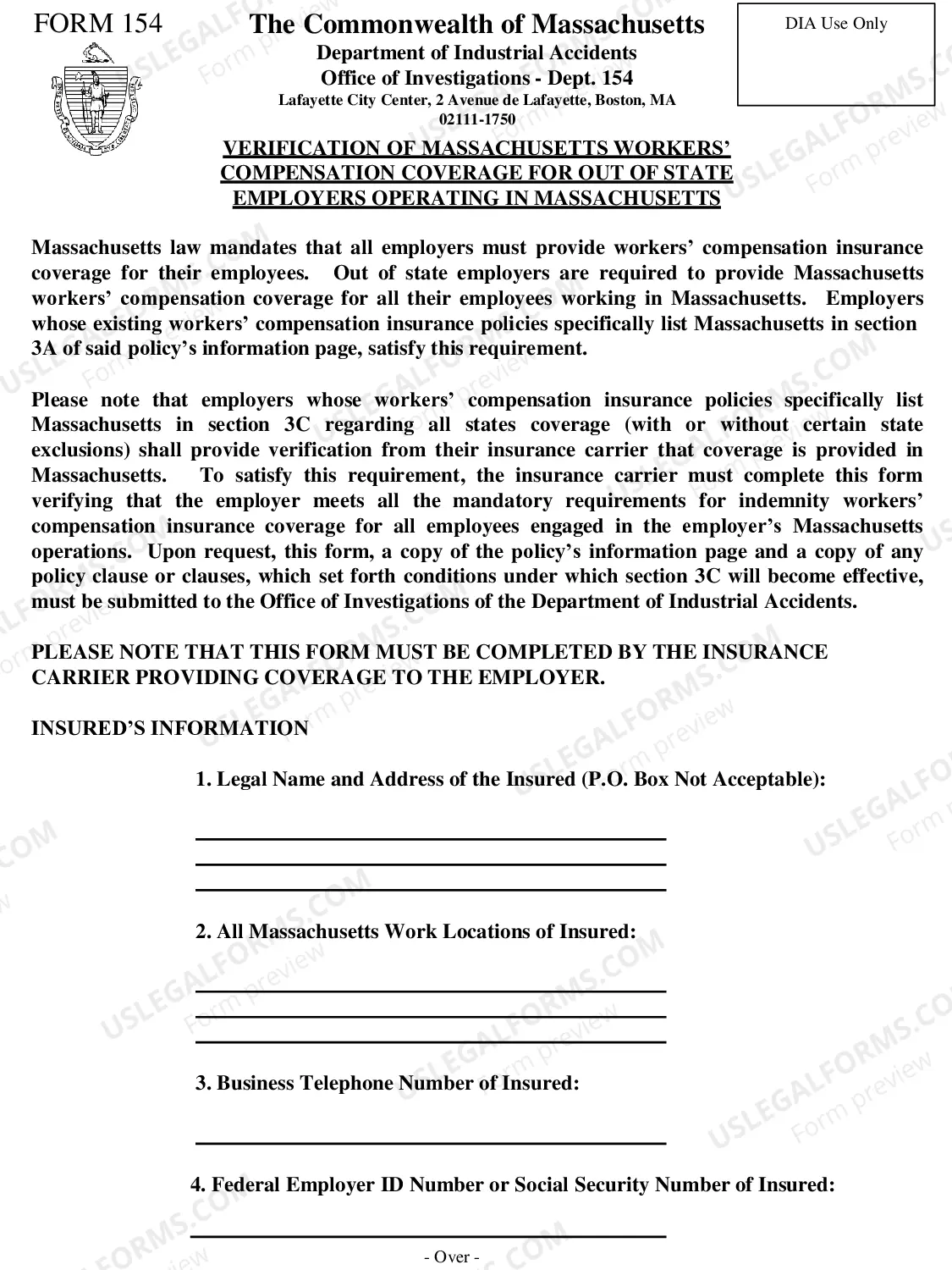
- Out-of-State Policies: Businesses based outside Massachusetts that send employees into the state must ensure their out-of-state workers' compensation policy includes "other states insurance" coverage or a Massachusetts endorsement. Operating in Massachusetts on an unendorsed policy from another state can be treated as non-compliance.
- Assuming Family Members Are Exempt: Hiring family members, spouses, or children does not automatically exempt an employer from workers' compensation mandates. If family members meet the legal definition of an employee, they must be covered unless they qualify under specific corporate officer exemption rules.
Penalties for Non-Compliance in Massachusetts
The Commonwealth of Massachusetts takes failure to maintain mandatory workers' compensation insurance very seriously. The DIA's Office of Investigations enforces compliance aggressively through audits, complaint investigations, and site visits.
When an employer is found operating without required workers' compensation insurance, the consequences can paralyze business operations:
- Stop-Work Orders: The DIA can issue an immediate stop-work order, halting all business operations until proof of valid coverage is provided. Operating in defiance of a stop-work order constitutes a criminal offense.
- Financial Penalties: Employers caught without coverage face substantial daily fines—often starting at $100 per day or more, accumulating for every day the business remains uninsured.
- Civil and Criminal Liability: If an uninsured employee is injured on the job, the employer loses statutory tort immunity. This means the injured worker can sue the business owner directly in civil court for negligence, exposing the owner's personal assets, home, and savings to catastrophic legal judgments. In addition, willful failure to secure coverage can result in criminal misdemeanor or felony charges for corporate officers.
Frequently Asked Questions
Can a sole proprietor in Massachusetts opt out of workers' compensation?
Sole proprietors without employees do not need to opt out because Massachusetts law does not require sole proprietors to purchase coverage for themselves. They are not considered employees under MGL c. 152. However, if a sole proprietor hires even one W-2 employee, they must purchase a policy for that employee immediately.
What percentage of ownership must a corporate officer hold to be excluded?
In Massachusetts, a corporate officer generally must own at least 25% of the voting stock of the corporation to elect an exclusion from workers' compensation coverage. Officers owning less than 25% must be included on the policy.
Does a certificate of insurance exempt a business from coverage mandates?
No. A certificate of insurance merely proves that a policy exists. Exclusions apply only when eligible corporate officers or LLC members execute proper waiver documentation recognized by the insurer and filed with the Massachusetts Department of Industrial Accidents.
Can independent contractors opt out of my workers' compensation policy?
True independent contractors who satisfy the Massachusetts legal three-prong ABC test do not need to be covered by your workers' compensation policy because they are self-employed businesses, not your employees. However, if a worker is misclassified as an independent contractor when they are legally an employee, you remain liable for coverage and potential penalties.
What should I do if my business cannot afford workers' compensation insurance?
If standard commercial market rates are cost-prohibitive, Massachusetts employers can access coverage through the Massachusetts Workers' Compensation Assigned Risk Pool (the residual market), which ensures that every legitimate employer can obtain insurance. Operating without insurance to save money is illegal and exposes the business to severe stop-work orders and personal liability.
Image Gallery