Security Vulnerabilities of Round Robin Load Balancing in Cloud Infrastructure
Round Robin load balancing in cloud environments presents significant security risks because its predictable, non-adaptive nature allows attackers to map infrastructure, exploit session inconsistencies, and launch targeted resource-exh...
Round Robin load balancing in cloud environments presents significant security risks because its predictable, non-adaptive nature allows attackers to map infrastructure, exploit session inconsistencies, and launch targeted resource-exhaustion attacks. While computationally efficient, its inability to account for server health or traffic complexity creates structural weaknesses that sophisticated modern threats can easily bypass.
Contents
Understanding Round Robin Load Balancing in the Cloud Context
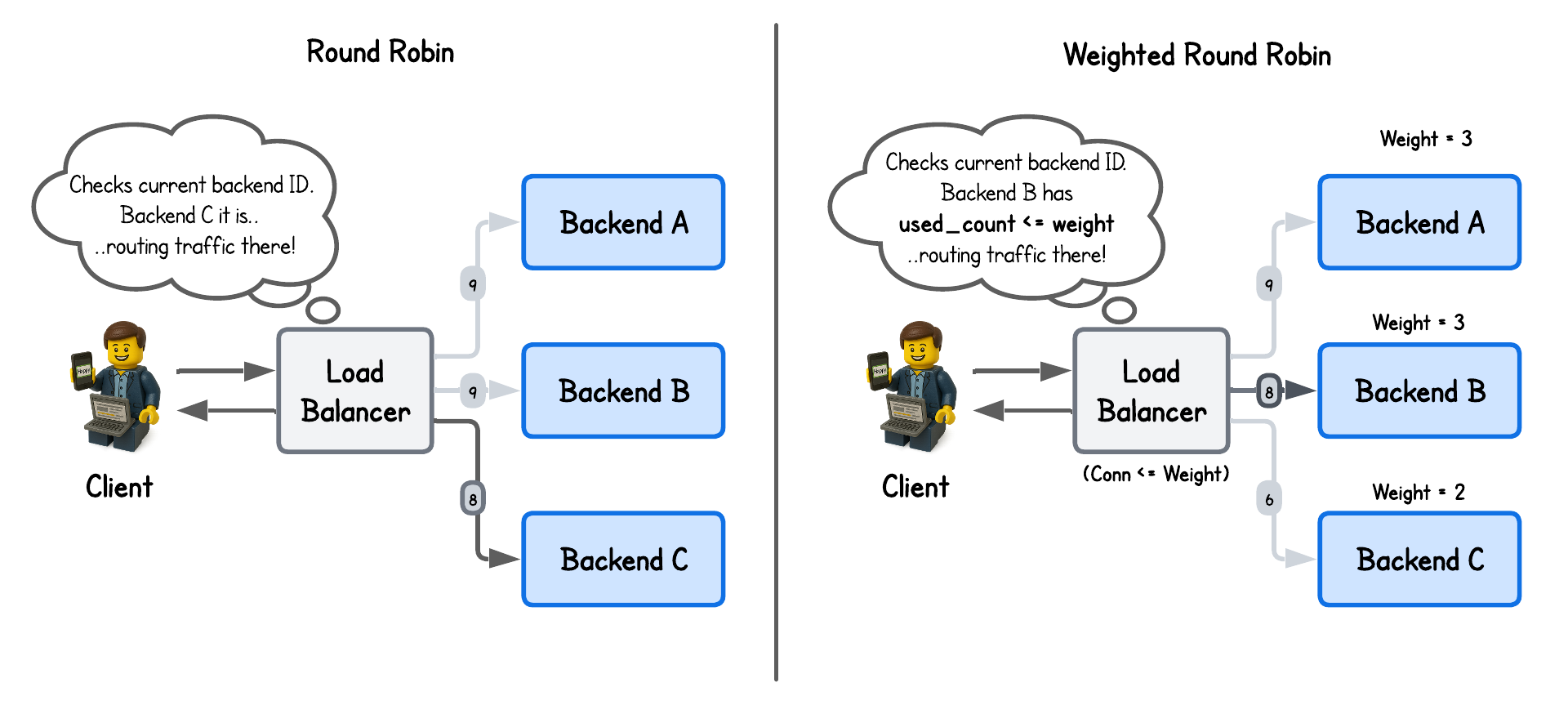
To evaluate the security implications of Round Robin (RR) load balancing, one must first understand its operational logic. In a cloud architecture, a load balancer acts as a reverse proxy, distributing incoming network or application traffic across a cluster of servers (nodes). The Round Robin algorithm is the most basic form of distribution: it passes each new request to the next server in a rotating list.
By 2026, cloud native environments have evolved toward extreme elasticity, yet the fundamental Round Robin method remains a common default because it requires minimal CPU overhead and no state tracking. However, in a security landscape dominated by AI-driven automated attacks and complex application-layer threats, this "blind" distribution method creates several points of failure. Unlike "Least Connections" or "Resource-Based" algorithms, Round Robin does not look at the current load, the nature of the request, or the real-time integrity of the destination node. This lack of intelligence is the primary driver of the security issues discussed below.
The Predictability Trap: Infrastructure Mapping and Targeted Attacks
One of the most significant security flaws in Round Robin load balancing is its high degree of predictability. Security through obscurity is rarely a complete defense, but blatant predictability is an open invitation for reconnaissance.
Sequence Analysis and Node Isolation
An attacker can easily determine the number of active nodes behind a cloud load balancer by sending a series of patterned requests and analyzing the responses (e.g., through unique header signatures, response times, or IP leaks). In a Round Robin setup, if there are five servers, the attacker knows that every fifth request will land on the same physical or virtual machine.
This allows for targeted exploitation. If an attacker identifies a specific vulnerability on "Server 3" (perhaps an unpatched microservice or a misconfigured container), they do not need to spam the entire cluster. They can time their malicious payloads to hit only the vulnerable node, minimizing their footprint and making detection by global rate-limiters more difficult.
Predictability in DDoS Amplification
Predictable routing simplifies the execution of Distributed Denial of Service (DDoS) attacks. In more advanced load-balancing scenarios, an attacker must overcome randomized or load-sensitive routing. With Round Robin, an attacker can synchronize a botnet to overwhelm specific nodes in a "staggered" fashion, ensuring that while the overall cluster might appear healthy to a high-level monitor, individual nodes are being systematically knocked offline or forced into high-latency states.
Resource Exhaustion and the "Asymmetric Load" Problem
Round Robin assumes that all requests are equal and all servers have equal capacity. In the cloud, this is rarely true. This discrepancy leads to a security vulnerability known as Resource Exhaustion, a subset of Availability attacks under the CIA (Confidentiality, Integrity, Availability) triad.
The Impact of Complex Requests
Modern web applications handle a variety of tasks, from serving static CSS files to executing complex cryptographic functions or heavy database queries.
- The Scenario: An attacker sends a mix of "heavy" and "light" requests.
- The Mechanism: By ensuring heavy requests (like large file uploads or complex searches) are routed sequentially, the attacker can cause a specific server to run out of RAM or CPU cycles while the neighboring server remains idle.
- The Result: The overloaded server may fail to process legitimate security checks, experience "fail-open" conditions, or simply crash, leading to a localized service outage.
Lack of Health-Aware Routing
While most cloud providers (AWS, Azure, GCP) offer health checks, basic Round Robin does not inherently wait for these checks to complete before assigning the next task in the queue. If a server becomes "unhealthy" but has not yet been officially marked "down" by the health probe (which often operates on 5-to-30-second intervals), the Round Robin balancer continues to feed it traffic. This creates a "black hole" where user data or authentication requests are lost or, worse, handled by a compromised system that is failing due to an ongoing exploit.
Session Inconsistency and State-Based Vulnerabilities
Security in the cloud often relies on maintaining a consistent state between the client and the server. Round Robin is inherently stateless, which introduces complications for session security.
Session Fixation and Hijacking Risks
If a cloud application does not use "Sticky Sessions" (Session Affinity), a user’s first request might go to Server A, and their second to Server B. If Server A and Server B do not perfectly synchronize session data in real-time, the application may require re-authentication or, in poorly coded environments, fail to validate the session token against the new node's local cache.
Attackers can exploit this by injecting themselves into the rotation. If they can predict which server will receive the next session token, they can attempt Session Fixation attacks, where they force a user to use a known session ID that the attacker can then use to impersonate the user once the load balancer rotates to the attacker's "target" node.
The Danger of Non-Synchronized WAFs
In some older or hybrid cloud configurations, Web Application Firewalls (WAFs) are deployed locally on the nodes rather than at the edge. If the load balancer uses Round Robin without centralized state management, an attacker can "spread" an attack across multiple servers. If Server A sees part of an SQL injection and Server B sees the rest, neither local WAF might trigger an alert because the full context of the attack is split across the rotation.
Comparison of Load Balancing Algorithms and Security Profiles
| Algorithm | Predictability | Resource Awareness | DDoS Resilience | Security Complexity |
|---|---|---|---|---|
| Round Robin | Very High | None | Low | Simple / High Risk |
| Weighted Round Robin | High | Static (Manual) | Moderate | Moderate |
| Least Connections | Low | Dynamic | High | Complex / Secure |
| IP Hash | Low | None | Moderate | Medium (Session Stable) |
| Resource-Based | Very Low | Full (CPU/RAM) | Very High | Most Secure |
Mitigating Round Robin Risks in 2026 Cloud Environments
If an organization must use Round Robin for performance or legacy reasons, several layers of defense must be added to close the security gaps.
1. Implementing Global Rate Limiting
To counter the predictability of Round Robin, cloud architects should deploy rate limiting at the CDN or Edge Layer rather than the individual node layer. This prevents an attacker from using the rotation logic to bypass local thresholds. By the time a request hits the Round Robin cycle, it should already have been scrubbed by a cloud-native WAF like AWS WAF or Cloudflare.
2. Mandatory Session Affinity (Sticky Sessions)
To prevent session-based exploits, session affinity must be enabled. This ensures that once a Round Robin choice is made for a specific user, that user is "stuck" to that server for the duration of their session. While this slightly reduces the "perfect" balance of traffic, it significantly hardens the application against session hijacking and inconsistency errors.
3. Rapid Health Probes and Circuit Breakers
In 2026, the standard for health checks has moved toward "Aggressive Probing." Load balancers should be configured with a "Circuit Breaker" pattern. If a node shows even a slight increase in error rates (4xx or 5xx responses), the load balancer should automatically eject it from the Round Robin rotation immediately, rather than waiting for a standard 30-second timeout.
4. Transitioning to Weighted or Least-Connection Models
The most effective mitigation is often moving away from pure Round Robin. Weighted Round Robin allows administrators to assign higher "costs" to certain nodes, which can help if some servers are more hardened or powerful than others. However, Least Connections remains the superior choice for security, as it naturally routes traffic away from servers that are struggling under the weight of a resource-exhaustion attack.
The Role of the Shared Responsibility Model
Security issues in cloud load balancing fall squarely within the Shared Responsibility Model. While the cloud service provider (CSP) is responsible for the physical security and the uptime of the load balancing software, the user is responsible for the configuration of the algorithm and the security of the traffic passing through it.
Misconfiguring a Round Robin balancer to ignore SSL/TLS termination at the edge, for instance, can expose unencrypted traffic to the internal cloud network. Organizations must ensure that even if Round Robin is used, the data in transit is encrypted using TLS 1.3, and the load balancer is configured to drop any traffic that does not meet modern cipher suite requirements.
Troubleshooting Common Round Robin Security Failures
When security incidents occur in a Round Robin environment, they often manifest as intermittent errors that are difficult to replicate.
- Symptom: Users report occasional "Access Denied" or "Session Expired" errors.
- Security Cause: A specific node in the rotation has a corrupted session sync or an outdated CRL (Certificate Revocation List).
- Symptom: Sudden spikes in CPU on one server while others remain cool.
- Security Cause: An attacker is likely exploiting the predictability of the rotation to perform a "Slowloris" attack on a single target node.
- Symptom: WAF logs show fragmented attacks.
- Security Cause: An attacker is spreading a malicious payload across multiple requests, knowing the Round Robin logic will distribute the "pieces" of the attack, hoping to evade pattern matching.
To resolve these, centralizing logs via a SIEM (Security Information and Event Management) system is essential. By aggregating logs from all nodes, security teams can see the "complete picture" of an attack that the Round Robin balancer has physically dispersed across the infrastructure.
Frequently Asked Questions
Is Round Robin load balancing ever secure for high-risk applications?
Round Robin is rarely the first choice for high-security environments. It lacks the intelligence to detect when a server is under stress or behaving erratically. For high-risk applications, such as financial or healthcare platforms, Least Connections or custom Resource-Based algorithms are preferred because they respond dynamically to the state of the infrastructure, making it harder for attackers to predict and exploit traffic patterns.
How does Round Robin affect DDoS mitigation?
Round Robin can actually hinder DDoS mitigation. Because it distributes traffic blindly, it can spread a DDoS attack across your entire fleet, potentially degrading the performance of all nodes simultaneously. Sophisticated DDoS protection usually works by identifying the source of the attack at the edge, but if the attack reaches the load balancer, a Round Robin setup makes it harder to isolate the impact to a single "sacrificial" subnet.
What is the difference between DNS Round Robin and Cloud Load Balancer Round Robin?
DNS Round Robin happens at the authoritative name server level, where multiple IP addresses are returned for a single hostname. This is even less secure than a Cloud Load Balancer because there is absolutely no health checking; if one IP is down, the DNS will still send users to it. Cloud Load Balancer Round Robin happens at the network or application layer and usually includes basic health checks, though it still suffers from the predictability and resource-exhaustion issues mentioned above.
Can I use Web Application Firewalls (WAF) with Round Robin?
Yes, and you should. However, the WAF should ideally be placed in front of the load balancer. If the WAF is placed on the individual servers behind the Round Robin balancer, it can be bypassed by "fragmented" attacks where the attacker sends different parts of a malicious script to different servers in the rotation, preventing any single WAF from seeing the whole threat.
Why do cloud providers still offer Round Robin if it has security issues?
Round Robin is offered because it is extremely "cheap" in terms of computational overhead. In scenarios where security is handled entirely at the edge (by a robust CDN and WAF) and where the application is entirely stateless (like serving static images), the risks of Round Robin are minimized. It provides a simple, low-latency way to scale, provided the architect understands the trade-offs.
Final Recommendation
For organizations operating in the cloud in 2026, the transition away from basic Round Robin toward Least Connections or Latency-Based Routing is highly recommended. If you must continue using Round Robin, ensure you have a robust, centralized WAF at the edge and implement aggressive health checks with automated node replacement. Predictability is the enemy of security; by introducing intelligence into your load balancing layer, you close one of the most common gaps used by modern automated threats.
Image Gallery