How to Read and Interpret the Achy Breaky Heart Lyrics
To read the "Achy Breaky Heart" lyrics effectively, you must analyze them as a narrative of defensive pride where the speaker uses personification to distance himself from his own vulnerability. The lyrics depict a man who can endure a...
To read the "Achy Breaky Heart" lyrics effectively, you must analyze them as a narrative of defensive pride where the speaker uses personification to distance himself from his own vulnerability. The lyrics depict a man who can endure any public humiliation or personal insult, provided his "achy breaky heart" is shielded from the finality of a breakup.
Contents
Released in 1992 by Billy Ray Cyrus and written by Don Von Tress, "Achy Breaky Heart" became a global phenomenon that transcended country music to become a permanent fixture in pop culture. While often dismissed as a simple novelty song, a closer reading of the lyrics reveals a clever use of rhythmic repetition and emotional displacement. As we look at the song from the perspective of 2026, its construction serves as a masterclass in how to build a lyrical "hook" that survives decades of cultural shifts.
Understanding the Narrative Structure
The song follows a standard Verse-Chorus-Verse-Chorus-Bridge-Chorus structure, which is common in commercial country songwriting. However, the "how" of reading these lyrics lies in identifying the contrast between the verses and the chorus.
The Verses: A Catalog of Resilience
In the verses, the protagonist lists several scenarios of social and personal ruin that he claims he can withstand. He invites his former partner to "tell the world" they are over, to "tell your Ma," and even to "tell my brother." This establishes a character who is concerned with his public image but claims a stoic indifference to it. By reading these lines carefully, you see a man attempting to maintain control during a moment of total loss.
The language used is colloquial and informal, typical of the "New Traditionalist" country movement of the early 1990s. Words like "Ma," "Aunt Louise," and "dog" ground the song in a specific Americana setting. When reading, pay attention to the escalation of what he is willing to lose; he is willing to be the subject of town gossip as long as his internal emotional core—the heart—remains uninformed.
The Chorus: The Personified Heart
The chorus is where the "Achy Breaky" terminology resides. To read this correctly, you must recognize that the singer is treating his heart as a separate entity—a fragile, almost childlike passenger in his body.
"But don't tell my heart, my achy breaky heart / I just don't think he'd understand."
The use of the pronoun "he" for the heart is a significant linguistic choice. It shifts the responsibility of the pain away from the "I" (the speaker) to an externalized version of himself. This displacement allows the protagonist to maintain his "tough guy" exterior while acknowledging extreme emotional fragility.
Linguistic Analysis of "Achy Breaky"
The phrase "Achy Breaky" is an example of reduplication, a linguistic process where a word or a part of a word is repeated, often with a slight change in the initial consonant or vowel. This is frequently used in nursery rhymes or "baby talk" (e.g., "okey-dokey" or "helter-skelter").
When reading these lyrics, the choice of "Achy Breaky" serves two functions:
- Phonetic Catchiness: The hard "k" sounds and the rhythmic "y" endings create a percussive quality that makes the line easy to remember and sing.
- Diminishing the Pain: By using "baby talk" to describe his pain, the speaker might be trying to downplay the severity of his heartbreak, even as he claims it could kill him. It adds a layer of irony to the song that is often missed in casual listening.
Stanza-by-Stanza Interpretation
To truly understand how to read the lyrics, we should break down the specific demands the singer makes of his former lover.
Verse One: Social Humiliation
The singer tells his ex that she can tell the world he was never her "girl" (a play on traditional phrasing) or tell his arms they aren't "holding" anything. This is a classic country music trope: the physical body reacting to the absence of a loved one. When reading this, notice the emphasis on external appearances. He is okay with the world thinking the relationship was a lie.
Verse Two: Family and Neighbors
The second verse moves to more intimate circles. Telling "Aunt Louise" or the "neighbor" represents the localized shame of a breakup. The mention of the "dog" that "squeals" is a humorous touch that adds a bit of levity to the otherwise somber subject of a broken home. Reading this verse requires an understanding of rural or small-town dynamics where everyone knows your business.
The Bridge: The Ultimate Threat
The bridge is the most dramatic part of the lyric.
"And if you tell my heart, my achy breaky heart / He might blow up and kill this man."
This is hyperbole at its finest. The "how" of reading this section involves recognizing the life-or-death stakes the protagonist has assigned to his denial. He isn't just saying he'll be sad; he's saying the shock of the truth will be physically fatal.
Technical Specifications of the Songwriting
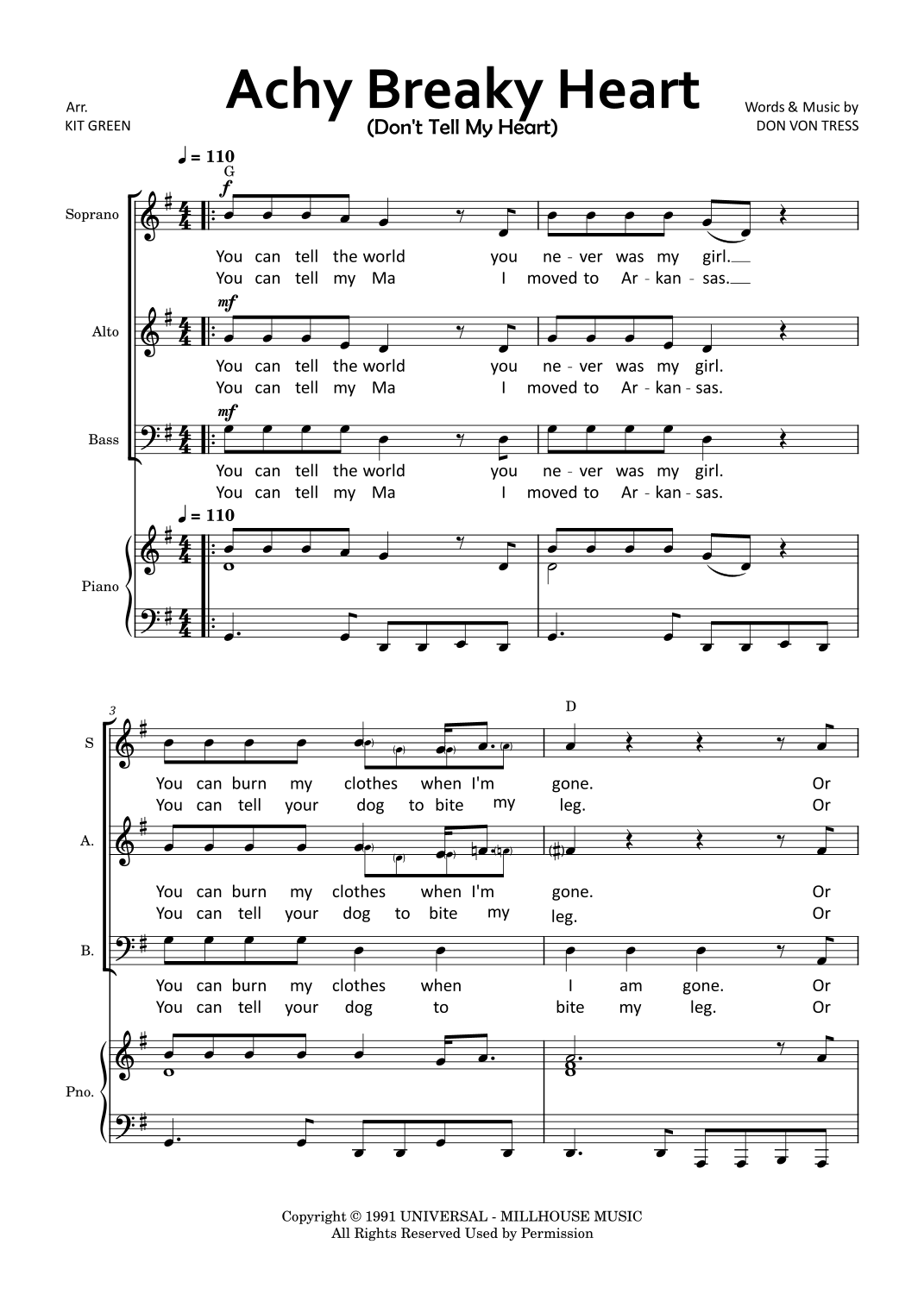
Understanding the "technical" side of the lyrics helps in reading the rhythm of the words on the page. The song is written in 4/4 time and relies on a very simple two-chord progression (usually G and C in the key of G). This simplicity is reflected in the lyrics' rhyme scheme.
| Section | Rhyme Scheme | Complexity | Primary Function |
|---|---|---|---|
| Verse 1 | ABCB | Low | Establishes the setting/conflict |
| Chorus | AABB (Approx) | Moderate | Delivers the "hook" and theme |
| Verse 2 | ABCB | Low | Expands the social consequences |
| Bridge | AAAA | High | Increases the emotional stakes |
The ABCB rhyme scheme in the verses is the "workhorse" of country music. It allows for a natural, conversational flow that doesn't feel forced. When you read the chorus, you notice it breaks this pattern to focus on the "heart/understand/man" rhymes, which are more forceful.
Historical and Cultural Context in 2026
In 2026, "Achy Breaky Heart" is viewed as a foundational text of the "Country Crossover" era. To read the lyrics today is to see the blueprint for how country music integrated pop sensibilities to reach a global audience.
The song was originally titled "Don't Tell My Heart" and was recorded by The Marcy Brothers in 1991. However, it was Billy Ray Cyrus’s interpretation—and specifically his delivery of the "Achy Breaky" hook—that transformed the lyrics into a cultural staple. Critics at the time were often harsh, calling the lyrics "simplistic" or "derivative," but the longevity of the song suggests that the lyrics tapped into a universal human experience: the desire to stay in denial to avoid pain.
The song also played a massive role in the 1990s line-dancing craze. The lyrics are paced perfectly for choreographed movement, with the chorus providing a clear "reset" for dancers. For more on the history of country music charts, you can visit Billboard’s historical archives.
Common Mistakes When Reading the Lyrics
- Taking it too literally: Some readers think the song is about a physical heart condition. It is entirely metaphorical. The "blowing up" is emotional, not medical.
- Ignoring the humor: There is a self-deprecating wit in the lyrics. The singer knows he is being dramatic. If you read it with a completely straight face, you miss the "wink" to the audience.
- Assuming it's a "happy" song: Because of the upbeat tempo and the line dancing, people often forget the lyrics are about a man begging his ex-girlfriend not to hurt him anymore. It is a song of desperation disguised as a party anthem.
Frequently Asked Questions
Who actually wrote the "Achy Breaky Heart" lyrics?
The lyrics were written by Don Von Tress. While Billy Ray Cyrus made them famous, Von Tress was the creative mind behind the "achy breaky" phrasing. He has stated in interviews that the song came to him quickly and was meant to be a simple, fun take on the classic country heartbreak theme.
What does "Achy Breaky" actually mean?
It is a rhythmic, rhyming description of a heart that is both aching (throbbing with pain) and breaking (shattering). It is a colloquialism that didn't exist in the common lexicon in this specific form before the song's release, though both words are standard English.
Why was the song so controversial among country music purists?
In the early 1990s, many purists felt the lyrics were too "pop" and lacked the "grit" of traditional country music. They felt the "Achy Breaky" hook was a gimmick. However, over time, the song has been reclaimed as a classic of the era.
Is there a deeper meaning to the "neighbor's dog" line?
While it seems like a throwaway line, it emphasizes the total collapse of the singer's private life. Even the animals in the neighborhood are aware of his failure. It reinforces the theme of "public shame vs. private pain."
How did the song influence later artists?
The song's success showed that country music could be fun, rhythmic, and globally accessible. You can see its influence in the "Bro-Country" movement of the 2010s and even in the genre-blending work of Billy Ray’s daughter, Miley Cyrus, and his later collaborator, Lil Nas X.
Final Recommendation for Readers
When reading or analyzing the "Achy Breaky Heart" lyrics, focus on the personification of the heart. The song works because it treats the heart as a character with its own feelings, separate from the man. This allows the listener to empathize with the speaker's vulnerability without him having to surrender his pride. To get the full experience, read the lyrics aloud to feel the percussive nature of the "k" and "b" sounds, which contribute to the song's infectious energy.
Image Gallery