Comprehensive Guide to Due Diligence in France: Legal, Financial, and Social Requirements
In the context of French business transactions, due diligence refers to the comprehensive process of verification and investigation conducted by a potential buyer or investor before finalizing a merger, acquisition, or partnership. Whi...
In the context of French business transactions, due diligence refers to the comprehensive process of verification and investigation conducted by a potential buyer or investor before finalizing a merger, acquisition, or partnership. While often referred to in French as audit d'acquisition or audit préalable, the English term is widely used in professional circles to encompass the rigorous examination of a target company’s financial health, legal standing, and operational risks.
Contents
Navigating the French market requires a nuanced understanding of specific regulatory frameworks, including the French Commercial Code, strict labor laws, and evolving transparency requirements. As of 2026, due diligence in France has expanded beyond traditional financial balance sheets to include sophisticated assessments of environmental, social, and governance (ESG) compliance, as well as digital infrastructure and data privacy under GDPR.
The Evolution and Terminology of Due Diligence in France
The concept of due diligence in France has transitioned from a purely legalistic "check the boxes" exercise to a strategic risk management tool. Historically, the French principle of caveat emptor (let the buyer beware) was less pronounced due to strong legal protections for purchasers; however, modern cross-border transactions have standardized high-intensity due diligence.
In French legal and business terminology, you will encounter several terms:
- Audit d'acquisition: The most common professional term for an acquisition audit.
- Vérification diligente: A literal translation of due diligence, often used in Quebec but occasionally seen in French administrative documents.
- Audit préalable: A general term for a preliminary audit.
In 2026, the focus has shifted heavily toward compliance and sustainability. With the full implementation of the Corporate Sustainability Reporting Directive (CSRD) and the continued enforcement of the Sapin II law, due diligence is no longer just about identifying past liabilities but about forecasting the future viability of a business model within the European Union's regulatory environment.
Financial Due Diligence (Audit Financier)
Financial due diligence remains the cornerstone of any French transaction. It aims to validate the historical financial statements and assess the sustainability of the target's earnings (EBITDA). In France, auditors pay close attention to the transition between French GAAP (Plan Comptable Général or PCG) and international standards such as IFRS, especially for larger entities.
Analyzing EBITDA and Cash Flow
In the French market, the Excédent Brut d'Exploitation (EBE) is the local equivalent of EBITDA. Financial due diligence professionals spend considerable time "restating" the EBE to identify one-off expenses or income that could distort the company's true profitability. This includes looking for "hidden" costs, such as owner-related expenses in family-owned SMEs (PME) or underfunded maintenance CapEx.
Net Debt and Working Capital
A critical component is the determination of "Net Debt" and "Normalized Working Capital." In France, specific items like the Participation des salariés (mandatory profit-sharing) and various state-backed loans (such as the remains of the Prêts Garantis par l'État or PGE from previous economic cycles) must be carefully classified. Disagreements over what constitutes "cash-like" items versus "debt-like" items are the most frequent causes of price adjustment disputes in French M&A.
Legal Due Diligence (Audit Juridique)
Legal due diligence in France involves a meticulous review of the target's corporate structure, contractual obligations, and litigation history. Given the complexity of the French Civil Code, this process requires specialized local expertise.
Corporate Governance and Structure
Investigators must verify that all corporate actions—such as board meetings, share issuances, and dividend distributions—have been recorded in the registres d'assemblées (minute books) and filed with the Greffe du Tribunal de Commerce. In France, irregularities in the chain of title for shares can lead to significant delays or even the nullification of a sale.
Material Contracts and Change of Control
A primary focus is the "Change of Control" clause. Many French commercial contracts, particularly in sectors like aerospace, luxury goods, and technology, contain clauses that allow the counterparty to terminate the agreement if the company's ownership changes. Identifying these clauses early is essential for the buyer to negotiate waivers or consents before the closing date.
Intellectual Property (IP) and IT
For tech-heavy acquisitions, verifying that the target company actually owns its code and patents is vital. In France, the principle is that IP created by employees does not always automatically vest in the employer unless specific contractual and legal conditions are met (notably for software). Due diligence must confirm that all droits d'auteur (copyrights) have been properly assigned.
Labor and Social Due Diligence (Audit Social)
The social component of due diligence is uniquely critical in France. French labor law (Droit du Travail) is among the most protective of employees in the world, and "social risk" is often the largest hidden liability in a transaction.
The Social and Economic Committee (CSE)
Most French companies with more than 11 employees must have a Comité Social et Économique (CSE). In companies with over 50 employees, the CSE has a "right to be informed and consulted" regarding the sale of the company. Failure to follow the strict consultation process can lead to a court injunction halting the transaction and may even constitute a criminal offense known as délit d'entrave (obstruction).
Employment Contracts and Benefits
Due diligence must verify that all employees are correctly classified under the relevant Convention Collective Nationale (CCN) or National Collective Bargaining Agreement. Errors in classification can lead to massive claims for back-pay, unpaid overtime, and social security contributions (cotisations sociales). Furthermore, under Article L1224-1 of the French Labor Code, employment contracts are automatically transferred to the buyer in an asset deal, meaning the buyer cannot simply "cherry-pick" which employees to keep.
Compliance and ESG Due Diligence
As of 2026, compliance due diligence has expanded significantly due to French and EU regulations aimed at transparency and ethical business practices.
Anti-Corruption (Sapin II)
The Sapin II law requires French companies of a certain size to implement robust anti-corruption programs. During due diligence, a buyer must evaluate the target's code of conduct, whistleblowing internal systems, and third-party mapping. If a target is found to be non-compliant, the buyer could inherit significant legal exposure and reputational damage.
The Duty of Vigilance (Devoir de Vigilance)
Large French corporations are subject to the Duty of Vigilance law, which requires them to identify and prevent human rights violations and environmental damage throughout their entire supply chain. Due diligence now involves auditing the target's suppliers, particularly those located in high-risk jurisdictions, to ensure there are no "vigilance" failures that could lead to civil liability.
GDPR and Data Privacy
With France's data protection authority (CNIL) being one of the most active in Europe, verifying GDPR compliance is mandatory. This involves auditing data processing registers, privacy policies, and security measures to prevent data breaches, which can result in fines of up to 4% of global turnover.
Comparing Due Diligence Standards: France vs. USA/UK
While the core objectives are similar, the execution of due diligence in France differs from the Anglo-American model in several key areas.
| Feature | French Standard (2026) | US/UK Standard |
|---|---|---|
| Primary Focus | Labor law (Social) and Regulatory Compliance | Financial performance and Representations/Warranties |
| Employee Rights | Mandatory CSE consultation; contracts transfer by law | "At-will" employment; limited mandatory consultation |
| Contract Law | Civil Code (emphasis on "Good Faith") | Common Law (emphasis on literal contract text) |
| Information Access | Electronic Data Room (VDR) is standard | Electronic Data Room (VDR) is standard |
| Pre-Sale Reports | Vendor Due Diligence (VDD) common for large deals | Common in UK; less frequent in US mid-market |
| Timing | Heavily dictated by CSE consultation periods | Dictated by negotiation and regulatory filings (HSR) |
The Due Diligence Process: Step-by-Step
A typical due diligence process in France for a mid-market transaction follows a structured timeline, often taking between 6 to 12 weeks.
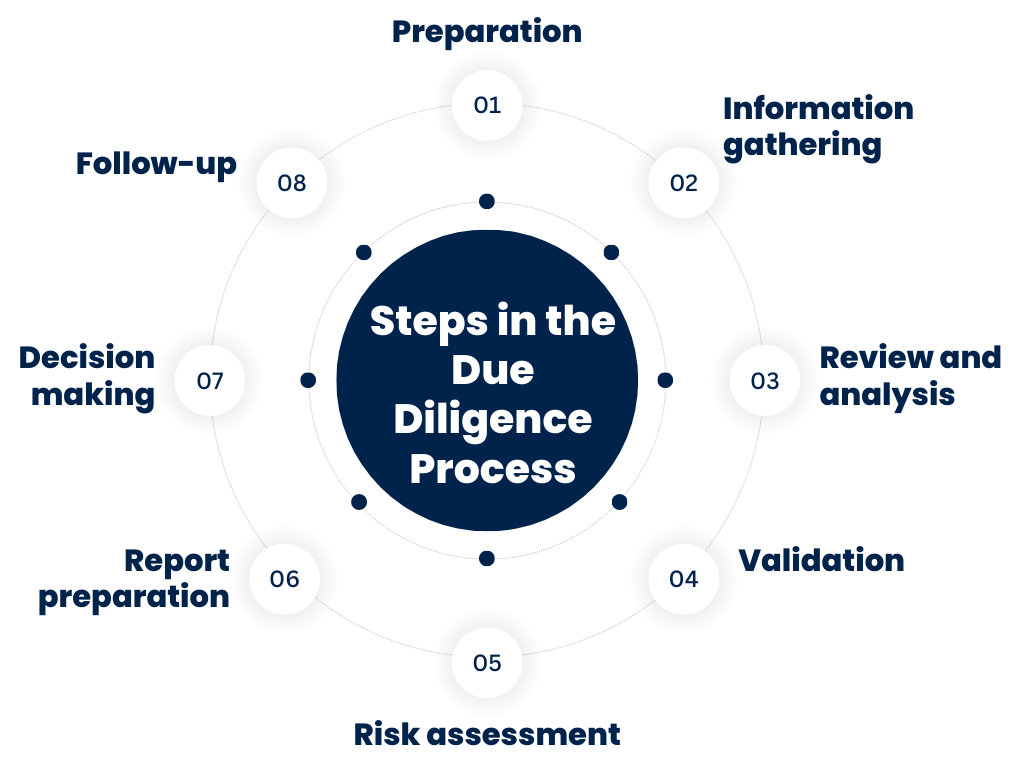
- Preparation and NDA: The parties sign a Non-Disclosure Agreement (NDA). The seller prepares an Electronic Data Room (VDR).
- Request List: The buyer’s advisors (lawyers, accountants) send a detailed list of required documents covering all pillars mentioned above.
- Review and Q&A: The buyer's team reviews the documents and submits written questions via the VDR platform. In France, management interviews (Management Presentations) are a critical part of this phase to assess the "human" element of the business.
- On-site Visits: Depending on the industry (e.g., manufacturing), physical inspections of plants and inventory are conducted to verify the existence and condition of assets.
- Drafting the Report: The advisors provide a "Red Flag" report (focusing only on major risks) or a "Full" report to the buyer.
- Negotiation of the SPA: The findings of the due diligence are used to negotiate the Share Purchase Agreement (SPA). Specific risks identified are usually covered by Indemnity clauses or price reductions.
Common Pitfalls to Avoid in French Due Diligence
Investors often stumble when they apply a generic international template to the French market without accounting for local specificities.
- Underestimating the CSE Timeline: Many deals are delayed because the buyer did not account for the statutory time required for the CSE to issue its "opinion" on the transaction. While the opinion doesn't have to be favorable, the process must be completed.
- Overlooking "Hidden" Tax Liabilities: French tax authorities have a three-year statute of limitations (prescription triennale), but this can be extended in cases of fraud or international tax maneuvers. The Taxe sur les Bureaux (office tax) and various local taxes (CFE, CVAE) are often overlooked.
- Cultural Misunderstandings: French business culture places high value on hierarchy and formal documentation. Lack of formal "minutes" for meetings is often a sign of poor governance rather than just administrative laziness.
- Real Estate Complexities: If the target company owns real estate, the Droit de Préemption (right of first refusal) by the local municipality can disrupt the transfer of assets.
Frequently Asked Questions
What is a "Vendor Due Diligence" (VDD) in France?
A Vendor Due Diligence is a report commissioned by the seller before the company is put on the market. It is prepared by independent auditors and shared with potential bidders. In France, VDDs are highly standard for large-cap transactions to speed up the process and provide a "certified" baseline of information.
How long does the social consultation process take?
In companies with a CSE, the consultation period typically lasts between one to two months depending on whether the CSE appoints its own expert. This must occur before the signing of a binding agreement, though a "put option" structure is often used to manage this sequence legally.
Is environmental due diligence mandatory?
While not mandatory for every small business, it is effectively mandatory for industrial sites (classified as ICPE - Installations Classées pour la Protection de l'Environnement) and for any company falling under the CSRD reporting requirements in 2026. Buyers risk significant "de-pollution" costs if they fail to audit site conditions.
Can a buyer walk away after starting due diligence?
Yes, provided the Letter of Intent (LOI) was drafted correctly. Most LOIs in France include a "due diligence condition," allowing the buyer to withdraw if the findings are not satisfactory. However, breaking off negotiations "abruptly and in bad faith" can lead to legal liability under the principle of rupture abusive des pourparlers.
Are digital assets and cybersecurity part of standard due diligence?
In 2026, cybersecurity due diligence is no longer optional. Given the rise in ransomware and the strictness of the NIS2 Directive in Europe, buyers must verify the robustness of a target's IT defenses and their disaster recovery plans.
Practical Recommendation
When conducting due diligence in France, the most effective strategy is to assemble a multidisciplinary team that includes local experts in French labor law and tax. Do not rely solely on international templates; instead, ensure that your "Request List" specifically targets French-specific documents such as the K-bis (company ID), the Bilan Social (social report), and evidence of CSE consultations.
Prioritize the "Social" and "Compliance" pillars early in the process, as these often reveal the most significant "deal-breakers" or price-adjustment factors. If the target company has a complex history of state aid or specific French subsidies, verify that all conditions for these aids have been met to avoid future repayment demands from the French treasury.
Image Gallery