How Term Life Insurance Level Premiums Work: A Complete Guide
Level premium term life insurance locks in a fixed payment rate and death benefit for a specified period, such as 10, 20, or 30 years. Insurers calculate a uniform premium by averaging the cost of mortality risk over the full term dura...
Level premium term life insurance locks in a fixed payment rate and death benefit for a specified period, such as 10, 20, or 30 years. Insurers calculate a uniform premium by averaging the cost of mortality risk over the full term duration, meaning policyholders pay more than their actual risk in the early years and less in the later years.
Contents
The Core Mechanics of Level Premium Term Insurance
Term life insurance provides financial protection for a pre-determined period. The defining characteristic of a level premium term policy is cost stability: the monthly or annual premium rate charged by the insurer remains identical from the first payment to the final payment of the agreed-upon term. Similarly, the face amount—the death benefit paid to beneficiaries if the insured passes away—remains constant throughout the policy's life.
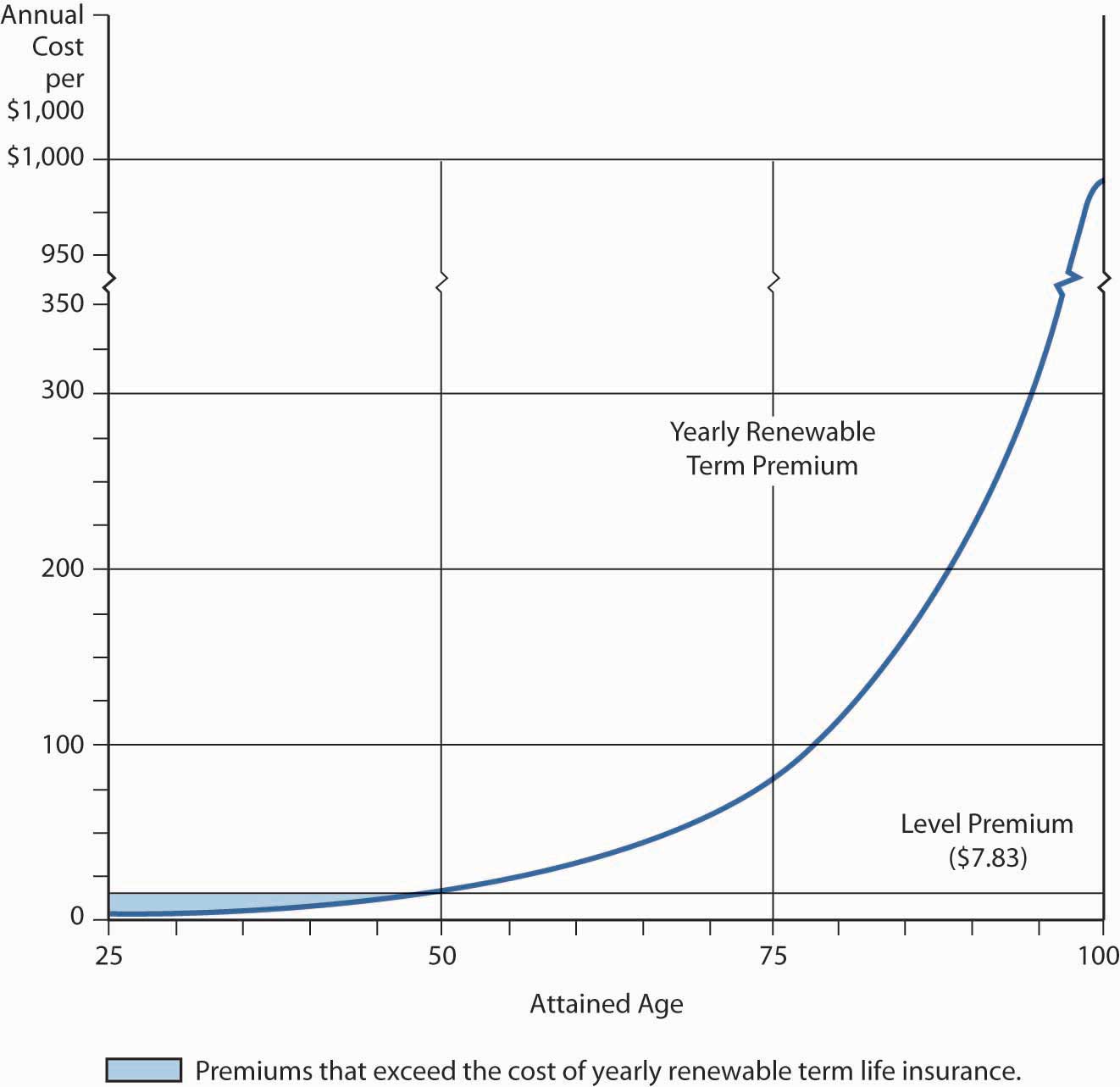
To understand how a level premium functions, it is essential to look at the underlying mortality risk. Statistically, the risk of dying increases with every year of age. If an insurance company charged for life insurance based strictly on your year-by-year risk of death (known as natural or annual renewable pricing), your premiums would start very low in your youth and rise exponentially as you grow older, eventually becoming unaffordable in late adulthood.
Level premium pricing resolves this upward cost curve through an actuarial balancing mechanism:
- Early-Year Overpayment: During the initial years of the policy, the level premium you pay is higher than the actual statistical cost needed to cover your mortality risk at that age.
- Reserve Accumulation: The insurance company takes the excess premiums collected during these early years and places them into an actuarial reserve account, which earns interest through conservative investments.
- Late-Year Underpayment: As you age into the later years of the term, your actual statistical mortality risk exceeds the level premium amount you pay. The insurer draws from the accumulated reserves to absorb the difference, keeping your required premium payment unchanged.
- Cost Over Time:
- Level Premium (Fixed Payment): Remains constant from Start to End
- Actual Risk: Increases over time from Start to End
- Early Overpayment: Occurs from Start to Mid-Term when Level Premium exceeds Actual Risk
- Late Underpayment: Occurs from Mid-Term to End when Actual Risk exceeds Level Premium
This structure makes level term policies straightforward and budget-friendly for buyers who want reliable protection over specific financial risk windows, such as the duration of a mortgage or the years until children reach financial independence.
Factors That Determine Level Premium Rates
Insurance underwriters evaluate several key risk variables during the application process to establish the exact dollar amount of your fixed premium. Once your policy is formally issued, these rates are contractually locked and cannot be increased by the insurer, regardless of changes in your health or occupation.
Age and Term Duration
Age is the most influential variable in pricing life insurance. Younger applicants secure lower fixed premiums because their statistical probability of dying during the term is lower. Additionally, the term length selected directly alters the baseline rate. A 30-year term carries a higher level premium than a 10-year term for the same applicant because the insurer assumes risk across a older age bracket where mortality probability rises significantly.
Underwriting Class and Health Status
Insurers conduct medical underwriting to assign applicants to specific risk tiers, such as Super Preferred, Preferred, Standard Plus, or Standard. Underwriters evaluate factors including:
- Blood pressure and cholesterol levels: Verified through laboratory blood samples or recent medical records.
- Body Mass Index (BMI): Weight relative to height influences long-term health risks.
- Personal and family health history: History of cardiovascular disease, cancer, diabetes, or hereditary conditions within immediate family members prior to age 60.
Tobacco Usage and Lifestyle Risks
Tobacco users pay substantially higher level premiums—often two to three times the rate of non-tobacco users—due to the heightened statistical incidence of respiratory and cardiovascular diseases. Hazardous occupations (such as commercial diving or aviation) and high-risk hobbies (such as skydiving or auto racing) may also result in flat fee surcharges or elevated premium tiers.
Comparing Level Term to Other Policy Structures
Understanding how level term compares to other life insurance options helps clarify whether fixed pricing suits your long-term planning needs.
| Policy Type | Premium Structure | Death Benefit Behavior | Typical Duration | Best Suited For |
|---|---|---|---|---|
| Level Term Life | Fixed and constant for the full term duration. | Fixed and constant throughout the term. | 10 to 30 years (or up to age 65/70). | Income replacement, debt payoff, general family protection. |
| Annual Renewable Term (ART) | Increases annually based on attained age. | Fixed and constant. | Year-to-year renewal up to a set age limit. | Short-term obligations or temporary bridge coverage (<3 years). |
| Decreasing Term | Fixed and constant for the term duration. | Decreases steadily over time according to a set schedule. | 15 to 30 years. | Matching declining balances, such as amortizing mortgages. |
| Whole Life Insurance | Fixed and guaranteed for the insured's entire lifetime. | Fixed and guaranteed, plus potential dividend additions. | Lifetime (permanent). | Estate planning, lifelong dependents, final expense planning. |
Level Term vs. Annual Renewable Term (ART)
While Annual Renewable Term insurance starts with a lower initial annual price than a 20-year level term policy, its cost scales upward every single year. Over a period longer than three to five years, the cumulative payments for an ART policy almost always exceed the total cumulative cost of a level term policy covering the same timeframe.
Level Term vs. Permanent Life Insurance
Permanent products like Whole Life or Universal Life also offer level premiums, but they differ fundamentally in scope and cost structure. Permanent policies build tax-deferred cash value and remain active for life, provided premiums are paid. Consequently, initial premiums for whole life coverage can be 5 to 15 times higher than level term rates for an equivalent death benefit. Level term insurance strips away the cash value component to provide maximum death benefit coverage at the lowest possible immediate cost.
What Happens When the Level Premium Period Ends?
A level premium guarantee lasts only for the specific term length specified in the contract (e.g., 10, 15, 20, or 30 years). Once the term period expires, policyholders face several potential pathways depending on their remaining financial needs and health status.
- Level Premium Term Period Ends:
- Option 1: Let Policy Lapse
- Coverage ends
- Option 2: Convert Policy to Permanent
- No medical exam required
- Option 3: Renew via ART Provision
- Extremely high annual rate
- Option 1: Let Policy Lapse
1. Allowing the Policy to Expire
If the primary financial obligation has passed—such as a mortgage being fully paid off or children becoming financially independent—the insured can simply stop paying premiums. Coverage terminates without penalty, and no death benefit is paid thereafter. Because term policies do not accumulate cash value, there is no cash surrender payout upon expiration.
2. Utilizing Guaranteed Convertible Provisions
Most quality level term policies contain a term conversion rider. This clause permits policyholders to convert all or a portion of their level term coverage into a permanent life insurance policy (such as Whole Life or Universal Life) before the term expires or before reaching a maximum conversion age (typically 65 to 70), without undergoing a medical exam or proving insurability. The premium for the new permanent policy will be higher—based on your age at the time of conversion—but your health status will be treated as identical to when you originally purchased the term policy.
3. Annual Renewable Extension (Rate Shock)
If you require coverage past the term expiration date but are in poor health and unable to qualify for a new policy, most contracts permit automatic annual renewal. However, the premium switches from a level rate to an Annual Renewable Term (ART) rate based on your current attained age. This results in an immediate, dramatic price jump—often called "rate shock"—where premiums can increase by 500% to 1,000% or more in the first post-term year, rising higher every year thereafter.
Evaluating Benefits and Drawbacks
Before selecting a level term duration, consider the balancing trade-offs inherent in this policy design:
Key Advantages
- Financial Predictability: Fixed monthly premiums make long-term household budgeting straightforward, insulating policyholders from inflationary price increases or health-related premium hikes.
- High Coverage-to-Cost Ratio: Because you pay strictly for mortality protection without cash-value investment management fees, level term provides the maximum death benefit per dollar spent.
- Targeted Timeline Alignment: Term lengths can be selected to match specific financial milestones, such as a 20-year term to cover child-rearing years or a 30-year term to mirror a home mortgage.
Trade-Offs and Limitations
- No Return of Premium or Equity: If you outlive the term, the insurer retains all premiums paid, and no cash value remains (unless a specialized "Return of Premium" rider was purchased at a significantly higher cost).
- Early Cancellation Loss: If you cancel a level term policy within the first few years, you do not receive a refund for the higher actuarial premiums paid upfront relative to your risk at that younger age.
- Expiration Risk: If your financial protection needs persist beyond the chosen term length, securing new coverage at an older age—or with updated health conditions—will cost substantially more.
How to Calculate and Select the Right Level Term Length
Choosing the optimal term length requires mapping your insurance purchase directly against your timeline of financial liabilities.
- Time Horizon Matching (0 to 30 Years):
- Mortgage Protection: 30-Year Level Term (Years 0 to 30)
- Income Replacement: 20-Year Level Term (Years 0 to 20)
- College Expenses: 10 to 15-Year Level Term (Years 0 to 10–15)
1. Inventory Your Long-Term Obligations
- Mortgage or Real Estate Debt: Match the term length to the remaining payoff timeline on your home mortgage (e.g., a 30-year fixed term for a new 30-year mortgage).
- Dependents' Education and Care: Select a term that spans the years until your youngest child completes higher education and transitions into full financial independence.
- Income Replacement: Calculate how many working years remain until your planned retirement date. A breadwinner who plans to work for 20 more years typically chooses a 20-year level term policy.
2. Determine Total Face Value Requirements
A standard rule of thumb for income replacement is multiplying your annual gross income by 10 to 12. Alternatively, sum your specific outstanding liabilities (mortgage balance, personal debts, future tuition estimates) plus an income buffer to arrive at an accurate face amount.
Frequently Asked Questions
Can the insurance company raise my level term premium if I get sick?
No. Once a level premium policy is issued and active, the insurer cannot raise your rates or cancel your coverage due to changes in your personal health status, job, or lifestyle habits, provided you pay required premiums on time.
What happens if I miss a monthly level premium payment?
Life insurance policies include a contractually mandated grace period—typically 30 or 31 days—following a missed payment deadline. If the premium is paid within the grace period, coverage remains uninterrupted. If unpaid past the grace period, the policy lapses and coverage terminates.
Is a level premium term policy the same as a level death benefit policy?
While they often go hand-in-hand, they refer to two distinct features. A level premium means your payment cost stays constant. A level death benefit means the payout amount given to beneficiaries remains constant. Most standard level term policies incorporate both features simultaneously.
Can I reduce my coverage and premium during the term?
Many insurance carriers allow policyholders to lower the face value of their policy (for example, reducing a $1,000,000 policy to $500,000) if their coverage needs decrease over time. Dropping the face value will proportionally lower your level monthly premium without requiring new medical underwriting.
Are level term insurance death benefits taxable to my beneficiaries?
In general, life insurance death benefits paid to beneficiaries are exempt from ordinary federal income tax. However, if the payout is structured as part of a gross estate that exceeds federal or state estate tax exemption thresholds, estate taxes may apply depending on ownership structure.
Practical Recommendation
When shopping for level term life insurance, secure a term length that covers your longest-running major debt or financial dependency, and apply while your age and health profile are most favorable. Always verify that any policy under consideration includes a zero-underwriting conversion rider, giving you flexible options to maintain coverage if your health changes before the term expires.
Disclaimer: This article provides general educational information about insurance concepts and does not constitute formal financial, legal, or tax advice. Consult a licensed insurance agent or qualified financial planner for guidance specific to your personal circumstances.
Image Gallery