Can You Receive Both Life and Accidental Death Insurance Payouts?
Yes, beneficiaries can receive payouts from both a standard life insurance policy and an accidental death insurance policy (or accidental death rider) if the insured dies from a covered accident. Because these policies function as sepa...
Yes, beneficiaries can receive payouts from both a standard life insurance policy and an accidental death insurance policy (or accidental death rider) if the insured dies from a covered accident. Because these policies function as separate contractual obligations, their death benefits stack together, allowing beneficiaries to collect the full face value of both policies simultaneously.
Contents
How Dual Life and Accidental Death Insurance Payouts Work
When an insured individual passes away due to a fatal accident, beneficiaries often wonder whether claiming one insurance policy invalidates or reduces another. In the insurance industry, benefit payouts from valid, active policies generally do not offset one another. If a person maintains a term life insurance policy and an accidental death policy, both insurers are contractually obligated to pay their respective death benefits upon receipt of proof of death, provided all contractual terms are met.
This layering of benefits is commonly known in the industry as benefit stacking. For instance, if an individual holds a $500,000 term life insurance policy and a $250,000 standalone Accidental Death and Dismemberment (AD&D) policy, a qualifying fatal car accident would result in a cumulative payout of $750,000 to the designated beneficiaries.
- Qualifying Accidental Death
- Base Life Insurance Policy (Term, Whole, or Universal)
- Pays Full Base Face Amount (e.g., $500,000 Payout)
- Accidental Death Coverage (Standalone AD&D or Rider)
- Pays Full Accidental Benefit (e.g., $250,000 Payout)
- Total Combined Payout to Beneficiary (e.g., $750,000 Total)
- Base Life Insurance Policy (Term, Whole, or Universal)
The dual payout structure applies whether the accidental death coverage is structured as an independent policy or attached directly to the base life insurance contract as a policy rider. When written as an endorsement to a life policy, the feature is traditionally called an Accidental Death Benefit (ADB) rider or a double indemnity clause. Under a double indemnity provision, the insurance company agrees to pay double the primary face amount if the cause of death satisfies the policy’s legal definition of an accident.
Policy Types: Standalone AD&D Policies vs. Accidental Death Riders
To determine how dual benefits will be evaluated, it is essential to distinguish between the two primary mechanisms for obtaining accidental death protection: standalone policies and policy riders.
1. Accidental Death Benefit (ADB) Riders
An ADB rider is an optional add-on attached directly to a base life insurance policy (such as term life, whole life, or universal life).
- Single Insurer Management: The policyholder pays a combined premium to one insurance provider.
- Proportional Payouts: The rider payout is typically tied to the face value of the primary policy—often matching it 1:1 (doubling the benefit) or adding a fixed sum.
- Shared Administration: Claims for both the primary life benefit and the accidental death rider are submitted to the same carrier, streamlining the administrative review process.
2. Standalone Accidental Death & Dismemberment (AD&D) Policies
A standalone AD&D policy is an entirely separate insurance contract, often purchased individually or provided as an employee benefit through group voluntary insurance plans.
- Separate Insurance Carriers: The policy may be issued by a completely different underwriting carrier than the primary life policy.
- Independent Claims Process: Beneficiaries must file separate claim applications, submit documentation to multiple claims departments, and satisfy each carrier’s independent investigation.
- Living Benefits: Unlike traditional life insurance, standalone AD&D policies also provide living payouts for catastrophic non-fatal injuries, such as loss of sight, speech, hearing, or limb paralysis resulting from a covered accident.
According to regulatory frameworks maintained by the National Association of Insurance Commissioners (NAIC), insurance policies are independent indemnity contracts unless explicit anti-duplication provisions exist—which are standard in health insurance but absent in life and accidental death coverage.
What Qualifies as an Accidental Death?
While primary life insurance pays for almost all causes of death—including natural illnesses, heart attacks, cancer, old age, and accidental injuries—accidental death coverage is strictly limited by contractual definitions. For a beneficiary to successfully collect both payouts, the cause of death must meet the precise criteria established under the accidental death contract.
- Cause of Death Evaluation
- Natural Causes / Chronic Illness
- Base Life Policy PAYS
- AD&D Policy DENIED
- Violent, External & Accidental Event
- Base Life Policy PAYS
- AD&D Policy PAYS
- Natural Causes / Chronic Illness
In standard life insurance contracts, an "accidental death" is generally defined as a death caused directly and independently of all other causes by violent, external, and accidental means.
Commonly Qualifying Events
- Motor Vehicle Crashes: Fatalities resulting from automobile, motorcycle, or pedestrian collisions, provided driving under the influence or illegal conduct was not a factor.
- Unintentional Falls: Accidental slips, structural collapses, or falls from heights that lead directly to fatal traumatic injuries.
- Accidental Poisoning or Inhalation: Unintentional carbon monoxide poisoning, chemical inhalation, or accidental drug overdoses where intent to harm is ruled out.
- Drowning and Equipment Accidents: Fatal water accidents or accidental machinery impacts in agricultural or industrial environments.
- Fires and Natural Disasters: Fatal burns, smoke inhalation, or blunt force trauma caused by fires, storms, or earthquakes.
The Timeframe Limitation Rule
Accidental death provisions almost universally require that death occur within a specified timeframe following the initial injury. Most standard contracts stipulate that fatal complications must arise within 90 to 180 days (and occasionally up to 365 days, depending on jurisdiction and policy contract) from the date of the accident. If an individual suffers severe injuries in an auto crash but survives on life support beyond the contractually defined window before dying, the AD&D insurer may deny the accidental claim, even though the primary life insurance policy will still pay out in full.
Key Exclusions That Can Block an Accidental Death Claim
The most frequent point of friction when attempting to collect dual payouts is the application of exclusion clauses contained within the accidental death rider or standalone policy. While the base life insurance policy may pay out without issue (assuming the policy is past its two-year contestability period), the accidental death insurer may launch an investigation and deny its portion of the claim.
1. Medical Conditions and Illness Proximity
If a medical condition contributes directly or indirectly to the accident, the AD&D insurer may refuse payout. For example, if a driver suffers a sudden fatal heart attack behind the wheel, causing the vehicle to crash into a wall, the primary life insurance policy will pay out. However, the AD&D insurer will likely deny the claim, arguing that natural cardiovascular disease—not the impact of the crash—was the primary cause of death (proximate cause).
2. Intoxication and Substance Exposure
Most accidental death policies contain explicit exclusions for deaths occurring while the insured is under the influence of alcohol above legal limits, non-prescribed narcotics, or controlled substances. If toxicological reports reveal elevated blood alcohol concentration (BAC) at the time of a fatal incident, the AD&D benefit will almost certainly be denied, whereas the primary life insurance policy remains obligated to pay.
3. Hazardous Occupations and Extreme Sports
AD&D contracts typically exclude injuries sustained during high-risk activities unless specialized coverage riders were purchased. Standard exclusions include:
- Skydiving, BASE jumping, and paragliding
- Auto racing or professional sports
- Scuba diving below specified depths
- Operating non-commercial aircraft (e.g., private piloting)
4. Illegal Acts and Incarceration
Deaths occurring during the commission of a felony, participation in a riot, or while detained by law enforcement are standard exclusion grounds across accidental death policies.
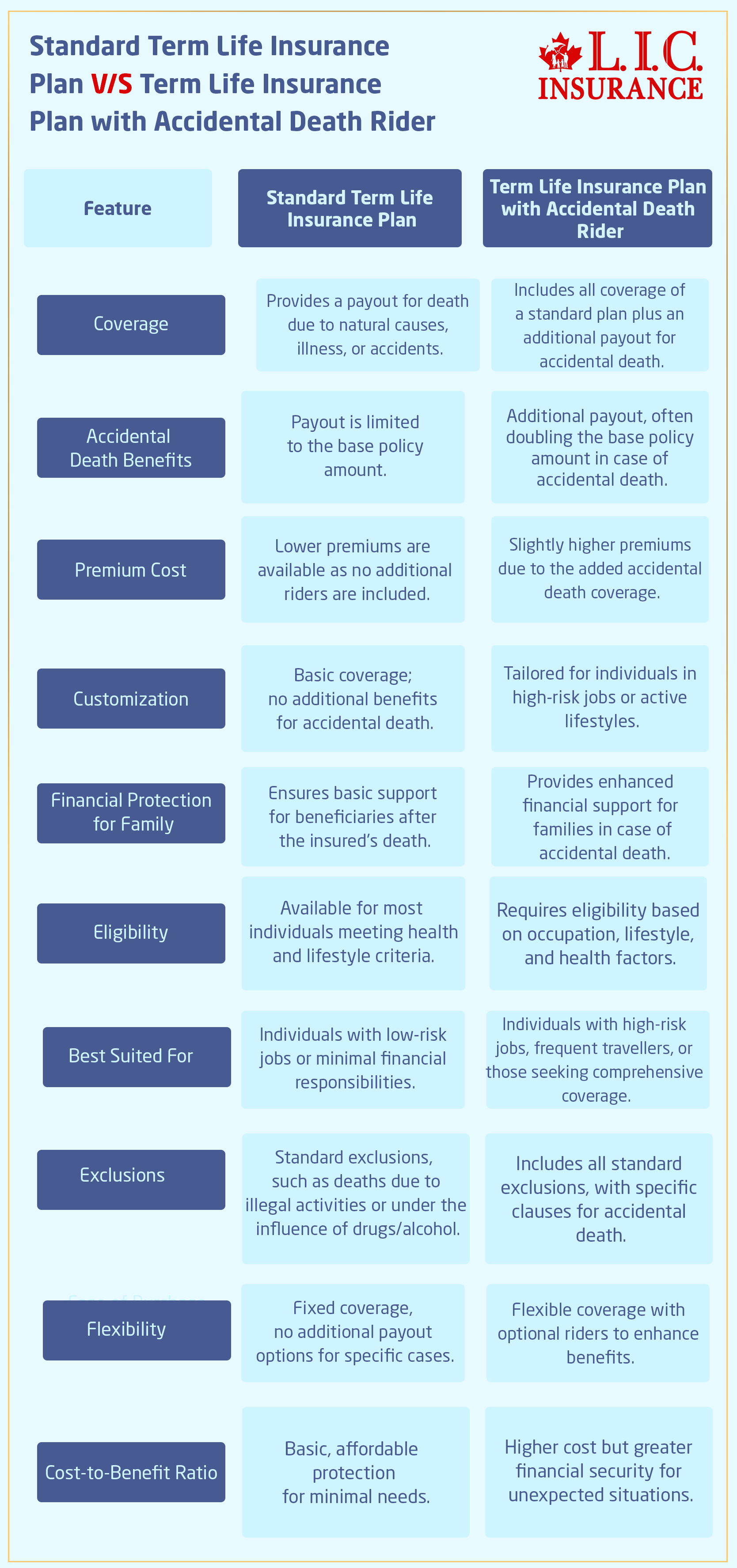
Comparison: Base Life Insurance vs. Accidental Death Coverage
Understanding how these policies compare highlights why beneficiaries must follow distinct pathways when filing dual claims.
| Feature / Dimension | Standard Base Life Insurance (Term/Whole) | Accidental Death Coverage (AD&D or Rider) |
|---|---|---|
| Primary Scope of Coverage | Pays on virtually all causes of death (natural, illness, accidental, aging). | Pays only if death results directly from a covered physical accident. |
| Underwriting Requirement | Full medical underwriting, health questionnaires, or exam often required. | Minimal or guaranteed-issue underwriting; no medical examination required. |
| Natural Illness Coverage | Fully covered (cancer, stroke, heart failure, organ failure, infection). | Strictly excluded. |
| Timeframe Deadlines | No time limit between illness diagnosis and death. | Death must occur within 90 to 365 days of the initial physical accident. |
| Living Benefits | Optional chronic/terminal illness accelerated death riders. | Pays scheduled benefits for dismemberment, paralysis, or loss of sight/hearing. |
| Cost Structure | Higher premium due to comprehensive risk coverage. | Low cost per thousand dollars of benefit due to narrow coverage scope. |
| Contestability Rules | Standard 2-year contestability period for material misrepresentations. | Subject to cause-of-death and exclusion investigations for every claim. |
Step-by-Step Guide to Filing Dual Death Benefit Claims
Filing for dual payouts requires a methodical approach to documentation. Because accidental death claims undergo stricter scrutiny than standard life claims, beneficiaries must prepare evidence thoroughly.
- Step 1: Obtain Documentation
- Multiple Certified Death Certificates (listing cause & manner of death)
- Police Reports & First Responder Logs
- Official Medical Examiner / Autopsy & Toxicology Reports
- Step 2: Notify Insurers
- Contact Primary Life Insurance Claims Department
- Contact AD&D Insurer / Claims Department
- Step 3: Submit Complete Claim Packets
- Base Life Packet: Claimant Statement + Death Certificate
- AD&D Packet: Statement + Death Certificate + Forensic Evidence
- Step 4: Claims Assessment & Verification
- Base Life: Rapid processing (typically 14–30 days)
- AD&D: Forensic review / Insurer investigation (30–90+ days)
- Step 5: Benefit Disbursement
- Dual Tax-Free Lump-Sum Payouts Distributed to Beneficiary
Step 1: Secure Multiple Certified Death Certificates
Order at least 5 to 10 certified copies of the official death certificate from the state or county vital statistics office. Ensure that the medical examiner or coroner has explicitly detailed both the immediate cause of death and the underlying manner of death (e.g., "Manner: Accident").
Step 2: Assemble Forensic and Investigatory Evidence
While standard life insurance typically requires only a death certificate and a completed claim form, accidental death policies require corroborating evidence. Collect the following documents immediately:
- Official police investigation reports and traffic collision reports.
- Complete autopsy reports from the county coroner or medical examiner.
- Official toxicology screening results.
- Emergency medical services (EMS) run sheets and emergency room admission records.
Step 3: File Separate Claim Forms
Submit claim packages independently to each insurance company:
- For the primary life policy, complete the standard Claimant’s Statement and attach a certified death certificate.
- For the accidental death coverage, complete the specialized Accidental Death Claim Form, attaching all police, autopsy, and medical documentation gathered in Step 2.
Step 4: Navigate the Claims Investigation
Expect the accidental death insurer to perform an independent investigation. The carrier may request medical records extending back several years prior to the accident to verify that pre-existing medical conditions (such as a seizure disorder, heart arrhythmia, or stroke) did not trigger the fatal event.
Tax Implications of Receiving Combined Payouts
Under United States federal tax law, life insurance proceeds are generally protected from federal income taxation.
According to Internal Revenue Code Section 101(a), gross income does not include amounts received under a life insurance contract if such amounts are paid by reason of the death of the insured. This exclusion applies equally to:
- Standard term and permanent life insurance death benefits.
- Payouts from accidental death benefit riders.
- Benefits paid out by standalone AD&D policies.
Consequently, if a beneficiary receives a $500,000 life insurance benefit along with a $500,000 accidental death payout for a total of $1,000,000, the entire sum is generally received free of federal income tax.
Important Tax Considerations
- Interest Income Is Taxable: If the insurance carrier holds the death benefit funds in an interest-bearing account or pays out the benefit via an annuity installment plan, any interest earned on the principal after the date of death is taxable as ordinary income.
- Estate Tax Exposure: If the deceased owned the insurance policies in their own name at the time of death, the full value of both payouts is included in the gross estate for estate tax calculation purposes. For estates exceeding federal or state estate tax exemption thresholds, establishing an Irrevocable Life Insurance Trust (ILIT) is a common legal strategy used to keep policy proceeds outside the taxable estate.
Frequently Asked Questions
Can an insurance company deny the accidental death portion while paying the life insurance claim?
Yes. It is common for an insurer to approve and pay the standard life insurance benefit while denying the accidental death claim. This happens when the cause of death fails to meet the strict legal definition of an "accident" under the AD&D policy—such as when an underlying health condition, drug toxicity, or policy exclusion is determined to be a contributing factor.
What happens if the death occurs months after the original accident?
Accidental death coverage contains strict timeframe limits. Most policies mandate that the insured must pass away within 90, 180, or 365 days of the traumatic event. If an individual sustains severe injuries in an accident but dies from complications after the contractually specified timeframe expires, the AD&D carrier can legally deny the claim. The primary life insurance policy, however, will pay out regardless of how much time has elapsed.
If I have accidental death coverage through my employer and a private life insurance policy, can both pay?
Yes. Benefits from an employer-sponsored group AD&D plan and a privately owned individual life insurance policy stack together. Group policies and individual policies act independently, and neither carrier will reduce its payout because another policy exists.
Does an autopsy report matter for an accidental death payout?
Yes, an autopsy report is often crucial for an accidental death claim. While a primary life insurance policy rarely requires an autopsy, an AD&D insurer almost always requires official pathology, autopsy, and toxicology reports to verify that natural illnesses, toxic substances, or pre-existing physical conditions did not cause or contribute to the fatality.
Is double indemnity the same thing as having two separate insurance policies?
No, but they achieve a similar result. "Double indemnity" refers specifically to an accidental death rider attached to a single life insurance contract, which doubles the base payout if death is accidental. Having two separate policies means holding one independent life policy and one distinct AD&D policy. Both setups allow beneficiaries to receive dual payouts following a fatal accident.
Next Steps for Policyholders and Beneficiaries
To ensure maximum financial protection and smooth claims processing, take the following practical steps:
- Audit Existing Policies: Review all individual and group insurance documents to identify primary life coverage, ADB riders, and employer-provided AD&D benefits.
- Check Exclusion Language: Read the fine print of any accidental death rider or standalone policy to understand policy-specific exclusions, such as aviation limitations, substance restrictions, or sports exclusions.
- Store Records Accessibly: Keep policy numbers, insurer contact details, and designated beneficiary forms in a secure, accessible location known to your loved ones.
- Consult Professional Counsel: If an insurer delays or denies an accidental death claim while approving the base life insurance claim, consult a qualified insurance coverage attorney or estate planning specialist to review the claim denial letter and medical records.
Disclaimer: Insurance policy terms, state regulations, and legal definitions vary by provider and jurisdiction. Beneficiaries and policyholders should consult a licensed insurance professional, tax advisor, or legal counsel for guidance regarding specific insurance contracts and estate plans.
Image Gallery